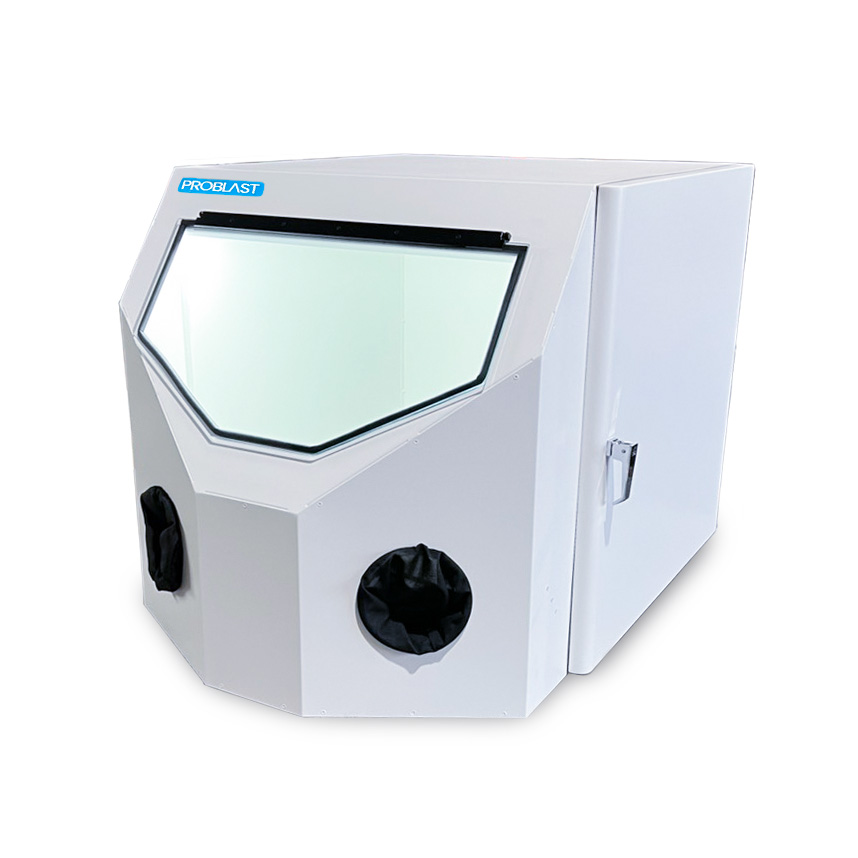
Vaniman Master Problast Titan ESD Micro-Abrasive Blaster
Large-chamber ESD-controlled removal for conformal coating & Parylene rework
The Vaniman Master Problast Titan ESD (P/N 80081) is the large-chamber micro-abrasive blasting system for electronics and electro-sensitive applications where additional working space is required.
The Titan ESD provides a grounded cabinet and work area with ionised airflow, allowing larger PCBs, fixtures and assemblies to be manipulated while carrying out controlled selective conformal coating and Parylene removal.
SCH supplies the complete process configuration including Master Problast Titan ESD equipment, StoneVac II dust collection, blasting media, application trials, consumables, spares, training and technical support. SCH also uses micro-abrasive removal within our own conformal coating and Parylene rework activities, providing practical process experience alongside equipment supply.
The Titan should normally be considered where the PCB, fixture or assembly cannot be comfortably manipulated within the smaller Master Problast 3 ESD chamber.
When Do I Need the Titan ESD?
The Master Problast Titan ESD is intended for applications where additional cabinet space is needed to position, rotate or manipulate the assembly during rework.
- Internal working chamber: approximately 610 mm W × 864 mm D × 584 mm H
- Large-format access: additional working space for oversized PCBs, fixtures and assemblies
- ESD-resistant working environment: grounded cabinet/work area with ionised airflow
- Three media tanks: allows different blasting-media configurations within the same machine
- Dust collection: external dust collection is required; SCH’s standard configuration uses StoneVac II
Not sure which machine you need? Send SCH the maximum PCB, fixture or assembly dimensions and we can help determine whether the Master Problast 3 ESD or Titan ESD provides the appropriate working space.
Why Choose the Titan ESD?
- ✅ Large-chamber access – additional working space for oversized boards, fixtures and assemblies
- ✅ Selective electronics rework – controlled micro-abrasive removal around populated PCB assemblies
- ✅ ESD-resistant working environment – grounded cabinet/work area with ionised airflow
- ✅ Adjustable process pressure – blasting parameters can be developed around the coating, media and assembly
- ✅ Three media tanks – supports different media configurations within one machine
- ✅ LED and UV illumination – supports visibility during coating-removal work
- ✅ Instant-Off media control – media flow stops when the foot control is released
- ✅ External dust collection – SCH’s standard Titan configuration uses StoneVac II
- ✅ Complete SCH support – equipment, media, application trials, training, spares and technical assistance
Dust Collection
External dust collection should be connected to the Titan during micro-abrasive blasting. The dust collector removes spent blasting media and generated particulate from the cabinet and helps maintain visibility during the process.
SCH currently supplies the Vaniman StoneVac II as our standard dust-collection configuration for Titan conformal coating and Parylene rework systems.
Where additional media separation is useful, an Accumulator can be incorporated ahead of the dust collector to separate blasting media and particulate before it reaches the main collector filter.
Conformal Coating & Parylene Removal on Larger Assemblies
The Master Problast Titan ESD provides the same controlled micro-abrasive removal principle as the smaller Problast system while providing substantially more space for larger assemblies and fixtures.
- Parylene rework – selectively expose components, connectors, pads, solder joints or localised board areas
- Conformal coating rework – remove suitable Acrylic, Urethane, Silicone and Epoxy coatings for inspection, repair or component replacement
- Selective access – expose test points, grounding areas and other defined locations
- Oversized assemblies – additional room for fixtures and operator manipulation
The objective is controlled coating removal rather than maximum stripping speed. Media, blasting pressure, nozzle position, distance and operator technique should be matched to the coating and assembly.
SCH can carry out representative application trials where the optimum removal process has not yet been established.
Blasting Media for Electronics Rework
For many conformal coating and Parylene rework applications, SCH uses Vaniman VanAcrylic thermoset acrylic blasting media as the standard starting point.
VanAcrylic allows coating to be removed progressively rather than relying on highly aggressive blasting media. This provides greater process control when working around populated PCB assemblies, components and solder mask.
Faster removal is not necessarily better. The objective is to remove sufficient coating for the required repair or modification while minimising unnecessary impact on the underlying assembly.
The Titan’s three media tanks also allow alternative media to be configured where a different removal characteristic is required.
- VanAcrylic thermoset acrylic media – SCH’s normal starting point for many conformal coating and Parylene applications
- Sodium bicarbonate – available for applications requiring different removal behaviour
- Aluminium oxide – a more abrasive option for suitable applications where greater removal intensity is appropriate
- Other compatible media – selectable according to the coating, surface and required process behaviour
Media selection: process behaviour is influenced by media type and particle size together with blasting pressure, nozzle distance, angle and operator technique.
For more information, see our VanAcrylic blasting media guide →
Titan ESD – Site Requirements
- Assembly space: confirm that the PCB, fixture or assembly can be comfortably positioned and manipulated within the Titan chamber
- Compressed air: clean, dry regulated compressed air is required
- Dust collection: external dust collection should be connected during operation; SCH’s standard configuration uses StoneVac II
- Electrical supply: appropriate local electrical supply for the blaster and dust collector
- Installation space: sufficient space should be allowed around the larger cabinet for operator access, dust collection and servicing
Planning an installation? Send SCH your assembly dimensions, fixture dimensions and available compressed-air details and we can review the proposed configuration before quotation.
Application Trials Before Equipment Purchase
Where the coating-removal process has not already been established, SCH can evaluate representative assemblies before equipment purchase.
Trials can help assess coating-removal behaviour, working access, media selection and practical starting parameters while also confirming whether the Titan provides the required working space.
This supports SCH’s preferred approach of evaluate → validate → standardise before transferring a process into regular production.
Training & Process Support
SCH provides practical training covering equipment operation, media selection, process control and coating-removal technique. Training can be adapted around the customer’s own coatings, assemblies and rework requirements.
Support can also include application trials, process development, consumables, replacement tips and ongoing equipment support.
Master Problast Titan ESD – FAQs
When should I choose the Titan ESD instead of the Master Problast 3 ESD?
What is the Titan ESD working area?
Is the Titan ESD designed for electro-sensitive electronics?
Does the Titan require dust collection?
What does an Accumulator do?
Which blasting media should I use?
Can the Titan ESD remove Parylene?
Can it remove Acrylic, Urethane, Silicone and Epoxy coatings?
Can SCH confirm whether my assembly will fit?
Can SCH carry out a trial before I purchase?
Does SCH provide training?
Request a Master Problast Titan ESD Quotation
The Titan ESD is intended for larger electronic assemblies and fixtures where the Master Problast 3 ESD does not provide sufficient working access.
To help us confirm the appropriate system, send your maximum PCB and fixture dimensions, coating type if known, area requiring removal and details of your available compressed-air supply.
Useful Links
Why Choose SCH for Vaniman Titan?
SCH combines Vaniman equipment supply with practical conformal coating and Parylene rework experience. This allows us to support the removal process as a whole rather than simply supplying a blasting cabinet.
- 🛠️ Practical Rework Experience – Hands-on experience with selective coating removal on electronic assemblies
- 📐 System Selection – Help deciding whether Problast 3 ESD or Titan ESD provides the required working space
- 🧪 Application Trials – Representative assemblies can be evaluated before equipment purchase
- ⚙️ Complete Configuration – Titan equipment, StoneVac II dust collection, blasting media, tips and spares
- 🎓 Training & Process Support – Practical support establishing removal parameters and operator technique
- 🔄 Ongoing Support – Consumables, replacement parts and troubleshooting after installation
📞 Call: +44 (0)1226 249019 | ✉ Email: sales@schservices.com | 💬 Contact Us ›
Disclaimer: Coating-removal results depend on the coating material, thickness, PCB construction, components, substrate, blasting media and process parameters. Representative testing should be carried out before adopting a removal process for production assemblies. The Master Problast Titan ESD requires appropriate compressed air and dust collection and should be installed and operated in accordance with Vaniman instructions and applicable workplace requirements.