CytoPel Coating Selection Matrix
Comparing ultra-thin, PFAS-free, hard and UV-curable advanced functional coatings
CytoPel coatings provide a range of advanced functional coating options for electronics, plastics, metals, glass, membranes and precision components where conventional conformal coating may not be the best fit. The correct material depends on the required film thickness, chemistry, cure route, PFAS position, contact behaviour, masking requirement and final operating environment.
This page compares the main CytoPel options supported by SCH Services so engineers can make an informed first selection before moving into sample testing, process validation or production coating.
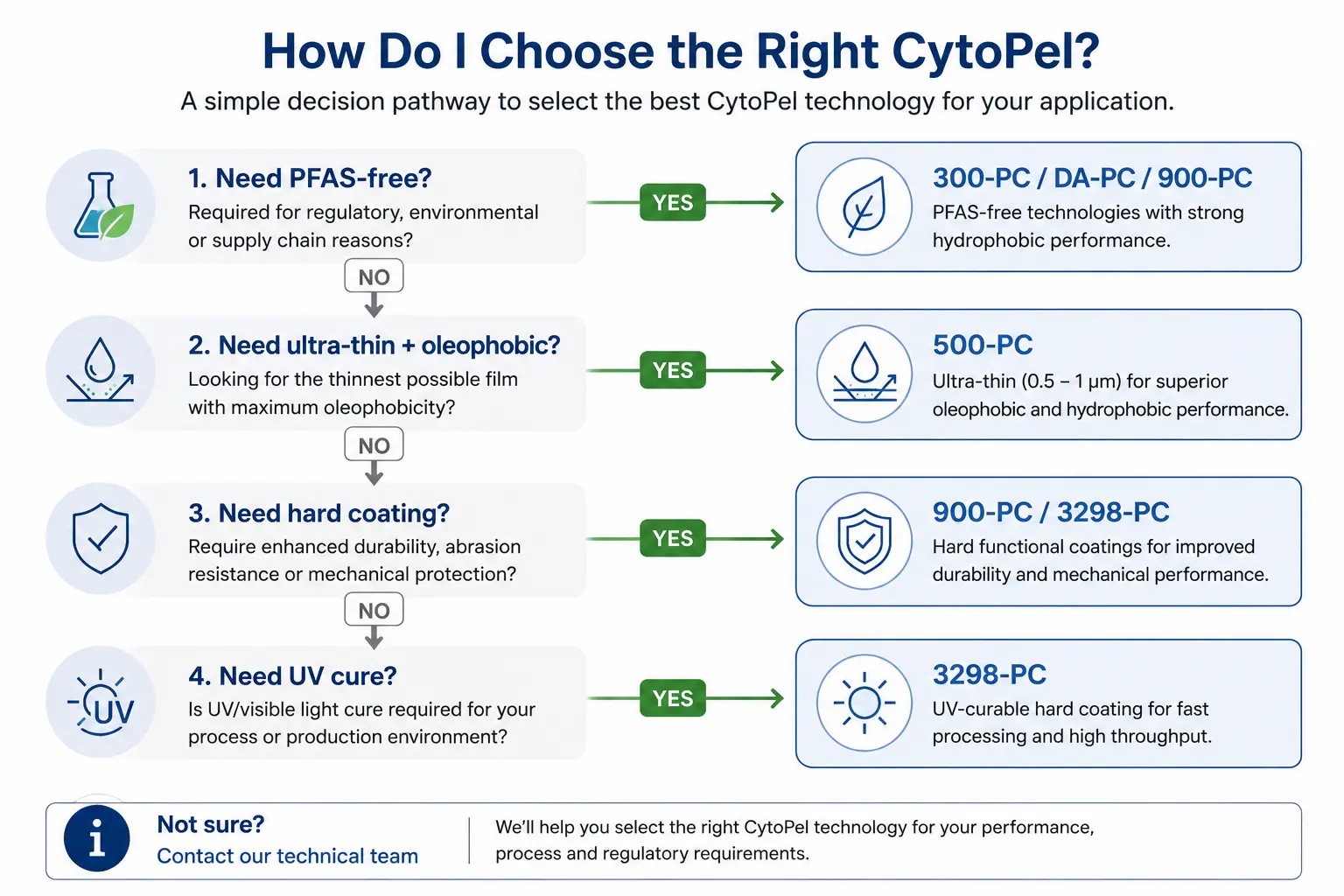
Simple engineering decision pathway for selecting CytoPel coating technologies based on coating behaviour, cure method and application requirements.
Quick Selection Guide
Use this section as a first-pass guide only. Final selection should be confirmed by coating trials, inspection and application-specific validation.
CytoPel 500-PC
Ultra-thin fluoro-acrylic coating for strong hydrophobic and oleophobic behaviour.
Typical use: low-build functional surface protection.
CytoPel 300-PC
PFAS-free acrylic coating for hydrophobic performance where a thin functional coating is preferred.
Typical use: PFAS-free thin-film electronics coating.
CytoPel 900-PC
Hard polyurethane coating for applications where contact push-through is not required.
Typical use: hard functional coating.
CytoPel DA-PC
PFAS-free hybrid polymer coating where thin build and hard coating behaviour are both relevant.
Typical use: thin hybrid hard coating.
CytoPel 3298-PC
Solvent-free UV-curable acrylic coating where fast cure and controlled masking are practical.
Typical use: fast UV-cure hard coating.
CytoPel Material Comparison Table
The table below summarises the key characteristics of the CytoPel materials used in advanced functional coating applications.
| Property | CytoPel 500-PC | CytoPel 300-PC | CytoPel 900-PC | CytoPel DA-PC | CytoPel 3298-PC |
|---|---|---|---|---|---|
| Solvent | HFE7100 | AS300 | Tert Butyl Acetate | Tert Butyl Acetate | Solvent-free |
| Thickness | 0.5–1 µm | 1–25 µm | 1–25 µm | 0.5–1 µm | 1–25 µm |
| Substrates | PCBA, plastics, metal, glass, membranes | PCBA, glass, plastic, metal | PCBA, glass, plastic, metal | PCBA, glass, plastic, metal | PCBA, glass, plastic, metal |
| Chemistry | Fluoro-acrylic | Acrylic | Polyurethane | Hybrid polymer | Acrylic |
| Dry / cure time | Seconds at room temperature | Few minutes at 60°C | Few minutes at 60°C | Few minutes at 60°C | 3 seconds UV-light |
| Water contact angle | ~115° | ~105° | ~105° | ~105° | ~105° |
| Masking required | No | No, at 1 µm | No, at 1 µm | No | Yes |
| PFAS-free | No | Yes, PFAS-free | Yes, PFAS-free | Yes, PFAS-free | Yes, PFAS-free |
| UV tracer | Yes | Yes | Yes | Yes | Yes |
| Non-flammable solvent | Yes | Yes | No | No | N/A |
| Application methods | Dip, spray, dam, etc. | Dip, spray, dam, etc. | Dip, spray, dam, etc. | Dip, spray, dam, etc. | Spray, brush, dam, etc. |
| Push-through contact | Yes | Yes, at 1 µm | No | N/A | No |
| Other features | Oleophobic, hydrophobic | Hydrophobic | Hard | Hard | Hard |
Important: “No masking required” and “push-through contact” should not be treated as universal design permissions. Connector geometry, contact force, signal level, coating thickness, mating cycles and qualification requirements must be validated.
Selection boundary: CytoPel coatings should be selected by required behaviour, not only by coating thickness or contact angle.
For related engineering guidance, see surface energy vs environmental barrier protection, RF transparent coatings for electronics & antennas and why water resistance is not corrosion protection.
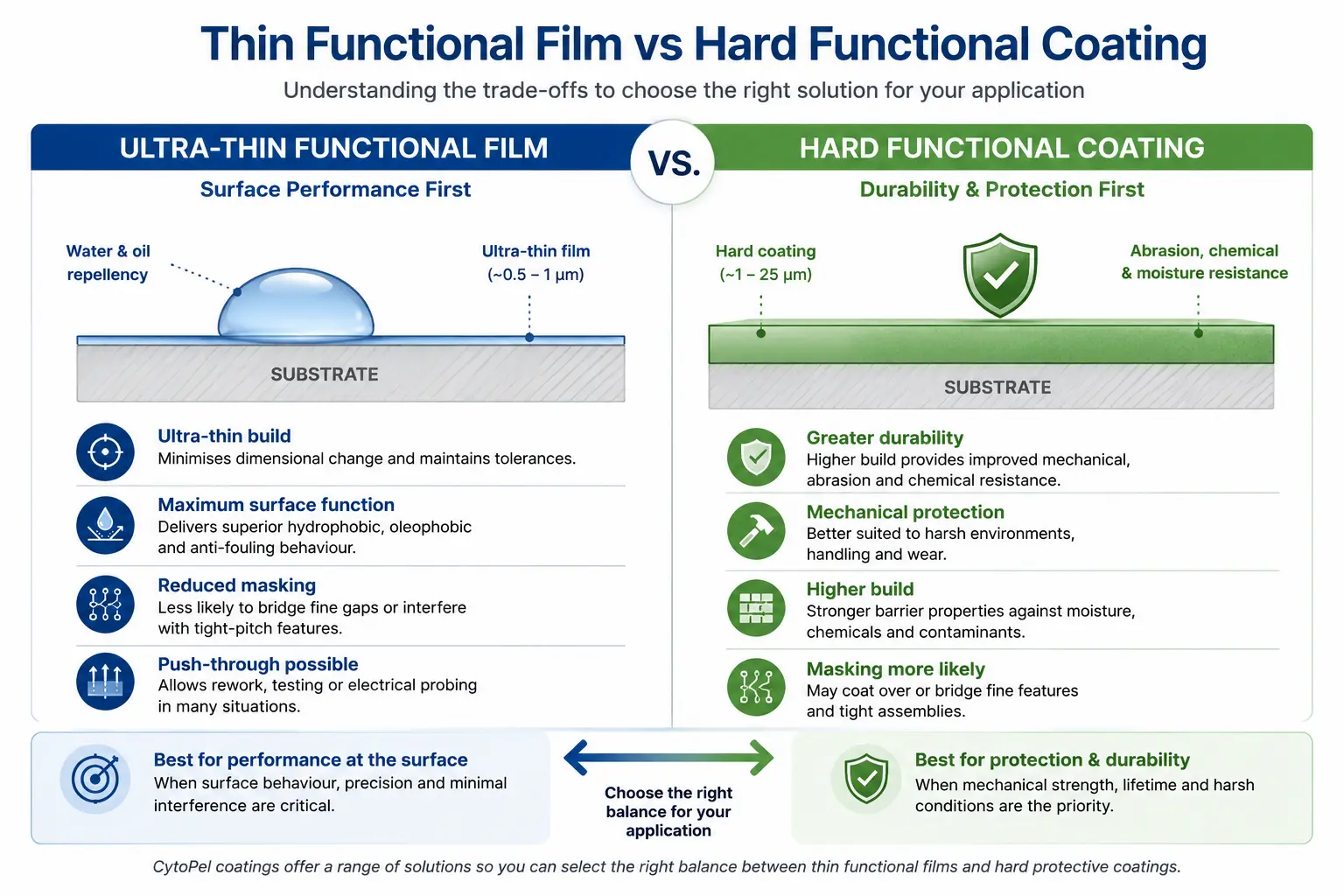
Ultra-thin functional coatings prioritise surface behaviour and reduced film build, while hard functional coatings prioritise durability, protection and mechanical resistance.
How SCH Interprets the Coating Choices
The CytoPel range should not be treated as one coating family with simple grade substitutions. Each option changes the balance between surface function, film build, process control, masking risk and regulatory positioning.
Ultra-thin functional coating
CytoPel 500-PC is the strongest fit where very low thickness, fast room-temperature drying and hydrophobic / oleophobic behaviour are the main drivers.
PFAS-free coating route
CytoPel 300-PC is a logical starting point where PFAS-free positioning is important and the application can accept acrylic chemistry.
Hard functional coating
CytoPel 900-PC, DA-PC and 3298-PC move the discussion toward hard functional coatings, with more attention needed on masking, contact access and cure process.
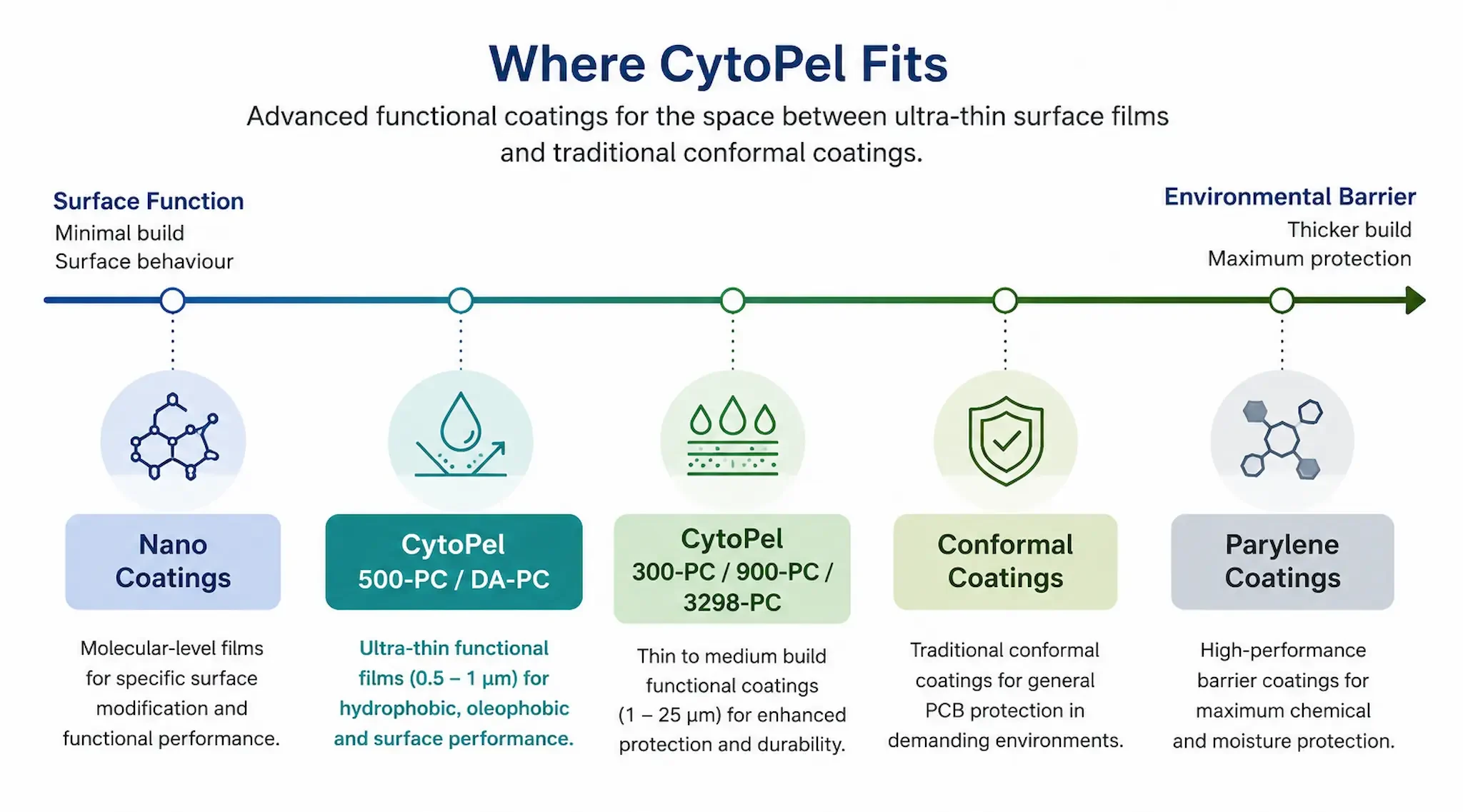
Where These Coatings Fit Against Conventional Coating Routes
Advanced functional coatings are useful where a conventional conformal coating, Parylene coating or nano coating does not fully match the application requirement.
Compared with conformal coating
CytoPel coatings can offer lower film build and specific surface functions. They may not provide the same conventional environmental protection envelope as thicker conformal coatings.
Compared with Parylene
Parylene provides a vapour-deposited barrier coating with highly uniform coverage. CytoPel coatings are liquid-applied and can be more suitable where surface function, speed or selective processing are priorities.
Compared with ultra-thin coatings
The lower-build CytoPel options overlap with ultra-thin functional coating selection, while the thicker and harder options move closer to film-forming protective coatings.
Key Engineering Questions Before Selection
Material selection should start with the application behaviour required, not only the coating name.
- Is the coating required mainly for hydrophobicity, oleophobicity, hardness, surface energy control or environmental protection?
- Is PFAS-free status mandatory, preferred or not relevant to the application?
- Can the product tolerate heat at 60°C, or is room-temperature drying preferred?
- Is UV curing practical for the component geometry and production route?
- Are connectors, test points, optical areas, seals or precision interfaces present?
- Does the design rely on push-through electrical contact after coating?
- Will the coating be applied by dip, spray, dam, brush or selective process?
- How will thickness, coverage and cure be verified in production?
Reality check: Thin coatings can reduce masking demand, but they do not remove the need for engineering judgement. Critical interfaces still need validation.
Typical Validation Route
SCH recommends a controlled validation route before approving any advanced functional coating for production use.
1. Define the function
Confirm whether the target is hydrophobicity, oleophobicity, hardness, contact behaviour, surface protection or a combination of requirements.
2. Select candidate coatings
Shortlist materials based on chemistry, thickness, cure route, PFAS position, masking need and application method.
3. Run sample coating
Coat representative substrates or assemblies using a process that reflects the intended production route.
4. Test the real risks
Check contact behaviour, adhesion, thickness, cure, surface performance, environmental exposure and any critical keep-out areas.
Related Advanced Functional Coating Options
CytoPel selection should be considered alongside the wider SCH advanced functional coating platform.
- Advanced Functional Coatings – overview of SCH advanced coating technologies.
- Hydrophobic Coatings – coatings designed to modify wetting behaviour and liquid interaction.
- PFAS-Free Coatings – coating routes where PFAS-free positioning is a key requirement.
- Ultra-Thin Coatings – low-build coating options for sensitive geometries and precision assemblies.
- Transitional Film-Forming Coatings – coatings positioned between ultra-thin surface treatments and conventional conformal coating.
- Advanced Functional Coating Services – subcontract coating, sample work and process support.
Need Help Selecting a CytoPel Coating?
SCH Services can help review your substrate, product geometry, coating objective, masking risk, cure constraints and validation requirements before selecting a candidate material.
We can support sample coating, process development, coating trials, inspection strategy and production implementation for advanced functional coatings.
Why Choose SCH Services?
SCH Services supports customers in selecting, validating and applying coating technologies based on real application requirements, not assumptions.
- Practical coating selection support across conformal coating, Parylene and advanced functional coatings.
- Application-led advice covering substrates, masking, thickness, cure, inspection and production control.
- Sample coating and process development support before committing to full production.
- Commercial coating services for customers who need controlled subcontract application.
- Technical support for engineers who need evidence-based coating decisions.
View advanced functional coating services or contact SCH Services to discuss your project.
Disclaimer: This page provides general technical guidance only. Coating selection, masking decisions, cure conditions, contact behaviour and qualification requirements must be validated against the specific product design, operating environment, customer specification and applicable standards. SCH Services can support testing and process development, but final approval remains application-specific.