What NASA Gets Right About Conformal Coating
NASA conformal coating requirements are really about cleanliness, process control, documentation and disciplined inspection — not just applying the coating
What this article covers. NASA conformal coating requirements are often misunderstood as a special coating method, when in reality they define a disciplined approach to cleanliness, process control, inspection and documentation. This article explains what NASA gets right, how those principles apply in real production, and why many coating processes fail long before the coating itself becomes the problem.
Who it is for. Engineers, quality teams, manufacturing managers, aerospace suppliers, and companies building higher-reliability conformal coating processes for electronics, vacuum-compatible assemblies, mission-critical products or customer-audited environments.
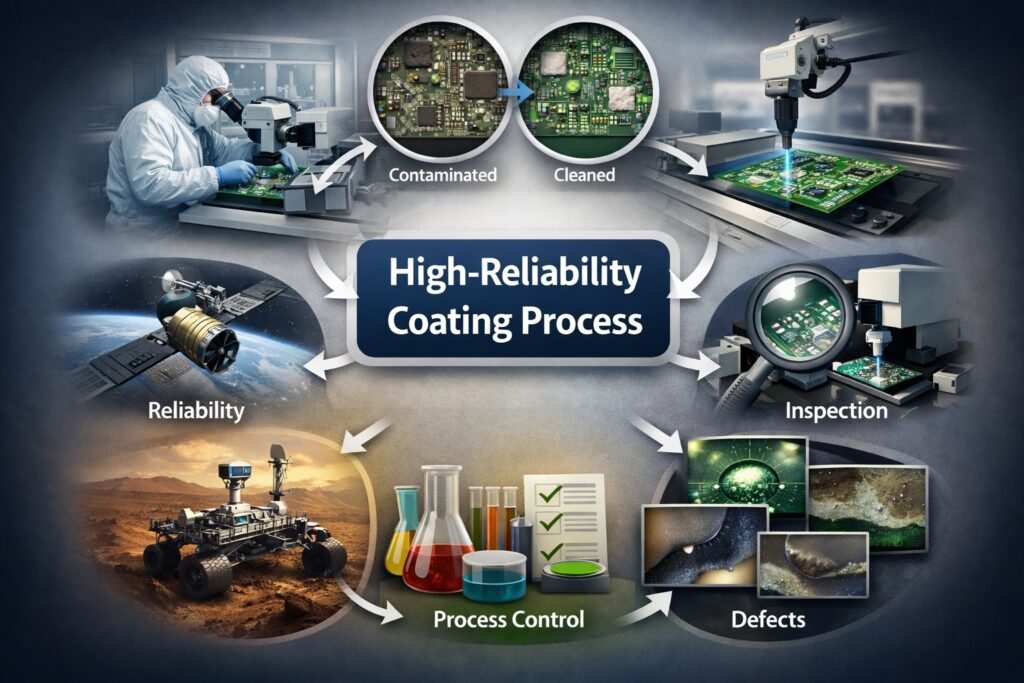
High-reliability conformal coating is driven by process control — including cleaning, environmental management, inspection discipline and material handling — rather than coating application alone.
Quick answer. NASA conformal coating standards do not mainly describe a secret way of spraying or dipping boards. They force discipline around board cleanliness, environmental control, material management, trained operators, defined inspection criteria, witness evidence and retained records. That is why NASA-style thinking remains useful well beyond space hardware.
Quick Links:
What NASA is really doing ·
NASA requirements explained ·
The big misunderstanding ·
Key principles ·
Where processes fail ·
What it really means ·
Practical lessons ·
FAQs
What NASA is really doing
When engineers search for a NASA conformal coating standard, they often expect to find a completely different coating process used only for flight hardware. That is not the most useful interpretation. The real value of NASA workmanship guidance is that it forces discipline around the entire coating process:
- cleanliness before coating
- environmental control during processing
- documented material handling
- trained and certified personnel
- witness samples and control specimens
- defined inspection and acceptance criteria
- traceable records
In other words, NASA is not simply saying “apply the coating carefully.” It is saying: build a process that can be repeated, inspected, audited and trusted.
That mindset is useful far beyond space programmes. Any company supplying aerospace, defence, medical, industrial, rail, energy or other high-reliability sectors can learn from it.
NASA conformal coating requirements explained
At a practical level, NASA conformal coating requirements are not mainly about selecting an exotic coating or using a special spray technique. They are about proving that the process around the coating is under control.
That usually means asking questions such as:
- How was the board cleaned, dried and protected from recontamination?
- Were the materials in date, correctly mixed and handled within working life?
- Was the environment suitable for the coating chemistry and method used?
- Are the operators and inspectors trained for the specific process?
- How is thickness verified and how are defects judged?
- What evidence exists if the result is challenged later?
Those are the right questions because they separate a coating process that occasionally works from one that can be relied on repeatedly.
Useful interpretation: NASA workmanship standards are not mainly about making the coating look impressive. They are about making the result defensible.
The big misunderstanding
The biggest misunderstanding is this:
Most conformal coating failures are not caused by the coating alone. They are caused by contamination, poor preparation, weak environmental control, unstable material handling, and inconsistent inspection.
That is why many companies can buy a qualified coating material, use a sensible spray gun, and still struggle with particles, dewetting, bubbles, edge defects, under-film corrosion, thickness inconsistency or repeat rework. The chemistry may be acceptable, but the process around it is not in control.
For a broader process-level explanation of that problem, see Why Conformal Coating Processes Fail.
The key principles NASA gets right
1. Cleanliness is not optional
NASA-style coating starts from the assumption that the board must be properly cleaned and protected from recontamination before coating. That matters because many adhesion failures, insulation problems and corrosion mechanisms begin with invisible residues rather than visible coating mistakes.
This is one of the strongest lessons in high-reliability coating: a board can look clean and still be unsuitable for coating.
2. Environment matters
Temperature, humidity, airborne contamination, drying discipline and ventilation are not side issues. They directly affect coating performance. Moisture-sensitive systems, solvent evaporation rate, contamination pickup and cure behaviour can all shift if the coating area is uncontrolled.
Many smaller operations underestimate this point. NASA does not.
3. Materials must be controlled, not just selected
Choosing the right coating is only the start. NASA-style thinking expects correct storage, shelf-life control, batch identification, proper mixing, witness samples and clear cure conditions. That is a major difference between a casual shop-floor process and a disciplined one.
4. Operators and inspectors must be trained for the actual task
NASA places strong emphasis on training, certification, recertification, vision requirements and evidence of competence. That is important because conformal coating quality is not controlled by instructions alone. It depends on the judgement and discipline of the people applying, inspecting and authorising the work.
5. Inspection is part of process control
NASA-style inspection is not a late-stage attempt to catch whatever went wrong. It is part of the process system. The point is not just to see defects — it is to verify that the process is behaving as intended.
That aligns closely with practical production needs, which is why the Inspection & Quality Hub matters so much in day-to-day manufacturing.
6. Documentation is what makes a process repeatable
One of NASA’s strongest habits is requiring written procedures, records, deviations, approvals and retained evidence. This is not bureaucracy for its own sake. It is how you stop good results from depending on one operator, one shift, or one memory of how the job was done last time.
Where most real processes fail
In everyday production, the recurring weaknesses are usually much more ordinary than people expect. Most problems appear in one or more of the following areas:
Cleaning and recontamination
Boards are cleaned, then handled, staged, masked, wiped again, exposed to workshop air, or coated too long afterwards. The process looks reasonable, but the board arriving at the coating step is no longer truly clean.
Airborne contamination
Small spray booths and improvised coating environments often contain fibres, packaging debris, poor airflow control or ineffective filtration. Those particles become trapped in the wet film.
Compressed air quality
Oil, water, particulates and unstable pressure can create defects that are often blamed on the coating itself. In many cases, the real problem is the air system.
Material handling drift
Mix ratio, pot life, solvent addition, induction time and cure conditions are not tightly controlled. Results may still look acceptable on some boards, but the process is no longer stable.
Inconsistent inspection intent
Some teams inspect for neat appearance. Others inspect for coverage only. Others focus on customer complaints. Without a defined inspection framework, defects are accepted or rejected inconsistently and root causes remain unresolved.
Practical point: In many real factories, the coating process fails before the spray gun is even picked up.
What “following NASA” really means
This is the section many readers need most.
Following NASA-style principles does not automatically mean:
- you are “NASA approved”
- your facility is qualified for flight hardware
- your coating process is certified by default
- you can skip customer-specific qualification requirements
What it does mean is that you are aligning with a more disciplined way of running the process.
That includes:
- clear procedures
- controlled cleaning and handling
- defined material management
- trained operators and inspectors
- witness and verification methods
- documented inspection logic
- retained evidence
For many companies, that is already a huge step forward. It improves reliability, reduces ambiguity, and makes customer discussions much easier.
It also supports broader quality-system ambitions. If your business is thinking about higher-reliability manufacturing, customer audits, or future aerospace positioning, these behaviours are often more important than casually claiming to “meet NASA”.
NASA-style thinking vs everyday uncontrolled coating
| Area | Uncontrolled everyday approach | NASA-style approach |
|---|---|---|
| Cleaning | Looks clean | Defined cleaning method and cleanliness verification |
| Environment | Normally okay | Controlled, monitored and documented |
| Material handling | Use as needed | Shelf life, batch, mix and witness control |
| Operators | Shown once and trusted | Trained, certified and rechecked |
| Inspection | Visual check at the end | Defined acceptance criteria with retained evidence |
| Documentation | Local knowledge | Documented and auditable process |
Practical lessons for production
You do not need to be coating space hardware to apply the right lessons. NASA workmanship requirements are useful because they force teams to behave in a more disciplined way, not because they turn commercial coating into a mysterious aerospace-only process.
Define the cleaning method
Do not leave cleaning to operator preference. Define the chemistry, method, drying approach, timing and handling rules.
Control the environment
Know the temperature and humidity where the work is done. Improve booth cleanliness. Check ventilation. Treat compressed air as a quality input, not just a utility.
Control material use
Record batch, mix time, shelf life and cure conditions. If the process depends on memory, it is not under control.
Use witness evidence
Thickness coupons, witness samples, control boards and retained examples make inspection decisions much more defensible.
Train to the standard you want to achieve
If you want higher reliability, operator training should reflect that aim. Teach not just “how to coat” but why contamination, handling and environmental drift matter.
Use inspection to learn, not just to reject
Repeated defects are data. Treat them as evidence of a process issue, not simply operator failure.
Where this links into SCH technical guidance
- Why Conformal Coating Processes Fail – the broader process-level root-cause view
- Inspection & Quality Hub – inspection standards, UV inspection, thickness verification and workflow control
- Conformal Coating Defects Hub – symptom-based defect diagnosis and root causes
- Conformal Coating Masking Hub – masking methods, contamination transfer risk and keep-out control
- Standards Hub – IPC, MIL and workmanship guidance context
Frequently asked questions
What is the NASA conformal coating standard?
In practical terms, engineers usually mean NASA workmanship requirements for staking and conformal coating of printed wiring boards and electronic assemblies. The important point is that the standard is about disciplined process control, documentation, inspection and training — not just coating application.
Does NASA approve conformal coating processes?
Not in the casual sense many people imply. A company cannot simply say it is “NASA approved” because it uses a certain coating or follows a guide. Actual requirements depend on programme flow-down, documentation, approvals and the wider quality system supporting the process.
What makes NASA conformal coating requirements different?
The main difference is not a unique spray method. It is the level of control around cleanliness, material handling, environmental conditions, operator competence, inspection logic and retained evidence.
Why do conformal coating processes fail in production?
Most failures are caused by contamination, weak cleaning discipline, dirty or wet compressed air, humidity effects, poor material handling, and inconsistent inspection intent rather than by the coating alone.
Is NASA standard required for aerospace conformal coating?
Not always. Aerospace work may instead follow customer-specific requirements, IPC standards, internal quality procedures or other contractual controls. However, NASA-style workmanship principles remain highly useful because they represent disciplined high-reliability process thinking.
Need help strengthening a high-reliability coating process?
SCH Services supports manufacturers with conformal coating process review, inspection strategy, troubleshooting, training and coating services. If you want to apply NASA-style process discipline in a practical commercial environment, we can help you identify the real weaknesses and strengthen the process around the coating.
TrainingConsultancyCoating ServicesInspection HubStandards Hub
Technical guidance note: This article provides general engineering guidance based on recognised workmanship principles and their practical interpretation in production environments. It does not by itself qualify a facility, operator or product for NASA or flight hardware work. Final requirements must always be validated against the applicable customer specification, programme requirements, quality system and approved process documentation.