Why Conformal Coating Processes Fail in Small Engineering Environments
Most coating problems are not caused by the coating material itself — they are caused by the process around it
What this article covers. Many companies assume conformal coating problems are mainly caused by choosing the wrong coating. In practice, most failures in small engineering environments come from contamination, cleaning, compressed air quality, humidity control, material handling and weak inspection discipline. This article explains where the real risks sit and what to review before blaming the coating itself.
Who it is for. Engineers, production managers, quality teams and organisations setting up or upgrading an in-house conformal coating process for prototypes, engineering models, low-to-medium volume production or high-reliability assemblies.
Quick answer. In most small spray coating environments, the biggest causes of failure are poor cleaning, airborne contamination, wet or dirty compressed air, uncontrolled humidity and incorrect material preparation. The coating often gets blamed, but the real issue is usually process control.
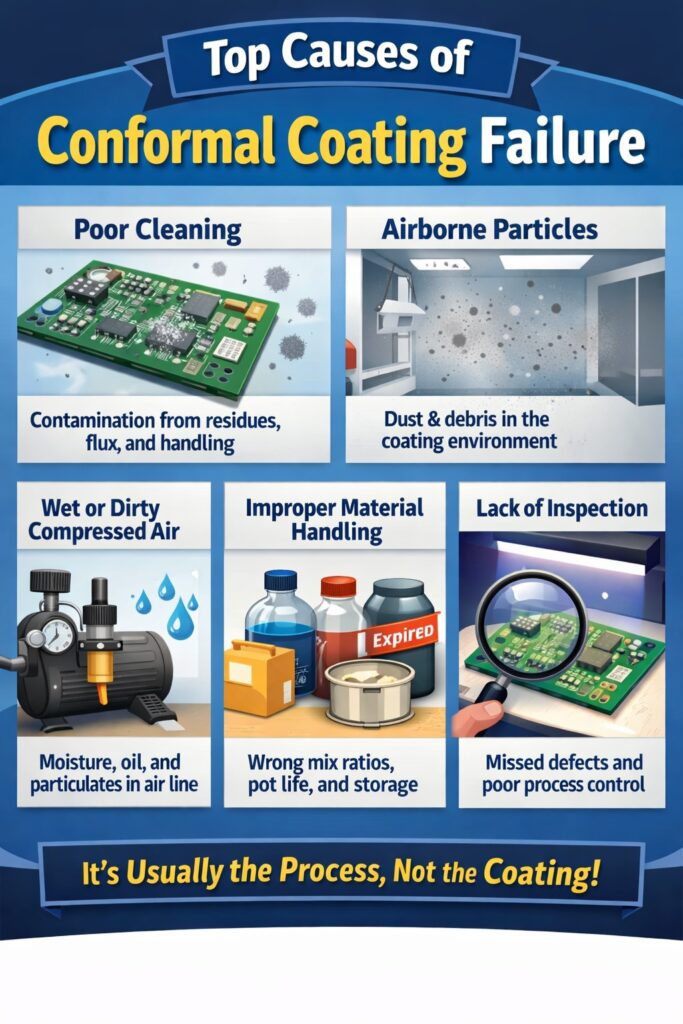
Common causes of conformal coating defects often originate in process issues such as contamination, poor cleaning, compressed air quality and incorrect material handling rather than the coating itself.
Quick Links
- Why the coating is rarely the problem
- The five real causes of failure
- What small spray setups often miss
- How aerospace and NASA-style standards change the picture
- Typical symptoms and what they often point to
- Practical checklist before you blame the coating
- Why this matters commercially as well as technically
- When to get help
Why the coating is rarely the problem
When an engineering team starts seeing particles trapped in coating, poor edge coverage, bubbles, fisheyes, patchy wetting or inconsistent finish, the immediate reaction is often to question the coating chemistry. That is understandable because the coating is the visible final layer. However, in many real-world processes, the coating is only exposing problems that already existed in the assembly, the environment or the application method.
A conformal coating process only works when six things come together:
- the assembly is genuinely clean
- the coating area is controlled
- the compressed air is dry and clean
- the material is mixed and handled correctly
- the application technique is stable
- inspection is good enough to catch defects early
If even one of those areas is weak, the process can look unreliable even when the coating itself is perfectly suitable.
That is why recurring defects often appear to move around. One week the problem looks like dust in the film. The next week it looks like fisheyes, bubbles, poor levelling or inconsistent cure. The common factor is not always the chemistry. It is usually an unstable process environment feeding different symptoms into the same line.
The five real causes of failure in small engineering environments
1. Inadequate cleaning before coating
Cleaning is often the largest hidden weakness. Boards may look visually clean but still carry ionic residues, fingerprints, handling contamination, dust, machining debris, flux residues or solvent traces. These can lead to de-wetting, adhesion loss, bubbles, poor insulation performance or long-term corrosion risk. For a practical example of how soldering residue can create coating defects, see Flux Residues Causing Conformal Coating Failure.
Common mistakes include:
- assuming a quick IPA wipe is always enough
- not matching the cleaning method to the flux chemistry
- using dirty wipes or contaminated solvents
- handling cleaned assemblies without proper gloves or controls
- coating too long after cleaning and allowing recontamination
Small operations often underestimate how quickly a clean board can become contaminated again during normal handling. Fingerprints, gloves, packaging contact and inspection handling can reintroduce contamination after cleaning and before coating. See Fingerprints and Handling Contamination Before Conformal Coating for practical guidance on this failure route.
Practical point: A board that is acceptable for general assembly handling may still be unsuitable for high-reliability conformal coating.
2. Airborne contamination in the coating area
Many small spray booths or improvised coating stations pull dust, fibres, packaging debris, clothing fibres, cardboard particles, masking debris or room contamination straight into the process. The result is simple: those particles become locked into the coating film.
This is one of the most common reasons teams say the coating keeps trapping contamination. In reality, the booth or room is feeding contamination into the wet film.
Typical sources include:
- poor booth airflow design
- dirty filters or no effective pre-filtration
- open workshop environments
- nearby machining, sanding, cutting or packing activity
- board rotation and handling methods that disturb settled dust
3. Poor compressed air quality
Compressed air is routinely underestimated. A spray process can fail simply because the air line is carrying moisture, oil, particulates or pressure instability. This can create defects that look like chemistry problems, when the true cause is the atomising air supply.
Typical compressed-air-related issues include:
- water contamination causing bubbles or finish inconsistency
- oil contamination causing fisheyes or poor wetting
- particulates creating visible inclusions
- unstable pressure affecting atomisation and thickness control
In many cases, a customer will change coating, gun setup or operator technique several times before discovering the real problem is upstream in the air system.
4. Incorrect material handling
Two-part coatings, moisture-sensitive coatings and higher-performance materials demand more discipline than many acrylic spray systems. Pot life, mix ratio, induction time, solvent addition, moisture exposure and cure conditions all matter.
With polyurethane systems in particular, moisture sensitivity can become a major issue. If the material is not stored, mixed or used correctly, the process may become inconsistent very quickly.
Common mistakes include:
- inaccurate mix ratios
- using material beyond pot life
- adding solvent to rescue ageing mixed material
- leaving moisture-sensitive materials exposed too long
- poor records of batch, time mixed and time used
5. Weak inspection and feedback loops
Some teams only inspect for whether the board has been coated rather than whether the coating is acceptable. That is a major difference. A process can keep producing the same defect repeatedly if nobody is reviewing finish quality, coverage quality, contamination levels, cure condition and defect trends in a structured way.
Good inspection is not just a final check. It is part of process control.
What small spray setups often miss
Many smaller engineering environments build a process around sensible-looking equipment: a spray gun, booth, compressed air, ESD grounding, board rotation and a curing method. That can be a good starting point, but several gaps still appear repeatedly.
Environmental control is often assumed, not proven
Teams often know their room is normally fine but do not actually monitor or record temperature and humidity at the point of coating. If humidity swings, moisture-sensitive coatings and surface condition can both change.
Booth cleanliness is not the same as contamination control
A booth can look clean and still be poor at controlling airborne particles. Filter quality, airflow direction, local sources of debris and work practices matter more than visual tidiness alone.
Masking is treated as a simple protection task
Masking materials, masking removal, residue left behind and fibre shedding can all affect coating quality. Some masking methods also create handling risks and recontamination opportunities.
Thickness is estimated, not controlled
Many small processes rely on operator feel. That may be acceptable for rough development work, but not for repeatability. Coating thickness influences protection, cure behaviour, flexibility, stress and reworkability.
Documentation is weak or inconsistent
Even where the right equipment exists, many smaller lines still rely too heavily on individual operator memory. Without defined settings, approved work instructions and a clear feedback loop, the process can drift without anybody realising it until defects begin to appear.
How aerospace and NASA-style standards change the picture
One of the most useful lessons from aerospace workmanship standards is that the coating process itself is not necessarily radically different from everyday conformal coating. The real change is the level of control around it.
In higher-reliability environments, the emphasis shifts to:
- formal operator training and certification
- written process documentation
- documented cleanliness methods
- controlled environmental conditions
- material traceability and shelf-life control
- witness samples and control specimens
- defined acceptance and rejection criteria
- inspection records and retained evidence
That is the real difference. High-reliability coating is less about secret spray technique and more about controlled process discipline.
A useful mindset: Commercial conformal coating often asks, “Can we coat this assembly?” Aerospace-style processing asks, “Can we prove this coating process is controlled, repeatable and acceptable?”
Related standards article: If you want the broader workmanship and process-discipline view behind this thinking, see What NASA Gets Right About Conformal Coating.
Typical symptoms and what they often point to
| Symptom | Often points to |
|---|---|
| Particles trapped in coating | Booth contamination, poor airflow, dirty handling, dirty compressed air |
| Fisheyes or poor wetting | Surface contamination, oil contamination, poor cleaning |
| Bubbles or voids | Moisture, trapped air, poor mixing, incorrect spray settings |
| Patchy coverage | Poor spray technique, viscosity drift, geometry challenges, weak inspection |
| Adhesion loss or peeling | Poor preparation, contamination, incompatible primer/process, cure issues |
| Inconsistent finish from board to board | Uncontrolled material condition, unstable environment, inconsistent operator method |
These are not absolute rules, but they are a useful starting point when deciding whether to review cleaning, atmosphere, material handling, equipment or inspection discipline first.
Practical checklist before you blame the coating
Before changing chemistry, suppliers or application method, review the basics properly.
Board preparation
- What exactly is the cleaning method?
- Is it compatible with the assembly and flux type?
- How is cleanliness verified?
- How are cleaned boards handled before coating?
Spray environment
- Is the booth actually controlling contamination, or just containing overspray?
- Where can dust or fibres enter the process?
- What are the local temperature and humidity conditions during coating?
Compressed air
- Is the air supply dry, oil-free, filtered and stable?
- When were filters last checked or changed?
- Is there evidence of water or oil carryover?
Material handling
- Is the coating within shelf life?
- Are mix ratios controlled?
- Is pot life recorded and followed?
- Is solvent being used correctly, or being used to rescue poor process control?
Inspection
- Are defects being classified or just noticed?
- Is there UV inspection, visual standards, thickness verification or witness evidence?
- Are repeat defects being trended and investigated?
Why this matters commercially as well as technically
A weak conformal coating process does not just create cosmetic issues. It can produce rework, delays, inconsistent customer confidence, trapped contamination, avoidable scrap and hidden long-term reliability risk. For teams trying to support aerospace, defence, medical, industrial or vacuum-compatible applications, process weakness becomes even more expensive.
That is why strong coating operations treat conformal coating as a controlled manufacturing process rather than a final cosmetic spray step.
Commercially, that means better consistency, more predictable delivery, stronger customer confidence and fewer situations where the team is firefighting symptoms instead of controlling the process.
When to get outside process support
If you are seeing repeated contamination, inconsistent coverage, poor finish or uncertainty around material handling, it is often worth reviewing the process before buying more equipment or trialling more chemistries.
External support is especially useful when:
- you are moving from acrylics into higher-performance materials
- you are building a new in-house coating capability
- you need a more disciplined process for high-reliability work
- you want to understand what aerospace-style control would require
- you are losing time to recurring defects without a clear root cause
Need help reviewing a conformal coating process?
SCH Services supports manufacturers with process review, troubleshooting, training, inspection guidance and coating services. If your team is setting up a new process or experiencing recurring defects, we can help identify the root causes and improve process control.
- Process reviews and troubleshooting
- Operator and engineer training, on-site or remote
- Inspection and quality framework support
- Coating services and process validation
Disclaimer: This article provides general engineering guidance. Final coating material selection, cleaning method, environmental controls, acceptance criteria and qualification approach should always be validated against the relevant customer specification, product design and applicable standards.