How to Choose the Right Coating
A practical decision guide for conformal coating, Parylene and advanced functional coatings
Most coating selection problems do not start with the wrong material. They start when the protection requirement, failure risk and process constraints are not clearly defined before a coating route is chosen.
This page walks through the coating selection process step by step, from defining the real problem through to choosing the most suitable coating route.
Start with the simple model, then move through capability and overlap before choosing the most likely pathway.
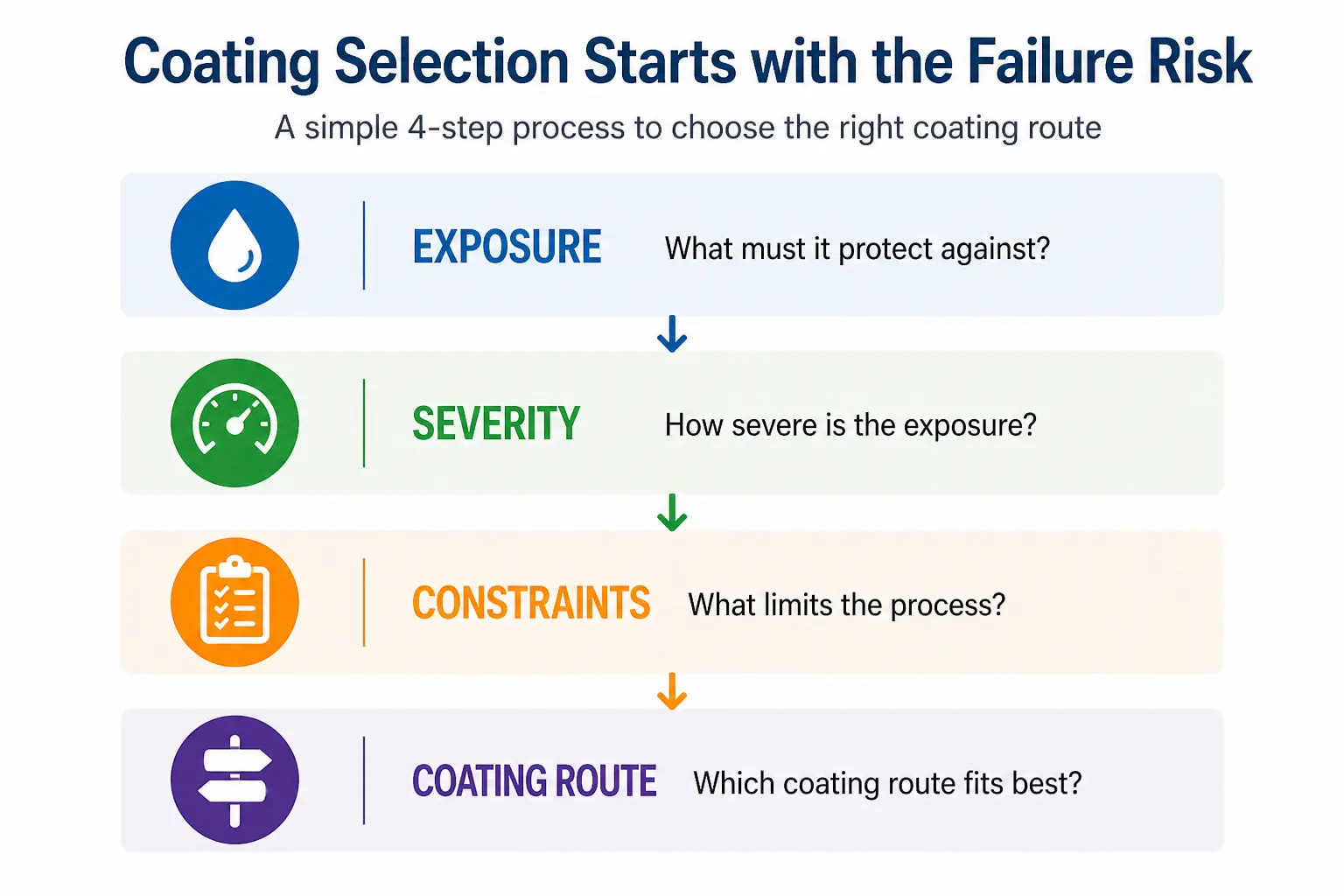
Coating selection starts by defining exposure, severity and process constraints before comparing coating routes.
1. Define the exposure
Before choosing a coating, identify the dominant exposure. Most applications fall into one of the categories below.
Moisture / humidity
General environmental exposure, condensation risk or long-term humidity-driven failure.
Water / condensation
Droplets, pooling, immersion or capillary-driven ingress into connectors and gaps.
Chemical exposure
Solvents, fuels, oils, cleaning fluids or aggressive process chemicals.
Mixed environment
Combination of moisture, contamination, residues and handling variability.
Surface behaviour
Hydrophobic, oleophobic, anti-wetting or contamination-shedding requirements.
Thermal / electrical
Temperature, dielectric behaviour, insulation or functional performance requirements.
Next step: once the exposure is clear, define how severe that exposure is in real operation.
2. Define the severity
The same exposure can lead to different coating choices depending on how severe the operating condition is.
Occasional exposure
Short-term or low-frequency exposure where general protection may be sufficient.
Continuous exposure
Regular humidity, contamination, chemical contact or operating stress that increases reliability risk.
Critical exposure
High-reliability, safety-critical, harsh environment or qualification-driven applications where failure is unacceptable.
Key point: severity often determines whether a standard coating process is enough or a higher-control route is needed.
3. Define the constraints
A coating may be technically suitable but still fail if it cannot be applied, controlled, inspected or repaired properly.
Thickness
Film build limits, tolerances, connector clearance or dimensional sensitivity.
Masking
Contacts, connectors, threads, seals, mating surfaces and other areas that must remain uncoated.
Geometry
Complex shapes, tight gaps, under-components, shadowing, capillary paths and accessibility.
Inspection / repair
Ability to verify coverage, control thickness, repair defects and maintain repeatability.
Reality check: coatings fail when the process cannot be controlled on the real assembly, even if the material looks correct on paper.
4. Understand what each coating route is good at
Before comparing capability, understand what each coating route is designed to do.
Conformal coating
Used where practical PCB environmental protection, liquid coating, inspection, repair and production cost all need to remain manageable.
Parylene coating
Used where uniform barrier coverage, complex geometry, tight gaps, high reliability or controlled film formation are more important than simple liquid application.
Advanced functional coatings
Used where the requirement is specialist surface behaviour, ultra-thin protection, chemical resistance, hydrophobicity, oleophobicity or PFAS-free performance.
5. Compare capability
This map shows where coating technologies typically sit in terms of thickness, protection level and process complexity.
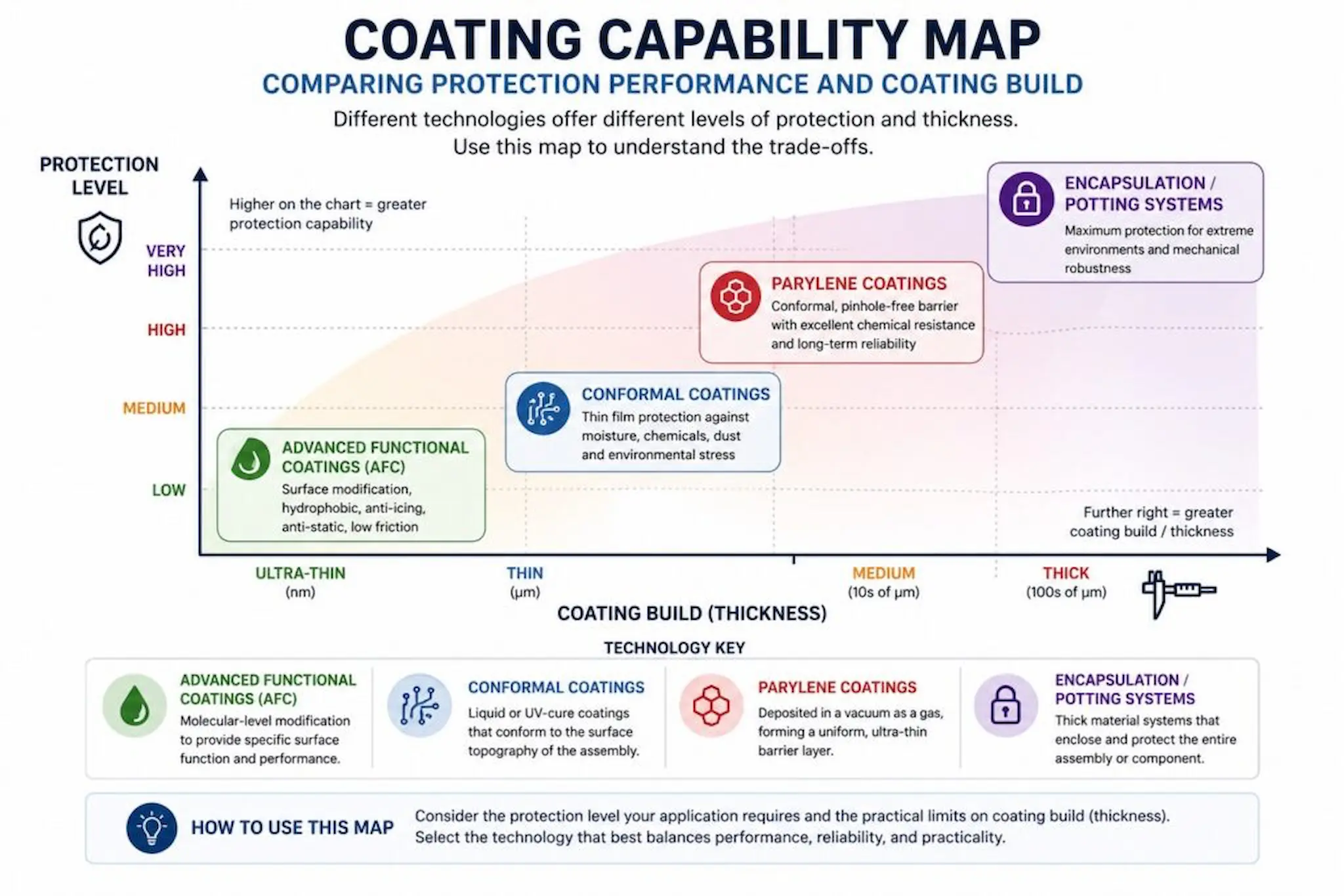
Coating capability map comparing conformal coating, Parylene and advanced functional coatings by thickness range and protection level.
6. See where routes overlap
This model shows where coating decisions become less clear. When applications sit in these overlap areas, more than one coating route may appear suitable.
The correct choice is normally determined by the dominant failure mode, not the coating type.
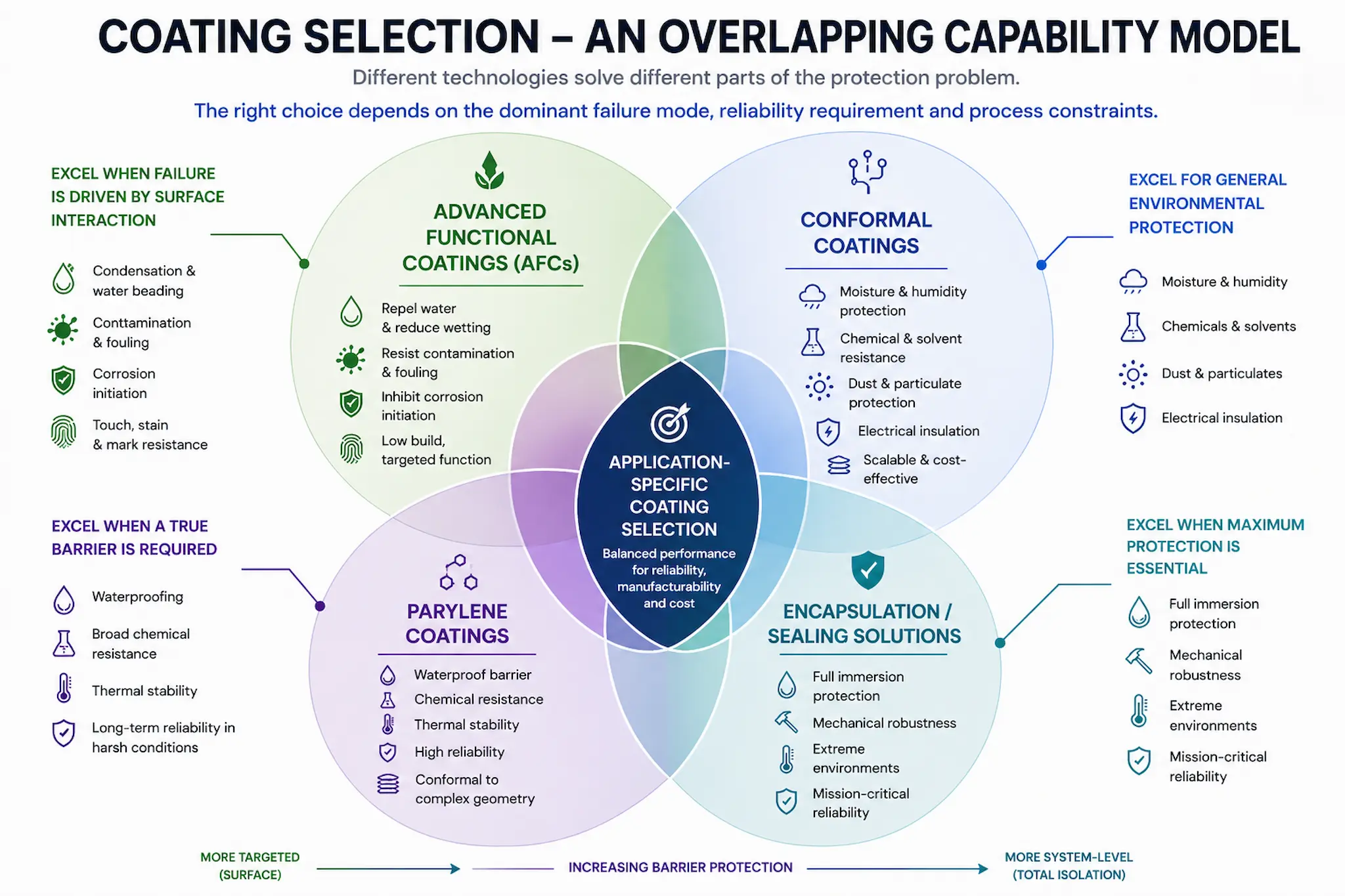
Coating selection overlap model showing how conformal coating, Parylene and advanced functional coatings apply depending on failure mode, reliability requirements and application constraints.
How to read this: if your application sits in an overlap zone, focus on the dominant failure mode — moisture, chemicals, geometry or process limitations — rather than the coating type itself.
7. Choose the most likely route
Use the exposure you identified earlier as your starting point, then check severity, constraints and overlap before selecting a route.
Start with conformal coating
Where the primary need is general PCB protection against moisture, humidity or contamination, and where application, inspection and repair must remain practical.
Start with Parylene
Where exposure severity is high, geometry is complex, gaps are tight or long-term reliability and uniform barrier coverage are critical.
Start with advanced functional coatings
Where the requirement is surface behaviour, chemical resistance, ultra-thin coating or PFAS-free performance rather than conventional environmental protection.
Important: this is a starting point. Many applications require validation, iteration or combined approaches.
8. Move to the next pathway
Once the likely coating route is clear, move into the page that explains how that route is implemented in practice.
Conformal coating pathway
For liquid coating processes, PCB protection, masking, inspection, coating services, equipment and operator training.
Parylene pathway
For vacuum-deposited barrier coatings, complex geometries, high-reliability applications and controlled Parylene implementation.
Advanced functional pathway
For ultra-thin, hydrophobic, oleophobic, PFAS-free, chemical-resistant and specialist surface performance coatings.
ESD and static control pathway
For static dissipative coatings on plastics, equipment, work surfaces, packaging, floors and hazardous process areas.
How will the coating be implemented?
The correct coating route still needs a practical implementation plan. This normally depends on production volume, internal capability, risk level and validation requirements.
- Outsourced coating services: useful for feasibility trials, validation runs, specialist coating processes and production without internal investment.
- In-house application: suitable where coating volume, process ownership or long-term production strategy justify equipment and training.
- SCH-supported implementation: useful where the customer needs coating selection, process development, equipment, masking, inspection and operator training as one controlled route.
If the process risk is high, review Conformal Coating Process Control before committing to a coating material or production method.
Specialist decision guides
If the application involves ultra-thin coatings, reduced masking, hydrophobic behaviour or surface performance rather than full barrier protection, these guides help separate useful functional coatings from coatings that are being asked to do too much.
- Nano Coating vs Conformal Coating for Electronics
- Hydrophobic Coating vs Conformal Coating for Electronics
- Why Hydrophobic Coatings Don’t Protect Electronics
- When to Use Hydrophobic Coatings in Electronics
- Limitations of Hydrophobic Coatings in Electronics
For the wider specialist coating range, review Advanced Functional Coatings, Hydrophobic Coatings, Ultra-Thin Coatings, Transitional Film-Forming Coatings, PFAS-Free Coatings and Nano Coatings.
Not sure which route is right?
If your application involves complex geometry, previous coating failures, contamination risk, masking difficulty, chemical exposure or uncertain inspection criteria, the coating choice should be reviewed against the real part and operating environment.
Why Choose SCH Services?
SCH Services provides coating selection, application and process support across conformal coating, Parylene and advanced functional coating technologies.
- Coating selection based on real application requirements
- Access to multiple coating technologies and material systems
- Support from early feasibility through to production
- Integrated services including coating, masking, inspection, equipment and training
Conformal Coating Solutions | Parylene Coating Solutions | Advanced Functional Coatings | Advanced Functional Coating Services | Contact SCH to Discuss Your Coating Requirement
This content is provided for general technical guidance only. Coating selection and process decisions must be validated against applicable standards, customer specifications and application-specific qualification requirements.