Conformal Coating Masking Hub
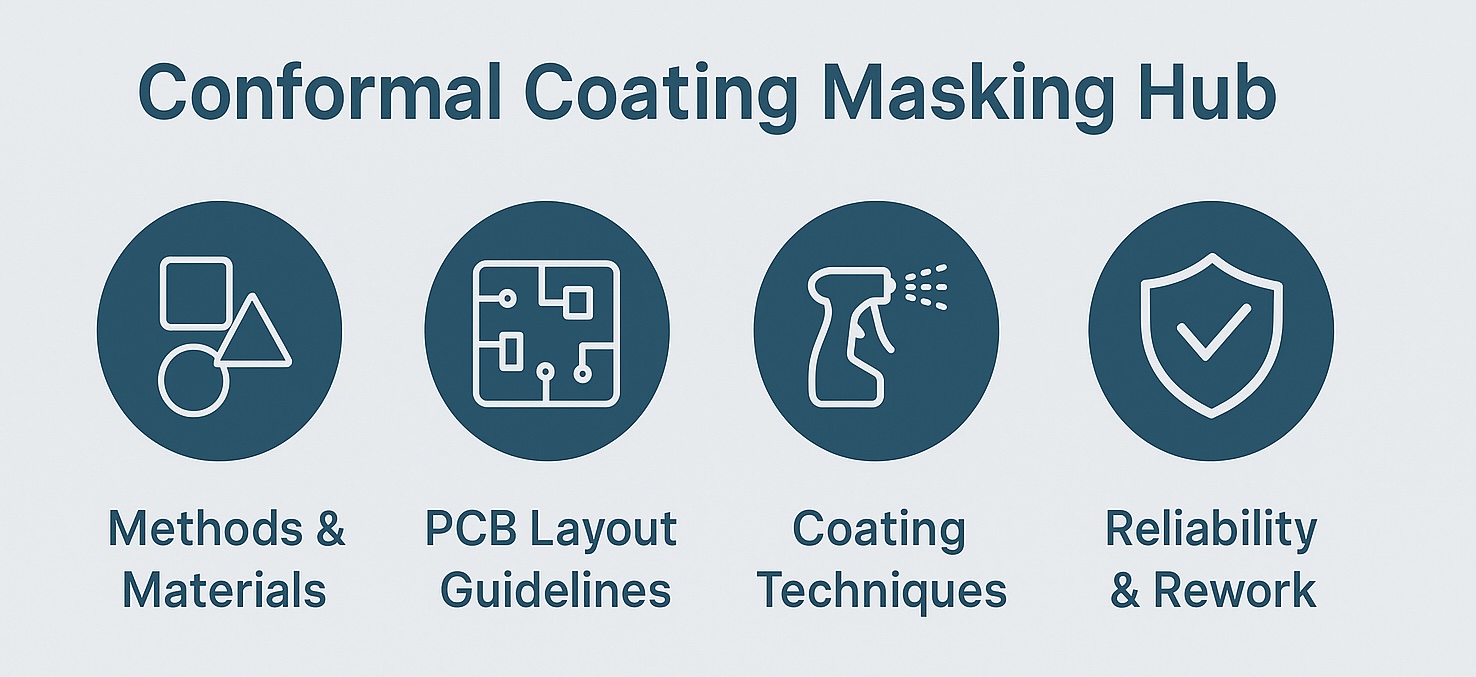
This Conformal Coating Masking Hub brings together SCH’s technical guidance on masking materials, application methods, PCB design considerations, operator technique, and post-coating verification.
Masking is treated here as a process control function — not a consumable choice — because incorrect masking is one of the leading causes of coating defects, rework, and reliability failures.
The articles below apply to spray, dip, selective robotic, and Parylene coating processes and are written from real production experience.
Related guides that reduce masking defects:
- Conformal Coating Design Hub – keep-outs, access, spacing and DfCC rules that make masking easier.
- Humidity vs Condensation in Electronics – why condensation events often drive failures (and why edge sealing matters).
- Inspection & Quality Hub – verification steps after masking and after coating.
- Conformal Coating Defects Hub – common masking-driven defects and root-cause patterns.
Index of Masking Articles
| Topic | Jump | Article |
|---|---|---|
| Masking Material Selection for Conformal Coating – choosing tapes, dots, boots and latex without creating defects | 🔗 | ↗ |
| Masking Application Best Practices – operator technique, sequencing and inspection before coating | 🔗 | ↗ |
| Masking Design Guidelines for PCBs & Assemblies – keep-outs, spacing, access and masking-friendly geometry | 🔗 | ↗ |
| Masking Removal & Verification After Coating – clean removal, residue checks and leakage inspection | 🔗 | ↗ |
| Reusable Masking Boots – cost, speed and repeatability in production | 🔗 | ↗ |
| How to Mask a PCB Using Shield / Boot Methods – fit, seal, vent and de-mask | 🔗 | ↗ |
| Liquid Latex & Hybrid Barrier Masking – sealing edges and converting shields into barriers | 🔗 | ↗ |
Masking Material Selection for Conformal Coating
Masking materials must seal reliably, survive the coating and cure environment, and remove cleanly without residue or damage. Incorrect material selection is a primary root cause of leakage, de-wetting, edge lift, and post-coating reliability failures.
This article explains how to select masking tapes, dots, boots and liquid masks based on geometry, dwell time, cure profile and coating chemistry — not convenience or availability.
Masking Application Best Practices
Even the correct masking material will fail if applied inconsistently. Operator technique, sequence within the coating process, and inspection discipline directly influence defect risk.
This guide covers operator handling, application order, inspection before coating, and common errors that lead to leakage or removal damage.
Masking Design Guidelines for PCBs & Assemblies
PCB layout decisions directly affect masking success. Tight spacing, inaccessible keep-outs and poorly defined boundaries force masking materials to distort or bridge gaps, increasing leakage and demask damage.
This article explains how to design assemblies that can be masked cleanly and repeatedly in production.
Masking Removal & Verification After Coating
Masking does not end when coating is applied. Removal timing, peel technique and verification are critical to preventing residue transfer, edge damage and latent reliability issues.
This guide provides a structured checklist for demasking and inspection after conformal coating.
Reusable Masking Boots
Reusable boots provide fast, repeatable protection for connectors and high-risk features. When designed and used correctly, they reduce labour time and masking variability compared to tape-based methods.
Shield / Boot Masking Process
This practical guide shows how to correctly apply boots and shields, manage venting, seal edges where required,
and remove masks without damage in the conformal coating process.
Liquid Latex & Hybrid Barrier Masking
Liquid latex is often used to convert shield-type masking into a true barrier by sealing edges, vias and irregular geometry. This article explains where latex works, where it fails, and how to control cure and removal.
Need Masking Support?
If masking is driving defects, rework or yield loss, SCH Services can help with process audits, training, material selection and production support.