Conformal Coating Masking Hub
Masking materials, connector protection, keep-out control and repeatable masking strategies for PCB coating
This hub focuses on masking control within conformal coating and PCB protection processes.
Masking is one of the most critical stages within conformal coating because it controls where coating must stop, where electrical interfaces remain exposed and how reliably the finished assembly performs in service.
Many coating defects are caused by poor masking selection, inconsistent application, connector contamination, edge leakage, residue transfer or incorrect demasking technique rather than the coating material itself.
This hub brings together SCH technical guidance covering masking materials, reusable boots, connector protection, liquid masking systems, PCB keep-out strategies and post-coating verification methods.
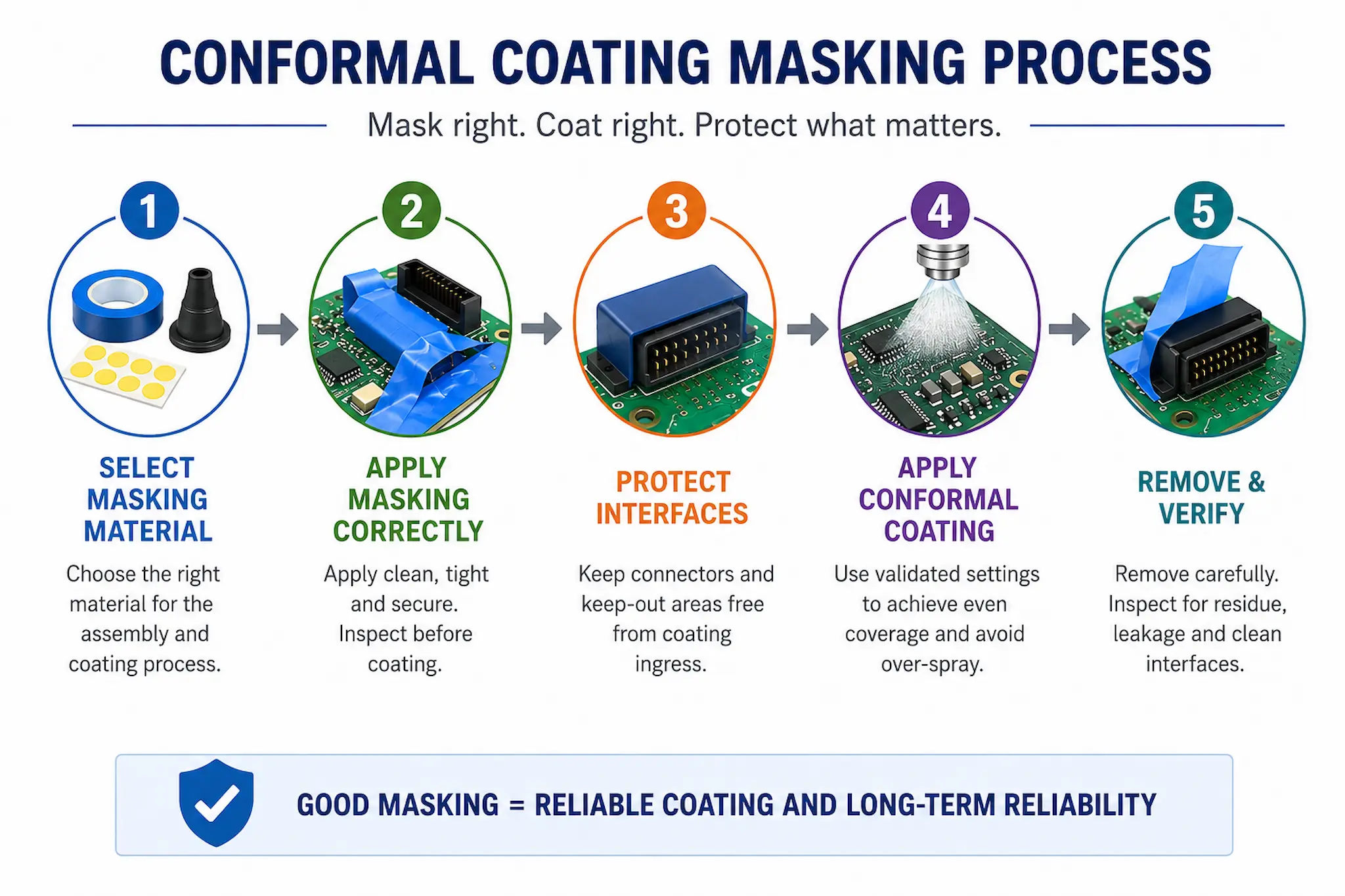
A controlled masking process links material selection, application, coating, demasking and final inspection to protect PCB keep-out areas and electrical interfaces.
Where are you in the masking process?
- Choosing tapes, dots, boots or masking materials → Masking Material Selection
- Improving masking consistency or operator technique → Masking Application Best Practices
- Protecting connectors and keep-out zones → Connector Interface Protection
- Reviewing demasking and post-coating inspection → Masking Removal & Verification
Masking Hub Index
| Topic | More | Article |
|---|---|---|
| Masking Material Selection for Conformal Coating – choosing tapes, dots, boots and latex systems | ↓ | ↗ |
| Masking Application Best Practices – operator technique, sequencing and inspection | ↓ | ↗ |
| Masking Design Guidelines for PCBs & Assemblies – keep-outs, spacing and masking-friendly layouts | ↓ | ↗ |
| Masking Removal & Verification After Coating – residue checks, edge inspection and clean demasking | ↓ | ↗ |
| Reusable Masking Boots – repeatable connector masking and production efficiency | ↓ | ↗ |
| How to Mask a PCB Using Shield / Boot Methods – fit, venting, sealing and removal technique | ↓ | ↗ |
| Liquid Latex & Hybrid Barrier Masking – sealing edges and improving masking barriers | ↓ | ↗ |
| Protecting Connector Interfaces Without Conformal Coating Them – controlling connector keep-out areas and electrical interfaces | ↓ | ↗ |
Masking Material Selection for Conformal Coating
Masking materials must survive coating exposure, cure conditions and handling without leakage, residue transfer or edge lifting. Material selection should always match geometry, coating chemistry and production method.
- Select masking materials based on coating process and cure profile.
- Prevent leakage by matching masking geometry to PCB features.
- Avoid residues that create adhesion or reliability problems.
- Control masking repeatability across production batches.
Common Masking Options
| Method | Typical Use | Key Consideration |
|---|---|---|
| Masking tape | Edges, larger keep-out zones and accessible flat areas | Adhesion, residue, edge sealing and clean removal |
| Masking dots | Small circular keep-outs and test points | Correct size, pressure, edge lift and movement during coating |
| Reusable boots | Connectors and repeat production geometries | Fit, sealing, venting, cleaning and repeatability |
| Liquid latex | Irregular shapes and difficult transition areas | Compatibility, cure, residue and removal |
| Hybrid masking | Complex interfaces needing mechanical masking plus edge sealing | Process complexity and controlled removal sequence |
What about ESD masking tape?
Masking material selection should consider the complete manufacturing risk rather than one material property in isolation. SCH does not automatically specify ESD masking tape because the ESD tapes we have evaluated have not provided the same handling and masking reliability as our established production materials. Where process-essential insulating masking materials are used, electrostatic charge is managed through the wider ESD-controlled process, including ionisation at appropriate workstations.
Why We Don’t Automatically Use ESD Masking Tape for Conformal Coating →
Masking Application Best Practices
Even the correct masking material can fail if it is applied inconsistently. Operator handling, masking sequence and inspection discipline strongly influence coating reliability.
- Control application pressure and sealing consistency.
- Inspect masking before coating begins.
- Prevent bridging, wrinkles and edge lift.
- Standardise masking methods across operators and shifts.
One common production issue is the assumption that a correctly placed masking dot will remain secure throughout coating. In reality, small masking dots can lift, move or release during coating, allowing contamination to reach protected areas. See Masking Dots Lift During Conformal Coating for practical causes and prevention methods.
Masking Design Guidelines for PCBs & Assemblies
PCB layout and component spacing directly influence masking success. Poor keep-out definition and inaccessible geometries increase masking complexity and defect risk.
- Design clear keep-out zones around connectors and interfaces.
- Allow physical access for masking tools and removable boots.
- Reduce sharp transitions that create leakage paths.
- Consider masking during PCB layout rather than after manufacture.
Masking Removal & Verification After Coating
Masking removal is a controlled process stage. Poor demasking technique can damage coating edges, leave contamination or expose hidden leakage problems.
- Remove masking at the correct cure stage.
- Inspect for residue, leakage and coating edge lift.
- Verify connector cleanliness and exposed interfaces.
- Use inspection evidence to confirm masking success.
Masking tape can also damage an otherwise acceptable coating if it is removed at the wrong cure stage, pulled at an unsuitable angle or allowed to create excessive stress at the coating boundary. Demasking should therefore be defined as part of the coating process rather than treated as a simple finishing operation.
Reusable Masking Boots
Reusable masking boots provide fast, repeatable connector protection within production environments and can significantly reduce masking variability and labour time.
- Improve masking repeatability on complex connectors.
- Reduce manual tape masking time.
- Control sealing pressure and interface protection.
- Support high-volume production masking consistency.
Where connector geometry and production volume justify dedicated reusable tooling, SCH can also support the practical masking route through its Masking Solutions.
How to Mask a PCB Using Shield / Boot Methods
Shield and boot masking systems must seal correctly, vent properly and remove cleanly after coating to avoid hidden reliability risks.
- Control venting to prevent pressure and coating ingress.
- Use correct fitting methods on connectors and interfaces.
- Seal irregular geometries where necessary.
- Prevent damage during mask removal.
Reusable boots can still allow coating ingress if fit, sealing, venting or connector geometry is poorly controlled. Their repeatability advantage therefore depends on validating the complete masking method rather than assuming that the boot itself guarantees protection.
Liquid Latex & Hybrid Barrier Masking
Liquid latex systems are often used to improve sealing around difficult geometries, connectors and transition areas where mechanical masking alone may not be sufficient.
- Use latex to improve sealing around irregular interfaces.
- Control cure and removal timing carefully.
- Avoid tearing and residue transfer.
- Validate compatibility with coating chemistry and process conditions.
Protecting Connector Interfaces Without Conformal Coating Them
Connector interfaces, contacts and mating surfaces often require complete protection from conformal coating because even small amounts of coating contamination can affect electrical performance and long-term reliability.
For a practical production example of how coating can still reach protected connector contact areas, see Connector Masking Failures and Contact Area Contamination.
- Define connector keep-out zones clearly.
- Prevent coating ingress into mating surfaces.
- Use repeatable masking systems for production control.
- Inspect interfaces after demasking and coating cure.
How Masking Links to the Wider Process
Masking sits at the centre of coating process control because it directly influences coating boundaries, inspection quality, connector reliability and rework complexity.
- Conformal Coating Processes Hub — master process navigation and overview.
- Conformal Coating Application Methods Hub — spray, dip, selective coating and process route selection.
- Conformal Coating Design Hub — PCB design, keep-out definition and coating-friendly assembly decisions.
- Conformal Coating Defects Hub — masking failures, leakage mechanisms and defect troubleshooting.
- Conformal Coating Inspection & Quality Hub — inspection, verification and coating quality control.
Need Help With Masking or Connector Protection?
SCH Services supports customers with conformal coating masking strategies, reusable masking boot systems, connector protection methods, process optimisation and production troubleshooting.
Whether the requirement involves a difficult connector, repeat masking failures, excessive masking labour or the need to improve production consistency, the next step is to evaluate the masking method against the PCB geometry and coating process.
Why Choose SCH Services?
SCH combines practical conformal coating production experience with masking design, connector protection, process optimisation and production troubleshooting. This allows masking decisions to be evaluated as part of the complete coating process rather than as an isolated consumable choice.
- Practical masking experience: tapes, dots, liquid masks, reusable boots and hybrid masking strategies.
- Connector protection: support for keep-out definition, coating ingress prevention and post-coating verification.
- Production repeatability: masking methods can be developed around operator consistency, cycle time and repeatable process control.
- Integrated coating knowledge: masking decisions can be assessed alongside coating chemistry, application method, curing, inspection and rework requirements.
Disclaimer: This content is provided for general technical guidance and educational purposes only. Final masking methods, connector protection strategies, materials and coating processes should be validated against the assembly design, coating chemistry, production process, applicable standards and customer requirements.