
Alternatives to Conformal Coating for Electronics
Parylene, nano coatings, ALD and MVD as alternative PCB protection strategies
Conformal coatings are widely used to protect electronic assemblies, but they are not always the correct solution. In many applications, coating thickness, masking requirements, or interaction with connectors and interfaces can introduce limitations.
For this reason, a range of alternative coating technologies are used where different performance characteristics are required. These include vapour-deposited coatings such as Parylene, ultra-thin nano coatings, and specialist thin film technologies such as ALD and MVD.
Selecting the correct alternative depends on whether the requirement is barrier protection, surface behaviour, ultra-thin coverage, or precision film control rather than simply applying a traditional coating layer.
These alternatives to conformal coating are used across electronics manufacturing where traditional coating approaches are not the best fit.
This infographic summarises the main alternatives to conformal coating used in electronics protection.
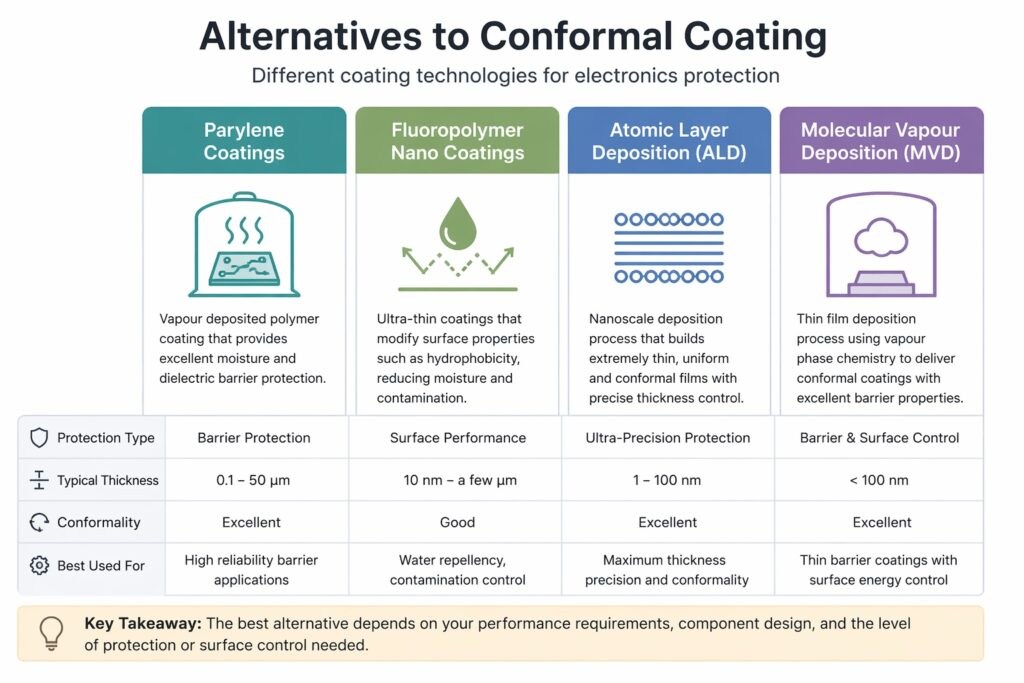
Comparison of alternative PCB coating technologies including Parylene, fluoropolymer nano coatings, ALD and MVD.
Why alternatives to conformal coating are used
Alternative coating technologies are used where conventional conformal coating introduces challenges such as:
- Excessive coating thickness
- High masking complexity
- Interference with connectors or contacts
- Incompatibility with tight tolerances
- Over-specification of protection level
In these cases, the objective is often not more coating, but better-matched protection or surface performance.
In many cases, this leads to the use of ultra-thin coating strategies or surface-driven approaches such as hydrophobic coatings rather than traditional barrier layers.
Main alternatives to conformal coating
Parylene coatings
Parylene is a vapour-deposited polymer coating applied in a vacuum chamber. It provides a highly conformal, pinhole-free coating that forms an effective dielectric and moisture barrier.
Parylene is often used where a uniform, high-integrity barrier coating is required across complex geometries.
Explore Parylene coating solutions or compare Parylene vs conformal coating.
Fluoropolymer and nano coatings
Ultra-thin coatings based on fluorinated chemistry are used where surface behaviour such as hydrophobicity or contamination resistance is required rather than a thick barrier layer.
These coatings are typically applied at very low thickness and can reduce masking requirements in some applications.
See fluoropolymer coatings for electronics, nano coatings, or hydrophobic coating strategies for more detail.
Atomic Layer Deposition (ALD)
ALD is a vapour-phase deposition process that builds coatings at an atomic scale. It provides extremely precise thickness control and highly conformal films.
- Typical thickness: 1–100 nm
- Highly controlled deposition process
- Dense and uniform thin films
Molecular Vapour Deposition (MVD)
MVD combines aspects of CVD and ALD, producing conformal thin films at very low thickness.
- Low chemical usage compared to traditional CVD
- Thin film coatings typically below 100 nm
- Provides barrier and surface energy control
How to select the right alternative
The correct coating choice depends on the real requirement:
- Barrier protection: Parylene
- Surface behaviour: fluoropolymer coatings or nano coatings
- Ultra-precision films: ALD or MVD
- Low thickness constraints: ultra-thin coatings
In many applications, the best solution is not a direct replacement, but a reframing of the protection requirement.
Related coating strategies
Why Choose SCH Services?
SCH Services supports customers in selecting the correct coating technology based on real application requirements, not assumptions.
- Comparison of coating technologies based on performance and process
- Support with coating selection and validation
- Access to conformal coating, Parylene, and advanced functional coatings
- Practical experience across electronics manufacturing environments
Contact SCH Services to discuss coating selection for your application.
This article provides general technical guidance only. Final coating selection must be validated against application requirements, standards, and qualification testing.
