Conformal Coating Defect Identification Guide
Defect identification is the fastest way to stop rework loops. Many conformal coating problems look similar on the surface (pinholes vs de-wetting, corrosion vs SIR leakage, ECM vs CAF), but they have very different root causes and corrective actions.
Use this guide when you know what you are seeing — but not yet what to call it. Then route to the correct technical page in the Defects Hub to confirm and fix.
For upstream control (cleanliness, masking discipline, inspection), see the Processes Hub, Masking Hub and Inspection & Quality Hub.
Related articles: While this guide helps identify defects from symptoms, many different defects share the same root causes. For a system-level explanation of recurring coating failures, see Why Conformal Coating Processes Fail.
For a high-reliability workmanship perspective on how cleanliness, documentation, inspection discipline and process control fit together in critical environments, see What NASA Gets Right About Conformal Coating.
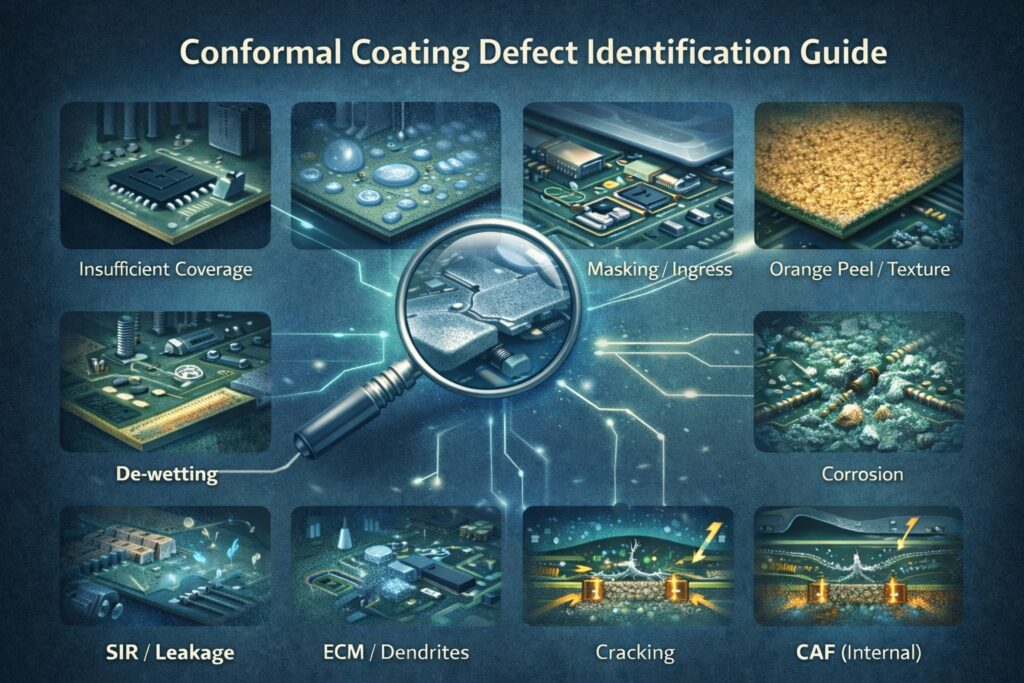
Symptom-based conformal coating defect identification guide showing how observable appearance, location and electrical behaviour route to the correct defect mechanism, including coverage defects, finish defects, adhesion failures and electrochemical reliability mechanisms.
Article Quicklinks
| Topic | More |
|---|---|
| How to use this guide: confirm before you “fix” | 🔗 |
| Symptom → Defect routing: the comprehensive matrix | 🔗 |
| Common misidentifications: look-alikes & fast separators | 🔗 |
| When to escalate: FA / testing triggers | 🔗 |
| Next steps: control-plan actions once identified | 🔗 |
How to Use This Defect Identification Guide
- Pick one dominant symptom (what you can reliably observe) — avoid diagnosing from assumptions.
- Route using the matrix below to the most likely defect page.
- Confirm using the defect page (mechanism + tell-tales + root cause pattern).
- Only then choose corrective action (touch-up vs strip & recoat vs process change).
Rule: If you cannot confirm the mechanism, you are not “fixing” — you are gambling. When in doubt, escalate to structured testing or FA.
Symptom → Defect Routing Matrix
This matrix matches the current Defects Hub structure (masking, coverage/boundary, flow/finish, cure-state, adhesion/interface, reliability/chemical mechanisms).
| Primary symptom you observe | Most likely defect mechanism | Open |
|---|---|---|
| Defects concentrated at keep-outs, connectors, tape edges, boot boundaries, post de-mask areas | Masking – root cause of many defects | 🔗 |
| UV weak zones, missed coating (“holidays”), thin film behind tall parts | Insufficient coverage & shadowing | 🔗 |
| Coating present where prohibited (connectors, test pads, mating faces) | Coating ingress into keep-out areas | 🔗 |
| Film spans between pins/features; thick fillets in fine pitch; unexpected insulation “bridges” | Bridging & webbing | 🔗 |
| Coating creeps under parts / along interfaces; meniscus lines; bare zones adjacent to wicking | Capillary / wicking around components | 🔗 |
| Drips, curtains, runs on vertical edges; heavy edge build; uneven thickness after cure | Runs, sags & curtains | 🔗 |
| Local thick puddles/pools; edge build; “lakes” that cure differently | Pooling & puddling | 🔗 |
| Rough/pebbled finish, dull texture, poor levelling (often spray-related) | Orange peel | 🔗 |
| You know it’s a “finish” problem but not which one (mixed texture symptoms) | Texture & finish defects (router) | 🔗 |
| White film/residue on coating surface; “blooming” or surface contamination after cure | Blooming & surface residue | 🔗 |
| Circular craters/fish-eyes; local pull-back spots; contamination-like rings | Fish-eyes & craters | 🔗 |
| Embedded particles, fibres, dust inclusions, “hair” under film, FOD in coating | Dust, fibres & FOD | 🔗 |
| Pinholes/voids, bubbles or foam in cured coating; burst bubbles or micro-voids | Pinholes, bubbles & foam | 🔗 |
| Sticky/tacky film; soft/rubbery cure; marks easily; picks up contamination | Tacky / soft-cured (under-cure) | 🔗 |
| Film is brittle; cracks easily; poor flex tolerance; “over-hard” behaviour | Brittleness / over-cured coating | 🔗 |
| Wrinkles, ripples, skinning; recoating/intercoat disturbance patterns | Wrinkling (recoating / intercoat defects) | 🔗 |
| Milky haze, whitening or blush; appearance change linked to humidity/solvent interaction | Haze, whitening & blushing | 🔗 |
| Poor adhesion on connector bodies or plastics; coating peels easily from polymer surfaces | Poor adhesion on plastics / connector bodies | 🔗 |
| Coating lifted/damaged during de-mask; ragged edges; edge lift at tape/boot boundary | Mask-edge lift & de-mask damage | 🔗 |
| Beading/pull-back; islands/craters exposing substrate immediately after application | De-wetting | 🔗 |
| Peeling, flaking, sheets lifting; adhesion loss with under-film tracking risk | Delamination | 🔗 |
| Cracking after cure or thermal cycling; fractures at thick areas/edges | Cracking | 🔗 |
| Corrosion products, under-film attack, metal degradation; contamination-driven failures | Corrosion & ionic contamination | 🔗 |
| Solder mask / plastics show softening, crazing, swelling; marking or damage after coating/thinners | Solvent attack & substrate damage | 🔗 |
Electrical reliability mechanisms (routing): If the symptom is leakage/IR drop, intermittent shorts, dendrites, or latent PCB shorts, route via the dedicated pages for SIR failures & leakage, ECM & dendrite growth, and CAF under coating / under solder mask.
Common Misidentifications (Fast Separators)
- Pinholes vs de-wetting: pinholes are voids in the film; de-wetting exposes substrate in islands/craters and often correlates with contamination/low surface energy.
- Corrosion vs SIR leakage: SIR may present as leakage/IR drift before corrosion products are visible.
- ECM vs CAF: ECM typically forms visible surface dendrites bridging conductors; CAF is inside the laminate and may persist even after coating removal.
- Delamination vs mask-edge damage: de-mask damage starts at boundaries and handling; delamination can indicate systemic adhesion/cleanliness/cure issues.
- Orange peel vs “texture router” defects: if the finish symptom is mixed/unclear, route through texture & finish defects first.
Control-plan lesson: misidentification almost always produces a “fix” that temporarily hides the symptom while the root cause remains active.
When to Escalate Beyond Visual Inspection
- Electrical leakage / IR instability (humidity-dependent, intermittent, drifting)
- Repeat failures after touch-up or strip/recoat
- Multiple defects at once (finish + adhesion + electrochemical symptoms)
- High-reliability products (aerospace, defence, automotive/EV, medical)
- Suspected laminate-level mechanisms (CAF indicators)
Escalation typically means structured testing (SIR / humidity-bias), contamination measurement (ROSE / ion chromatography), and/or FA (microsectioning). Your defect page should tell you which test proves the mechanism.
Next Steps Once You Identify the Defect
- Fix the mechanism (root cause), not the appearance.
- Document the signature: symptom, location logic, when it appears, and the confirming evidence.
- Update your control plan: add an upstream check (cleanliness, masking discipline, viscosity, cure verification, inspection rule).
- Decide repair rules: accept / touch-up / strip & recoat / scrap — driven by risk and access to verification.
If your next question is “is this acceptable?”, route to the Defect Acceptance & Repair Rules page once published.
Looking for the Full Defect Index?
This page is the symptom-based router. For the complete defect index (grouped by mechanism) and links to each technical article:
Training on Conformal Coating Defects
SCH delivers practical, standards-driven training covering defect identification, masking discipline, cleanliness control, inspection methods, and the wider defects framework used to prevent repeat failures.
Industry Standards We Work To
SCH Services aligns coating services, training, equipment supply and materials to relevant IPC standards, including:
- IPC-A-610 – Acceptability of Electronic Assemblies
- IPC-CC-830 – Qualification & Performance of Conformal Coatings
- IPC-HDBK-830 – Conformal Coating Handbook (guidance and best practice)
For further details on IPC standards: electronics.org/ipc-standards ↗
Explore Topic Hubs
Conformal Coating Processes Hub
Conformal Coating Equipment Hub
Conformal Coating Masking Hub
Conformal Coating Design Hub
Conformal Coating Defects Hub
Inspection & Quality Hub
Removal & Rework Hub
Standards Hub
Parylene Basics Hub
Parylene Application Hub
Why Choose SCH Services?
You gain a complete, integrated platform for Conformal Coating, Parylene & ProShieldESD—plus equipment, materials and training—backed by decades of hands-on process support.
- 🛠️ End-to-End Support – Selection, masking, inspection and troubleshooting.
- ✅ Process Discipline – Recipes, control windows and repeatability.
- 🌍 Global Reach – Support across Europe, North America and Asia.
📞 Call: +44 (0)1226 249019 | ✉ Email: sales@schservices.com | 💬 Contact Us ›