Mon - Thur 7.30-15.30   Fri 7.30-14.00

Why Conformal Coating Processes Fail in Small Engineering Environments


Most coating defects are driven by process issues β€” not the material itself

Most conformal coating defects are not caused by the coating. They are caused by what happens before the coating is applied β€” contamination, poor cleaning, compressed air quality, humidity control and material handling.

If you are troubleshooting recurring coating issues, you can explore the Conformal Coating Defects Hub for detailed root causes and the Conformal Coating Processes Hub for guidance on building stable, repeatable coating systems.

In many cases, risk is also introduced outside the coating process itself β€” through packaging, storage, handling and wider working environments. This broader system effect is explored in Why ESD Protection Fails in Data Centres, where infrastructure and handling are shown to directly influence reliability outcomes.

This insight highlights a common mistake: when coating results look inconsistent, teams often change materials first, instead of identifying where the process is introducing risk.

Quick take. Most conformal coating problems are caused by contamination, poor cleaning, airborne particles, compressed air quality, humidity variation and incorrect material handling β€” not the coating chemistry itself.

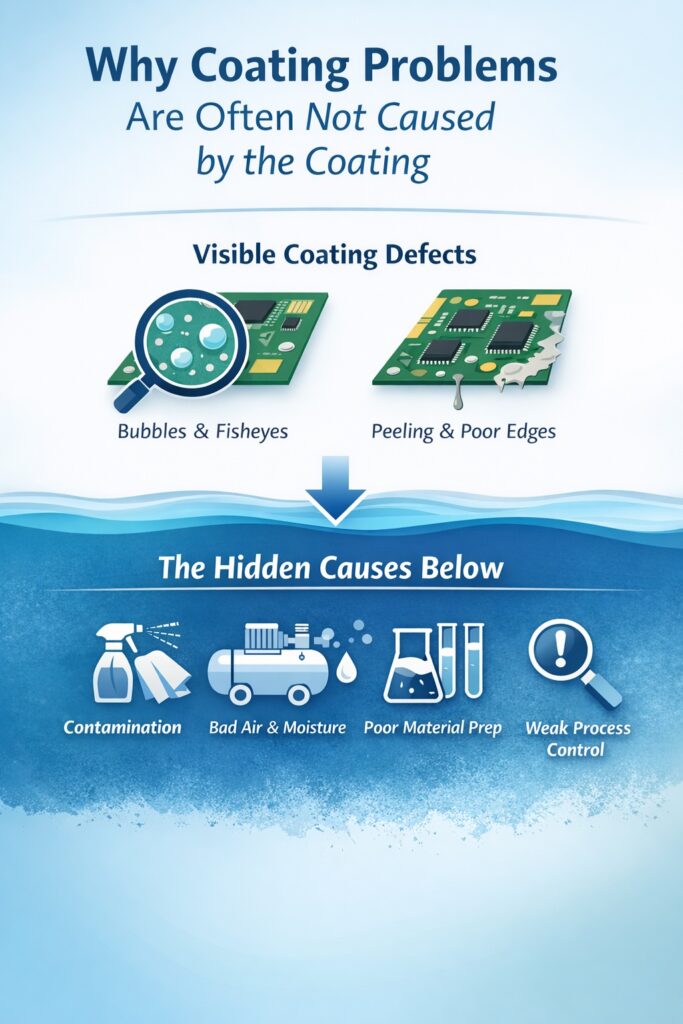
Infographic showing why conformal coating defects are often caused by process issues such as contamination, poor cleaning, compressed air quality and material handling rather than the coating itself

Most conformal coating defects originate from process issues such as contamination, cleaning, compressed air quality and material handling β€” not the coating itself.

Why this matters

When an engineering team starts seeing particles trapped in coating, poor edge coverage, bubbles, fisheyes, patchy wetting, or inconsistent finish, the immediate reaction is often to question the coating chemistry. That is understandable because the coating is the visible final layer.

In reality, the coating is often only exposing problems that already existed in the assembly, the environment, or the application method. A conformal coating process only works when the board is genuinely clean, the coating area is controlled, the compressed air is dry and clean, the material is handled correctly, the application method is stable, and inspection is strong enough to catch defects early.

If one of those areas is weak, the whole process can look unreliable even when the coating itself is perfectly suitable.

In many cases, failure is not caused by the coating itself, but by how products are handled, stored, or moved through different environments. This wider-system risk is explored in Why ESD Protection Fails in Data Centres, where packaging, infrastructure and handling are shown to directly influence reliability outcomes.

The pattern we see again and again

Small engineering environments often build a coating process around sensible-looking equipment: a spray gun, a booth, compressed air, some masking, and a curing method. That can be a reasonable starting point, but the hidden weakness is usually not the visible hardware β€” it is the surrounding discipline.

  • Boards may look clean but still carry ionic residues, oils, fingerprints, or solvent traces.
  • Spray areas may look tidy but still feed fibres and dust into the wet film.
  • Compressed air may appear stable while carrying moisture, oil, or particulates.
  • Material handling may drift through poor mixing, pot life overruns, or uncontrolled thinning.
  • Inspection may only confirm that the board was coated, not that the coating is actually acceptable.

That combination creates a process that feels unpredictable, even though the real cause is usually poor control rather than poor chemistry.

A more useful way to think about conformal coating

Commercial coating teams often ask, β€œCan we coat this assembly?” High-reliability teams ask a different question: β€œCan we prove this coating process is controlled, repeatable, and acceptable?”

That shift in mindset is where better results usually begin.

What This Means in Practice

If this sounds familiar, the next step is not to trial another coating β€” it is to understand where your process is introducing risk.

If you want a deeper breakdown of how these issues appear in real environments, see Why Conformal Coating Processes Fail in Small Engineering Environments.

For a higher-reliability perspective, including how controlled coating processes are approached in aerospace-style environments, see What NASA Gets Right About Conformal Coating.

This is where many teams benefit from stepping back and reviewing the full coating process rather than changing materials repeatedly.
Note: This insight provides general technical guidance only. Final design, safety, process control, and compliance decisions must be verified by the product manufacturer and validated against the applicable standards and customer requirements.

Ultra-Thin Static Dissipative Coatings for Electrostatic Speaker Diaphragms


Introduction

Electrostatic speaker diaphragms present a highly unusual coating challenge. The surface must be static dissipative enough to distribute charge in a controlled manner, yet the coating must add as little mass as possible to an extremely light polymer film. In practice, many coatings can meet the electrical requirement, but far fewer can do so without degrading diaphragm performance.

This technical insight outlines the key engineering trade-offs when evaluating ultra-thin static dissipative coatings for thin polymer diaphragms such as Mylar (PET), focusing on coating mass, surface resistance, film uniformity and substrate compatibility. It is written as a process-focused overview rather than an application-specific product claim.

Ultra-thin functional coatings are also widely used in electronics protection. For background on another ultra-thin polymer coating technology and its engineering considerations, see our Parylene Basics Hub.

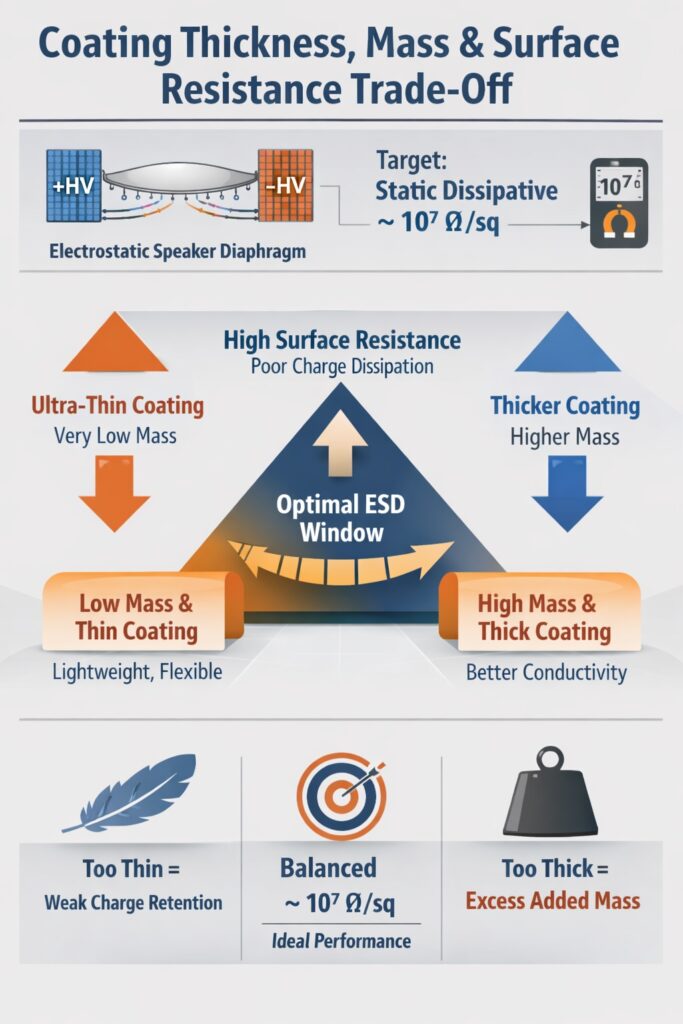
Infographic showing the relationship between coating thickness, added mass and static dissipative surface resistance for electrostatic speaker diaphragm coatings.

Engineering trade-off between coating thickness, mass and surface resistance when designing ultra-thin static dissipative coatings for electrostatic speaker diaphragms.

1) The Core Engineering Challenge

For electrostatic speaker use, the coating is not judged only by whether it is electrically active. It must also preserve the mechanical behaviour of the diaphragm. The practical challenge is therefore a balance between:

  • Achieving the required surface resistance
  • Keeping coating thickness and mass as low as possible
  • Maintaining flexibility during diaphragm movement
  • Ensuring uniform coverage without local overbuild

This means the best coating is not necessarily the lowest-resistance material overall. It is the coating that reaches the required electrical window with the least added weight.

2) Surface Resistance vs Coating Mass

A common issue with static dissipative coatings is that the target surface resistance may only be reached after multiple coats. Electrically this can be acceptable, but mechanically it may become unsuitable because each additional layer increases mass on the diaphragm.

For thin polymer films, even a small increase in coating mass can influence:

  • Sensitivity and output
  • Resonance behaviour
  • High-frequency response
  • Long-term consistency of diaphragm movement

In this type of application, coating build must therefore be treated as a critical engineering variable rather than just a process setting.

3) Why the Electrical Window Matters

In many electrostatic diaphragm applications, the goal is not a truly conductive surface. Instead, the surface usually needs to be within a controlled static dissipative range so charge can distribute across the diaphragm without discharging too rapidly. A target around 107 ohms per square is therefore better described as static dissipative rather than conductive.

This distinction matters because a coating that is too conductive may behave very differently from one that sits in the intended static dissipative window. The requirement is therefore controlled electrical behaviour, not simply maximum conductivity.

4) Substrate Considerations: Mylar and Similar Films

Polymer diaphragms such as Mylar (PET) are lightweight and dimensionally stable, but they are also sensitive to surface chemistry and handling. Any candidate coating system should be assessed for:

  • Adhesion to untreated or treated PET film
  • Risk of cracking or flaking during flexing
  • Solvent compatibility with very thin films
  • Potential for distortion, wrinkling or tension changes during application and drying

Because the base film is so light, process stress from solvent loading, drying conditions or poor wetting can become just as important as the surface resistance target itself.

5) Why Film Uniformity Matters

Uniform static dissipative performance across the diaphragm is essential. If the coating is uneven, the surface may charge inconsistently, leading to local performance variation. For this reason, the coating process must be capable of forming a controlled and repeatable film rather than simply depositing electrically active material.

Key process concerns include:

  • Localised heavy spots caused by over-application
  • Edge build-up or drying marks
  • Streaking from wipe or brush application
  • Inconsistent surface resistance caused by poor dispersion

In demanding applications, a very thin and well-controlled coating may outperform a heavier coating with lower nominal resistance simply because it is more uniform and mechanically stable.

6) Application Method Selection

The choice of application method can strongly affect final performance. Depending on the coating chemistry and the size of the diaphragm, possible routes may include:

  • Fine spray application for low-build controlled deposition
  • Wipe application where extremely low add-on is required
  • Dip processes where geometry and handling allow
  • Specialist deposition approaches for ultra-thin functional layers

The correct process depends not only on the coating but also on how tightly film thickness, mass and uniformity must be controlled. In many cases, the coating chemistry and the application method have to be developed together.

7) Practical Evaluation Strategy

For applications like electrostatic diaphragms, the most reliable approach is usually a structured sample trial. Rather than judging a material on a datasheet alone, engineering evaluation should consider:

  • Achievable film thickness in real application conditions
  • Surface resistance at that thickness
  • Added mass per coated area
  • Adhesion and flexibility after curing or drying
  • Visual uniformity across the active diaphragm area

This allows the selection process to remain focused on functional performance rather than nominal electrical behaviour alone.

For broader inspection and measurement considerations see our Inspection & Quality Hub.

Where extremely thin coatings are used, careful handling and controlled removal may occasionally be required during evaluation or development trials. For broader considerations around coating removal and rework processes, see our Removal & Rework Hub.

8) The Key Insight

The real problem in electrostatic speaker diaphragm coating is rarely conductivity by itself. The true challenge is achieving the required static dissipative surface resistance at the lowest possible coating mass. That is why a coating that appears electrically suitable on paper may still fail in practice if it only reaches the target after too much film build.

Any successful solution must therefore combine controlled static dissipative performance, ultra-low add-on, substrate compatibility and a highly repeatable application process.

Practical Next Step

Discuss your application

If you are assessing ultra-thin static dissipative coatings for thin polymer films or electrostatic components, SCH can support early-stage evaluation around film build, surface resistance and process feasibility.

Discuss with SCH

Related Resources

FAQs

Why do static dissipative coatings affect electrostatic speaker performance?

Because the diaphragm is extremely light, added coating mass can change its mechanical behaviour. A coating may be electrically suitable but still reduce performance if too much film build is required.

Is 107 ohms per square a conductive coating?

Not normally. A surface resistance around 107 ohms per square is generally described as static dissipative rather than conductive. In electrostatic diaphragm applications, this controlled dissipative range is often the intended target.

Can a very thin coating still provide useful static dissipative performance?

Potentially yes, but it depends on the coating chemistry, dispersion quality and application method. The key question is whether the target surface resistance can be reached at minimal film thickness.

Parylene Coating for Stent Frames & Fine Metal Structures


Introduction

Fine-feature metal structures such as stent frames and other micro-machined components present unique challenges in conformal coating. While Parylene deposition is inherently conformal, the real engineering work is usually in preparation discipline, repeatable presentation and fixturing, thickness control and inspection strategy.

This technical insight outlines practical considerations when coating small metal lattice or tubular structures, without assuming a regulated end-use and without relying on application-specific claims.

Infographic: Key Engineering Considerations

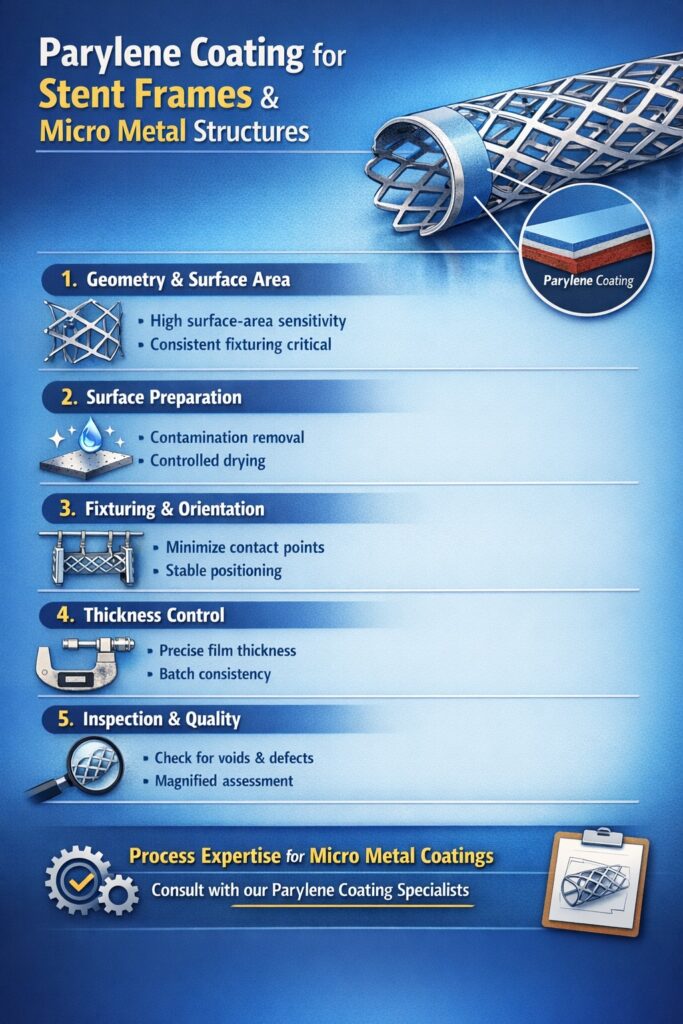
Infographic showing engineering considerations for Parylene coating of stent frames and fine metal structures including surface preparation, fixturing, thickness control and inspection.

Engineering considerations when applying ultra-thin Parylene coatings to fine-feature metal components.

This infographic summarises the key engineering controls required when applying Parylene to micro-structured metal components, including geometry sensitivity, surface preparation discipline and inspection methodology.

1) Geometry and Surface-Area Effects

Micro-structured components typically have a very high surface-area-to-mass ratio. This influences deposition consistency and the sensitivity of results to small variations in handling and contamination. Key considerations include:

  • Stability of deposition rate across very small loads
  • Local thickness variation across tight lattice features
  • Handling sensitivity during loading and unloading
  • Batch repeatability driven by spacing and presentation

Although Parylene polymerises conformally, orientation and spacing still influence consistency across a batch. Repeatable fixturing is therefore critical.

2) Surface Preparation of Metal Substrates

For metals commonly used in precision components, such as stainless steel, aluminium alloys, cobalt chrome or shape-memory alloys including nitinol, coating reliability is strongly linked to surface condition. Typical process controls include:

  • Removal of machining oils, polishing compounds and handling residues
  • Controlled drying to reduce moisture carryover
  • Particulate control following any abrasive or finishing step
  • Consistent adhesion promotion where required

Because ultra-thin polymer films are unforgiving, minor surface contamination or moisture carryover can significantly affect adhesion and long-term performance. The most reliable results come from disciplined handling, documented preparation steps and prevention of re-contamination between stages.

3) Fixturing and Orientation

How a component is supported inside the deposition chamber directly impacts contact marks, shadowing risk and run-to-run reproducibility. Effective fixturing aims to:

  • Minimise contact points and avoid critical functional areas
  • Maintain consistent spacing between parts
  • Prevent movement during pump-down and deposition
  • Enable repeatable loading practices for process control

For small tubular or lattice components, suspended or end-supported configurations are often preferred to reduce contact artefacts and ensure uniform exposure of complex geometry.

4) Thickness Selection and Control

Film thickness should be selected based on the required function, such as barrier performance, flexibility and dimensional tolerance. Achieving consistent thickness on micro parts relies on disciplined control of:

  • Material loading calculations
  • Chamber stability and repeatable batch configuration
  • Verification using witness coupons and documented inspection checks

For more detailed guidance on thickness considerations, see our article: Parylene Thickness & Environmental Protection: How Much Is Enough?

5) Inspection and Quality Checks

Inspection of fine metal components typically involves magnified visual assessment for:

  • Coverage continuity
  • Pinhole or void indications
  • Foreign inclusions or particulates
  • Handling damage or contact marking

Where coating removal or selective rework is required on precision components, a controlled approach is essential. For broader rework considerations, see our Removal & Rework Hub.

Practical Next Step

Discuss your application

If you are evaluating Parylene for fine-feature metal parts and would like a process-focused discussion around geometry, fixturing and thickness targets, our engineering team can assist.

Parylene Coating Services

Related Resources

FAQs

Is Parylene suitable for very small metal lattice structures?

Yes. Parylene deposition is conformal and capable of coating fine features uniformly. However, surface preparation, contamination control and repeatable fixturing play a critical role in achieving consistent results.

Does part orientation matter during Parylene deposition?

Yes. While Parylene is not line-of-sight limited, orientation and spacing influence repeatability and reduce the risk of contact artefacts or localised non-uniformity across a batch.

What metals can be coated with Parylene?

Parylene is commonly applied to a range of metals used in precision engineering, including stainless steels, aluminium alloys, nickel-containing alloys and shape-memory alloys such as nitinol. Final performance depends on preparation discipline and intended service environment.

Anti-Static Fan Coating: What Actually Works on Rotating Plastic Blades?


Industrial fans used in electronics, hazardous areas and process environments are sometimes specified as β€œanti-static” or β€œESD safe.” In practice, achieving stable static control on a rotating component is more complex than simply applying a dissipative ESD coating system.

Why Static Control on Fans Is Different

Unlike flat panels or housings, fans are continuously rotating, exposed to airflow abrasion and dust loading, and mechanically stressed at blade roots. Any anti-static fan coating must maintain electrical performance under dynamic conditions β€” not just pass an initial surface resistivity test.

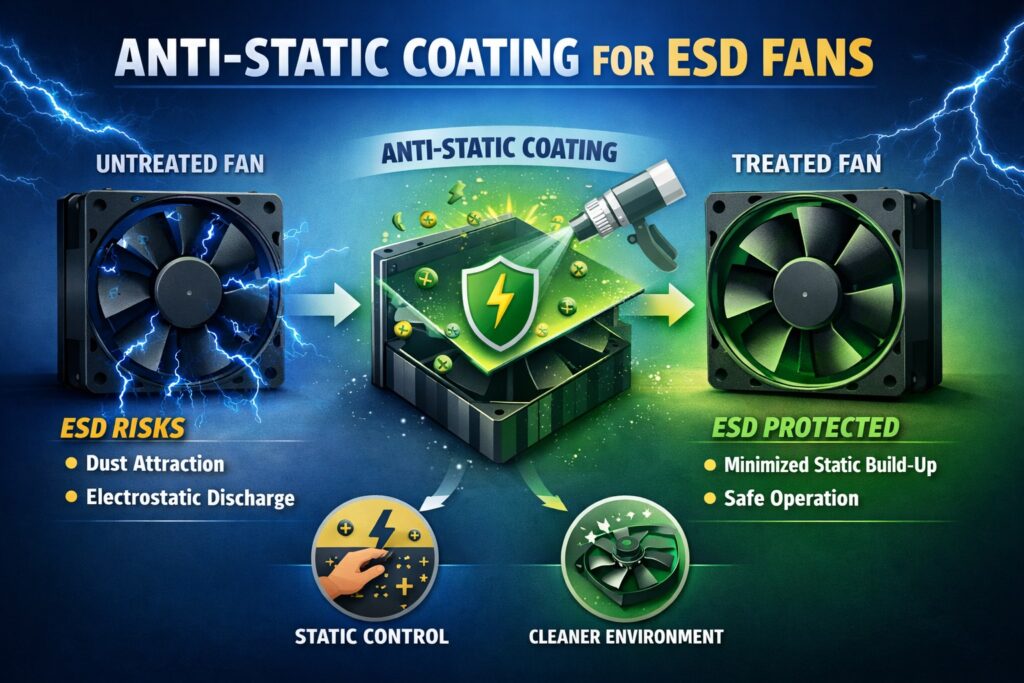
This infographic summarises the key engineering risks when specifying anti-static fan coating for rotating equipment.

Anti-static fan coating infographic showing ESD coating durability, adhesion and surface resistivity stability on rotating plastic fan blades

Infographic summarising the engineering challenges of applying anti-static (ESD) coating to rotating plastic fan blades, including adhesion, abrasion resistance and grounding continuity.

What β€œAnti-Static” Actually Means

In engineering terms, anti-static usually refers to a surface resistivity in the dissipative range (commonly 10⁢–10⁹ Ξ©/sq, depending on application and standard). On rotating components, three additional factors often determine whether it actually works in service:

  • Electrical continuity to ground (a coating alone is not a grounding strategy)
  • Stability of resistivity under wear (erosion changes performance)
  • Environmental durability (humidity, temperature, airborne contamination)

Without a reliable ground path, even a well-applied dissipative coating may not control charge effectively.

Common Failure Modes on Coated Fans

In practice, issues typically fall into one (or more) of these categories:

  • Resistivity drift – electrical performance changes over time.
  • Edge wear – coating erodes at blade tips due to airflow abrasion.
  • Adhesion loss – coating lifts from low surface energy plastics or contaminated surfaces.
  • Inconsistent coverage – uneven film build affecting balance and durability.

For background on surface-energy and contamination-driven mechanisms, see the Conformal Coating Defects Hub and the specific defect pages for de-wetting and poor adhesion on plastics / connector bodies.

Material Selection Considerations

When coating fan blades, the substrate type is critical. Low surface energy polymers (e.g., PP/PE) present adhesion challenges similar to those discussed in our Insight on ESD coating on silicone keyboards (different polymer, similar β€œlow surface energy” reality).

Where coating is feasible, success typically depends on controlled surface preparation and verification, for example:

  • Surface activation (plasma or corona) where appropriate
  • Controlled film thickness and repeatable application method (see the Processes Hub)
  • Verification of balance and vibration post-application
  • Surface resistivity measurement and acceptance criteria (see the Inspection & Quality Hub)
  • Electrical continuity / grounding validation in the assembled product

Mechanical Balance Matters

Coating thickness must be tightly controlled. Even small asymmetries can alter rotational balance, increase bearing load, and shorten service life. This is often overlooked during prototyping.

Engineering Insight: Define β€œWorking” Early

When a project is β€œprogressing well,” it is worth clarifying what has actually been proven:

  • Has surface resistivity been measured after environmental exposure?
  • Has performance been tested at operational RPM and duty cycle?
  • Has grounding continuity been verified in the final assembly?
  • Has wear been assessed after extended runtime?

Static control on moving components must be validated under real operating conditions β€” not just laboratory conditions.

If you are evaluating anti-static coating on rotating components, we can advise on structured validation routes and realistic performance criteria based on the end-use requirements.


Related Insights:

Can ESD Coatings Adhere to Silicone Keyboards?


Silicone components (keypads, seals, flexible housings) are common in industrial and hazardous-area products, but silicone is one of the most challenging substrates to coat reliably. If you are considering an ESD (dissipative) coating system on a silicone keyboard, it is important to understand the adhesion risks and what is realistically achievable. Short answer: Silicone can be coated, but adhesion is not guaranteed without surface activation and structured validation testing.

Why Silicone Is Difficult to Coat

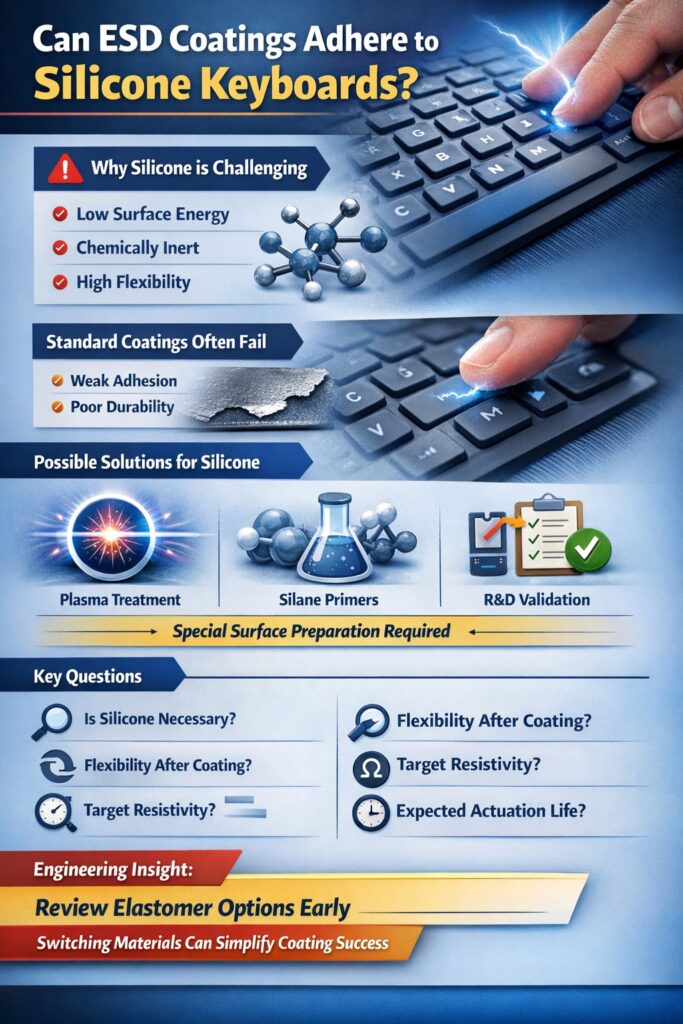
ESD coating adhesion on silicone keyboard infographic showing surface energy challenges, plasma treatment and silicone primer solutions

Infographic explaining why silicone keyboards are difficult to coat with ESD coatings and the surface preparation methods typically required for reliable adhesion.

Silicone elastomers have very low surface energy, making ESD coating adhesion to silicone particularly difficult without specialist preparation. In practice, this means most coatings will not bond well to untreated silicone, and common β€œplastic primers” designed for PP/PVC/ABS generally do not work on silicone.

For deeper background on adhesion failure mechanisms (including low surface energy and contamination-driven pull-back), see:

Related Insight (real-world case): De-wetting seen after cleaning (when β€˜clean’ isn’t clean enough).

Can ProShieldESD Adhere to Silicone?

With our current ProShieldESD material range, adhesion to silicone cannot be guaranteed. If silicone is mandatory, the project should be treated as an R&D / validation exercise rather than a standard production supply.

What Usually Makes Silicone Coating Possible

Where coating on silicone is required, reliable adhesion typically depends on specialist surface preparation and validation testing. Common technical routes include:

  • Plasma surface activation (often the most effective route)
  • Corona treatment
  • Specialist silicone adhesion promoters (e.g., silane-based systems designed for silicone elastomers)

Even with surface activation, durability must be proven under real use conditions.

Flexibility and Durability Matter for Keyboards

Silicone keyboards are designed to flex repeatedly. Any coating system must be evaluated for flex-cracking, wear, and stability of electrical performance over the expected actuation life. (For a coating durability analogue in electronics, see Cracking (Defects Hub) and the related Insight below.)

Engineering Insight: Challenge the Substrate Choice Early

Before investing time in coating trials, it is worth asking a simple but high-impact question: does the component have to be silicone, or could an alternative elastomer be used? In many applications, selecting a more β€œcoatable” substrate can reduce risk, simplify processing, and improve long-term reliability.

If you are assessing a silicone keyboard for ESD performance, we can advise on practical trial routes and realistic success criteria based on the end-use requirements.


Related Insights:

Restoring ESD Performance on PVC Conveyor Belts – Without Replacement


A manufacturing customer operating an electronics assembly line identified that their PVC conveyor belt surface had drifted out of ESD compliance over time.

Measured surface resistivity had increased to:

>109 Ξ©/sq

At this level, the belt was behaving as an insulator rather than a static dissipative surface β€” introducing electrostatic risk in a controlled production environment.

Full belt replacement was possible, but would have involved production downtime, mechanical removal, and significant cost. SCH proposed an alternative: on-site restoration using a flexible ProShieldESD coating platform.

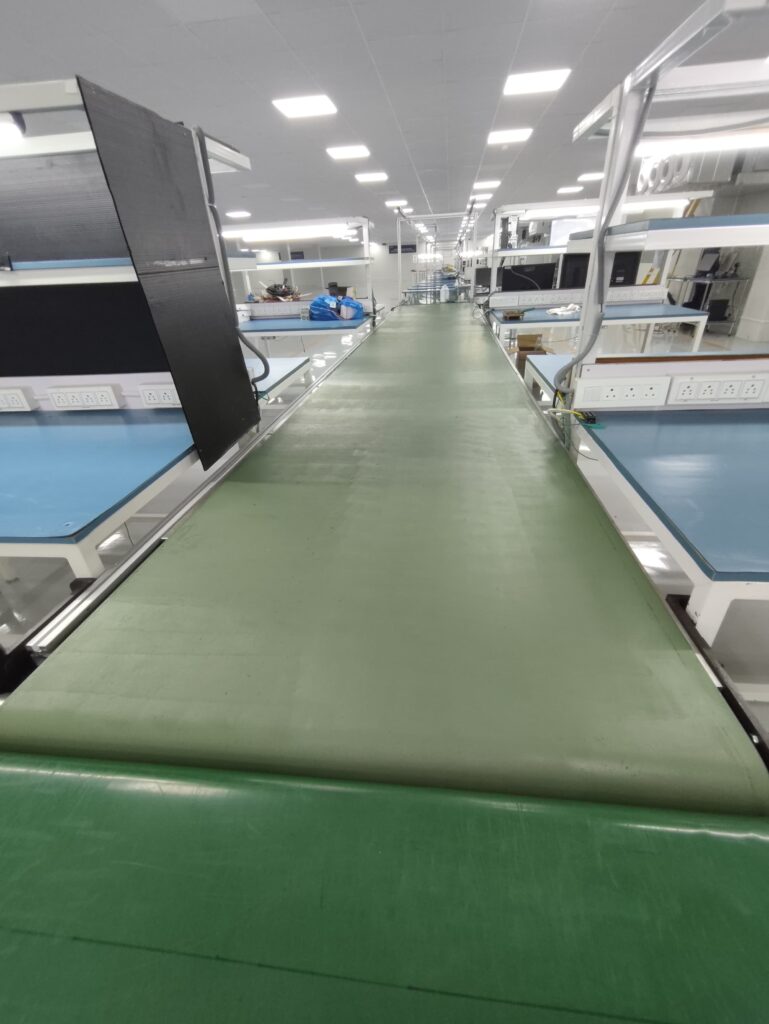
Before and after comparison of PVC conveyor belt restored using flexible ProShieldESD conductive coating in electronics assembly line

Original PVC conveyor belt (left foreground) compared with newly applied flexible conductive coating (right), restoring surface resistivity from >109 Ξ©/sq to 106–107 Ξ©/sq without belt removal.

Substrate & Conditions

  • Substrate: Flexible PVC conveyor belt
  • Environment: Active assembly line
  • Requirement: Maintain flexibility and mechanical durability
  • Application constraint: No belt removal

Technical Solution

A new two-part flexible conductive coating variant (within the ProShieldESD platform) was applied directly to the belt surface. Application was carried out via our ProShieldESD subcontract coating services, enabling in-situ refurbishment without mechanical disruption.

Application Method

  • Surface cleaned with mild solvent
  • No primer required
  • Roller-applied in situ
  • Belt remained installed
  • Functional resistivity confirmed within 2–3 hours

Performance Outcome

Post-application surface resistivity:

106 – 107 Ξ©/sq

This returned the surface into the static dissipative range, suitable for electronics assembly environments. For more detail on conductive polymer behaviour and how ProShieldESD differs from conventional ESD paints, see the ProShieldESD FAQs.

Additional Technical Advantages

  • Fully flexible after cure
  • Mechanically durable
  • Localised repair possible (scratch-visible indicator)
  • No complex tooling required

Engineering Value

This approach demonstrates a practical refurbishment model for flexible plastic ESD surfaces where:

  • Conductive fillers in the original belt degrade over time
  • Cleaning cycles reduce surface performance
  • Capital replacement costs are disproportionate

Instead of replacing mechanical infrastructure, the ESD performance layer can be reinstated as a coating system.

Conclusion

This field beta installation confirms that flexible PVC conveyor systems can be restored to static dissipative performance without removal or downtime-heavy replacement.

For facilities managing ageing ESD flooring, mats or conveyor systems, this represents a significant process and cost advantage.

Cracked Conformal Coating After Thermal Cycling β€” A Process Reality Check


Cracking of conformal coating is most often discovered not during initial inspection, but after thermal cycling, environmental testing, or extended service exposure.

In field investigations, cracking is rarely caused by a single factor. Instead, it is usually the result of combined stresses, such as excessive coating thickness, rigid material selection, and differential thermal expansion between the coating and substrate.

We commonly see cracking:

  • Over sharp component edges or solder fillets
  • Where coating thickness exceeds recommended limits
  • On assemblies exposed to wide thermal excursions

Importantly, coatings that appear compliant and defect-free at room temperature may still fail under thermal stress if thickness and material flexibility are not properly controlled.

Cracked conformal coating on PCB after thermal cycling showing fractures around solder joints, component edges and high stress regions

Cracking of conformal coating after thermal cycling, typically occurring at stress points such as solder joints, sharp edges and areas of excessive coating thickness.

In practice, cracking risk is also closely tied to how the coating is applied and cured. Poor control of film build, flash-off and cure conditions can increase internal stress and make later failure more likely. For broader process guidance, see Conformal Coating Curing & Drying.

A deeper technical breakdown of cracking mechanisms and prevention is available in our Defects Hub article on cracking in conformal coating.

De-Wetting Seen After Cleaning β€” When β€œClean” Isn’t Clean Enough


A common inspection finding is localised de-wetting of conformal coating, particularly on solder joints or around component leads, even when a cleaning process has been applied beforehand.

In many cases, the boards are genuinely clean in a visual sense. However, de-wetting is often caused by residues that are invisible to the naked eye β€” including low-level ionic contamination, surfactant residues from aqueous cleaning, or incompatible cleaning chemistries.

Typical characteristics include:

  • Circular pull-back around solder joints
  • Patchy coating coverage on ENIG or HASL finishes
  • Repeatable locations across multiple assemblies

Crucially, operators may notice the effect during coating but assume it is cosmetic. In reality, de-wetting is a strong indicator of a surface energy problem and should always trigger escalation and investigation rather than acceptance.

Detailed causes, acceptance criteria, and corrective actions are covered in our Defects Hub guidance on de-wetting in conformal coating.

Why Conformal Coating Wicks Along Wire Strands β€” A Field Observation


During inspection of coated assemblies, we occasionally observe conformal coating creeping along exposed wire strands well beyond the intended coated area. This is often flagged as β€œover-application”, but in practice the root cause is usually more subtle.

In this scenario, the coating is not flowing excessively during application. Instead, capillary forces draw low-viscosity material along fine wire strands, braid structures, or conductor interfaces after deposition. This effect is amplified where flux residues, incomplete cleaning, or high surface energy materials are present.

We most often see this behaviour:

  • At wire terminations and soldered pigtails
  • Where insulation stripping exposes fine conductor bundles
  • When low-viscosity acrylics or urethanes are used without sufficient flash-off

From a process perspective, this is not something that can be β€œsprayed out”. Masking strategy, cleanliness, and controlled flash times are far more influential than spray parameters alone.

For definitive technical guidance on this phenomenon, see our Defects Hub page on capillary wicking in conformal coating.

Rework in Conformal Coating and Parylene: Why Removal Method Matters More Than Most Teams Realise


What coating services experience teaches about speed, control and damage risk in real PCB rework

Rework is not just unavoidable β€” it is one of the biggest hidden cost drivers in conformal coating and Parylene processing.

In practice, the method used for rework often determines whether a defect is corrected in seconds or becomes a multi-step process involving stripping, cleaning, drying and re-inspection.

Across both liquid conformal coating services and Parylene services, the same pattern appears repeatedly: the real limitation is rarely whether the coating can be removed. The real limitation is how controlled, repeatable and localised the removal method is.

This matters because rework is where many otherwise stable coating processes lose time, create board damage, or introduce new variability. For a broader overview of removal options, see our guide to conformal coating removal methods.

Quick take. The biggest rework problem is not whether removal is possible. It is whether the removal method gives consistent control without damaging pads, solder mask, plated surfaces or adjacent components. That is why micro-abrasive removal has become so important in both conformal coating and Parylene rework.

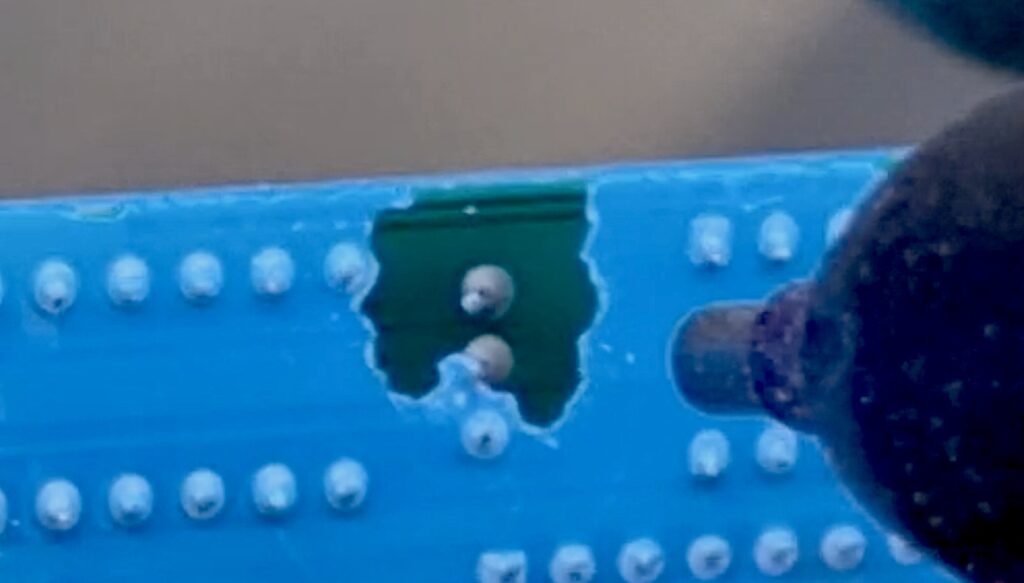
Micro-abrasive removal of conformal coating from PCB showing precise localised stripping without damaging solder mask or components

Precision removal of conformal coating using micro-abrasive blasting, demonstrating clean exposure of the PCB without substrate damage or chemical processing.

What we see in real production

Across coating services, rework typically falls into two broad categories:

  • Liquid coatings such as acrylic, polyurethane and silicone β€” often removable, but time is lost in softening, cleaning, rinsing, drying and local touch-up.
  • Parylene β€” chemically resistant and extremely thin, which makes traditional removal slow, inconsistent and highly operator-dependent when done manually.

In both cases, rework can be triggered by missed masking, exposed keep-out areas, engineering changes, inspection findings, soldering access requirements or local repair work. The problem is not unusual. It is routine.

The engineering challenge is therefore not β€œhow do we avoid rework completely?” but β€œhow do we make rework fast, localised, safe and repeatable?”

Why traditional rework methods slow the process down

In practice, most liquid conformal coating rework is carried out using chemical stripping, while Parylene removal often falls back to manual methods due to its chemical resistance. Both approaches can work, but they introduce limitations in control, consistency and process time.

Wet chemical stripping (liquid coatings)

  • Primary method for acrylics and polyurethanes using local or full stripping processes
  • Requires dwell time for softening, followed by cleaning and rinse stages
  • Introduces risk of under-component ingress if not tightly controlled
  • Can affect labels, plastics, adhesives and connector materials
  • Adds process steps (strip β†’ clean β†’ dry β†’ inspect) which increase cycle time

Manual removal (primarily Parylene and localised cases)

  • Parylene is highly resistant to chemical stripping, so manual removal is often used
  • Knives and fibre pens tend to drag rather than create clean exposure areas
  • High risk of damaging pads, plating or solder mask
  • Strong operator dependency and poor repeatability
  • Time increases rapidly on fine-pitch or dense assemblies

Local scraping on liquid coatings (limited use cases)

  • Sometimes used for small local repairs or silicone coatings where stripping is less practical
  • Generally avoided for production rework due to damage risk and inconsistency

Across all methods, removal is usually achievable β€” but control, repeatability and process efficiency are often the real limitations.

Practical warning sign. If rework time varies dramatically between operators, boards or shifts, the issue is often not the coating chemistry itself. It is the removal method and how much operator judgement it depends on.

Why micro-abrasive blasting changes the equation

Micro-abrasive blasting addresses a specific bottleneck that appears across both liquid and Parylene rework: controlled, localised removal without chemical soak, blade pressure or thermal stress.

Using systems such as the Vaniman ProBlast 3 ESD, operators can expose solder joints, connector edges, test points and local repair areas by eroding the coating layer rather than softening it chemically or cutting it mechanically.

This matters because the rework step becomes much closer to a controlled process than an operator-dependent workaround.

For structured guidance on where micro-abrasion sits alongside chemical and manual methods, see the Removal & Rework Hub.

What the Vaniman ProBlast actually does well

The ProBlast is not an industrial sandblaster. It is a controlled micro-abrasion system intended for delicate removal work on electronics. In practice, its value comes from a few specific advantages:

  • Foot-pedal control for consistent on/off blasting
  • Adjustable pressure and media flow for local process tuning
  • Dry removal with integrated debris extraction
  • No heat and no solvent exposure
  • Applicability across both liquid coatings and Parylene removal workflows

The key point is not that it removes coatings. It is that it can remove them locally, quickly and with much better repeatability than manual scraping or wet stripping in many rework situations.

Why rework fails in practice

The biggest rework issue is not removal. It is control.

  • Over-removal damages solder mask or pads
  • Under-removal leaves contamination or poor surfaces for re-coating
  • Wet methods introduce ingress, drying and residue risks
  • Manual methods create strong operator-to-operator variation
  • Slow rework encourages β€œgood enough” decision-making under production pressure

This is why rework often becomes one of the least stable parts of the coating process. It sits outside the main recipe but still has a major effect on yield, labour cost and downstream reliability.

For a wider process view of how repeatability is lost in coating operations, see Why Conformal Coating Processes Fail.

ProBlast vs wet stripping vs scraping

Feature ProBlast Chemical Stripping Manual Scraping
Works on Parylene? Yes Usually no / limited Yes, but slow
Time per rework Fast Medium to slow Slow
Risk of board damage Low when controlled properly Medium High
Cleanliness Dry, extracted Wet, requires post-cleaning Debris and fibres possible
Operator dependence Lower Medium High
Safety burden No solvents Chemical handling and waste Blade injury / debris risk

Where the time saving actually comes from

When people say micro-abrasive blasting can cut rework time by up to 50%, the value is not just in faster coating removal. The time saving usually comes from eliminating secondary steps:

  • No soak time waiting for chemical softening
  • No rinse and dry stage after local stripping
  • Less manual cutting and local board handling
  • Cleaner transition into re-soldering, repair or inspection

In other words, the gain is process simplification, not just media speed.

What This Means in Practice

Rework is no longer a side issue in coating operations. It is part of the real process architecture. The removal method chosen will strongly influence labour time, operator consistency, local damage risk and the quality of the recovered surface.

For liquid coatings, this often means deciding when wet stripping is still justified and when dry local removal is the better route. For Parylene, it often means recognising that manual scraping may be technically possible but operationally poor.

This is how modern coating operations move from β€œrework as a workaround” to rework as a controlled process step.

Where this fits in the wider coating system

Rework links directly to masking quality, inspection effectiveness, local defect interpretation and removal method selection. That is why it should not be treated as an isolated repair function.

In practice, teams get better results when rework is planned as part of the coating process rather than left to operator improvisation after defects are found.

For the wider technical structure around removal, local stripping and process selection, use the Removal & Rework Hub.

Why Choose SCH Services?

SCH works across both liquid conformal coating and Parylene processing, so our view of rework is based on real production behaviour rather than theory alone. We support customers with coating removal strategy, process review, micro-abrasive removal systems, training and practical rework support.

  • πŸ› οΈ Removal method selection – choosing the right route for liquid coatings, Parylene and local repair tasks.
  • πŸŽ“ Training and process support – helping operators make rework more repeatable and less damaging.
  • πŸ”§ Equipment and service support – including Vaniman ProBlast systems and practical coating removal guidance.

πŸ“ž Call: +44 (0)1226 249019 | βœ‰ Email: sales@schservices.com | πŸ’¬ Contact Us β€Ί

↑ Back to top

Note: This insight provides general technical guidance only. Final removal method, process controls, board-level risk and validation decisions must be confirmed against the coating type, component sensitivity, customer specification and applicable standards.

0
  • Your current order total is £0.00 β€” you must have an order with a minimum of £75.00 to place your order.
0
Your Cart
Your cart is empty
  • Your current order total is £0.00 β€” you must have an order with a minimum of £75.00 to place your order.
Calculate Shipping
  • Your current order total is £0.00 β€” you must have an order with a minimum of £75.00 to place your order.

Conformal Coating UK

Technical banner showing PCB and process icons representing conformal coating, masking, inspection and training on the SCH technical knowledge hub.
Conformal Coating UK
Privacy Overview

This website uses cookies so that we can provide you with the best user experience possible. Cookie information is stored in your browser and performs functions such as recognising you when you return to our website and helping our team to understand which sections of the website you find most interesting and useful.