Mon - Thur 7.30-15.30   Fri 7.30-14.00

Conformal Coating Consultation


Troubleshooting, Optimisation & Benchmarking

SCH Services Ltd provides world-class conformal coating consultancy for liquid, nano, and Parylene coating processes. From material selection and new product introduction (NPI) to troubleshooting, optimisation, and full process benchmarking, we deliver practical, compliant, and cost-effective solutions tailored to your production environment.

With our expertise in consultancy on conformal coating solutions and over 25 years of global experience across aerospace, automotive, medical, defence, and industrial electronics, SCH is trusted worldwide to improve coating performance, strengthen compliance, and solve complex production challenges.

If you’re exploring wider support such as equipment, services, or training, visit our Conformal Coating Solutions or Inspection Training pages.

Conformal coating consultancy - inspection and troubleshooting

Our Conformal Coating Consultancy Services

Troubleshooting

Through our unique approach to conformal coating consultancy, we provide rapid support for defects such as adhesion failure, bubbles, contamination, or curing problems. Consultation through SCH aligns with IPC-A-610, IPC-CC-830, and ISO 9001.

For typical defect types, see our Conformal Coating Defects Hub.

Process Optimisation

We increase yield, repeatability, and throughput using process tuning, equipment calibration, and material compatibility checks as part of our expert consultancy services in conformal coating industries.

If you’re installing or upgrading systems, view our Support Equipment.

Benchmarking

Benchmarking against IPC, ISO 9001 and global best-practices highlights improvement potential. Tailored consultancy for conformal coating can be paired with Inspection Training to ensure consistency.

New Product Introduction (NPI)

Seamlessly integrate conformal coating into new product launches. Assistance includes coating material selection, process qualification, and documentation. Consultation services ensure your product launch is supported comprehensively.

For full process support, visit Conformal Coating Solutions.

Support Packages

  • Ongoing troubleshooting (remote or onsite)
  • Regular optimisation and audits
  • Compliance validation and documentation
  • Expert advice on new materials or processes through our comprehensive consultancy service, including consultation for conformal coating adoption.

If outsourcing is preferred, see our Subcontract Coating Services.

Why Choose SCH Services?

Partnering with SCH Services means more than just outsourcing โ€” you gain a complete, integrated platform for
Conformal Coating, Parylene & ProShieldESD Solutions, alongside equipment, materials, and training, all backed by decades of hands-on expertise.

  • โœˆ๏ธ 25+ Years of Expertise โ€“ Specialists in coating technologies trusted by aerospace, medical, defence, automotive, and electronics industries worldwide.
  • ๐Ÿ› ๏ธ End-to-End Support โ€“ Guidance on coating selection, Parylene grades, masking strategies, application methods, inspection, and ProShieldESD integration, which also benefit from comprehensive consultancy in conformal coating.
  • ๐Ÿ“ˆ Scalable Solutions โ€“ From small prototype batches to full-scale, high-volume production, SCH delivers flexible capacity that grows with your needs.
  • ๐ŸŒ Global Reach โ€“ Responsive technical support and supply coverage across Europe, North America, and Asia.
  • โœ… Proven Reliability โ€“ A strong reputation built on quality, consistency, and customer satisfaction across services, equipment, and materials.

๐Ÿ“ž Call: +44 (0)1226 249019
โœ‰ Email: sales@schservices.com
๐Ÿ’ฌ Contact Us โ€บ

Why do so many conformal coating problems appear โ€œrandomโ€?


Why Conformal Coating Problems Often Appear Random โ€” And Why They Arenโ€™t

In most cases, they arenโ€™t random at all โ€” they are symptoms of a process that was never aligned from the start. Conformal coating only works reliably when PCB design, environmental demands, coating chemistry, application method and inspection strategy all work together as a unified system.

To help manufacturers establish stable, scalable and predictable coating processes, weโ€™ve published a fully updated guide:

๐Ÿ‘‰ย Holistic Conformal Coating Process โ€“ End-to-End Framework

Below is a high-level summary. For the full technical model, diagrams and linked resources, explore the article above.

1. It all begins with PCB design

Most coating challenges originate at the design stage โ€” long before production starts. Poor keep-outs, difficult orientations, insufficient drain paths or incompatible materials lead to:

  • excessive masking
  • rework and inspection delays
  • pooling, edge thinning and trapped solvent
  • long-term reliability risks

A design that supports coating reduces cost and improves first-pass yield.

Explore the Design for Conformal Coating Hub:

๐Ÿ‘‰ย Design Hub Articles

2. Chemistry must be matched to the real environment

No coating is universally suitable. Chemistry selection should be driven by environmental stress, including:

  • humidity and condensation
  • SOโ‚‚ย / Hโ‚‚S corrosion
  • fuels, oils, chemicals and solvents
  • UV exposure
  • thermal cycling and vibration
  • high-voltage creepage and clearance

Using the wrong chemistry often results in de-wetting, cracking, poor adhesion or long-term corrosion.

Explore:

๐Ÿ‘‰ย Parylene Coating Solutions

๐Ÿ‘‰ย ProShieldESD Conductive Polymer Platform

3. The application method must suit material, volume & geometry

Selective coating, manual spray, dip coating and Parylene each solve different process challenges. Selecting the wrong method leads to inconsistent thickness, material waste and increased labour.

Your method should reflect:

  • production volume
  • assembly density
  • design geometry
  • material selection
  • drainage capability
  • masking burden

See the Coating Process Hub Overview:

๐Ÿ‘‰ย Coating Processes Hub

4. Material & process control prevent drift

Even well-designed processes degrade over time if material conditions are not tightly managed.

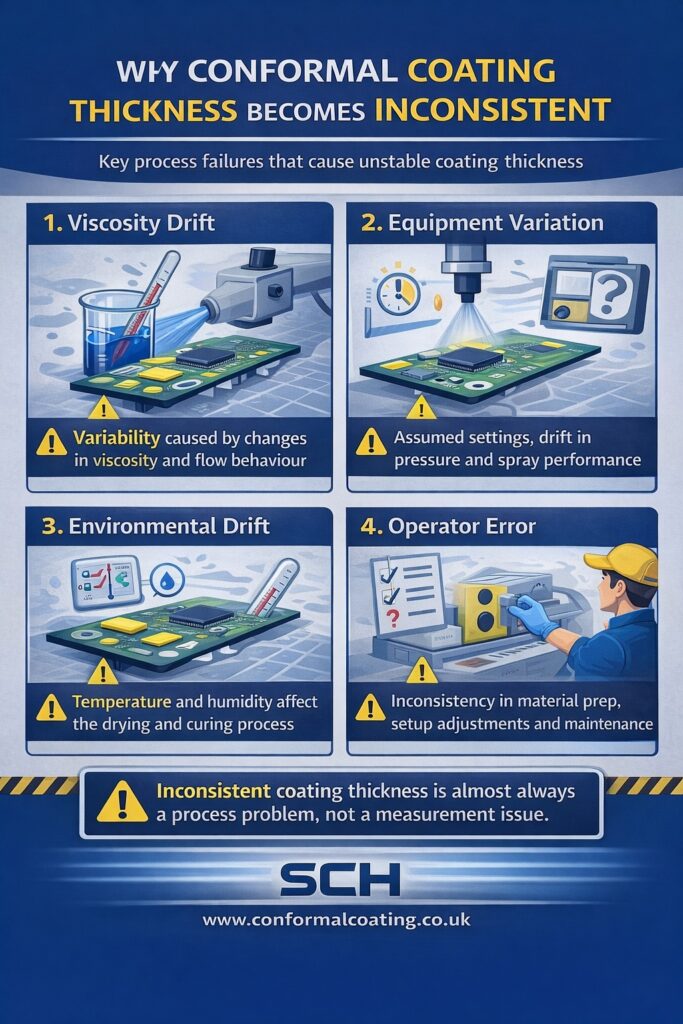
Small variations in:

  • viscosity
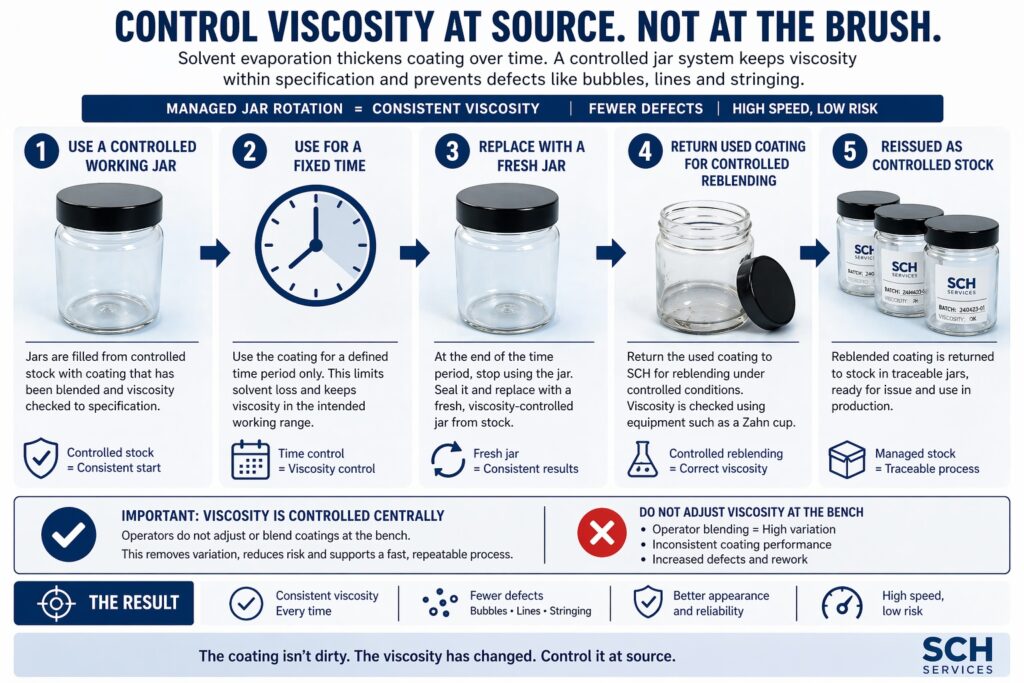
  • solvent balance
  • 2K mix ratio
  • temperature & humidity
  • flash-off or cure profile

โ€ฆcan create large deviations in coverage, edge definition, adhesion and repeatability.

Good material management is one of the strongest predictors of coating stability over time.

5. Inspection closes the loop

Inspection validates the process and ensures defects are caught before assemblies reach customers.

A robust inspection strategy should include:

  • UV contrast and coverage checks
  • thickness measurement (preferably with coupons)
  • adhesion and environmental tests
  • periodic functional/hi-pot checks

Explore the Inspection & Quality Hub:

๐Ÿ‘‰ย Inspection & Quality Articles

SCH-manufactured UV Inspection Booths:

๐Ÿ‘‰ย UV Inspection Booths

6. Continuous improvement keeps the process stable

Production changes, new PCB variants and supplier shifts all introduce risk. Without structured review, even a previously stable line can begin to drift.

SCHโ€™s consultancy team provides:

  • NPI validation & materials benchmarking
  • full process audits
  • defect pattern analysis
  • SPC review & control planning
  • design alignment and masking strategy optimisation

Explore:

๐Ÿ‘‰ย Conformal Coating Consultancy

7. When Parylene is the smarter choice

For certain assemblies, liquid coatings will never deliver the required performance. Parylene excels when:

  • geometries are complex
  • components are closely packed
  • surfaces are hidden, recessed or sharp-edged
  • moisture protection must be absolute
  • very high electrical resistance or stability is required
  • field reliability is mission-critical

Explore:

๐Ÿ‘‰ย Parylene Coating Services

๐Ÿ‘‰ย Parylene Deposition Systems

8. Why the holistic model matters

Failures rarely originate in the coating booth. They arise from misalignment of design, chemistry, application method or environment.

Symptoms include:

  • dewetting
  • fisheyes and pinholes
  • inconsistent thickness
  • chronic masking leakage
  • pooling and edge thinning
  • delamination and poor adhesion

These issues often appear random โ€” yet almost always stem from upstream decisions.

Explore the full Coating Defects Hub:

๐Ÿ‘‰ย Common Coating Defects

9. SCHโ€™s Total Solutions Approach

Whether you coat in-house or outsource, SCH provides full lifecycle support across both liquid coatings and Parylene.

โญย In-house coating support

โญย Outsourced coating services

Explore:

๐Ÿ‘‰ย Total Conformal Coating Solutions

๐Ÿ”ย Read the full technical framework

This blog provides a high-level summary only. For the complete methodology, diagrams, commercial considerations and cross-linked technical resources, view the full article:

๐Ÿ‘‰ย Holistic Conformal Coating Process โ€“ Full Guide

ProShieldESD โ€“ Productronica 2025 Technical Report


ProShieldESD โ€“ The Worldโ€™s First Universal, Fully Functional ESD Coating


ProShieldESD conductive polymer ESD coating logo

ProShieldESD is a filler-free conductive polymer ESD coating (often described as an โ€œESD paintโ€ due to its
ease of application) designed to deliver repeatable, standards-aligned static control across a wide range of substrates.
Unlike traditional ESD coatings that rely on carbon, metal fillers, graphite, or temporary surface additives, ProShieldESD forms a stable resistive network that bonds effectively to rigid, flexible, porous, and smooth materials.

In practical terms, ProShieldESD can convert everyday items into uniform ESD-dissipative surfaces suitable for
electronics manufacturing environments. Typical substrates include tiles, PP flute board, EVA foam, cartons, PVC mats, tools, bins, and even brush handles and bristlesโ€”without significantly changing the base materialโ€™s mechanical behaviour.

This makes ProShieldESD a single-platform approach for building controlled ESD-safe environments across floors, packaging, handling aids, trays, storage, accessories, and fixtures.
Explore ProShieldESD โ†—

Live ESD Testing at Productronica 2025, Munich

To demonstrate real-world performance under professional conditions, ProShieldESD was tested live at Productronica 2025 in Munich using the sparktrapยฎ EPA SafeAssureยฎ (Keinath Electronic GmbH, Germany) โ€” a dedicated ESD multimeter designed for accurate, standards-oriented measurement.

Measurement capability highlights:

  • Flat weight probe for surface resistance
  • Concentric ring probe for surface resistivity
  • Precision 2-point probe for small objects
  • Integrated temperature, humidity & voltage monitoring
  • High-stability 100 V measurement mode
  • IEC 61340 & ANSI/ESD S20.20 conformity

Environmental conditions during testing:

  • Temperature: 22โ€“23 ยฐC
  • Humidity: 53โ€“55% RH
  • Test voltage: 100 V

Measurement Results โ€“ sparktrapยฎ EPA SafeAssureยฎ

Material Avg Resistance Scientific Notation Assessment Technical Note
Flooring (Tile + ProShieldESD) 1.501 Mฮฉ 1.5 ร— 10โถ ฮฉ Excellent Within a strong ESD floor range for controlled discharge.
PP Flute Board 4.778 Mฮฉ 4.8 ร— 10โถ ฮฉ Very Good Stable dissipative range suitable for packaging/handling.
Carton Box (Coated) 741.9 Mฮฉ 7.4 ร— 10โธ ฮฉ Very Good Higher dissipative value; useful for packaging applications.
EVA Foam 65.35 Mฮฉ 6.5 ร— 10โท ฮฉ Very Good Consistent dissipative behaviour for protective inserts.
PVC Mat 964.3 kฮฉ 9.6 ร— 10โต ฮฉ Excellent Classic ESD mat range around 10โถ ฮฉ.
ESD Linbin 1.699 Mฮฉ 1.7 ร— 10โถ ฮฉ Very Good Suitable range for ESD-safe component storage.
Plastic Carry Case 1.644 Mฮฉ 1.6 ร— 10โถ ฮฉ Excellent Uniform dissipation; good target range for handling aids.
ESD Brush โ€“ Handle 3.009 Mฮฉ 3.0 ร— 10โถ ฮฉ Excellent Provides a safe discharge path during tool use.
ESD Brush โ€“ Bristles 317.0 kฮฉ 3.1 ร— 10โต ฮฉ Excellent Lower resistance beneficial for contact discharge behaviour.
ESD Pen 2.113 Mฮฉ 2.1 ร— 10โถ ฮฉ Excellent Helps prevent charge accumulation during handling.
Metal Surface 88.19 kฮฉ 8.8 ร— 10โด ฮฉ Conductive Expected conductive reference surface.

Conclusion & Acknowledgement

The Productronica 2025 demonstration highlighted two practical advances for ESD control:

  • ProShieldESD โ€” a universal, filler-free conductive polymer ESD coating that enables repeatable static-control performance across diverse substrates.
  • sparktrapยฎ EPA SafeAssureยฎ โ€” a purpose-built ESD multimeter supporting more consistent, standards-oriented evaluation.

Together, these innovations show how manufacturers can extend ESD control beyond benches and matsโ€”into floors, packaging, tools, storage, and handling systemsโ€”using an engineered coating approach.

SCH Coating Solutions thanks Keinath Electronic GmbH for their collaborative support at Productronica 2025 and for
providing the sparktrapยฎ EPA SafeAssureยฎ instrument during the live demonstrations.

Want to discuss your substrates, targets, and validation approach?
Contact SCH โ†’

Inline Dip Coating โ€“ The New Era of Conformal Coating Automation


Conformal Coating Automation & Industry 4.0

For many years, conformal coating was seen as a labour-intensive, operator-driven process. Whether spraying PCBs by hand or manually dipping assemblies, consistency depended heavily on individual technique. But the industry has shifted. Manufacturers now expectย repeatability, digital traceability and real-time process controlโ€”and automation is becoming central to achieving these goals.

At SCH, we are seeing rapid adoption ofย inline dip systems,ย robotic spray coating,ย vision inspection, andย SPC-driven quality controlย across aerospace, EV, defence, industrial and IoT electronics. Together, these tools define what a modern, Industry-4.0-ready coating line looks like.

In this article, we explore how these technologies are changing the landscape and how manufacturers can begin implementing them.

Why Automation Is Now Essential

Automation delivers immediate, measurable improvements:

  • Consistent film buildย through controlled spray passes and dip parameters
  • Lower reworkย thanks to early wet-film inspection
  • Traceable processingย with logged recipes and parameters
  • Predictable throughputย with reduced labour dependency
  • Proactive qualityย powered by SPC trend analysis

When combined with smart handling, curing and inspection methods, coating lines become stable, predictable and audit-ready.

Inline Dip Coating โ€“ Stability Through Digital Control

Dip coating has always provided excellent coverage, butย manual dipping introduces huge variabilityโ€”insertion speed, dip depth, dwell time, withdrawal angle, drain orientation, and more.

Aย conveyorised inline dip systemย solves the problem by controlling:

  • Dwell time in the coating tank
  • Withdrawal and drain profile
  • Immersion speed and depth
  • Drain time and fixed board orientation

These parameters are digitally locked, repeatable, and traceableโ€”allowing dip coating to sit neatly within a fully automated line.

To learn more about coating methods, see:

๐Ÿ‘‰ย Conformal Coating Processes Hub


Robotic Spray Coating โ€“ Precision Without Operator Drift

Where dipping isnโ€™t suitable,ย robotic spray controlย offers accuracy and repeatability far beyond any manual process.

Modern systems include:

  • Vision alignment
  • Dynamic speed adjustment
  • Path optimisation for complex geometries
  • Masking-clearance detection
  • Locked recipes for process security

This ensures every PCB receives identical coverage regardless of operator, shift, or batch.


Vision Inspection & SPC Data โ€“ The Core of Industry 4.0

Industry 4.0 relies on data, and conformal coating is no exception.

Vision Systems

Wet-film vision inspection can verify:

  • Coverage effects including de-wetting
  • Pooling
  • Thick edges
  • Masking position and presence

These checks happenย before curing, when rework is fast and low risk.


SPC & Trend Monitoring

Inline or near-line thickness data feeds into SPC dashboards, allowing you to:

  • Detect drift before defects occur
  • Set control limits
  • Analyse coating uniformity
  • Maintain long-term process stability

This level of visibility is quickly becoming an industry expectation.


Traceability & MES Connectivity

Fully automated coating lines increasingly feed intoย MES/ERP systems, providing:

  • Logged process parameters
  • Batch, panel or serial traceability
  • Linked operator or cell ID
  • Locked revision-controlled recipes
  • Digital audit trails

This capability is vital for aerospace, defence and EV sectors where documentation is legally mandated.


Where Automation Delivers the Best ROI

We see the largest return in:

  • High-mix PCB assemblyย where manual variation is hard to manage
  • Automotive & EV electronicsย with tight process control requirements
  • Aerospace & defence, where traceability is critical
  • IoT & miniature devices, where coverage must be perfect
  • Products where dip coating is preferredย but historically inconsistent

Automation eliminates the root causes of variation and transforms coating lines into predictable manufacturing assets.


Building a Roadmap Toward Industry 4.0 Coating

Companies donโ€™t need to automate everything at once. Most follow this progression:

  1. Robotic spray or simple automated dip
  2. Digital recipe locking & controlled parameters
  3. Vision inspection before cure
  4. SPC dashboards & data-driven quality
  5. Full MES/ERP connectivity

Each step increases stability, repeatability, and visibility.


How SCH Supports Coating Automation

SCH provides:

Our team helps manufacturers implement stable, repeatable coating workflowsโ€”from dip process control to robotic spray paths and digital traceability.

If youโ€™d like help designing or optimising your coating process:

๐Ÿ‘‰ย Contact the SCH Technical Team

Why Parylene Dimer Purity Defines Coating Performance


Clean chemistry, flawless coatings

Behind every reliable Parylene coating lies the dimer โ€” a crystalline, purified precursor that drives the entire deposition process. Parylene dimer purity is the single most critical factor in achieving flawless polymerisation, electrical performance and long-term reliability.

When sublimed and cleaved under vacuum, the dimer becomes a reactive monomer that polymerises onto every exposed surface, forming a perfectly conformal, pinhole-free film.

But that level of precision depends on one factor above all others: purity.

How impurities affect coating quality

Even trace contamination in a Parylene dimer can have major consequences. Impurities such as moisture, oxygen, halogens, metal residues or unreacted intermediates can:

  • Reduce dielectric strength by interrupting polymer chain growth
  • Cause discolouration or haziness in the deposited film
  • Lead to pinholes, voids, and residues during sublimation and pyrolysis
  • Trigger uneven coating thickness or adhesion issues

Because the Parylene process amplifies any chemical irregularity during polymerisation, even parts-per-million contaminants can result in visible or electrical defects.

Why SCH focuses on ultra-pure feedstock

SCH Services Ltd sources and supplies high-purity Parylene dimers for advanced electronics, aerospace, and medical applications. Each batch undergoes controlled crystallisation, vacuum drying and contamination screening to ensure complete chemical consistency.

Our commitment to purity extends beyond production โ€” itโ€™s independently verified.

Independent SGS verification

Independent SGS testing throughout 2025 confirmed that all SCH Parylene materials โ€” including Parylene N, C, D and fluorinated F (AF-4) โ€” contain no detectable Substances of Very High Concern (SVHCs), polycyclic aromatic hydrocarbons (PAHs), or PFOS/PFOA compounds to ppm-level detection limits.

Fluorinated grades also meet full RoHS 2.0 (2015/863) compliance.

This independent verification demonstrates ultra-high-purity feedstock (>99.9 % equivalent), ensuring stable polymerisation, high dielectric performance, and pinhole-free coatings across the entire SCH Parylene range.

Performance benefits of high-purity Parylene

  • Improved dielectric strength and insulation resistance
  • Cleaner surface finish with no whitening or carbonised residue
  • Consistent film uniformity across complex geometries
  • Reduced risk of adhesion failures and outgassing
  • Enhanced long-term reliability under thermal or chemical stress

Certified materials for demanding industries

Whether youโ€™re coating aerospace PCBs, medical implants, or automotive sensors, the purity of the dimer defines the quality of the final coating.

SCHโ€™s independently tested materials ensure regulatory compliance, consistent film quality and traceable supply.

Frequently Asked Questions: Parylene Dimer Purity

Why does Parylene dimer purity matter?

Parylene dimer purity directly affects polymerisation, dielectric strength, film uniformity and long-term reliability. Even trace contaminants can disrupt chain growth, leading to pinholes, discolouration, adhesion loss or electrical instability.

What impurities cause problems in Parylene coatings?

Common problematic impurities include moisture, oxygen, halogens, metal residues and unreacted intermediates. These can cause voids during sublimation, hazy films, uneven thickness and reduced insulation resistance.

Can low-purity Parylene dimer still meet thickness targets?

Yes โ€” but thickness alone does not guarantee performance. Low-purity dimers may reach nominal thickness while still producing coatings with reduced dielectric strength, pinholes or long-term reliability failures.

How does dimer purity affect dielectric performance?

High-purity Parylene dimers allow uninterrupted polymer chain formation, resulting in higher dielectric strength, stable insulation resistance and improved performance in high-voltage or high-humidity environments.

Are SCH Parylene dimers independently tested?

Yes. SCH Parylene materials have been independently tested by SGS and confirmed to contain no detectable SVHCs, PAHs or PFOS/PFOA to ppm-level detection limits. Fluorinated grades also meet full RoHS 2.0 compliance.

Does higher dimer purity reduce coating defects?

Yes. High-purity feedstock significantly reduces the risk of pinholes, hazing, carbonised residues, adhesion failures and outgassing โ€” especially on complex geometries and sensitive electronics.

Learn more

Explore our full range of Parylene dimers or dive deeper into the chemistry behind coating performance in the Parylene Dimers Hub and find out how dimer purity affects coating quality.

All SCH Parylene materials have been independently tested by SGS to confirm no detectable SVHCs, PAHs or PFOS/PFOA, ensuring the highest levels of purity and performance.

Conformal coating masking methods to prevent coating defects, leakage and rework

Masking Made Easy โ€“ 3 Ways to Reduce Defects in Conformal Coating


Masking is one of the simplest steps in conformal coating โ€” and one of the most common causes of defects, rework and customer complaints when it goes wrong. Coating on connector pins. Adhesive residue left behind. Silicone boots leaking. Latex that tears or pulls the coating away. These issues cost time and money โ€” but most are preventable.

The solution isnโ€™t only better operator training โ€” it starts with using the right masking materials and adhesives, the same paper-based tapes, dots and pre-cut shapes we use in our own coating services every day. To understand all available masking materials, see Conformal Coating Masking: Methods & Materials to review different tapes, dots, custom boots, latex and pre-cut shapes.


Why Masking Goes Wrong

Masking protects connectors, test pads, gold fingers, housings and other areas that must remain coating-free. Most masking failures are caused by:

  • Coating wicking under tape, dots, shapes or silicone boots
  • Coating de-wetting away from the tapes and dots due to the adhesive used.
  • Adhesive residue left behind after removal
  • Using general-purpose tape instead of conformal coating tested materials
  • Silicone boots that donโ€™t seal or are worn out
  • Liquid latex applied too thick or removed too late
  • No inspection during demasking

To better understand leak paths and barrier methods, see Conformal Coating Masking Strategies โ€“ Barrier vs Shielding.

1. Choose the Right Masking Method โ€” and the Right Adhesive

Masking Tape

  • Best for: General areas, edges and flat surfaces
  • Benefits: Low cost, flexible, easy to apply
  • Important: Must be paper-based, low-tack, clean-release. Avoid Kapton or painterโ€™s tape โ€” they leave residue or pull coating off.

Masking Dots & Discs

  • Best for: Test pads, vias, screw holes
  • Benefits: Fast, consistent sizing, no cutting needed
  • Important: Use paper-based coating-safe masking discs. Vinyl stickers, labels or strong adhesives will leave residue or lift coating.

Pre-Cut Masking Shapes (Custom Paper Shapes on Sheets/Rolls)

  • Best for: Complex flat areas, precision masking, gold fingers, connector faces, repeat PCB builds
  • Benefits: No hand-cutting, accurate placement, speeds up production
  • Important: Made from specialist paper masking material with low-tack adhesive โ€” same type we use daily in conformal coating services.

Silicone Masking Boots & Caps

Liquid Latex / Hybrid Barrier Systems

  • Best for: Board edges, non-flat surfaces, irregular shapes
  • Benefits: Seamless coating barrier where tape cannot reach
  • Important: Apply in thin coats, peel at the correct time. See Liquid Latex & Hybrid Barrier Systems โ€“ sealing tapes & keep-out edges.

๐Ÿ›’ Want materials? Visit Masking Boots, Tapes, Dots & Pre-Cut Shapes from SCH.

2. Apply Masking Correctly โ€” Clean, Seal and Fit

Even the right masking materials fail if theyโ€™re not applied properly.

Best Practice:

  • Clean the board before masking โ€” oils and flux stop adhesives sealing.
  • Press tape/dots/shapes firmly, especially around edges.
  • Use Pre-Cut Masking Shapes for speed and consistency in repeat jobs.
  • Fit boots fully โ€” no lifted edges or gaps. For guidance, see How to Mask a PCB with Boots โ€“ A How to Guide.
  • Latex must be applied in thin layers and peeled before it fully hardens.

For understanding the benefits of reusable boots in production environments, see Reusable Masking Boots โ€“ cost, speed, repeatability.

3. Inspect During Demasking โ€” Not After Testing

Most masking failures are found too late โ€” after coating cures or during electrical test. The best time to detect problems is while removing masking.

During demasking, check for:

  • Coating on pins, connectors or gold fingers
  • Adhesive residue or paper fibres
  • Coating lifting with the tape or shapes
  • Silicone boots pulling coating at the edges
  • Latex tearing or leaving fragments

Early detection = repair before full cure.

More masking advice can be found in Conformal Coating Masking: Methods & Materials โ€“and Designing Effective PCB Masking Strategies.


๐Ÿ’ก Bonus Tips โ€” Speed Up Masking, Reduce Rework

  • Use Pre-Cut Masking Shapes for intricate masking, complex areas, gold fingers and flat surfaces in repeat builds.
  • Replace silicone boots when they swell, crack or donโ€™t seal.
  • Use latex or hybrid barrier approaches on difficult edges โ€” see Liquid Latex & Hybrid Barrier Systems โ€“ sealing tapes & keep-out edges.
  • Add masking diagrams and photos to work instructions.
  • Train operators specifically in masking and demasking โ€” not just coating.

Conclusion

Most masking problems arenโ€™t caused by operator error โ€” theyโ€™re caused by using the wrong tape, dots, shapes or boots.

Using the correct conformal coating masking tapes, dots, custom pre-cut shapes, silicone boots or peelable latex, applied and removed at the right time, will drastically cut defects, rework and costs.

Training, Trust & Technology โ€“ The SCH Way of Working


At SCH Services Ltd, we believe that excellence doesnโ€™t happen by chance. Itโ€™s builtโ€”carefully, consistently, and collaborativelyโ€”through three key pillars: training, trust, and technology.

In the high-precision world of conformal coating, Parylene deposition, and ESD control, every detail matters. But behind every perfect finish is something even more importantโ€”a team thatโ€™s skilled, trusted, and equipped with the right tools.


Training: Building capability from the inside out

SCHโ€™s success is built on people who understand why their work matters. From new starters to senior technicians, everyone is part of an ongoing development journey that combines structured training with on-the-job experience.

We invest in:

  • Structured training pathways for coating, masking, demasking, inspection, and Parylene application.
  • Competency matrices that track skill progression and highlight where extra coaching is needed.
  • Cross-functional learning, so each person understands not just their own process, but how it connects to the next.

Training isnโ€™t just about complianceโ€”itโ€™s about confidence. When staff understand both the process and the purpose, they take pride in the results.


Trust: Empowering people to deliver

Trust is at the core of how we work. We hire for potential and attitude, then give people the structure and autonomy to succeed.

At SCH, we believe:

  • Trust means delegating responsibility, not just tasks.
  • Accountability grows when people feel ownership of outcomes.
  • Open communication creates a workplace where feedback leads to improvement, not fear.

Our production, quality, and operations teams work hand-in-handโ€”supported, not micromanaged. That trust shows in the consistency of our output, the reliability of our customer commitments, and the way our staff support one another when pressure is on.


Technology: Precision through innovation

Technology is the third pillar of the SCH way. From advanced selective coating and UV inspection systems to Parylene vacuum deposition and ProShield ESDโ„ข control, our investment in technology keeps us ahead of industry standards.

We use technology to:

  • Reduce variation and improve repeatability.
  • Track efficiency and quality metrics across every job.
  • Shorten turnaround times while maintaining strict process control.

Innovation at SCH isnโ€™t about chasing the latest gadgetโ€”itโ€™s about using the right technology to make peopleโ€™s work easier, safer, and smarter.


Where the three pillars meet

When training, trust, and technology align, you get more than just good resultsโ€”you get a culture of continuous improvement.

  • Trained people use technology better.
  • Trusted people take ownership of quality.
  • Modern tools free skilled staff to focus on detail and precision.

Thatโ€™s the SCH difference. Itโ€™s why our customers rely on us for high-reliability coating solutions, and why our people stay, grow, and take pride in what they do.


The SCH Way โ€“ simple, effective, human

At the end of the day, weโ€™re a people business powered by technology. Whether weโ€™re coating a medical device, protecting an aerospace circuit, or implementing an ESD program, our approach remains the sameโ€”train well, trust deeply, and invest wisely.

Thatโ€™s the SCH way of working.

How the Vaniman ProBlast 3 ESD Cuts Conformal Coating Rework Time in Half


Rework is an unavoidable part of conformal coating and Parylene processing. Components get missed during masking, test points need exposing, defects appear after inspection, or engineering changes require parts of the board to be stripped. The question is no longer โ€œhow do we avoid rework?โ€ but โ€œhow do we complete it quickly, safely and without damaging the PCB?โ€

For many manufacturers, rework still means scalpels, fibreglass pencils, chemical stripping using solvents either locally or complete removal, or manual scraping of Parylene with a blade. These methods work โ€” but theyโ€™re slow, inconsistent, labour-heavy and carry a high risk of lifting pads, scratching solder mask or contaminating assemblies.

Micro-abrasive blasting using the Vaniman ProBlast 3 ESD has rapidly become the preferred alternative. It removes conformal coatings and even Parylene in seconds, without solvents or heat, and allows operators to expose precise areas for soldering or repair while protecting the PCB.

This article explains how it works, why it cuts rework time by up to 50%, and how it compares against wet stripping and manual scraping.


What Is the Vaniman ProBlast?

The Vaniman ProBlast is a micro-abrasion blasting unit designed for precision surface removal. Instead of knives or solvents, it uses a controlled stream of fine media (such as bicarbonate of soda, plastic bead or VanAcrylic) propelled by compressed air. The stream is directed through a handheld nozzle while a built-in vacuum extracts debris.

Key features:

  • Foot-pedal control for on/off blasting
  • Adjustable pressure and media flow for delicate work
  • Works under a microscope or enclosed cabinet
  • No heat, no solvents, no chemical residues
  • Designed for PCB and electronic rework โ€” not industrial sandblasting

Why Traditional Methods Slow Down Rework

Manual scraping (acrylic, polyurethane, silicone):

  • Requires careful cutting around component leads or pads
  • High chance of slipping and scratching solder mask or cutting tracks
  • Slow, especially around fine-pitch components
  • Operator-dependent โ€” some take 2 minutes, others take 12

Parylene removal by scalpel or fibre pen:

  • Parylene is chemically inert and extremely tough โ€” knives tend to โ€œdragโ€ rather than cut cleanly
  • Can take 20โ€“30 minutes to expose pins on a connector
  • Risk of delamination or cutting through gold plating

Wet stripping (chemical gels or immersion baths):

  • Effective for acrylics and polyurethanes โ€” but not for Parylene
  • Slow: requires soak time, softening, then cleaning residues
  • Can damage labels, plastics, adhesives or certain connectors
  • Risk of chemical ingression under components if not fully rinsed
  • Generates hazardous waste, PPE requirements, disposal costs

How ProBlast Cuts Rework Time in Half

Micro-abrasion blasting avoids chemical softening and manual cutting. Instead, it cleanly erodes the coating โ€” and only the coating layer.

By removing only the coating layerโ€”without softening, cutting or soakingโ€”operators eliminate multiple steps. What previously may have required masking, stripping, rinsing and inspection becomes a single controlled operation lasting seconds.


How It Works Without Damaging the PCB

The ProBlast is not a high-pressure industrial blaster. It is designed for delicate electronics. You choose the media type and air pressure depending on coating type and it works with hard and soft materials.

Itโ€™s also fully protected against ESD damage & effects.


ProBlast vs Wet Stripping vs Scraping

Feature ProBlast Chemical Stripping Manual Scraping
Works on Parylene? โœ… Yes โŒ No โš  Yes, but slow
Time per rework Fast Mediumโ€“slow Slow
Risk of board damage Low Medium (under-component ingress) High (cuts, pad lifting)
Cleanliness level Dry, vacuum extracted Wet, requires cleaning Debris and fibres
Operator fatigue Low Medium High
Safety No solvents Chemical fumes & waste Blade injuries

Reduces Labour, Scrap and Defects

Using ProBlast simplifies rework to a repeatable process rather than relying on โ€œsteady hands and patience.โ€

ROI โ€“ How Quick Is the Payback?

Even small EMS companies recover the cost in weeks or months.

Where It Fits in the Process

The ProBlast is typically used at final inspection and demasking stages, rework stations, and Parylene removal areas.

Final Thoughts

Rework is inevitable in conformal coating and Parylene processing โ€” but the method you choose determines whether it costs minutes or hours, pennies or scrap boards.

Find out more about the various conformal coating methods of removal at our Knowledge Hub.

Want to see how micro-abrasion blasting could work in your coating process? We can provide demonstrations, trials and training for your operators. Or, we can carry out Parylene Removal Services as required.

Call: +44 (0)1226 249019

Email: sales@schservices.com

5 Industries Benefiting from Parylene Coating Technology


Parylene coating applications are now recognised as one of the most advanced protective solutions for electronics, sensors, medical devices and precision components. Applied through chemical vapour deposition (CVD), Parylene forms a completely uniform, pinhole-free film that conforms to every surface โ€” even into microscopic gaps and sharp edges.

Unlike traditional liquid coatings, Parylene contains no solvents, does not shrink or crack, and creates no surface tension during deposition. It is applied as a vapour, building molecule by molecule to produce an ultra-thin, transparent and highly durable coating. Because of this unique combination of properties, demand for high-reliability Parylene coating services and Parylene equipment continues to grow across multiple sectors.

Thanks to its chemical resistance, moisture barrier performance, electrical insulation and biocompatibility, Parylene coating applications now span a wide range of industries. Below are five of the most important Parylene coating applications seen across global markets today.

1. Aerospace and Defence

Aerospace and defence equipment must perform flawlessly in environments where failure is not an option. Electronics and sensors face extreme temperatures, pressure changes, vibration, salt fog, fuel vapours and moisture.

Why Parylene works so well in this industry:

  • Ultra-thin and lightweight protection without affecting component tolerances.
  • Exceptional barrier against corrosion, humidity and atmospheric contaminants.
  • Stable electrical insulation even at high altitude and low pressure.
  • Zero outgassing, ideal for space and satellite applications.

Typical aerospace/defence applications:

  • Avionics and flight control systems
  • Radar, communication and navigation modules
  • Fuel system sensors and connectors
  • Satellite electronics, optics and camera assemblies
  • Military night-vision equipment and guidance systems

Learn how Parylene protects avionics, satellite electronics and mission-critical defence systems in our Aerospace & Defence page.

2. Medical Devices and Life Sciences

Medical devices require coatings that are biocompatible, durable and able to withstand sterilisation methods such as autoclaving, ethylene oxide or gamma radiation. Parylene meets all these demands.

Key advantages for medical use:

  • Certified to ISO 10993 and USP Class VI biocompatibility standards.
  • Safe for implantable and skin-contact devices.
  • Creates a moisture and chemical barrier while preventing leaching of metals or chemicals from the device.
  • Flexible and non-cracking, even on thin-film circuits or small components.

Where it is used:

  • Pacemakers, neurostimulators and implantable sensors
  • Cochlear implants, hearing aids and diagnostic tools
  • Catheters, stents and surgical instruments
  • Lab-on-chip devices and microfluidic systems

See how Parylene is used to protect implants, surgical tools and diagnostic devices on our Medical Coatings section.

3. Automotive and Electric Vehicles (EVs)

Modern vehicles rely heavily on electronics that must survive vibration, temperature changes, oils, salt, water and dust. With electric vehicles, the demands on sensors and high-voltage systems are even higher.

Benefits in the automotive sector:

  • Protects PCBs, connectors and sensors from corrosion and moisture.
  • High dielectric strength ensures insulation in battery management and high-voltage systems.
  • Resistant to temperature extremes from engine heat to sub-zero climates.
  • Lightweight and thin, ideal for compact and sensitive components.

Typical components protected:

  • Battery management system (BMS) electronics
  • Advanced driver assistance systems (ADAS) including radar, LiDAR and cameras
  • ECU (Electronic Control Units) and PCB assemblies
  • LED lighting, sensors and underbody electronics

Learn more about Parylene protection for BMS, sensors and ADAS technologies on our Automotive & EV Parylene Coatings section.

4. Consumer Electronics and IoT Devices

Consumers expect their electronics to be smaller, lighter, waterproof and long-lasting. Parylene enables this without changing the appearance, size or performance of the device.

Why Parylene is chosen for consumer tech:

  • Transparent, ultra-thin coating that doesnโ€™t affect touchscreens, buttons or LEDs.
  • Protects circuits from moisture, sweat, oils, dust and daily wear.
  • Ideal for miniaturised components such as MEMS sensors and microphones.
  • Improves lifespan and reliability without adding bulk.

Examples include:

  • Smartwatches, fitness trackers and wearable electronics
  • Smartphones components (microphones, speakers, cameras)
  • Hearing aids and earbuds
  • Smart home sensors and IoT devices

See how Parylene enhances durability in wearables, IoT devices and miniaturised electronics on our Consumer Electronics page.

5. Industrial, Energy and Harsh Environments

Industrial electronics face harsh settingsโ€”chemical vapours, humidity, salt, dirt, pressure and mechanical stress. Parylene helps ensure reliability, safety and longer operational life.

Why itโ€™s valuable here:

  • High resistance to chemicals, solvents and gases
  • Prevents corrosion in offshore, marine and high-humidity environments
  • Strong electrical insulation for high-voltage systems
  • Works in high-pressure or submerged conditions without degrading

Applications in this sector:

  • Pressure and temperature sensors
  • Industrial control systems, PLCs and drive boards
  • Oil, gas and renewable energy electronics
  • Solar inverters, wind turbine sensors and power electronics
  • Leak detection and chemical instrumentation systems

Discover how Parylene protects sensors, control systems and energy infrastructure in harsh environments on our Industrial & Energy sector page.

Summary

Parylene is no longer a specialist coating used only in niche applicationsโ€”it is now a critical protection technology used across aerospace, medical, automotive, consumer and industrial sectors.

Its unrivalled combination of ultra-thin coverage, chemical resistance, electrical insulation, flexibility and biocompatibility makes it one of the most reliable and versatile coating technologies available.

Whether itโ€™s safeguarding a pacemaker, a drone sensor or an EV battery system, Parylene enables engineers to design smaller, lighter and more durable products that meet the growing demand for reliability and performance.

Additional Resources and Links

To help readers explore specific aspects of Parylene technology in more depth, the following related articles can be linked within this blog:

Ready to Take Your Parylene Coating Further?

Choosing SCH Services means partnering with a specialist, not just a supplier. We provide complete Parylene Solutionsโ€”supported by coating service, equipment, materials, process development and training.

Why manufacturers choose SCH:

  • 25+ Years of Expertise โ€“ Trusted across aerospace, medical, defence, automotive and electronics industries.
  • End-to-End Support โ€“ From coating selection and Parylene grades to masking, application methods, inspection and ESD protection.
  • Scalable Capacity โ€“ Prototype trials, validation work or full high-volume production โ€” we match your demand.
  • Global Coverage โ€“ Technical support and supply across the UK, Europe, North America and Asia.
  • Proven Quality & Reliability โ€“ Consistent results across services, equipment and materials.

Talk to our Parylene specialists:

Call: +44 (0)1226 249019
Email: sales@schservices.com
Contact form: Use our website contact page to send us a message.

SCH Services team working in conformal coating, Parylene and ESD protection processes

Behind the Scenes at SCH โ€“ Where Precision Meets People


At SCH Services Ltd, weโ€™re often known for what we deliver โ€” world-class conformal coating, Parylene solutions, and ESD protection trusted by electronics manufacturers across the UK and beyond. But what truly defines SCH isnโ€™t just the technology. Itโ€™s the people and processes behind it.

Step behind the scenes, and youโ€™ll find that precision here isnโ€™t just about machinery or materials โ€” itโ€™s about mindset. Every member of the SCH team understands that protecting electronics means protecting performance, reliability, and reputation. From the first board to the final inspection, every detail matters.

Precision in Every Process

Our commitment to precision runs through every layer of our operations. Whether itโ€™s the controlled environment of our coating rooms, the exact science of Parylene deposition, or the meticulous ESD testing that underpins ProShieldESD, each step is guided by robust quality systems, ISO standards, and decades of expertise.

Our technicians and quality supervisors work closely together to ensure coatings meet the tightest specifications. Efficiency logs, training matrices, and continuous improvement processes help us stay on track โ€” and ahead of industry expectations.

People at the Heart of Performance

What makes SCH different is that behind every coated board, every inspection, and every innovation, thereโ€™s a person who cares.

From our skilled masking and demasking technicians to our quality team and operations leaders, everyone contributes to the same goal โ€” protecting what matters.

Our culture is one of accountability, teamwork, and continual growth. When challenges arise, we donโ€™t point fingers โ€” we find solutions.

Innovation with Integrity

As we prepare for Productronica 2025, weโ€™re showcasing more than just technology. Weโ€™re sharing a story โ€” one of people who take pride in their craft, of a company that combines innovation with integrity, and of a shared belief that excellence isnโ€™t an act, but a habit.

At SCH, precision meets people every day. Itโ€™s what keeps us grounded, what drives us forward, and what makes the difference for every customer we serve.

Learn more about SCHโ€™s conformal coating and Parylene solutions

0
  • Your current order total is £0.00 โ€” you must have an order with a minimum of £75.00 to place your order.
0
Your Cart
Your cart is empty
  • Your current order total is £0.00 โ€” you must have an order with a minimum of £75.00 to place your order.
Calculate Shipping
  • Your current order total is £0.00 โ€” you must have an order with a minimum of £75.00 to place your order.

Conformal Coating UK

Conformal Coating UK
Privacy Overview

This website uses cookies so that we can provide you with the best user experience possible. Cookie information is stored in your browser and performs functions such as recognising you when you return to our website and helping our team to understand which sections of the website you find most interesting and useful.