Conformal Coating Inspection & Quality Hub
Inspection guidance, acceptance criteria, UV checks, thickness verification and process quality control
This Conformal Coating Inspection & Quality Hub brings together practical guidance on conformal coating inspection, acceptance criteria, UV inspection, white-light inspection, coating thickness verification, process failure diagnosis and high-reliability workmanship thinking.
Inspection is not just a visual check. It is a control system that connects what matters, how defects are seen, how acceptance decisions are made and how repeat failures are prevented.
Many inspection findings originate earlier in the process through contamination, poor surface preparation, masking defects, handling escapes or weak process control. For the wider reliability view, see Why Conformal Coating Processes Fail.
External references: IPC-CC-830, UL 746E, NASA Workmanship Guidelines
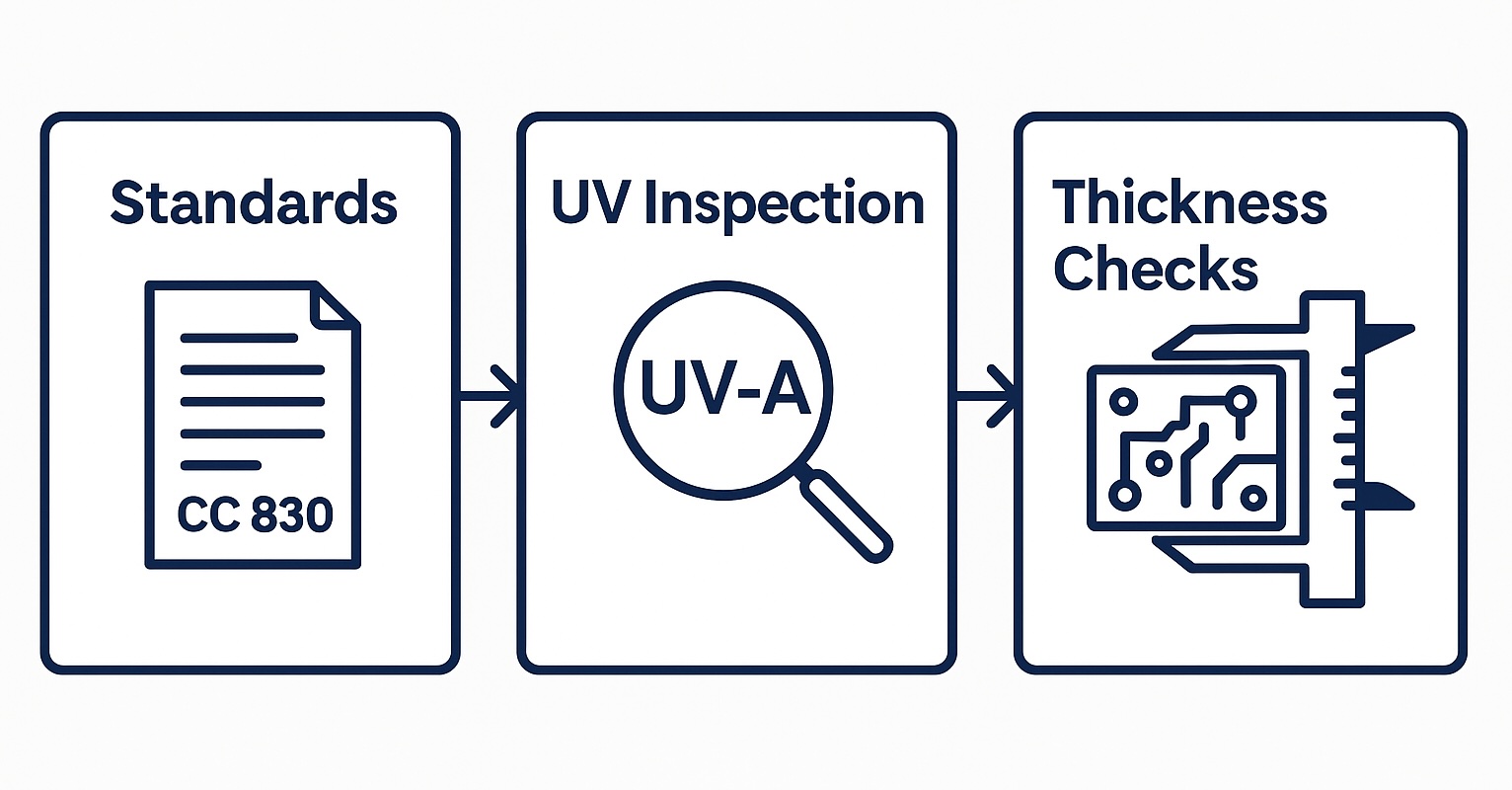
Conformal coating inspection combines standards, acceptance criteria, UV inspection, thickness verification and process control to make coating quality decisions repeatable.
Inspection is a Control System — Not a Visual Check
In conformal coating, inspection failures rarely come from a lack of inspection. They usually come from misaligned intent. Teams often inspect for cosmetic perfection, while reliability, standards and customer requirements may need something different.
A strong inspection system aligns inspection intent, inspection methods, verification plans and process control thinking so that operators, engineers and quality teams make consistent and defensible decisions.
Common Inspection Triggers
- Conformal Coating Defects Hub — match what you see, such as pinholes, de-wetting, orange peel or corrosion, to likely causes.
- Conformal Coating Masking Hub — de-masking checks, residue risks, keep-out failures and leakage verification.
- Conformal Coating Surface Preparation Hub — contamination control, cleaning verification, adhesion and reliability fundamentals that drive many inspection findings.
- Conformal Coating Thickness, Curing & Verification Hub — thickness measurement, cure confirmation and production verification.
- Humidity vs Condensation — why many humidity issues are actually condensation plus ionic contamination issues.
- Conformal Coating Standards Hub — inspection intent, workmanship expectations and what “good” means.
- What NASA Gets Right About Conformal Coating — cleanliness, documentation, inspection discipline and process control in high-reliability environments.
Inspection & Quality Hub Index
| Topic | More | Article |
|---|---|---|
| Inspection Standards & Methods — IPC, UL and workmanship frameworks | ↓ | ↗ |
| Inspection Acceptance Criteria — accept, reject and rework decisions | ↓ | ↗ |
| Inspection Workflow & Standard Work — gated sequence, risk zones, tagging and disposition rules | ↓ | ↗ |
| UV Inspection — fluorescence, coverage and edge definition | ↓ | ↗ |
| Thickness Verification — AQL, witness coupons, test coupons and SPC | ↓ | ↗ |
| Why Conformal Coating Processes Fail — contamination, cleaning, compressed air, handling and process control | ↓ | ↗ |
| What NASA Gets Right About Conformal Coating — cleanliness, workmanship discipline, documentation and high-reliability process control | ↓ | ↗ |
Inspection findings frequently link back to masking quality, process stability, contamination control, defect mechanisms and workmanship discipline. For root-cause context, explore the Masking Hub, Defects Hub, Thickness, Curing & Verification Hub and Standards Hub.
Inspection Standards & Methods
Defines what inspection must cover and how it aligns with IPC-A-610, IPC-CC-830, UL requirements and customer workmanship standards.
Effective inspection normally combines methods rather than relying on a single visual technique. UV fluorescence can help identify coating presence and boundaries, while white-light inspection and appropriate magnification can reveal surface defects, contamination, bubbles, cracking, residues and workmanship issues that UV alone may not show.
Inspection Acceptance Criteria
Provides structured rules for determining what is acceptable, rejectable or requires rework based on functional risk rather than cosmetic appearance.
Inspection Workflow & Standard Work
Converts inspection theory into executable shop-floor control: cure-state gating, UV-first and white-light-second sequencing, risk-zone prioritisation, photo standards, defect tagging, disposition rules and escalation triggers.
UV Inspection
Explains how ultraviolet fluorescence is used to verify coating presence, masking boundaries and keep-out compliance in production.
Inspection warning: UV trace confirms that a fluorescent material is visible, but it does not automatically prove correct coating coverage, film continuity, thickness or protection. See Why UV Trace Does Not Guarantee Correct Coating Coverage.
False-pass warning: UV fluorescence can create a false sense of security. A visible UV trace does not prove adequate thickness, complete coverage, continuity beneath components or long-term protection. Read Why UV Inspection Can Give False Pass Results.
UV inspection should therefore be supported by white-light examination, appropriate magnification, thickness verification and defined acceptance criteria where the product risk requires it.
Thickness Verification Plans
Shows how AQL sampling, witness coupons, SPC and dedicated test coupons are used to statistically prove coating thickness and process stability.
For the wider relationship between specified thickness, curing and verification methods, see the Conformal Coating Thickness, Curing & Verification Hub.
Why Conformal Coating Processes Fail
Explains why many coating problems are caused not by the coating itself, but by poor cleaning, airborne contamination, compressed air quality, uncontrolled humidity, incorrect material handling and weak process control.
What NASA Gets Right About Conformal Coating
Explains how NASA-style workmanship thinking integrates cleanliness, training, documentation, inspection discipline and process control to achieve more reliable coating outcomes in high-reliability environments. It complements the practical lessons discussed in Why Conformal Coating Processes Fail.
Need Help Strengthening Your Inspection & Quality System?
If inspection results vary between operators, audits trigger repeated findings or acceptance decisions are debated instead of controlled, your inspection system may need alignment rather than more inspection.
Inspection System Alignment & Audits
- Inspection workflow reviews aligned to IPC-A-610, IPC-CC-830 and customer standards.
- Acceptance criteria definition and defect decision rules.
- UV and white-light inspection setup, lighting optimisation and interpretation training.
- Thickness verification strategy using AQL, coupons and SPC.
- Audit readiness support and objective evidence development.
Technical Training for Inspection Teams
- Standards interpretation for inspectors, engineers and QA teams.
- Practical defect recognition and acceptability judgement.
- UV inspection discipline, white-light inspection and masking boundary interpretation.
- Measurement systems awareness and traceability.
- Process review training covering cleaning, contamination control, compressed air quality and repeat defect reduction.
Why Choose SCH Services?
SCH combines practical conformal coating production experience with inspection, process control, training and defect investigation. This helps customers move from subjective visual checking to repeatable, documented and technically defensible quality decisions.
- Practical inspection experience: UV inspection, white-light inspection, defect recognition and production-quality decision making.
- Acceptance and verification: support with coating acceptance criteria, thickness verification, witness coupons and inspection plans.
- Process-led troubleshooting: inspection findings can be traced back through cleaning, contamination, masking, application, curing and handling.
- Training and standardisation: support for operators, engineers and quality teams to improve consistency and judgement.
Disclaimer: This content is provided for general technical guidance and educational purposes only. Final process controls, inspection criteria, acceptance decisions and compliance requirements should be validated against the applicable standards, customer specifications, coating-system requirements and approved product documentation.