Static Control for Industrial Equipment
Upgrade machinery, fixtures and production surfaces with controlled ESD performance
Industrial equipment is rarely designed with electrostatic control in mind. Machines, housings, guards, fixtures and handling systems are typically built from insulating materials such as plastics, coatings and composites. During operation, these surfaces can accumulate static charge through airflow, friction, movement and normal process interaction.
This can lead to contamination, dust attraction, handling instability, nuisance discharge and inconsistent process performance. In sensitive environments, it may also contribute to product defects or reliability issues.
Static control for industrial equipment provides a practical way to upgrade insulating machinery and surfaces without redesigning the entire system.
Using the ProShieldESD coating platform, insulating materials can be converted into stable static-dissipative surfaces across real operating environments.
This diagram shows how industrial equipment surfaces can be converted from insulating to controlled static-dissipative behaviour.
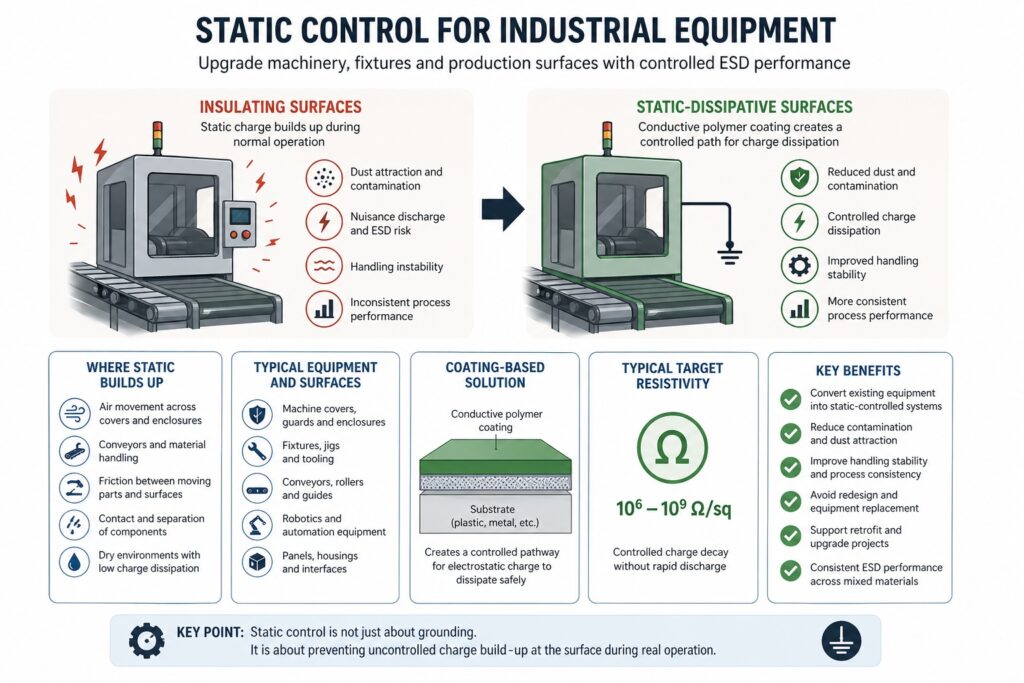
Simple diagram showing how industrial equipment surfaces can be converted from insulating to controlled static-dissipative behaviour
Where Static Builds Up in Industrial Equipment
Static charge is generated in many everyday industrial processes. Equipment that appears mechanically stable may still create electrostatic issues during normal use.
- Air movement across machine covers, ducts and enclosures
- Conveyor systems and material handling equipment
- Friction between moving parts and surfaces
- Contact and separation of components during processing
- Dry environments with low natural charge dissipation
These effects are often overlooked because they do not always produce visible discharge. However, they can still influence contamination, handling behaviour and process consistency.
Typical Equipment and Surfaces
Static control for industrial equipment can be applied across a wide range of components and systems where insulating surfaces are present.
- Machine covers, guards and protective enclosures
- Production line fixtures, jigs and tooling
- Conveyor systems, rollers and guides
- Robotic cells and automation equipment
- Handling frames, racks and support structures
- Panels, housings and operator interfaces
Many of these surfaces are made from plastics or coated metals. For more detail on polymer substrates, see Anti-Static Coating for Plastic. Where the issue is part of the wider working area, see Static Control for Work Surfaces & Facilities.
Why Traditional Approaches Fall Short
Conventional static control methods for equipment often involve conductive materials, grounding straps or environmental control. While these can help, they do not always address the root cause of surface charge generation.
- Conductive materials require redesign and replacement
- Grounding alone does not prevent charge build-up on insulating surfaces
- Environmental control such as humidity is not always stable or practical
- Filler-based coatings can drift or degrade over time
This is especially important on industrial equipment, where wear, cleaning, handling and mixed materials can expose the weaknesses of carbon-filled coatings or moulded anti-static parts. For a practical breakdown, see why carbon-filled ESD paints and moulded anti-static plastics can fail.
This is why surface engineering using filler-free conductive polymer technology provides a more stable and controllable approach.
Key point: Static control is not just about grounding. It is about preventing uncontrolled charge build-up at the surface during real operation.
How Coating-Based Static Control Works
Instead of replacing the entire component, a conductive polymer coating is applied to the equipment surface. This creates a controlled pathway for electrostatic charge to dissipate safely.
The underlying material retains its mechanical properties, while the surface gains stable static-dissipative behaviour. In most industrial applications, the target is a resistivity range of 106 – 109 Ω/sq, allowing controlled charge decay without rapid discharge.
For a broader explanation, see what an ESD coating is.
Benefits for Industrial Systems
- Convert existing equipment into static-controlled systems
- Reduce contamination and dust attraction
- Improve handling stability and process consistency
- Avoid redesign of machines and tooling
- Apply consistent ESD performance across mixed materials
- Support retrofit and upgrade projects
These advantages are particularly valuable where equipment is already installed and functioning mechanically, but electrical surface behaviour is limiting performance.
Choosing the Right Static Control Route
Industrial equipment is one of the most common sources of static generation, but it is only part of the wider control strategy. The correct solution depends on how charge is generated, what materials are involved, and whether the issue relates to plastics, packaging, facility areas or higher-risk environments.
For a structured decision pathway across all application types, see How to Choose the Right Static Control Approach.
Related ProShieldESD Solutions
Other ProShieldESD solutions support related static control requirements across plastics, work surfaces, packaging, hazardous environments and specialist ATEX applications.
How SCH Services Supports Industrial Applications
SCH Services supports evaluation, testing and implementation of static control solutions across industrial equipment and production environments.
- Assessment of equipment, substrates and operating conditions
- Selection of appropriate coating chemistry and application method
- Trial coating and validation
- Support for retrofit and upgrade projects
- Access to subcontract coating services where in-house capability is not required
Why Choose SCH Services?
SCH Services combines coating process experience with practical industrial application knowledge to deliver reliable static control solutions.
- Technical guidance for coating selection and implementation
- Experience across industrial, electronics and safety-critical environments
- Support for both development and production stages
- Practical approach to retrofit and upgrade projects
Disclaimer: This page provides general technical guidance only. Static control suitability depends on substrate, environment, grounding strategy, resistance range and verification testing. Final performance must be confirmed through appropriate trials and qualification.