How controlled viscosity improves manual conformal coating quality
Brush coating defects are often blamed on the brush, the operator, or contamination. In many cases, the real issue is that the coating viscosity has changed during use.
Solvent-based conformal coatings thicken as solvent evaporates. If the coating is held in an uncontrolled working jar, left open too long, or used beyond a defined working period, the viscosity can move outside the intended application range.
Controlled viscosity is therefore central to repeatable brush coating. It ensures the coating flows correctly from the brush, levels properly on the PCB, and reduces visible defects.
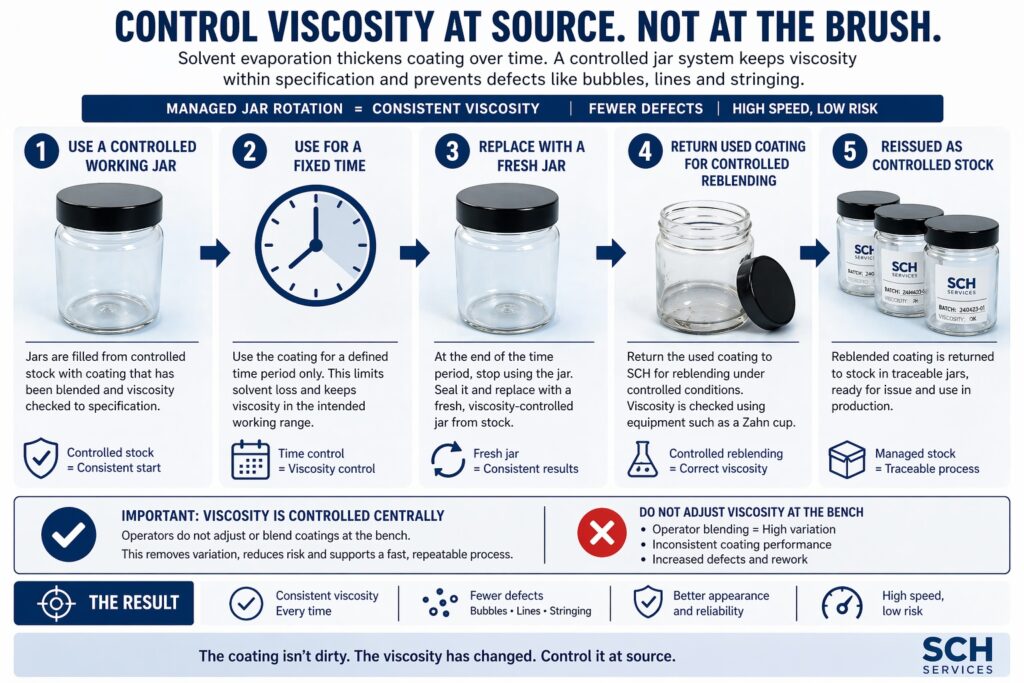
Controlled viscosity system: fixed jar time, central reblending and traceable stock reduce defects such as bubbles, lines and stringing.
The coating is not always dirty
When operators see bubbles, lines or stringing in brush-applied coating, it is easy to assume the material has become contaminated.
Sometimes that can happen, but in many production environments the problem is not dirt. It is solvent loss and viscosity drift.
As solvent evaporates, the coating becomes thicker. Once the material moves outside the intended working viscosity, it no longer flows correctly from the brush or levels properly on the PCB.
For wider defect troubleshooting, see our guide to pinholes, bubbles and foam in conformal coating.
Key insight: Good brush coating depends on controlling viscosity at source, not asking operators to adjust coating at the bench.
Why controlled jars matter
A brush coating jar is not just a convenient container. It is part of a controlled viscosity system.
Using defined working jars reduces solvent evaporation, limits exposure time, and keeps coating within a usable viscosity range during application.
Working with small, controlled volumes also avoids repeatedly opening bulk material, helping maintain consistency across production.
How SCH controls brush coating viscosity
At SCH, viscosity is controlled centrally, not at the bench. Operators do not adjust or blend coatings during application.
Coating is issued in controlled working jars from viscosity-checked stock. Each jar is used for a defined time period, then replaced with a fresh, controlled jar.
Used coating is returned for controlled reblending under managed conditions. Viscosity is checked using appropriate methods, such as a Zahn cup, before being reissued as traceable stock.
Why operators should not adjust viscosity at the bench
Manual adjustment of coating viscosity at the bench introduces unnecessary variation. Different operators may add solvent differently, mix inconsistently, or judge coating behaviour by eye.
This variation affects coating thickness, flow, appearance and reliability, increasing the risk of defects and rework.
A stock of correctly blended, viscosity-controlled jars provides a faster, lower-risk process: use the jar, replace it at the defined time, and maintain consistent application.
Common defects linked to viscosity drift
- Bubbles forming during application
- Visible brush lines in the coating film
- Stringing between the brush and PCB
- Poor levelling after application
- Heavy local build-up or uneven coating appearance
These symptoms do not automatically mean the coating is contaminated. They often indicate that the working material has become too viscous for controlled brush application.
Where coating does not wet or flow properly on the board, viscosity should be considered alongside other causes such as de-wetting in conformal coating and surface preparation and cleanliness.
Related products and guides
For controlled manual coating work, SCH supplies practical application consumables used in real coating processes.
- Conformal coating jars for controlled brush coating and material handling
- Conformal coating brushes for PCB coating and touch-up
- Surface preparation and cleanliness for conformal coating
- Conformal coating thickness verification
These resources support repeatable brush coating by helping control the material, the application method and the inspection process.
Why Choose SCH Services?
SCH Services supports conformal coating processes with practical production experience, coating services, process consumables, equipment, training and technical support.
- Hands-on experience in real PCB coating production
- Practical support for brush coating, masking, inspection and process control
- Consumables selected for use in controlled coating workflows
- Technical guidance for reducing defects and improving repeatability
Contact SCH Services to discuss coating process support, consumables or manual coating control.
This article provides general technical guidance only. Final process settings, material handling methods and coating controls should be validated against the coating manufacturer’s datasheet, customer requirements and applicable production standards.