Insufficient Coverage & Shadowing in Conformal Coating
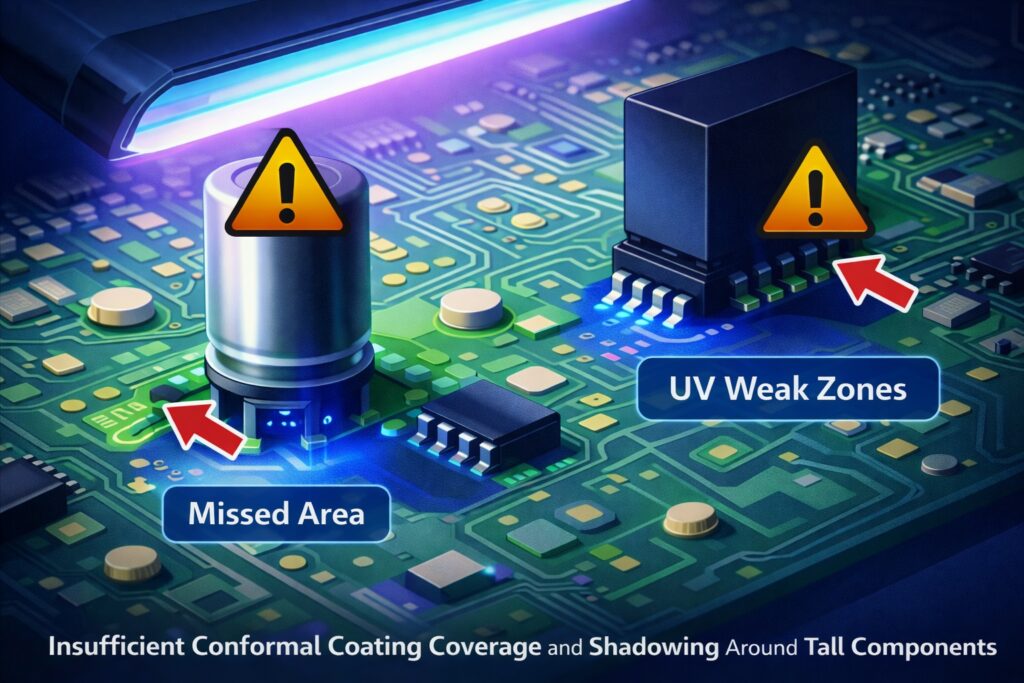
Issues such as insufficient conformal coating coverage occur when the coating fails to fully protect all required PCB surfaces, leaving thin, weak, or bare areas. A common form is shadowing, where geometry, orientation, or application path prevents coating from reaching certain zones.
The defect typically presents as missed or uncoated areas, UV weak zones, or patchy coverage adjacent to components, leads, or vertical features. These exposed or under-built areas are a frequent root cause of moisture ingress, corrosion, and electrical leakage.
This page focuses specifically on coverage loss due to access and geometry. If coating has flowed away into gaps or under components, see capillary (wicking). If coating is present but pulled back into circular bare zones, see
de-wetting.
Article Quicklinks
| Topic | More |
|---|---|
| Definitions: what insufficient coverage and shadowing mean | 🔗 |
| Root Causes: geometry, access and application limit | 🔗 |
| Prevention: application strategy and process controls | 🔗 |
| Troubleshooting & Diagnosis | 🔗 |
What is Insufficient Coverage / Shadowing?
- Insufficient coverage — the applied coating thickness is below the minimum required, or entirely absent, on areas that should be protected.
- Shadowing — a specific form of insufficient coverage where components, leads, or vertical features physically block coating deposition.
- Typical indicators — UV fluorescence fades or disappears, laminate or solder mask texture remains visible, or coating abruptly stops at component edges.
- Risk — exposed copper, solder joints, or laminate edges become entry points for moisture, ionic contamination, and corrosion mechanisms.
Unlike wicking or de-wetting, insufficient coverage is usually caused by lack of access rather than coating movement after application.
Causes of Insufficient Coverage & Shadowing
- Component geometry — tall parts, fine-pitch leads, connectors, shields and heat sinks block the spray or flow path.
- Low standoff components — chip resistors, QFNs and LGAs prevent coating from reaching underneath edges.
- Application angle and distance — fixed spray angles or excessive gun distance reduce penetration into complex assemblies.
- Robotic path limitations — insufficient path overlap, poor vector selection, or conservative keep-out programming.
- Film build strategy — single-direction passes that never re-address shadowed regions.
- Masking overreach — keep-out masking unintentionally blocks coating from adjacent required areas.
Diagnostic Cross-check (look-alikes):
- If coating is present but pulled away into circular bare zones, see de-wetting.
- If coating is thick under components but thin nearby, see capillary (wicking).
- If coverage exists but has rough texture, see orange peel / dry spray.
Related articles: Coverage issues are often treated as application problems, but they are frequently linked to broader process setup, fixturing and environmental control. For a wider view of why coating processes fail, see Why Conformal Coating Processes Fail.
This is also exactly the kind of issue that high-reliability workmanship guidance tries to prevent through disciplined process control, cleanliness, inspection and verification. For the broader NASA-style process view, see What NASA Gets Right About Conformal Coating.
How to Prevent Insufficient Conformal Coating Coverage
- Multi-angle application — apply coating from more than one direction to break shadow lines.
- Optimised robot paths — add secondary vectors and overlap passes around tall or dense components.
- Controlled film build — use staged light passes to build thickness without runs or pooling.
- Correct gun distance and pressure — maintain penetration while avoiding excessive atomisation.
- Masking discipline — ensure keep-out masking does not encroach into required coating zones.
- Design-for-coating awareness — identify high-risk geometries early and define mitigation strategies.
Coverage verification methods and acceptance criteria are detailed in the Inspection & Quality Hub.
Troubleshooting & Diagnosis
- UV inspection mapping — identify consistent weak or dark zones relative to component geometry.
- White-light confirmation — check for exposed laminate, solder mask texture, or sharp coating cut-offs.
- Pattern repeatability — confirm the defect repeats in the same locations across multiple boards.
- Path review — overlay robot paths or spray directions with defect locations.
- Masking audit — verify masks are not blocking adjacent required areas.
- A/B trials — adjust angle, distance, or add a secondary pass to confirm shadowing as the mechanism.
Looking for Other Defect Types?
This page addresses insufficient coverage and shadowing. For other defect mechanisms and diagnostic guides, explore the full index:
Training on Coverage Failures & Defect Prevention
SCH provides conformal coating training focused on real-world defect recognition and prevention, including shadowing, missed areas, wicking, de-wetting, cure failures and corrosion mechanisms.
Industry Standards We Work To
- IPC-A-610 – Acceptability of Electronic Assemblies
- IPC-CC-830 – Qualification & Performance of Conformal Coatings
- IPC-HDBK-830 – Conformal Coating Handbook
Explore Topic Hubs
Conformal Coating Processes Hub
Conformal Coating Equipment Hub
Conformal Coating Masking Hub
Conformal Coating Design Hub
Conformal Coating Defects Hub
Inspection & Quality Hub
Removal & Rework Hub
Standards Hub
Parylene Basics Hub
Parylene Application Hub
Why Choose SCH Services?
Partnering with SCH Services means more than just outsourcing — you gain a complete, integrated platform for Conformal Coating, Parylene & ProShieldESD Solutions, alongside equipment, materials, and training, all backed by decades of hands-on expertise.
- ✈️ 25+ Years of Expertise – Specialists in coating technologies trusted worldwide.
- 🛠️ End-to-End Support – Guidance on coating selection, masking, inspection, and ProShieldESD integration.
- 📈 Scalable Solutions – From prototype to high-volume production.
- 🌍 Global Reach – Support across Europe, North America, and Asia.
- ✅ Proven Reliability – Built on quality, consistency, and customer satisfaction.
📞 Call: +44 (0)1226 249019 | ✉ Email: sales@schservices.com | 💬 Contact Us ›