Parylene Basics Hub
Parylene coating fundamentals, deposition process & application engineering
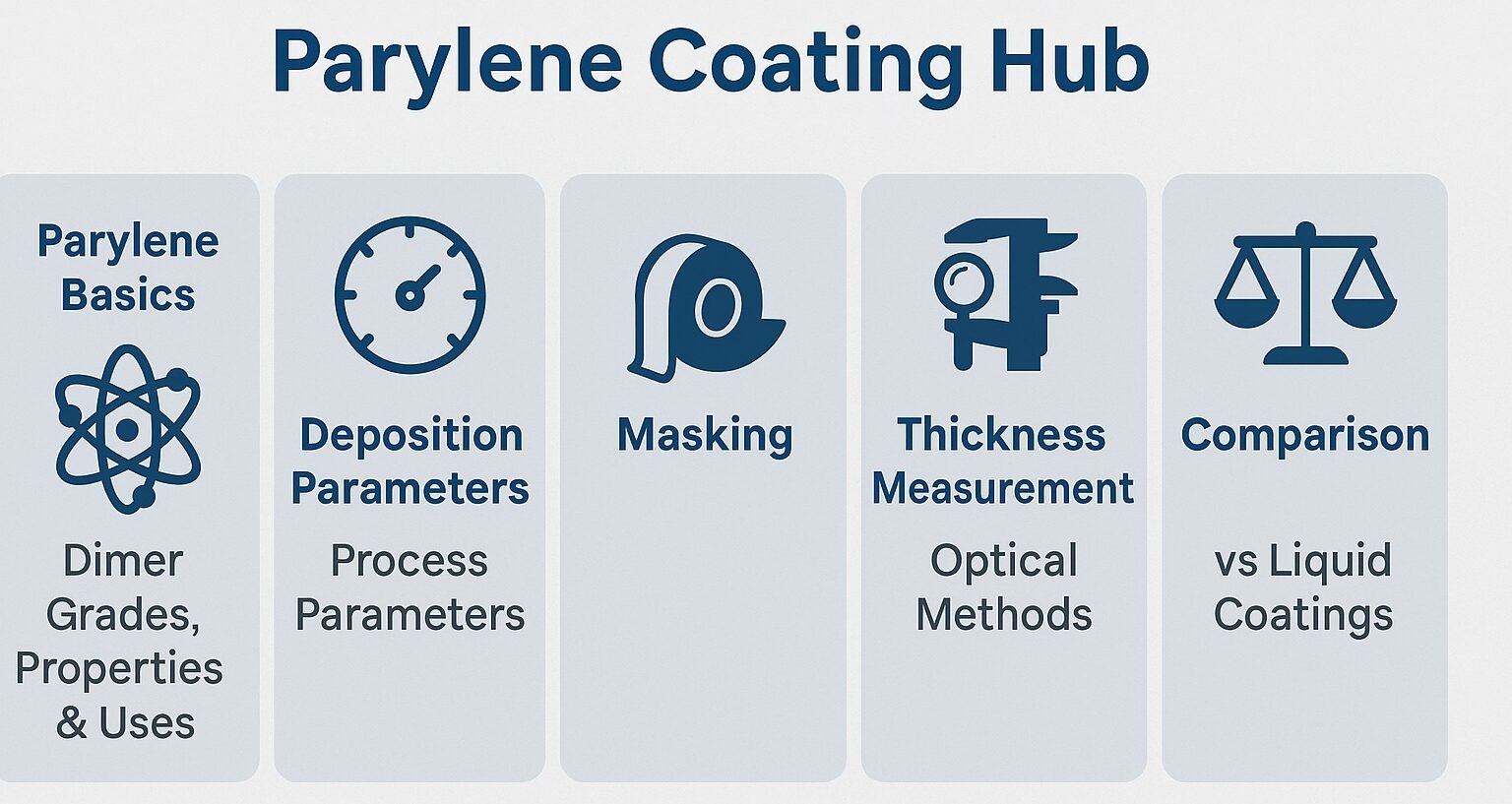
The Parylene Basics Hub brings together essential guides on Parylene dimer grades, deposition principles, masking methods, adhesion, thickness measurement, thickness specification and core application concepts.
It is designed as a structured starting point for engineers who need to understand how Parylene works, where it fits best, and how to specify it correctly for high-reliability electronics, medical devices, sensors and industrial products.
External resource: See IPC-A-610 – Acceptability of Electronic Assemblies
Index of Parylene Basics Articles
| Topic | More | Article |
|---|---|---|
| Parylene Basics: Dimer Grades, Properties & Uses | 🔗 | ↗ |
| How to Specify Parylene Coating | 🔗 | ↗ |
| Parylene Deposition: Process Parameters | 🔗 | ↗ |
| Masking for Parylene | 🔗 | ↗ |
| Parylene Adhesion: Causes of Failure & Solutions | 🔗 | ↗ |
| Optical Thickness Measurement for Parylene | 🔗 | ↗ |
| Parylene Thickness & Environmental Protection: How Much Is Enough? | 🔗 | ↗ |
| Parylene Thickness Specification Guide: Dielectric Performance, Coverage Limits & Cost Control | 🔗 | ↗ |
| Parylene Applications: Where It Fits | 🔗 | ↗ |
| Parylene vs Conformal Coating: How to Choose the Right Protection for Electronics | 🔗 | ↗ |
Parylene Basics: Dimer Grades, Properties & Uses
Parylene comes in multiple dimer grades (N, C, D and fluorinated variants such as HT). Each grade has unique properties that influence dielectric strength, moisture and chemical barrier performance, penetration into fine features, and cost. Selecting the right dimer grade ensures the coating matches environmental, electrical and reliability requirements.
↑ Back to Index – Full Article ↗
How to Specify Parylene Coating
Correctly specifying Parylene is critical for repeatable performance and compliance. This guide explains how to define the operating environment, choose the right Parylene grade, set realistic thickness ranges, document masking and keep-out zones, and align cleaning, testing and qualification requirements with your reliability targets.
↑ Back to Index – Full Article ↗
Parylene Deposition: Process Parameters
Parylene deposits through a vapour deposition process under vacuum. Key parameters such as temperature, chamber pressure and dimer feed rate directly control coating uniformity and step coverage. Consistent process control helps prevent defects and ensures repeatable results across batches.
↑ Back to Index – Full Article ↗
Masking Options
Parylene coats in the vapour phase, so masking requires complete sealing of no-coat regions. Engineers use boots, tapes, dots and custom shields to protect connectors, mating faces and sensitive areas. Effective Parylene masking minimises rework and helps maintain long-term reliability.
↑ Back to Index – Full Article ↗
Parylene Adhesion: Causes of Failure & Solutions
Parylene adhesion depends on surface condition, substrate compatibility and correct preparation. This guide explains why coatings can blister, peel or delaminate, and shows how cleaning, plasma treatment and A-174 silane adhesion promoters improve long-term coating reliability.
↑ Back to Index – Full Article ↗
Optical Thickness Measurement
Thickness measurement plays a crucial role in quality assurance. Non-contact optical methods provide high accuracy and traceable results without damaging the coating, unlike mechanical gauges or destructive cross-sections. This enables manufacturers to demonstrate compliance with customer specifications and standards.
↑ Back to Index – Full Article ↗
Parylene Thickness & Environmental Protection: How Much Is Enough?
Thickness is one of the most frequently debated Parylene specifications. This guide explains how protection margin typically increases with thickness, especially for humidity, condensation cycling and harsh environments. It also provides practical thickness bands (2–5 µm, 5–15 µm, 15–25 µm, 25–50 µm) so engineers can choose a sensible thickness window without over-specifying early.
↑ Back to Index – Full Article ↗
Parylene Thickness Specification Guide: Dielectric Performance, Coverage Limits & Cost Control
This engineering guide explains how to choose a sensible Parylene thickness range based on dielectric requirements, environmental protection targets, geometry coverage and process economics. It helps engineers move from general thickness guidance to a practical specification that balances reliability, throughput and cost without over- or under-specifying the coating.
↑ Back to Index – Full Article ↗
Parylene Applications: Where It Fits
Parylene provides ultra-thin, pinhole-free protection for electronics & PCBs, medical devices, MEMS & sensors, optics & LEDs, aerospace/defence and automotive/EV. Typical drivers include moisture and ionic barrier, dielectric isolation, biocompatibility (ISO 10993), chemical resistance and long-term reliability at low thickness (2–25 µm).
- Electronics & PCBs: Avionics, automotive modules, industrial controls.
- Medical: Implants, catheters, neurostimulators, hearing aids.
- MEMS & Sensors: Pressure sensors, biosensors, microstructures.
- Optics & LEDs: Lenses, LED assemblies, optical blocks.
- Aerospace & Defence: Navigation modules, satellites and rugged systems.
- Automotive & EV: ADAS sensors, BMS boards, under-hood electronics.
Parylene vs Conformal Coating: How to Choose the Right Protection for Electronics
Parylene delivers pinhole-free 3D coverage and excellent dielectric strength at very low thickness, while traditional liquid conformal coatings often offer easier rework and lower initial process costs. This guide helps engineers compare coverage, thickness, reliability and manufacturing trade-offs between the two technologies.
↑ Back to Index – Full Article ↗
Why Choose SCH Services?
Partnering with SCH Services means more than just outsourcing — you gain a complete, integrated platform for Conformal Coating, Parylene & ProShieldESD Solutions, alongside equipment, materials, and training, all backed by decades of hands-on expertise.
- ✈️ 25+ Years of Expertise – Specialists in coating technologies trusted worldwide.
- 🛠️ End-to-End Support – Guidance on coating selection, Parylene grades, masking, inspection, and ProShieldESD integration.
- 📈 Scalable Solutions – From prototype batches to high-volume production, SCH grows with your needs.
- 🌍 Global Reach – Responsive support across Europe, North America, and Asia.
- ✅ Proven Reliability – Built on quality, consistency, and customer satisfaction.
📞 Call: +44 (0)1226 249019 ✉ Email: sales@schservices.com 💬 Contact Us ›