Surface Craters & Fish-Eyes in Conformal Coating
Fish-eyes and craters are circular surface defects where the wet film pulls away from a small local contamination source (often silicone or oils), leaving a round void or thin “ring” edge. They can look similar to de-wetting, but are often more circular, localised and repeatable when driven by point-source contamination or surface-energy hotspots.
For a complete index of defect types and links to each technical article, use the Conformal Coating Defects Hub.
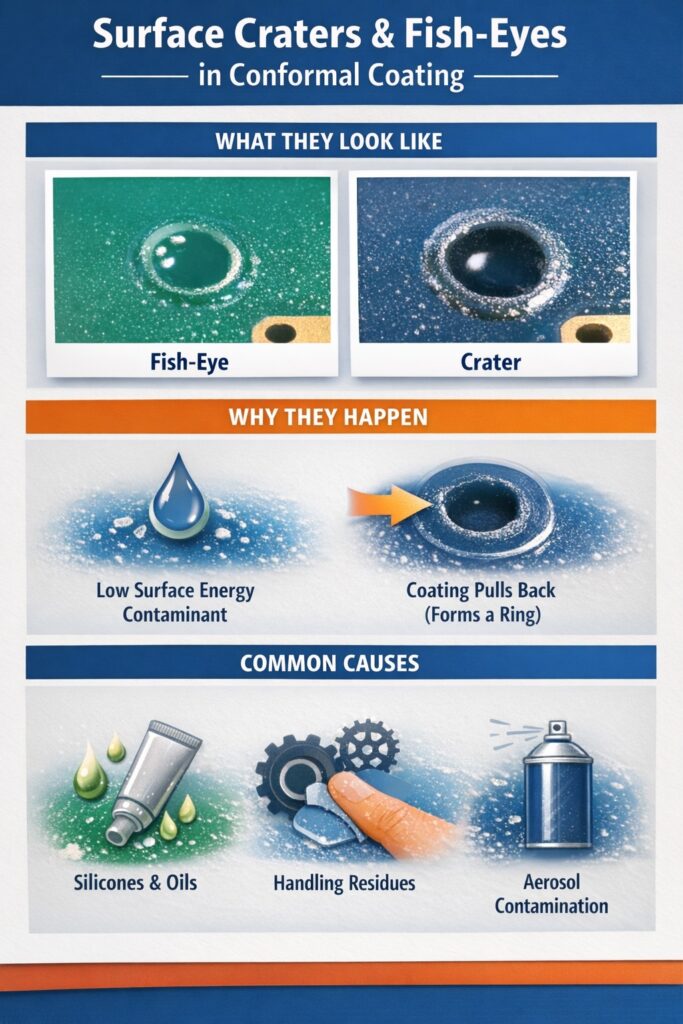
Infographic showing how surface craters and fish-eyes form in conformal coating due to local contamination and surface-energy pull-back.
Article Quicklinks
| Topic | More |
|---|---|
| Definitions: fish-eye vs crater vs de-wetting | 🔗 |
| Mechanisms: surface energy and pull-back rings | 🔗 |
| Root Causes: silicone, oils, aerosols, handling | 🔗 |
| Prevention: contamination control and process discipline | 🔗 |
| Troubleshooting & Diagnosis: isolate the source | 🔗 |
| Repair: local rework vs strip and recoat | 🔗 |
What are Fish-Eyes and Surface Craters?
- Fish-eye — a small, circular pull-back defect with a defined rim, typically caused by a local low surface-energy contaminant (often silicone/oil).
- Crater — a larger circular depression where coating retreats away from a point source and leaves a thin/void centre or a ring edge.
These defects are especially risky near keep-outs and fine pitch because the “ring edge” can leave local thin zones and leakage paths.
Difference vs de-wetting: de-wetting often presents as broader “islands” and patchy pull-back across an area; fish-eyes/craters are commonly round, localised and repeatable (point-source driven), although both share surface-energy mechanisms.
How Fish-Eyes and Craters Form (Mechanisms)
- Surface-energy hotspot: a tiny contamination spot (silicone/oil) creates a low-energy region the coating cannot wet.
- Wet film pull-back: the coating retreats away from the hotspot, forming a circular rim and leaving a thin/void centre.
- Levelling can worsen visibility: as the film levels, the defect becomes a cleaner ring if the contaminant remains active.
Pattern clue: if defects appear in the same locations board-to-board (near a specific connector, handling point, or masking edge), suspect repeatable point-source contamination rather than bulk chemistry.
Root Causes of Fish-Eyes / Craters
Contamination sources (most common)
- Silicone transfer — gloves, wipes, release agents, lubricants, sealants, RTVs, and silicone-containing products in the area.
- Oils/greases — handling residues, tooling lubricants, compressor oils, skin oils.
- Aerosols — sprays (cleaners, lubricants, air fresheners) that can deposit trace silicones/oils.
Process contributors
- Masking residues — adhesive transfer or latex residues at edges.
- Rework contamination — polish compounds, flux residues, marker inks, label adhesives.
- Inadequate cleaning validation — non-ionic residues can still drive wetting defects even when ionic tests are acceptable.
Sanity check (look-alikes):
- If you see broader patchy pull-back or bare “islands,” route to de-wetting.
- If the defect is a void inside the film rather than a surface ring, route to pinholes/bubbles/foam.
- If debris is embedded (not a ring), route to dust/fibres/FOD.
How to Prevent Fish-Eyes and Craters
Contamination discipline
- Control silicone sources — treat silicones as “critical contaminants” in coating areas.
- Standardise gloves/wipes — validated, low-transfer consumables only.
- Ban aerosols near coating — even trace deposition can trigger fish-eyes.
Cleaning and handling controls
- Validate cleaning for both ionic and non-ionic residues where risk exists (process-appropriate methods).
- Control handling points and avoid touching coated areas before coating.
- Segregate rework tools/materials that may introduce oils or silicone transfer.
For standards-aligned inspection and defect calling under UV/white light, use the Inspection & Quality Hub.
Troubleshooting & Diagnosis
- Confirm the geometry: circular rings are a strong fish-eye/crater indicator.
- Map repeatability: same locations suggest point-source contamination.
- Trace the source: gloves/wipes, masking residues, lubricants, aerosols, fixtures.
- Controlled coupon trial: if permitted by your controls, compare a “clean handled” coupon vs a coupon touched with the suspected source to see if rings reproduce.
Repair: When to Touch-Up vs Strip & Recoat
- Small isolated rings: if accessible and acceptance allows, local removal and recoat may be possible — but only after eliminating the contamination source.
- Multiple/repeating craters: treat as contamination control failure — stripping and recoat is often the only robust outcome.
- Near keep-outs/fine pitch: treat as high risk due to thin ring edges; escalate per repair rules.
For removal workflows and best-fit methods, see the Removal & Rework Hub.
Looking for Other Defect Types?
This page covers fish-eyes and surface craters. For the complete index of defect types and links to each technical article:
Training on Conformal Coating Defects
SCH offers conformal coating training that goes beyond theory—defect recognition, contamination control, masking discipline and process stabilisation.
Explore Topic Hubs
Conformal Coating Processes Hub
Conformal Coating Equipment Hub
Conformal Coating Masking Hub
Conformal Coating Design Hub
Conformal Coating Defects Hub
Inspection & Quality Hub
Removal & Rework Hub
Standards Hub
Parylene Basics Hub
Parylene Application Hub
Why Choose SCH Services?
You gain a complete, integrated platform for Conformal Coating, Parylene & ProShieldESD—plus equipment, materials and training—backed by decades of hands-on process support.
- 🛠️ End-to-End Support – Selection, masking, inspection and troubleshooting.
- ✅ Process Discipline – Recipes, control windows and repeatability.
- 🌍 Global Reach – Support across Europe, North America and Asia.
📞 Call: +44 (0)1226 249019 | ✉ Email: sales@schservices.com| 💬 Contact Us ›