SIR Failures & Leakage Under Conformal Coating

SIR failures and leakage under conformal coating occur when insulation resistance between conductors degrades enough to create measurable leakage current, noise, drift or intermittent-to-hard shorts. The most common drivers are ionic contamination + moisture + electrical bias, amplified by coverage weaknesses (thin edges, voids, boundaries and interfaces). This is rarely β€œjust a coating problem” β€” it is a cleanliness + dry-out + coverage + inspection discipline problem.

For a complete index of defect types and links to each technical article, use the Conformal Coating Defects Hub. For upstream control (cleaning windows, dry-out strategy, coating process stability), see the Conformal Coating Processes Hub and the Inspection & Quality Hub.

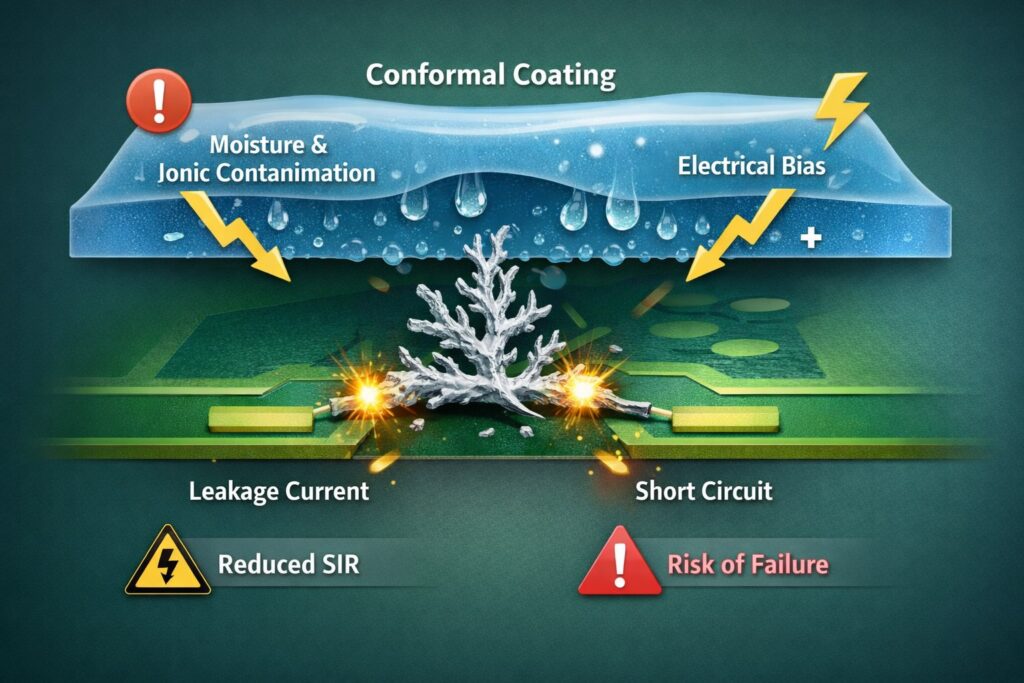
SIR failures and leakage under conformal coating showing moisture and ionic contamination forming an electrolyte path under electrical bias, leading to reduced insulation resistance and dendrite growth

Surface insulation resistance (SIR) failures and leakage under conformal coating caused by ionic contamination and moisture under electrical bias, leading to reduced insulation resistance, leakage currents and potential short circuits.

What are SIR Failures & Leakage Under Conformal Coating?

  • Insulation resistance (IR) β€” resistance between two conductors intended to be electrically isolated. Low IR means increased leakage risk.
  • Surface insulation resistance (SIR) β€” IR measured across a surface path (often via contamination + moisture films), typically under controlled humidity and bias for verification.
  • Leakage current β€” unintended current flow between conductors. In practice, it can cause drift, noise, unstable logic, sensor offset and intermittent behaviour long before a hard short occurs.
  • SIR failure β€” IR falls below an acceptable threshold (or trends down under humidity + bias), indicating a mechanism is active (often ionic contamination and moisture under coating).

SIR failures are often the β€œearly warning stage” of ECM/dendrite growth and corrosion. Many field issues present as intermittent faults because the leakage path strengthens/weaken with humidity and temperature cycling.

↑ Back to Quicklinks

How SIR Failures Happen Under (or Through) Conformal Coating

  • Step 1 β€” ions remain on the assembly: flux residues, fabrication chemistry, handling salts, or cleaning drift leave conductive ionic species on the surface (often under components and at interfaces).
  • Step 2 β€” moisture becomes available: high RH, condensation cycles, trapped moisture pre-coat, or ingress at boundaries creates a thin electrolyte layer.
  • Step 3 β€” bias drives leakage: the electrolyte enables ionic conduction between biased conductors, reducing IR and creating measurable leakage current.
  • Step 4 β€” mechanisms escalate: sustained bias can evolve leakage into ECM/dendrites or under-film corrosion, shifting from intermittent leakage to hard shorts.

Pattern clue: humidity-sensitive behaviour (works dry, fails damp) strongly suggests an electrolyte-based leakage path rather than a purely electrical design issue. Where failures align with coating voids, edges or keep-out boundaries, treat it as a coverage/boundary amplifier on top of contamination and moisture.

↑ Back to Quicklinks

Root Causes of SIR Failures & Leakage Under Coating

Contamination sources (what creates the electrolyte)

  • Flux residues (assembly or rework), especially under low-standoff parts and fine pitch regions.
  • Fabrication residues (etch/plate chemistry remnants, solder mask residues, handling contamination).
  • Cleaning process drift (exhausted chemistry, insufficient wash energy, poor rinse quality, inadequate drying).
  • Handling & FOD (fingerprint salts, dust, glove contamination, fibres) creating localised leakage pathways.

Moisture pathways (how water reaches the ions)

  • Trapped moisture pre-coat (insufficient dry-out after cleaning or from ambient absorption in laminate/mask).
  • Ingress at boundaries (masking edges, keep-out zones, connectors, enclosure interfaces).
  • Permeation over time (all polymers transmit some moisture; long exposure + ions + bias matters).

Coverage weaknesses (what amplifies risk)

  • Thin edges, shadowing, and incomplete coverage near high-risk nets.
  • Pinholes/voids that shorten the barrier path and admit moisture locally.
  • Capillary interfaces that transport moisture under-film (see wicking below).

Sanity check (related mechanisms): if you also see corrosion residues, route to corrosion & ionic contamination. If moisture clearly tracks along interfaces/edges, also see capillary wicking. If voids dominate, see pinholes, bubbles & foam.

↑ Back to Quicklinks

How to Prevent SIR Failures & Leakage Under Conformal Coating

1) Control cleanliness (before you coat)

  • Validated wash, rinse and dry processes β€” define parameters, monitor drift, and control change-out rules.
  • Rework discipline β€” re-clean after rework; prevent local flux concentration and under-component residue retention.
  • Verification β€” use ROSE for drift monitoring where appropriate; use ion chromatography for species identification on critical builds.

2) Control moisture (dry-out + queue times + storage)

  • Dry-out / pre-bake β€” remove absorbed and trapped moisture before coating (validate profiles vs components and assemblies).
  • Queue-time rules β€” define max time from clean β†’ coat; control storage RH to prevent re-absorption.
  • Packaging discipline β€” don’t bag/ship parts before full cure and dry-out; use barrier packaging where required.

3) Control barrier integrity (coverage and boundaries)

  • Edge coverage & thickness β€” avoid thin edges and shadowing in high-risk nets; verify thickness using coupons/defined checks.
  • Boundary quality β€” keep masking edges clean and well-defined; ragged boundaries can create capillary pathways.
  • Inspection plan β€” UV + white light inspection as appropriate; focus on edges, keep-outs, connectors and under-component shadow zones.

If SIR failures recur, treat them as a control-plan gap. Define release criteria for cleanliness, dry-out and boundary integrity β€” not just β€œcoated/not coated”.

↑ Back to Quicklinks

Troubleshooting & Diagnosis

1) Confirm the failure signature

  • Humidity dependence β€” if leakage rises with RH/condensation, you are almost certainly dealing with an electrolyte-based mechanism.
  • Location logic β€” edges, interfaces, shadow zones and keep-out boundaries are common moisture pathways and residue traps.
  • Trend behaviour β€” intermittent faults often precede hard shorts; log leakage/IR vs time and environment.

2) Replicate and measure (don’t guess)

  • SIR / humidity-bias testing β€” apply bias under controlled humidity and trend IR/leakage over time.
  • Local strip + microscopy β€” remove coating in the suspect zone and inspect for residues, dendrites, corrosion tracks or boundary-driven ingress.
  • Ion chromatography β€” identify ionic species and trace sources (flux activators vs fabrication residues vs rinse chemistry).

3) Audit the process chain

  • Cleaning audit β€” chemistry control, loading, filtration, rinse quality, drying effectiveness.
  • Dry-out verification β€” confirm moisture removal for the assembled population, not just bare boards.
  • Coverage audit β€” confirm edge thickness, shadowing, voids/pinholes, boundary quality and ingress routes.

↑ Back to Quicklinks

Repair: When to Touch-Up vs Strip & Recoat

  • Single, localised coverage escape with verified cleanliness: controlled local removal, re-clean, dry-out and touch-up can be acceptable where inspection is robust and the customer spec allows it.
  • Confirmed SIR degradation across multiple sites: treat as systemic contamination/moisture control failure; strip, re-clean, verify, then recoat is usually required.
  • Under-component risk: if you cannot access/inspect the leakage path (e.g., under QFN/BGA), assume the mechanism may persist and escalate to strip/rework or scrap per customer rules.

For removal workflows and best-fit methods, see the Removal & Rework Hub.

↑ Back to Quicklinks

Looking for Other Defect Types?

This page covers SIR failures & leakage under conformal coating. For the complete index of defect types and links to each technical article:

Explore the Defects Hub β†—

Training on Conformal Coating Defects

SCH delivers practical, standards-driven training covering SIR/leakage mechanisms, cleanliness control, inspection discipline, and the wider defects framework used to prevent repeat failures.

Explore Conformal Coating Training β†—

Industry Standards We Work To

SCH Services aligns coating services, training, equipment supply and materials to relevant IPC standards, including:

  • IPC-A-610 – Acceptability of Electronic Assemblies
  • IPC-CC-830 – Qualification & Performance of Conformal Coatings
  • IPC-HDBK-830 – Conformal Coating Handbook (guidance and best practice)

For further details on IPC standards: electronics.org/ipc-standards β†—

Explore Topic Hubs

Conformal Coating Processes Hub
Core coating processes (spray, dip, selective, brush) plus setup, control windows, and optimisation for repeatable results.

Open β†—

Conformal Coating Equipment Hub
Equipment selection, setup and best-practice for spray/booths, dip systems, valves and selective robotics.

Open β†—

Conformal Coating Masking Hub
Masking methods & materials (tapes, dots, boots, latex, custom shapes) and when to use barrier vs shielding.

Open β†—

Conformal Coating Design Hub
Design-for-coating guidance: keep-outs, spacing, creepage/clearance, drainage, inspection aids, and DfM/DfCC.

Open β†—

Conformal Coating Defects Hub
Defect mechanisms, root causes, diagnosis and prevention (pinholes, orange peel, de-wetting, delamination, cracking, corrosion, wicking).

Open β†—

Inspection & Quality Hub
Inspection methods and control plans: UV checks, thickness verification, AQL/coupons/SPC, and standards-aligned acceptance.

Open β†—

Removal & Rework Hub
Removal and rework methods (wet stripping, micro-abrasion, local vs full removal) plus structured rework workflow.

Open β†—

Standards Hub
Key conformal coating and Parylene standards and how they map to inspection, workmanship and qualification expectations.

Open β†—

Parylene Basics Hub
Parylene fundamentals: grades, deposition, masking, thickness measurement and specification basics.

Open β†—

Parylene Design Hub
Design-for-Parylene: layout/spacing, vapour access, masking design, materials/adhesion, and DfM for scale-up.

Open β†—

Parylene Application Hub
Application-led guidance across medical, PCB protection, aerospace/defence, automotive/EV, sensors/MEMS and harsh environments.

Open β†—

Parylene Dimers Hub
Dimer chemistry, grades (N/C/D/AF-4), purity impacts, and selecting the right dimer for performance and reliability.

Open β†—

Why Choose SCH Services?

You gain a complete, integrated platform for Conformal Coating, Parylene & ProShieldESDβ€”plus equipment, materials and trainingβ€”backed by decades of hands-on process support.

  • πŸ› οΈ End-to-End Support – Selection, cleaning, masking, inspection and troubleshooting.
  • βœ… Process Discipline – Recipes, control windows and repeatability.
  • 🌍 Global Reach – Support across Europe, North America and Asia.

πŸ“ž Call: +44 (0)1226 249019 Β  | βœ‰ Email: sales@schservices.com | Β  πŸ’¬ Contact Us β€Ί

Note: This article provides general technical guidance only. Final design, safety, and compliance decisions must be verified by the product manufacturer and validated against the applicable standards.