Blooming & Surface Residue in Conformal Coating
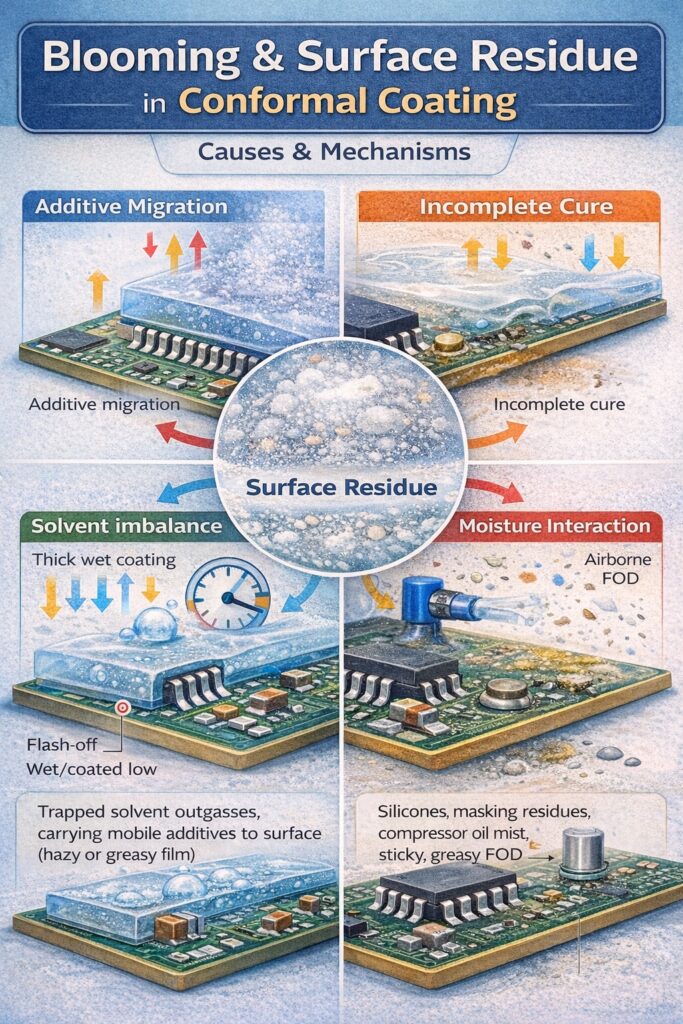
Blooming and surface residue are conformal coating defects where a hazy, waxy, greasy, powdery, or sticky film appears on the coating surface after drying or cure. These effects typically indicate additive or plasticiser migration, solvent imbalance, incomplete cure, or contamination transfer. This page explains how to identify the likely mechanism and how to prevent recurrence.
For a complete index of defect types and links to each technical article, use the Conformal Coating Defects Hub.
Article Quicklinks
| What it looks like: typical visual signatures | 🔗 |
| Why it matters: reliability and rework risks | 🔗 |
| Root causes: migration, cure, solvent, contamination | 🔗 |
| Quick checks: fast classification tests | 🔗 |
| Prevention: stopping recurrence | 🔗 |
| Sanity check: common look-alikes | 🔗 |
What “Blooming” Looks Like
- Waxy / chalky haze (often patchy) on the surface after cure.
- Greasy film that fingerprints or attracts dust.
- White bloom around component bases or edges where volatiles escape.
- Sticky residue that suggests under-cure, trapped solvent, or plasticiser migration.
Why Blooming & Residue Matters
A surface residue is not always “cosmetic”. It can create contamination pathways, reduce surface insulation resistance (SIR), interfere with adhesion of rework coatings, and indicate a coating that is not chemically stable in the field.
- Attracts dust and fibres → increases FOD entrapment risk during handling.
- Changes surface energy → can trigger fish-eyes / craters on recoats.
- Signals cure window issues → related to under-cure (tacky/soft).
Most Common Root Causes
1) Additive / Plasticiser Migration (Bloom)
Many coatings contain flow/levelling aids, slip agents, and other additives. If the formulation is stressed (wrong solvent balance, wrong film build, wrong cure), these can migrate to the surface and form a visible film.
- Often appears as a waxy haze or powdery bloom after cure.
- Can be worse on thicker areas (edges, pooling zones) or at temperature gradients.
2) Incomplete Cure / Wrong Cure Energy
Under-cured films can leave unreacted species near the surface, or allow mobile components to migrate over time.
- Check against Tacky / Soft-Cured (Under-Cure).
- Residue is often sticky rather than dry/waxy.
3) Solvent Imbalance / Trapped Volatiles
If flash-off is too short or film build is too wet/thick, solvent can remain and then transport material to the surface during cure.
- Often linked to pooling/puddling and heavy deposits.
- Can coexist with haze/whitening/blushing (moisture–solvent interaction).
4) Contamination Transfer (Handling, Masking, Airborne)
Some residues are not from the coating at all. Common culprits include silicones, release agents, masking residues, cleaning agent carryover, or compressor/oil aerosols.
- Can present alongside de-wetting or fish-eyes.
- May increase FOD capture: see Dust, Fibres & FOD.
Quick Checks (Fast Diagnosis)
Use these simple checks to classify the residue before changing process settings. (Always follow your customer rules and internal test procedures.)
A) Solvent Wipe Behaviour
- Wipes away cleanly and reappears later → likely migration (bloom) or outgassing transport.
- Smears / gets tacky → points to under-cure or a soft film.
- No change → may be external contamination or cured surface texture/haze.
B) Location Pattern
- Only in thick/low-point areas → suspect solvent entrapment, pooling, flash-off control.
- Near mask edges / connectors → suspect masking residue transfer or de-mask timing.
- Uniform across board → suspect formulation/cure window, humidity, or process recipe change.
C) Dust Attraction
- If the surface quickly becomes “dirty”, the top layer may be sticky (under-cure) or oily (contamination).
Prevention Actions (What Actually Stops Recurrence)
1) Lock the Cure Window
- Verify oven setpoint vs actual part temperature (profiling, not guesswork).
- Prevent soft films: validate against the Under-Cure guidance.
- Avoid pushing time/temperature beyond limits that can cause brittleness: see Over-Cure / Brittleness.
2) Control Film Build & Flash-Off
- Use multiple lighter passes rather than heavy wet coats.
- Standardise flash time and airflow before cure.
- Eliminate low-point accumulation: review Pooling & Puddling and Runs, Sags & Curtains.
3) Tighten Cleanliness & Contamination Controls
- Separate masking materials from clean handling zones (silicone transfer control).
- Confirm compressed air quality (oil/water filtration) where applicable.
- Reduce airborne load: see Dust, Fibres & FOD.
4) Validate Recoat Compatibility
- Residue can sabotage rework adhesion. If you are recoating or repairing, cross-check Wrinkling (Recoating Defects).
Sanity Check (Look-Alike Defects)
Not all “white films” are the same mechanism. Use these quick routes to avoid misdiagnosis:
- If the finish is cloudy/milky linked to humidity during drying, go to Haze, Whitening & Blushing.
- If the coating is soft/tacky overall and picks up dirt, route to Tacky / Soft-Cured (Under-Cure).
- If the issue appears mainly as circular pull-back or craters, route to Fish-Eyes & Craters.
- If the surface issue is texture/roughness rather than residue, check Orange Peel.
Need Help Eliminating Residue & Stability Issues?
If conformal coating blooming or residue is appearing after cure, the fix is rarely “wipe it off”. SCH can help you lock the process window (cleanliness, viscosity, film build, flash-off and cure) so the coating remains stable and repeatable.
Industry Standards We Work To
SCH Services follows international standards across all our coating services, training, equipment supply and materials. Our processes are aligned to the relevant IPC standards, including:
- IPC-A-610 – Acceptability of Electronic Assemblies
- IPC-CC-830 – Qualification & Performance of Conformal Coatings
- IPC-HDBK-830 – Conformal Coating Handbook (guidance and best practice)
For further details on IPC standards, visit: electronics.org/ipc-standards ↗
Explore Topic Hubs
Conformal Coating Processes Hub
Conformal Coating Equipment Hub
Conformal Coating Masking Hub
Conformal Coating Design Hub
Conformal Coating Defects Hub
Inspection & Quality Hub
Removal & Rework Hub
Standards Hub
Parylene Basics Hub
Parylene Application Hub
Why Choose SCH Services?
Partnering with SCH Services means more than just outsourcing — you gain a complete, integrated platform for Conformal Coating, Parylene & ProShieldESD Solutions, alongside equipment, materials, and training, all backed by decades of hands-on expertise.
- ✈️ 25+ Years of Expertise – Specialists in coating technologies trusted worldwide.
- 🛠️ End-to-End Support – Guidance on coating selection, masking, inspection, and ProShieldESD integration.
- 📈 Scalable Solutions – From prototype to high-volume production.
- 🌍 Global Reach – Support across Europe, North America, and Asia.
- ✅ Proven Reliability – Built on quality, consistency, and customer satisfaction.
📞 Call: +44 (0)1226 249019 | ✉ Email: sales@schservices.com | 💬 Contact Us ›