Delamination in Conformal Coating
Delamination is the loss of adhesion between the conformal coating and the PCB or component surfaces. It often appears as lifting, flaking, edge peel, or “sheeting” and can rapidly undermine environmental protection and long-term reliability.
For the complete index of defect types and links to each dedicated article, use the Conformal Coating Defects Hub. For wider process context (application methods, control windows and repeatability), see the Conformal Coating Processes Hub.
📄 Download:
Delamination defect bulletin (PDF)
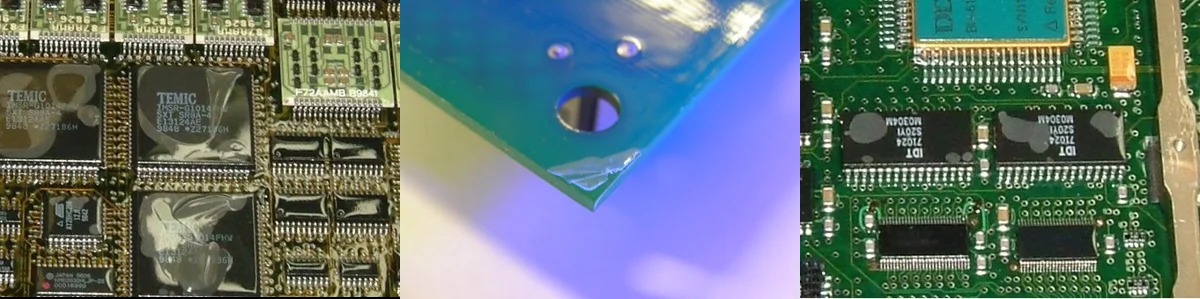
Once a peel front forms, moisture and contamination can track underneath the coating and cause hidden reliability failures.
Article Quicklinks
| Topic | More |
|---|---|
| Definitions: what delamination is and why it matters | 🔗 |
| How it forms: failure modes & “tell-tale” signs | 🔗 |
| Root Causes: surface, cure, stress, masking | 🔗 |
| Prevention: controls that actually stop recurrence | 🔗 |
| Troubleshooting & Diagnosis: isolate the real mechanism | 🔗 |
| Repair: when to touch-up vs strip & recoat | 🔗 |
What is Delamination in Conformal Coating?
- Definition: separation of the coating from the substrate (PCB solder mask, copper, components, inks), typically seen as lifting, peeling, flaking, or sheets of coating coming away.
- Why it matters: once the edge lifts, moisture and contamination can track underneath the film, causing hidden corrosion, leakage paths, and electrochemical failure mechanisms.
- Common line trigger: delamination that appears during de-masking or at sharp mask edges often indicates boundary contamination / weak interfacial wetting rather than a bulk “coating chemistry” issue.
How Delamination Forms (Mechanisms)
- Interface failure (adhesive): coating releases cleanly from the surface, leaving a “clean” substrate behind. Common drivers: low surface energy contamination, incompatibility, inadequate surface prep, poor wetting at boundaries.
- Internal failure (cohesive tear): coating tears within itself while some film remains attached. Common drivers: under-cure, poor film integrity, excessive solvent trap, or stress concentrating in a weak layer.
- Stress-driven peel: thermal/mechanical cycling concentrates stress at edges, corners, component boundaries, and mask lines (CTE mismatch). A small weak point becomes a peel front.
- Outgassing-assisted lift: moisture/volatiles from boards/components evolve during dry/cure and disrupt bonding at the interface—often seen as lift around dense parts or over porous materials.
Pattern clue: lift that starts at mask edges or appears during de-masking usually points to a boundary condition (contamination/low surface energy/sharp edge). Lift that appears after thermal exposure often points to stress + marginal adhesion.
Root Causes of Delamination
Surface & Cleanliness
- Low surface energy contamination — oils, silicones, surfactants, release agents, flux residues, and handling contamination prevent proper wetting and bonding.
- Inadequate cleaning / dry-out — contamination is redistributed rather than removed; trapped moisture undermines interface stability.
- Masking residue transfer — tapes/boots/dots and local silicone sources can introduce boundary contamination. (Common trigger: “looks fine until de-masking”.)
Cure & Film Build
- Under-cure — weak cohesive strength; film can tear and lift under handling or stress.
- Over-cure / embrittlement — reduced compliance; stress concentrates at edges and interfaces.
- Heavy single-pass film builds — wet film skins before fully wetting edges/features; marginal boundary adhesion later peels.
Stress, Compatibility & Substrates
- CTE mismatch — differential expansion between coating, solder mask, copper, component plastics/metals concentrates stress at interfaces.
- Material incompatibility — poor affinity to specific plastics, solder masks, inks, labels, or adhesives can produce repeatable lift patterns.
- Moisture in PCBs/components — outgassing during dry/cure disrupts bonding and promotes lift.
Diagnostic Cross-Check (look-alikes):
- If you see craters/islands/bare patches in wet film, route to de-wetting.
- If you see voids/pits, route to pinholes, bubbles & foam.
- If the surface is failing by fracture lines, route to cracking.
- If the trigger is masking choices, see why masking causes many conformal coating defects.
Related articles: Delamination is often linked to contamination, poor surface preparation or incorrect handling before coating. For a broader breakdown of process-related failure drivers, see Why Conformal Coating Processes Fail.
This is also exactly the kind of failure mode that high-reliability workmanship guidance tries to prevent through disciplined cleanliness, handling, inspection and verification. For the broader NASA-style process view, see What NASA Gets Right About Conformal Coating.
How to Prevent Delamination
Stabilise adhesion at the interface
- Validate cleaning (chemistry, rinse, dry-out) and enforce handling discipline to stop re-contamination.
- Segregate silicones: no silicone sprays, hand creams, or silicone-based maintenance products near coating.
- Use surface activation/adhesion promoters where required and qualified (do not “trial” on production without validation).
Control cure and film build
- Follow flash-off and cure guidance and verify using oven profiling (not just setpoint).
- Build film with controlled passes rather than heavy single coats, especially at mask boundaries and component edges.
- Manage moisture risk: where appropriate, pre-bake/dry boards and moisture-sensitive parts (validate vs components and specs).
Reduce stress concentration at edges
- Mask edge quality: avoid sharp, high-stress boundaries where possible; ensure demasking does not mechanically “start” a peel front.
- Confirm substrate compatibility across solder mask, inks, plastics and metals—especially if delamination is repeatable on one material.
For upstream control strategy, use Surface Preparation & Cleanliness and the Inspection & Quality Hub.
Troubleshooting & Diagnosis
1) Confirm the failure mode
- Adhesive vs cohesive: does the coating lift cleanly (interface failure) or tear (film integrity/cure issue)?
- Where it starts: mask edge, component boundary, specific substrate (ink/plastic), or random field locations.
2) Check the three big levers
- Cleanliness: audit cleaning/rinse/dry-out, handling discipline, and contamination sources (especially silicones and masking residues).
- Cure profile: verify flash-off, ramp, and soak; look for embrittlement or under-cure indicators.
- Stress: review thermal exposure, thickness build, and edge conditions where peel fronts form.
3) Prove the hypothesis
- Adhesion checks: tape-pull / cross-hatch on representative witness coupons (and on-board where allowed) to see if adhesion is globally marginal or localised.
- Microscopy / cross-section (when needed): locate the separation interface and look for residue layers.
- Witness strategy: run known-clean coupons alongside production to separate board-related from process-related effects.
📄 For the condensed version for your team: download the PDF bulletin.
Repair: When to Touch-Up vs Strip & Recoat
- Local mask-edge lift: if lift is small/local and the underlying surface can be cleaned and stabilised, controlled edge prep + touch-up may be appropriate (subject to spec/acceptance).
- Widespread clean lift: usually indicates a systemic surface-energy/cleanliness or compatibility issue → strip, re-clean, and recoat is normally the robust route.
- Contamination under the film: do not “seal over” contamination—remove affected coating, clean correctly, then recoat.
- Non-inspectable lift fronts (under components): treat as a process escape and rework accordingly; hidden pathways are high risk in harsh environments.
For removal workflows and best-fit methods, see the Removal & Rework Hub.
Looking for Other Defect Types?
This page focuses specifically on delamination. For the complete index of defect types and links to each technical article:
Industry Standards We Work To
SCH Services aligns coating services, training, equipment supply and materials to relevant IPC standards, including:
- IPC-A-610 – Acceptability of Electronic Assemblies
- IPC-CC-830 – Qualification & Performance of Conformal Coatings
- IPC-HDBK-830 – Conformal Coating Handbook (guidance and best practice)
For further details on IPC standards: electronics.org/ipc-standards ↗
Explore Topic Hubs
Conformal Coating Processes Hub
Conformal Coating Equipment Hub
Conformal Coating Masking Hub
Conformal Coating Design Hub
Conformal Coating Defects Hub
Inspection & Quality Hub
Removal & Rework Hub
Standards Hub
Parylene Basics Hub
Parylene Design Hub
Parylene Application Hub
Parylene Dimers Hub
Why Choose SCH Services?
You gain a complete, integrated platform for Conformal Coating, Parylene & ProShieldESD—plus equipment, materials and training—backed by decades of hands-on process support.
- 🛠️ End-to-End Support – Selection, masking, inspection and troubleshooting.
- ✅ Process Discipline – Recipes, control windows and repeatability.
- 🌍 Global Reach – Support across Europe, North America and Asia.
📞 Call: +44 (0)1226 249019 | ✉ Email: sales@schservices.com | 💬 Contact Us ›