Conformal Coating Standards Hub
IPC, IEC, UL, MIL and NASA guidance for coating materials, workmanship, electrical design and process control
This hub explains how the principal standards used around conformal coating and Parylene fit together—and, critically, what each standard actually controls.
No single standard controls every part of a coated electronics process. Different documents address different engineering questions, including coating-material qualification, finished-assembly workmanship, electrical insulation coordination, polymeric-material evaluation, high-reliability process discipline and contractual requirements.
The principal standards discussed here include IPC-A-610, IPC-CC-830, MIL-I-46058C, IEC 60664-1, the UL 746 family and NASA-STD-8739.1. Use this hub to identify which type of requirement applies before translating it into coating selection, PCB design, process control, inspection and qualification.
A material qualification, workmanship standard or safety standard answers a different question. Meeting one requirement does not automatically demonstrate compliance with the others or prove that the finished product is suitable for its operating environment.
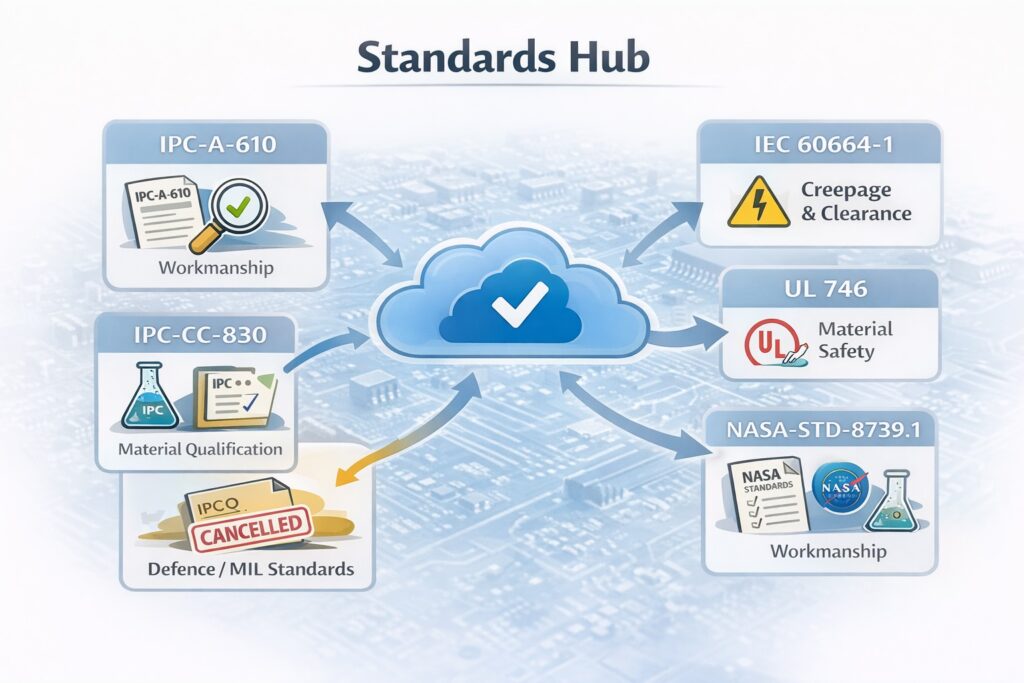
Different standards control different parts of the coating system: material qualification, workmanship, electrical design, polymer evaluation, contractual requirements and high-reliability process control.
Where Are You in the Standards Decision?
Start with the requirement you are trying to control rather than with the name of a standard.
- I need to decide whether the finished coated assembly is acceptable → IPC-A-610
- I need evidence that a conformal coating material has passed a recognised qualification regime → IPC-CC-830
- A legacy military drawing calls up MIL-I-46058C → MIL-I-46058C
- I am designing creepage, clearance or an insulation system → IEC 60664-1
- I need to understand UL polymeric-material evaluation or recognition → UL 746 Family
- I need high-reliability workmanship and process discipline for polymeric applications → NASA-STD-8739.1
- I need to know where Parylene fits into these standards → Parylene and Standards
- I need to turn requirements into inspection criteria → Inspection & Quality Hub
- I need to turn requirements into PCB design decisions → Conformal Coating Design Hub
First Decide What Type of Standard You Are Dealing With
Many coating specifications become confusing because standards with completely different purposes are grouped together. This comparison provides the starting distinction.
| Standard | Requirement Type | Primary Question | Does It Qualify the Finished Product? |
|---|---|---|---|
| IPC-A-610 | Assembly workmanship / acceptability | Is the manufactured electronic assembly acceptable? | No—not by itself. |
| IPC-CC-830 | Coating-material qualification and conformance | Has the conformal coating material met the specified qualification requirements? | No—it primarily addresses the coating material. |
| MIL-I-46058C | Legacy military material specification | What does a historical military coating requirement mean for this programme? | No—and the specification is cancelled. |
| IEC 60664-1 | Electrical insulation coordination / basic safety | What clearances, creepage distances and insulation criteria are required? | No—it forms part of the electrical design framework. |
| UL 746 Family | Polymeric-material and application evaluation | How is a polymeric material or its use evaluated for the relevant electrical-equipment application? | No—product certification remains application-specific. |
| NASA-STD-8739.1 | Polymeric-application workmanship and quality assurance | How should high-reliability polymeric applications be controlled and verified? | No—programme and hardware requirements still apply. |
Engineering rule: Material qualification, process control, workmanship acceptance, electrical design and product qualification are separate layers. A robust coating specification connects them rather than assuming that one standard covers everything.
Standards Guide Index
| Topic | Summary | Guide |
|---|---|---|
| IPC-A-610 – assembly workmanship, coating coverage, thickness and acceptability | ↓ | Read ↗ |
| IPC-CC-830 – conformal coating material qualification and conformance | ↓ | Read ↗ |
| MIL-I-46058C – cancelled military coating specification and legacy drawing requirements | ↓ | Read ↗ |
| IEC 60664-1 – insulation coordination, creepage, clearance and solid insulation | ↓ | Read ↗ |
| UL 746 Family – polymeric-material properties and use in electrical equipment | ↓ | — |
| NASA-STD-8739.1 – workmanship and quality-assurance requirements for polymeric applications | ↓ | Read ↗ |
| Parylene and Standards – IPC Type XY, legacy MIL Type XY and application-specific Parylene specification | ↓ | Read ↗ |
IPC-A-610 – Acceptability of Electronic Assemblies
IPC-A-610 is an electronic-assembly acceptability standard. Its conformal coating requirements are concerned with evaluating the finished assembly rather than qualifying the coating material itself.
- Required coating coverage and uncoated areas.
- Coating thickness where applicable.
- Voids, bubbles and visible coating conditions.
- Coating on surfaces or features intended to remain free from material.
- Acceptance requirements associated with the applicable assembly class and contractual documentation.
IPC-A-610 therefore belongs primarily in the workmanship and inspection layer. It should not be used as a substitute for a coating-material qualification document, detailed coating drawing, application process instruction or product environmental qualification programme.
In practice, inspection should combine the applicable IPC criteria with clearly defined coated areas, keep-outs, customer requirements, suitable illumination and magnification, coating-specific inspection methods and documented rules for disposition and escalation.
IPC-CC-830 – Conformal Coating Material Qualification
IPC-CC-830 establishes qualification and conformance requirements for electrical insulating compounds used as conformal coatings on printed wiring assemblies. Its primary role is material qualification, not finished-product qualification.
- Defines recognised coating classifications and qualification requirements.
- Provides a framework for qualification retention and material conformance.
- Supports controlled material selection and approved-material requirements.
- Provides defined test methods and performance requirements under specified conditions.
- Includes conventional liquid coating chemistries as well as Type XY – Paraxylylene and ultra-thin coating classifications.
A material meeting IPC-CC-830 does not automatically mean that every assembly coated with it is reliable. Cleaning, surface condition, application or deposition process, thickness, cure where applicable, masking, geometry, adhesion and inspection all influence performance on the real product.
Where IPC-CC-830 is specified, the product documentation should still define the approved coating, thickness requirement, coated areas and keep-outs, preparation and processing requirements, inspection criteria and any environmental or electrical validation required by the application.
MIL-I-46058C and Legacy Military Coating Requirements
MIL-I-46058C was historically used as a military specification for conformal coating materials and has been cancelled. It nevertheless continues to appear on legacy drawings, approved-material lists and contractual documentation.
The original specification covered coating types including acrylic, epoxy, silicone, polyurethane and Type XY – Paraxylylene, and recognised application by methods including vacuum deposition.
When MIL-I-46058C appears on current documentation, establish whether it represents:
- A historical material call-out that has never been updated.
- A contractual requirement that remains binding for that programme.
- A requirement for a previously qualified or approved coating.
- A customer-specific flow-down that must not be changed without design-authority approval.
Do not automatically replace a legacy MIL call-out with IPC-CC-830 simply because the documents address similar subject matter. The correct route should be agreed with the customer, contracting authority or design authority and formally reflected in the controlled product documentation.
IEC 60664-1 – Insulation Coordination, Creepage and Clearance
IEC 60664-1 is fundamentally an electrical insulation-coordination and basic-safety standard. It provides principles, requirements and tests used to determine clearances, creepage distances and criteria for solid insulation for equipment within its defined low-voltage scope.
The design process may need to consider factors including:
- Working or rated voltage.
- Overvoltage conditions and the relevant equipment framework.
- Clearance through air.
- Creepage distance across insulating surfaces.
- Pollution degree and environmental conditions.
- Material characteristics relevant to surface tracking.
- Altitude and other conditions that affect insulation coordination.
- Solid-insulation requirements and associated testing.
Conformal coating does not automatically permit reduced creepage or clearance. Whether a coating can influence an insulation design depends on the applicable product standard, insulation concept and the ability to demonstrate that the coating remains controlled and effective throughout production and service.
If electrical safety depends on a coating, the engineering question moves beyond simply choosing a material. Coverage, adhesion, thickness where relevant, contamination control, defects, processing consistency, inspection and long-term environmental performance become part of the insulation-control strategy.
Current-edition note: Standards evolve. IEC currently publishes IEC 60664-1:2020 together with Amendment 1:2025 as a consolidated edition. Contractual and certification work should always be checked against the exact edition invoked by the product standard, drawing or certification route.
UL 746 Family – Polymeric Materials and Electrical-Equipment Evaluation
The UL 746 family is not one generic conformal-coating standard. Different parts address different aspects of polymeric-material evaluation, so a reference to “UL 746” should be narrowed to the actual requirement involved.
- UL 746A – short-term property evaluations of polymeric materials.
- UL 746B – long-term property evaluations of polymeric materials.
- UL 746C – evaluation of polymeric materials used in electrical equipment and their use in specific applications.
- UL 746E – industrial laminates and materials used in printed wiring boards.
For conformal coating work, engineers should therefore determine the exact UL requirement, material recognition and end-product certification route rather than relying on a general statement such as “UL approved.”
Check the exact formulation, recognised use, thickness or construction conditions where applicable, substrate or application limitations, temperature requirements and any conditions attached to the recognition.
Flammability should also be distinguished from the UL 746 family. UL 94 is the dedicated UL standard widely used for flammability testing of plastic materials. A flammability classification is not the same thing as overall product certification or suitability of a conformal coating for a particular electrical assembly.
Ultimately, using a recognised polymeric material does not automatically make the finished product UL certified. Compliance depends on the complete construction and the applicable end-product certification requirements.
NASA-STD-8739.1 – Polymeric Applications Workmanship
NASA-STD-8739.1 is a workmanship standard for polymeric applications on electrical and electronic assemblies. Its scope includes requirements for activities such as staking, conformal coating, bonding and encapsulation.
The standard is especially useful for understanding the systems approach required in high-reliability manufacture. Reliability is not created by inspecting a coating at the end of production; it is built by controlling the complete process.
- Personnel: appropriately trained and authorised operators and inspectors.
- Materials: controlled materials, traceability and defined processing requirements.
- Preparation: cleanliness, contamination control and suitable assembly condition before polymer application.
- Application: documented and controlled polymeric application methods.
- Process evidence: records demonstrating that required operations were performed correctly.
- Inspection: defined acceptance criteria rather than subjective judgement.
- Rework and deviations: controlled handling of repairs, nonconformances and authorised departures.
NASA requirements should not simply be copied into an unrelated commercial process. The transferable engineering lesson is the importance of disciplined process definition, personnel competency, traceability, contamination control, inspection and configuration control where high reliability is required.
Current-edition note: NASA currently identifies NASA-STD-8739.1B, Change 2 as active. Always verify the current controlled document and programme-specific flow-down before contractual use.
Where Parylene Fits into Conformal Coating Standards
Parylene should remain within this Standards Hub. It is not outside the established conformal-coating standards framework simply because it is applied by vapour deposition rather than from a liquid.
IPC-CC-830 includes Type XY – Paraxylylene within its conformal coating classifications. The older MIL-I-46058C specification also included Type XY and specifically recognised vacuum deposition as an application route.
However, the phrase “Parylene to IPC” is still insufficient as a production specification. A controlled Parylene requirement should normally identify:
- The Parylene grade or approved dimer/material system.
- The applicable material qualification or customer approval requirement.
- Nominal, minimum and maximum coating thickness.
- Coated surfaces, masking boundaries and prohibited coating areas.
- Cleaning, drying or bake-out requirements.
- Adhesion promotion, plasma treatment or other preparation where required.
- Deposition and process-control requirements where these are critical.
- Thickness-verification method and witness-coupon requirements.
- Inspection and acceptance criteria.
- Electrical, environmental, chemical, thermal or biological validation specific to the application.
- Lot traceability, production records and deviation controls.
This distinction is important because a qualified Parylene material does not automatically validate a particular deposition process or prove reliability on a specific product. Material qualification, deposition control and product qualification remain separate engineering layers.
From Standard to Production Control
A standard only becomes useful when its requirements are translated into controls that design, production and inspection teams can apply consistently.
- Conformal Coating Design Hub – convert requirements into keep-outs, layout, creepage, clearance and coating-friendly design.
- Surface Preparation Hub – cleanliness, drying, contamination control and adhesion readiness.
- Process Control Hub – establish stable application, thickness, curing and production controls.
- Inspection & Quality Hub – translate requirements into measurable acceptance criteria and verification.
- Conformal Coating Defects Hub – understand coating defects and their process causes.
- Parylene Basics Hub – Parylene grades, deposition, masking, adhesion and specification.
- Parylene Process & Reliability Hub – translate Parylene requirements into controlled deposition and repeatable production.
Official Standards Resources
For contractual, certification or compliance work, always verify the complete authorised standard and the revision required by the product specification or customer.
- IPC – IPC standards and current publications.
- IEC Webstore – official IEC standards and revision status.
- UL Solutions – standards, certification and material-evaluation information.
- NASA Technical Standards System – controlled NASA standards and document status.
- ASSIST / DLA Quick Search – US military specifications and document-status information.
Need Help Turning a Standard or Drawing into a Coating Process?
SCH Services can review the coating requirements on a drawing, customer specification or standards flow-down and help translate them into practical manufacturing and inspection controls.
Useful information to send us includes: the drawing or specification, applicable standard and revision, coating material or proposed material, required thickness, coated areas and keep-outs, product environment, electrical requirements and any defined acceptance or qualification tests.
- Drawing and coating-specification review.
- Identification of material, workmanship, design and qualification requirements.
- Thickness, coating-boundary and keep-out definition.
- Process and inspection-plan development.
- Prototype coating and qualification support.
- Parylene specification and process review.
- Training and consultancy for engineering, production and quality teams.
Why Choose SCH Services?
SCH Services works across coating design, application, inspection, training and process development, helping customers turn written standards into practical and repeatable manufacturing controls.
- Practical coating experience – standards interpretation linked to real coating and manufacturing requirements.
- Process-led support – design review, material selection, preparation, coating, inspection and production control considered as one system.
- Liquid conformal coating and Parylene – support across conventional coating processes and vapour-deposited Parylene.
- Training and consultancy – support for engineering, production, inspection and quality teams.
- Qualification support – development trials and validation planning for customer-specific applications.
📞 Call: +44 (0)1226 249019 | ✉ Email: sales@schservices.com | 💬 Contact Us ›
Disclaimer: This content provides general technical guidance on conformal coating, Parylene and industry standards. Standards, amendments, revisions, certification requirements and customer specifications must be reviewed in their complete authorised form. The applicable standard and revision may depend on the product, contract, certification route and design authority. Final design, safety, compliance, material-selection and qualification decisions remain the responsibility of the product manufacturer, design authority and applicable certification or approval body.