Parylene Design for Manufacturability
Design rules that improve yield, throughput and stable production coating
← Back to the Parylene Design Hub
Parylene design for manufacturability focuses on making coatings repeatable in real production—not just “good enough” on a prototype. Many assemblies coat successfully once, but fail in volume due to masking variation, handling damage, inconsistent fixturing or poor access for inspection.
This article explains how to apply Parylene design for manufacturability principles so coating performance remains stable as you scale from prototype builds to regular production.
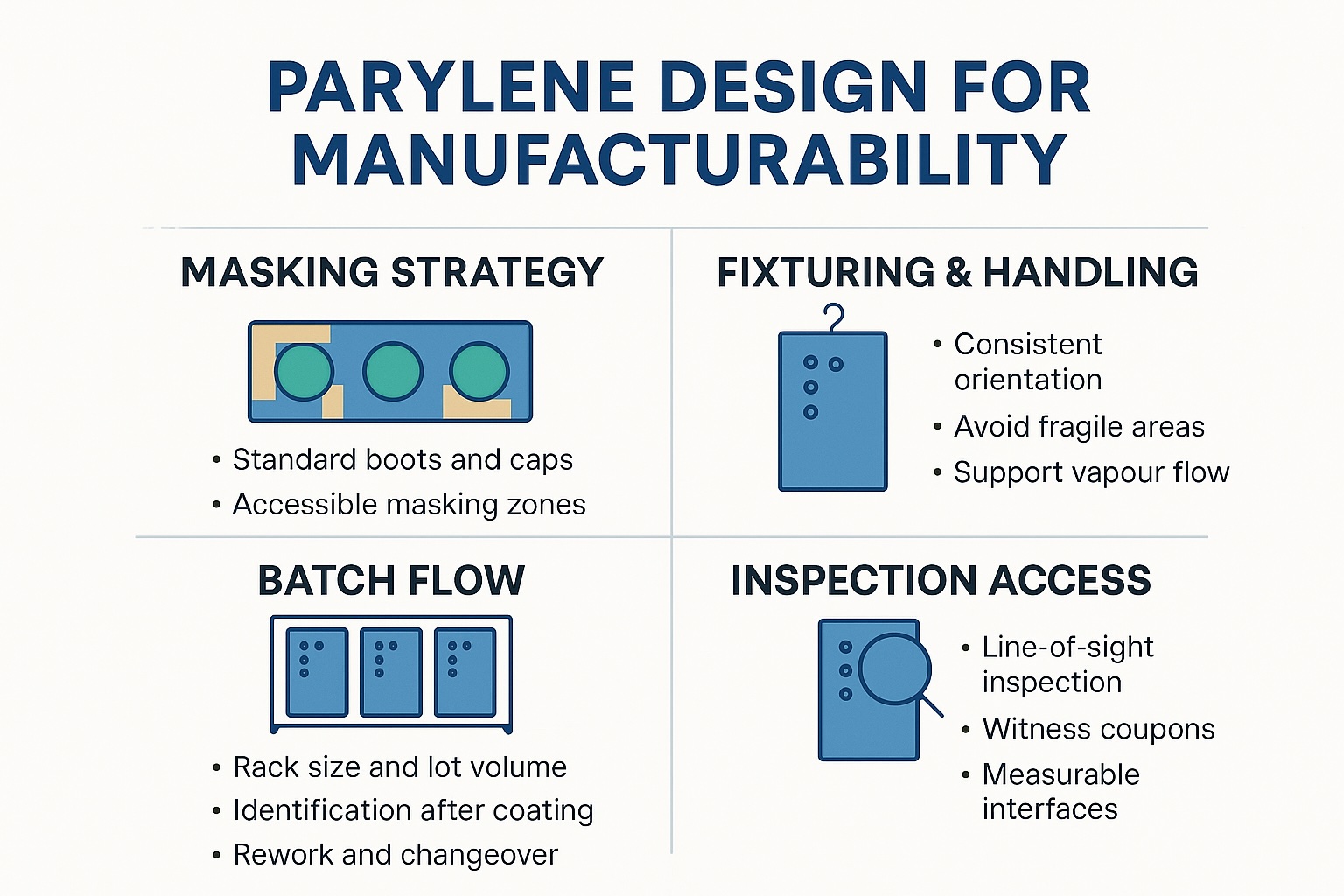
Key design-for-manufacturability rules that improve yield, throughput and production stability in Parylene coating.
Why Manufacturability Matters for Parylene Coating
Parylene design for manufacturability matters because production success depends on controlling variation. Key outcomes include:
- Consistent coating coverage and fewer escapes
- Reduced masking labour and improved repeatability
- Stable cycle times and predictable throughput
- Reliable inspection and defect detection
A manufacturable design reduces cost and improves reliability across the product lifecycle.
Masking Strategy and Standardisation
Manufacturable masking uses standard methods wherever possible:
- Design keep-outs that support standard boots, caps and fixtures
- Group masked features into accessible zones
- Avoid numerous tiny, isolated keep-outs
- Provide stable edges and surfaces for repeatable masking lines
Strong Parylene design for manufacturability aims to minimise manual masking variation.
Fixturing, Orientation and Handling
Fixturing and handling should be designed in, not improvised:
- Add handling points that avoid critical coated surfaces
- Maintain consistent orientation for deposition repeatability
- Ensure parts can be loaded/unloaded without damage
- Use fixtures that support airflow and vapour access
These steps are core to Parylene design for manufacturability in production environments.
Batch Flow, Lot Size and Process Capability
Design should align with expected production volume:
- Consider batch size and how parts will be racked
- Minimise features that slow masking or increase changeover time
- Ensure identification and traceability remain readable after coating
- Plan for rework access if selective removal is required
Parylene design for manufacturability links design decisions to practical throughput and quality control.
Inspection Access and Verification
Production reliability depends on inspection access:
- Design for line-of-sight inspection of critical areas
- Plan witness coupons or control samples where required
- Ensure key interfaces remain measurable and testable
If you cannot inspect or test it reliably, you cannot control it in production.
Explore Topic Hubs
Why Work with SCH on Parylene DFM?
SCH supports customers applying Parylene design for manufacturability through:
- Design-led reviews focused on masking, fixturing and inspection access
- Turnkey capability covering coating services, equipment, dimers and training
- Cross-sector experience in medical, aerospace, automotive and industrial electronics
- Scale-up support from feasibility through qualification and stable production
Call: +44 (0)1226 249019 · Email: sales@schservices.com
Contact SCH to discuss manufacturability and scale-up ›
Disclaimer: This article provides general guidance on Parylene design for manufacturability. Performance, suitability and compliance depend on the specific design, materials and environment. SCH Services can review assemblies and specifications to confirm the most appropriate Parylene coating approach.