Parylene Coating Thickness Selection
How to specify realistic, manufacturable Parylene thickness ranges
← Back to the Parylene Design Hub
The correct Parylene coating thickness selection is one of the most important design decisions for long-term reliability. Thickness directly influences moisture barrier performance, dielectric strength, mechanical behaviour and cost.
This guide explains how to define a thickness band—not a single number—based on environment, electrical risk, geometry and production realities.
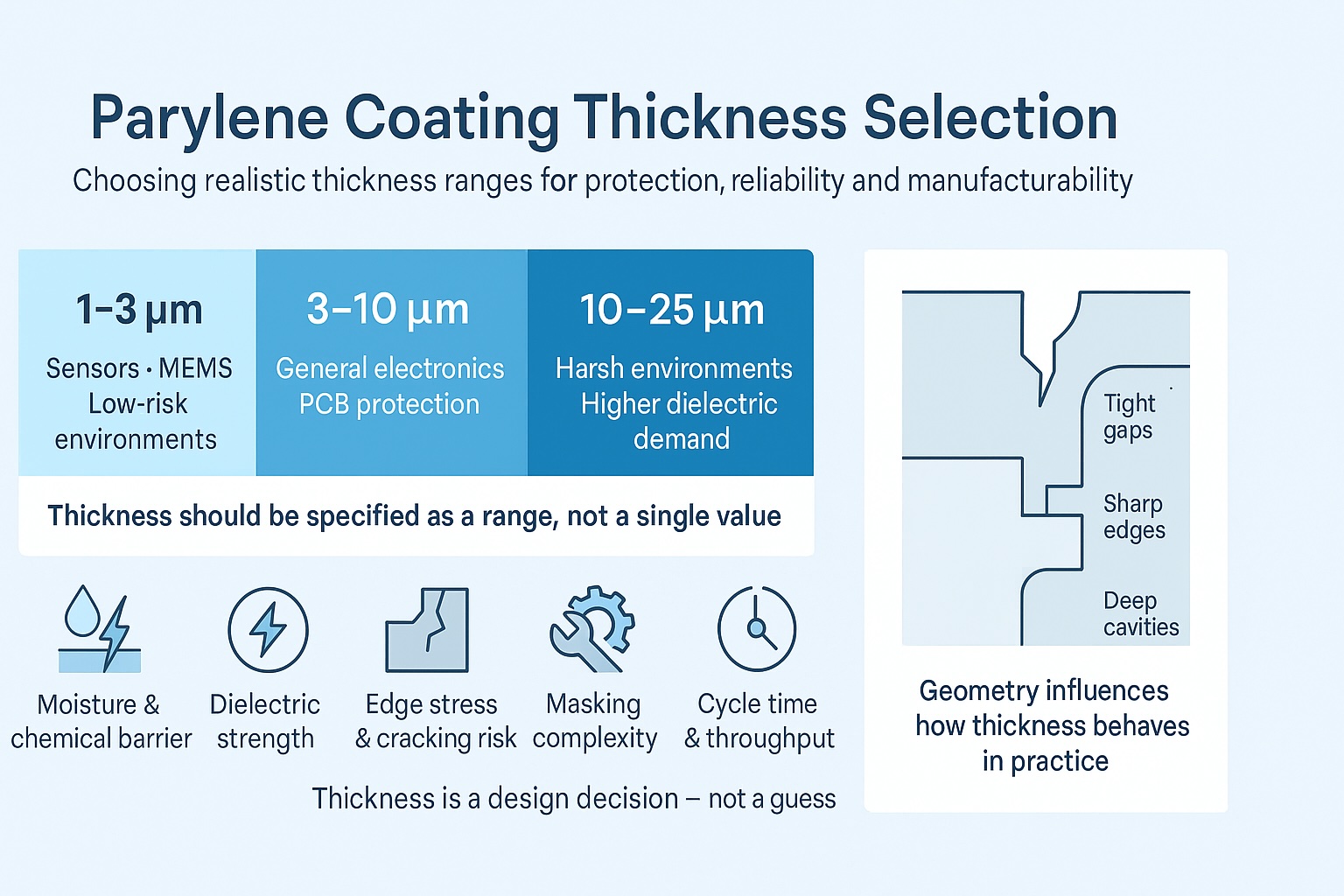
Typical Parylene coating thickness ranges and the key design and manufacturability factors that influence selection.
Why Thickness Is a Design Variable
- Too thin: risk of moisture ingress, dielectric breakdown and early failure.
- Too thick: higher cost, longer cycles, edge stress and masking challenges.
- Correctly specified: balanced protection, yield and scalability.
Parylene is deposited molecule-by-molecule, but geometry still affects how thickness behaves in practice.
Typical Thickness Ranges
- 1–3 µm: sensors, MEMS, low-risk environments.
- 3–10 µm: general electronics, PCB protection.
- 10–25 µm: harsh environments, higher dielectric demand.
Final values should always be verified by testing, not assumed.
Geometry, Gaps & Edge Effects
Thickness behaves differently in:
- Very tight gaps and under components
- Sharp edges and corners
- Deep cavities and blind holes
Designers must understand where Parylene coating thickness selection is functionally critical and where variation is acceptable.
How to Specify Thickness Correctly
- Specify a minimum and maximum thickness
- Define critical measurement locations
- Reference witness coupons where appropriate
- Align thickness with inspection capability
Explore Topic Hubs
Why Work with SCH on Parylene Design?
SCH combines practical coating services with Parylene equipment, dimers and training, allowing you to integrate Parylene into designs at concept stage and carry that through to production.
- Design-led support – focus on layout, materials and manufacturability from the outset.
- Turnkey capability – services, systems, materials and training from a single partner.
- Experience across sectors – medical, aerospace, automotive, industrial and defence.
- Clear pathway from prototype to volume – feasibility trials, qualification and ramp-up support.
Call: +44 (0)1226 249019 · Email: sales@schservices.com
Contact SCH to discuss your Parylene design requirements ›
Disclaimer: This hub provides general design guidance only. Performance, suitability and compliance depend on the specific design, materials and environment. SCH Services can review assemblies and specifications to confirm the most appropriate Parylene coating approach.