Conformal Coating vs Nano Coating vs Parylene: How to Choose the Right Protection Strategy
Choosing PCB protection based on failure mode, geometry and process control — not just coating type
Most teams start with the wrong question.
They ask whether they need conformal coating, nano coating or Parylene. In practice, the better question is: what failure are we trying to prevent, and what process can control the boundary safely?
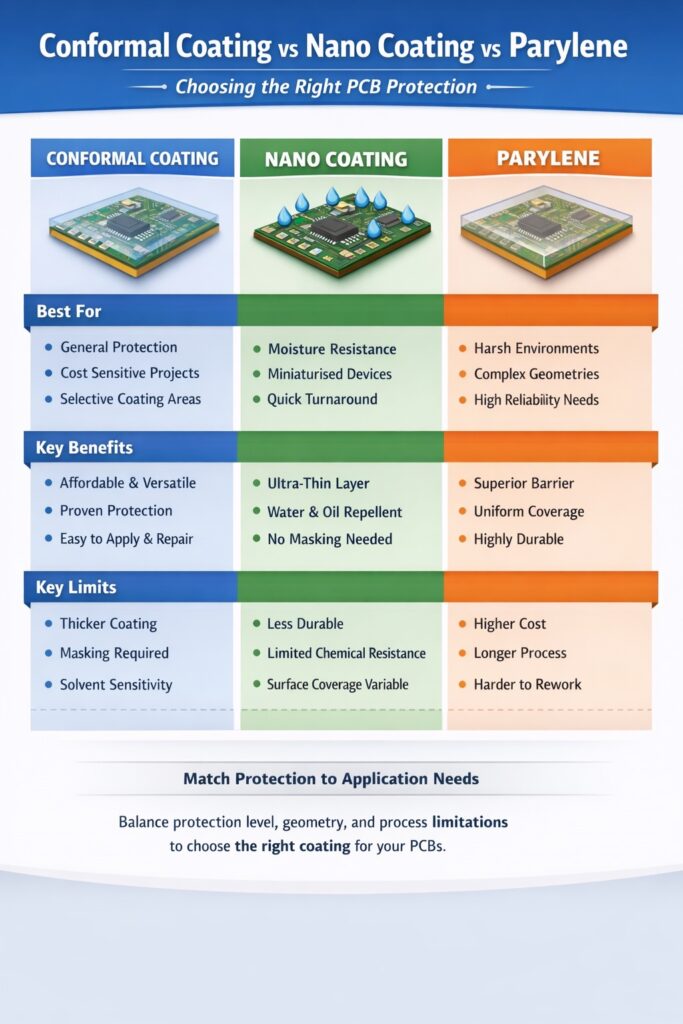
Each protection route has strengths, limits and process implications. Conventional conformal coatings provide thickness and barrier performance. Nano coatings provide ultra-thin hydrophobic enhancement. Parylene provides highly conformal vapour-deposited coverage with excellent uniformity, but it also creates masking and rework implications.
The right choice is usually driven less by “best material” thinking and more by geometry, connector sensitivity, contamination risk, rework requirements and realistic process capability.
1) Start with failure mode, not coating preference
Different protection systems solve different problems.
- Moisture and environmental exposure: may point towards conformal coating or Parylene
- Complex geometry and full 3D coverage: may favour Parylene or a hybrid approach
- Connector-sensitive designs: may rule out thick local film build in critical areas
- Contamination adhesion and wetting reduction: may suit nano coating as an enhancement layer
- Reworkability and field repair: may favour conventional conformal coating over Parylene
If the real failure mode is not defined first, the coating decision often becomes a guess dressed up as a materials choice — especially when surface preparation and cleanliness are not properly controlled.
2) Conventional conformal coating: where it is strongest
Conventional conformal coating remains the most common protection route because it offers a practical balance of barrier protection, inspection, cost and reworkability.
- Provides useful film thickness and insulation margin — supported by proper thickness measurement and control
- Available in multiple chemistries for different environments — see choosing the right conformal coating material
- Can be sprayed, dipped, brushed or selectively applied
- Usually easier to inspect and repair than Parylene
- Often the most practical option for mainstream production
Its weakness is not that it “does not work”. It is that liquid behaviour introduces process risk around boundaries, under components and around connectors.
That is why difficult boards often fail through geometry and process behaviour rather than chemistry alone, including how the coating behaves during curing and drying behaviour. For the wider reality behind these failures on dense, mixed-function boards, see Why Conformal Coating Fails in Complex PCB Assemblies.
3) Nano coating: where it adds value
Nano coatings are best understood as surface-function enhancement layers, not direct replacements for thicker conformal coatings.
- Very thin coverage with minimal build-up
- Hydrophobic surface behaviour
- Can reach difficult regions with simple whole-board application
- Useful where connectors or interfaces cannot tolerate thick coating
- Can reduce wetting and reduce some contamination adhesion
Their weakness is also obvious: they do not provide the same thickness, dielectric build or physical barrier depth as conventional conformal coating.
That is why nano coating is strongest when used in the right role, not when oversold as a universal replacement. See What Nano Coatings Can and Can’t Do on PCB Assemblies.
4) Parylene: where it is strongest
Parylene is a very different protection route. It is deposited from vapour phase and forms a highly conformal coating over exposed surfaces, including complex internal geometry.
- Extremely uniform 3D coverage
- Very strong performance on complex shapes and fine features
- No liquid flow, pooling or meniscus in the usual sense
- Well suited to demanding environments where uniformity matters
Its trade-offs are equally important:
- Connector interfaces and keep-out zones become more critical
- Masking discipline is essential
- Rework is more specialised
- Process route and capital requirements are different from liquid coating
Parylene is often the right answer for some assemblies, but it is rarely the easiest answer for assemblies with complex mating interfaces that must remain uncoated.
Quick comparison:
- Conformal coating: best all-round mainstream route where thickness, practicality and reworkability matter
- Nano coating: best as a thin enhancement layer where build-up must stay minimal
- Parylene: best where highly conformal vapour-deposited uniformity is needed and masking can be controlled properly
5) The real selection problem is usually boundary control
Many selection decisions are really about boundary control rather than protection level alone.
- If the board has sensitive keep-out zones, conventional conformal coating may become difficult to control
- If the board contains press-fit connectors, thick film ingress may be unacceptable
- If the design needs full-board treatment without aggressive masking, nano coating may help
- If exposed internal features must be coated uniformly, Parylene may be the strongest route
This is why software paths and machine accuracy alone do not solve the problem in liquid systems.
For the practical reality of liquid edge control, see Selective Conformal Coating Accuracy: Why ±1 mm Is the Reality. For the wider interaction between geometry, contamination and process limits, see Why Conformal Coating Fails in Complex PCB Assemblies.
6) Connectors often decide the whole strategy
On many complex assemblies, the connector is the real decision-maker.
- Press-fit interfaces do not tolerate unwanted film ingress well
- Liquid coatings can wick into hidden contact areas
- Parylene can penetrate exposed internal features if not masked
- Thicker local coating may conflict directly with electrical function
In these designs, “best protection” cannot be defined by barrier performance alone. It must include what has to stay electrically functional.
For that reason, connector-heavy boards often push the decision towards either highly controlled masking, a hybrid approach, or a fundamentally different process route. See Press-Fit Connector Coating Problems: Why They Cause Failures and How Conformal Coating and Parylene Interfere with Press-Fit Electrical Contacts.
7) When hybrid strategy is the best answer
A hybrid strategy becomes powerful when no single coating route can solve the whole assembly safely.
- Use conventional conformal coating where primary protection and thickness matter
- Keep connector-sensitive regions free from thick coating
- Apply nano coating as a full-board enhancement layer afterwards
This is often the most practical answer for boards with mixed functional regions, connector risk and contamination sensitivity.
See Hybrid Coating Strategy: Combining Conformal and Nano Coatings for Complex PCBAs.
Important:
There is no universally “best” PCB protection technology. The right answer depends on what must be protected, what must remain functional, and what the process can control consistently in production.
8) A simple decision framework
A practical way to decide is to ask:
- Do we need thickness and barrier depth? → lean towards conformal coating
- Do we need ultra-thin enhancement with minimal build? → consider nano coating
- Do we need highly conformal vapour coverage on complex 3D geometry? → consider Parylene
- Do connectors or keep-outs make single-route coating unstable? → consider hybrid strategy
- Do we need easy rework and field serviceability? → conventional conformal coating is often stronger operationally
This keeps the decision grounded in application reality instead of brochure language and aligns with the practical conformal coating process routes and methods used in production.
9) Summary
Choosing between conformal coating, nano coating and Parylene is really about choosing the right protection strategy for the failure mode and process constraints.
- Conformal coating is usually best where thickness, practicality and reworkability matter
- Nano coating is best used as a thin enhancement layer, not a direct replacement
- Parylene is strongest where highly conformal vapour-deposited uniformity is needed
- Hybrid strategy is often the best route where one technology cannot safely solve the whole assembly
The right answer starts with the real engineering problem — not the product label. Where conventional coating continues to fail on difficult assemblies, the next step is usually understanding why conformal coating fails in complex PCB assemblies.
Related process articles:
- Why Conformal Coating Fails in Complex PCB Assemblies
- Selective Conformal Coating Accuracy: Why ±1 mm Is the Reality
- What Nano Coatings Can and Can’t Do on PCB Assemblies
- Hybrid Coating Strategy: Combining Conformal and Nano Coatings for Complex PCBAs
- Press-Fit Connector Coating Problems: Why They Cause Failures
- How Conformal Coating and Parylene Interfere with Press-Fit Electrical Contacts
Why Choose SCH Services?
SCH Services helps customers choose protection strategies based on real process behaviour, connector risk, geometry and production needs. We support design review, coating selection, process development, masking strategy and practical validation.
- ✈️ 25+ Years of Expertise – Specialists in coating technologies
- 🛠️ Process-Led Support – Selection based on function, not assumptions
- 📈 Scalable Solutions – From NPI through to production
- 🌍 Global Support – UK, Europe, Asia and North America
- ✅ Practical Reliability Focus – Built around what real assemblies and real processes can achieve
📞 Call: +44 (0)1226 249019 | ✉ Email: sales@schservices.com | 💬 Contact Us ›