
Test Coupons & Witness Boards
Coverage & thickness validation tools for conformal coating processes
Conformal coating test coupons and witness boards let you validate coverage, edge definition and thickness before you risk production assemblies. They are essential for proving that your spray, dip or Parylene process is stable, repeatable and compliant with your design rules.
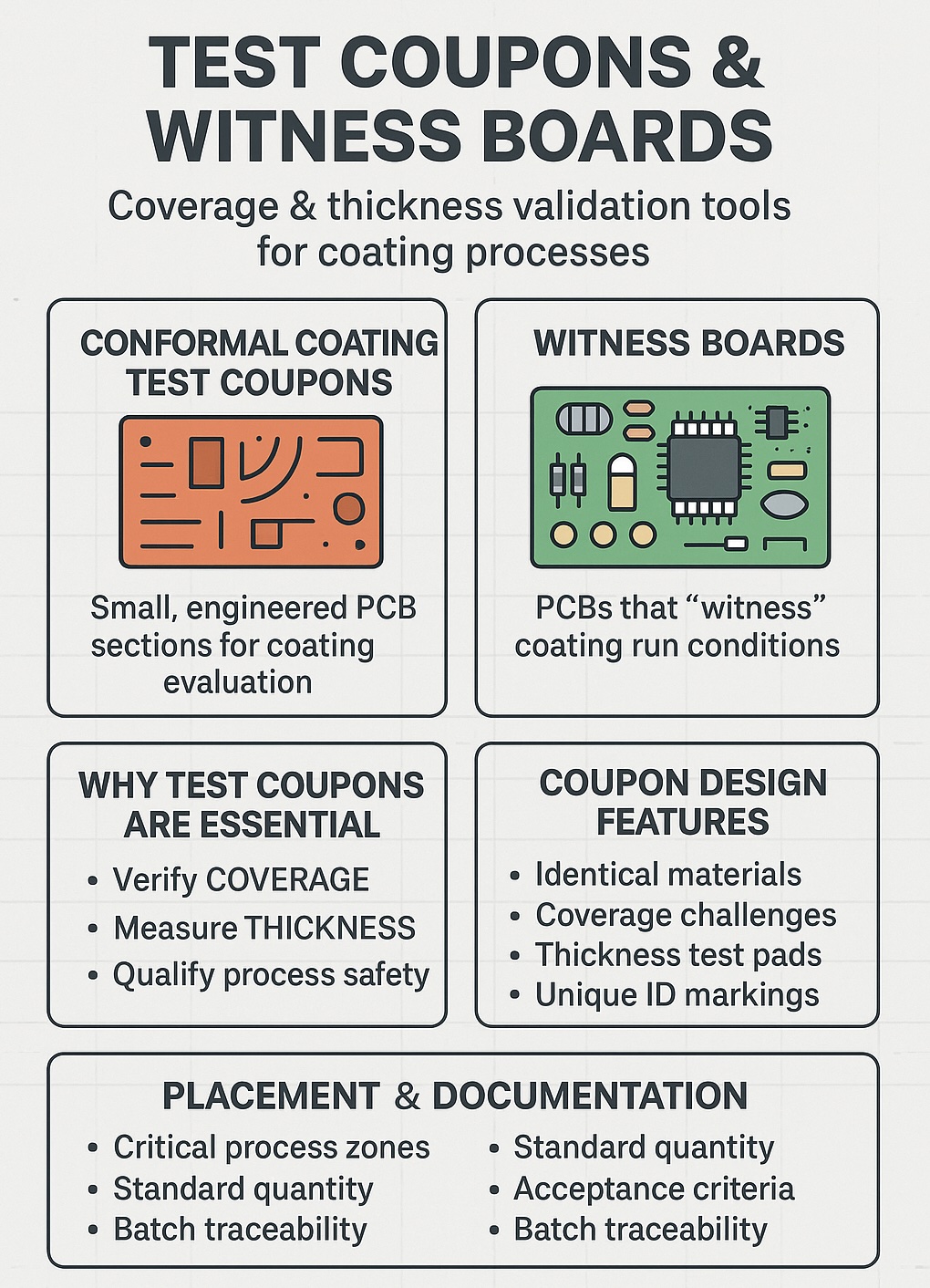
Why test coupons and witness boards are essential
Every coating process has natural variation — viscosity drift, gun pattern changes, masking differences, fixture effects and chamber loading. Conformal coating test coupons and witness boards help you:
- Verify coverage and edge definition under UV inspection.
- Measure thickness using pads, steps or dedicated gauge areas.
- Capture evidence before and after process adjustments.
- Build SPC trends for thickness and coverage stability.
- Qualify new materials, parameters or equipment safely.
Good coupon strategy works alongside design-for-coating rules such as keep-outs, component orientation and edge coverage & drain paths.
What are test coupons and witness boards?
- Test coupons – small, engineered PCB sections designed to include challenging geometries that let you consistently evaluate coating quality and thickness.
- Witness boards – scrap, surrogate or representative PCBs that run with the job and witness the real coating conditions of each batch.
Most coating lines use both: test coupons for measurement and repeatability, and witness boards to capture real-world production behaviour.
Designing effective conformal coating test coupons
A good coupon is small, consistent and representative. When specifying conformal coating test coupons, ensure they include:
- The same laminate, finish and soldermask as the main PCB.
- Representative pad sizes, track widths and gaps.
- Critical coverage challenges such as tall parts, under-component gaps and vertical edges.
- Flat test pads sized for your thickness gauge or interferometer.
- Clear UV inspection areas for meniscus and edge definition checks.
- Unique ID markings for batch traceability.
Wherever possible, place coupons in the panel rails or add them as break-off sections.
How to build coverage challenges into coupon design
Coverage issues usually appear in predictable places. Make sure your coupons include:
- Vertical edges for meniscus height checks.
- Slots, vias and apertures to observe flow and wetting.
- Fine-pitch IC footprints for bridging and shadowing checks.
- Dense passive arrays to test masking access and de-masking risk.
- Connector-like geometries to validate keep-outs and masking strategy.
Using coupons to measure coating thickness
Conformal coating test coupons are ideal for consistent thickness measurement. Methods include:
- Dedicated copper pads for eddy-current or magnetic thickness gauges.
- Raised steps or fins for optical measurement, ideal for Parylene.
- Microsectioning sacrificial coupons instead of product boards.
- Correlation mapping between coupon readings and accessible features on the main PCB.
Use the defined thickness targets from your process specification and record coupon data for every batch.
Placement of coupons & witness boards in the process
Correct placement is essential to get meaningful results:
- Spray coating: place coupons at leading and trailing edges and low-angle zones.
- Dip coating: orient coupons the same as production items to duplicate meniscus behaviour.
- Parylene: distribute coupons across top, middle and bottom of the chamber to track uniformity.
- Use a consistent minimum quantity per batch or per carrier.
Documenting acceptance criteria & results
To gain real value, link coupon and witness board results to your quality system:
- Define visual coverage acceptance criteria with UV reference photos.
- Record thickness measurements against batch numbers and rack positions.
- Ensure every coupon has traceability: job number, PCB revision, date and operator.
- Use AQL or SPC charts to track process drift over time.
- Store reference coupons from important qualifications.
Combined with rules for clearance & creepage and PCB layout, test coupons and witness boards provide strong evidence that your coating process is controlled, stable and predictable.
Why Choose SCH Services?
Stable coating performance depends on evidence, not assumptions. SCH Services helps customers define practical coupon strategies, witness board usage and measurement methods so coating coverage and thickness can be checked consistently before problems reach production hardware.
- 📏 Validation-Focused Support – Practical guidance on coupon design, witness board use and batch-by-batch coating verification.
- 🔍 Coverage & Thickness Control – Support selecting suitable features, measurement methods and inspection checks for liquid coatings and Parylene.
- 📈 Better Process Evidence – Help building repeatability data, SPC trends and traceable records that support robust process control.
- 🛠️ Design & Process Alignment – Advice linking coupon strategy to masking, geometry, keep-outs and real production behaviour.
- 🌍 Integrated Technical Capability – Consultancy, coating services, training and process troubleshooting from one specialist partner.
📞 Call: +44 (0)1226 249019
✉ Email: sales@schservices.com
💬 Contact Us ›
