
Pooling & Puddling Defects in Conformal Coating
Pooling and puddling are thickness-related conformal coating defects where excessive material accumulates at low points, edges, or around component features. While coverage may appear complete, pooled coating often introduces secondary failure mechanisms including solvent entrapment, uneven cure, cracking, and long-term reliability risk.
This page explains how pooling forms, how to distinguish it from similar defects, and how to prevent recurrence without compromising coverage or protection.
For a complete index of defect types, use the Conformal Coating Defects Hub.
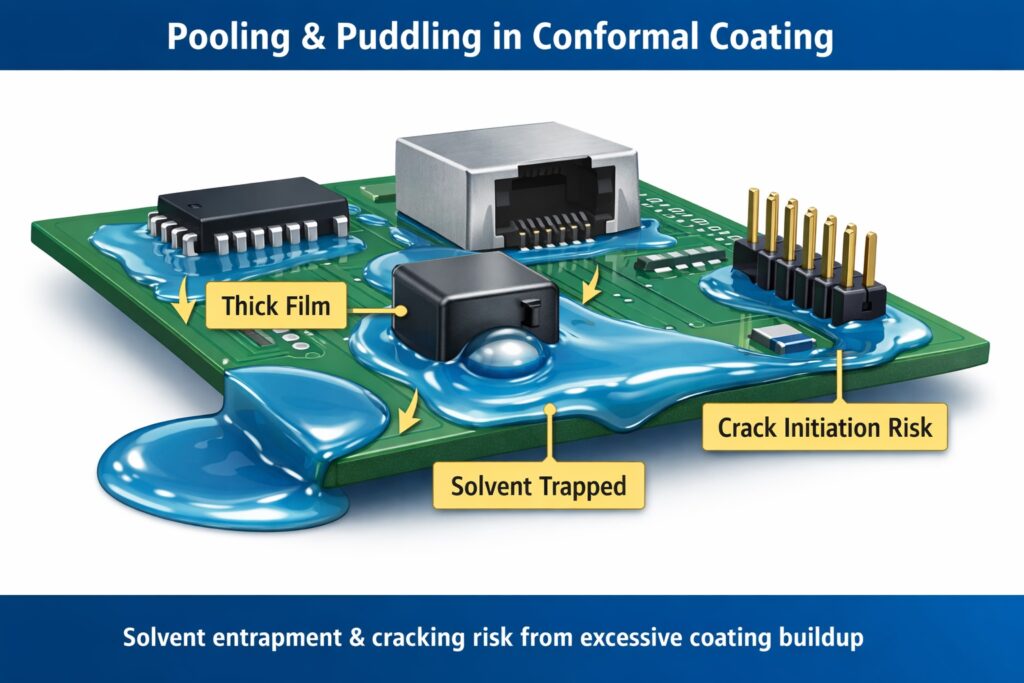
How excessive conformal coating build pools at low points and around components, creating thick films and reliability risk
Article Quicklinks
| Topic | More |
|---|---|
| Definitions: pooling vs puddling | 🔗 |
| Mechanisms: why thickness matters | 🔗 |
| Root Causes: process, material, geometry | 🔗 |
| Prevention: thickness and flow control | 🔗 |
| Troubleshooting & Diagnosis | 🔗 |
| Repair: touch-up vs strip & recoat | 🔗 |
What is Pooling / Puddling?
- Pooling — localised thick build caused by coating flowing and collecting before cure.
- Puddling — pronounced accumulation, often visibly domed or sagged, typically at low points or edges.
- Key concern — excessive thickness alters cure behaviour and stress distribution.
Although pooled coating may pass an initial coverage inspection, it frequently becomes the origin of voids, cracking, or adhesion loss during service.
Why Pooling & Puddling Cause Failures
- Solvent entrapment — thick films restrict solvent escape, leading to voiding or soft cure.
- Uneven cure — surface skins while the bulk remains mobile or under-cured.
- Stress concentration — shrinkage and CTE mismatch are amplified in thick sections.
- Crack initiation — pooled zones are common origins for cracking during thermal cycling.
These mechanisms explain why pooling is often linked to cracking defects even when coverage initially appears acceptable.
Root Causes of Pooling & Puddling
- Over-wet application — excessive material deposited in a single pass.
- Low viscosity / high flow — coating migrates before skinning or gelation.
- Gravity and orientation — edges, connectors, and tilted boards encourage flow into low points.
- Keep-wet overlaps — repeated passes maintain a mobile film.
- Geometry-driven traps — under components, around shields, or at abrupt height changes.
How to Prevent Pooling & Puddling
- Build film gradually using multiple light passes.
- Control viscosity within a validated process window.
- Manage board orientation during flash-off and early cure.
- Reduce overlaps in selective and robotic paths.
- Mask or shield high-risk low-point features where required.
For inspection planning and acceptance criteria, use the Inspection & Quality Hub.
Troubleshooting & Diagnosis
- Map thickness variation using UV and white-light inspection.
- Look for repeatable low-point patterns across assemblies.
- Review viscosity, flash-off time, and overlap behaviour.
- Check whether pooled zones correlate with cracking or voiding.
Repair: When to Touch-Up vs Strip & Recoat
- Minor pooling — controlled rework may be acceptable if fully cured and within specification.
- Heavy puddling — strip and recoat is typically required to restore uniform cure and stress behaviour.
See the Removal & Rework Hub for method selection.
Looking for Other Defect Types?
This page focuses on pooling and puddling. For the complete index of defect types and links to each technical article:
Training on Conformal Coating Defects
SCH offers conformal coating training that goes beyond theory—recognising and preventing pooling, puddling, bridging, cracking, de-wetting, voiding and long-term reliability failures. We cover process analysis, troubleshooting, materials, and application methods.
Industry Standards We Work To
SCH Services aligns coating services, training, equipment supply and materials to relevant IPC standards, including:
- IPC-A-610 – Acceptability of Electronic Assemblies
- IPC-CC-830 – Qualification & Performance of Conformal Coatings
- IPC-HDBK-830 – Conformal Coating Handbook
For further details on IPC standards: electronics.org/ipc-standards ↗
Explore Topic Hubs
Conformal Coating Processes Hub
Conformal Coating Equipment Hub
Conformal Coating Masking Hub
Conformal Coating Design Hub
Conformal Coating Defects Hub
Inspection & Quality Hub
Removal & Rework Hub
Standards Hub
Parylene Basics Hub
Parylene Application Hub
Why Choose SCH Services?
You gain a complete, integrated platform for Conformal Coating, Parylene & ProShieldESD—plus equipment, materials and training—backed by decades of hands-on process support.
- 🛠️ End-to-End Support – Selection, masking, inspection and troubleshooting.
- ✅ Process Discipline – Recipes, control windows and repeatability.
- 🌍 Global Reach – Support across Europe, North America and Asia.
📞 Call: +44 (0)1226 249019 | ✉ Email: sales@schservices.com | 💬 Contact Us ›
