Pinholes, Bubbles & Foam Defects in Conformal Coating
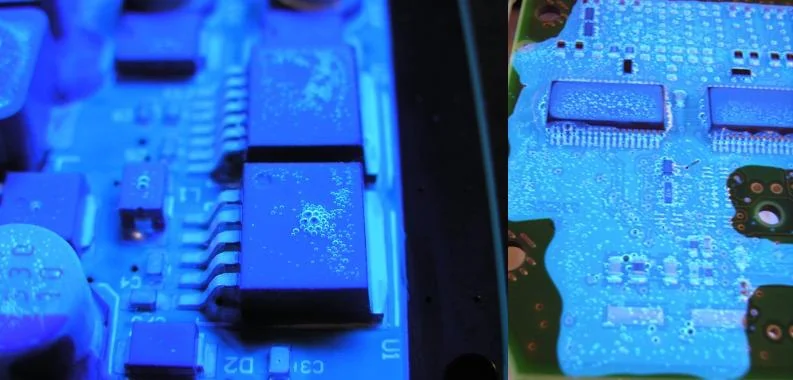
Pinholes, bubbles and foam are void-related conformal coating defects caused by trapped air, dissolved gases, or volatile release during application, flash-off, drying and cure. This page explains how they form, how to diagnose the likely mechanism, and how to prevent recurrence.
For a complete index of defect types and links to each technical article, use the Conformal Coating Defects Hub.
📄 Download:
Pinholes, Bubbles & Foam Defects bulletin (PDF)
Article Quicklinks
| Topic | More |
|---|---|
| Definitions: bubbles, pinholes & foam | 🔗 |
| How they form: mechanisms & “tell-tale” signs | 🔗 |
| Root Causes: process, material, equipment | 🔗 |
| Prevention: control window & recipes | 🔗 |
| Troubleshooting & Diagnosis: isolate the mechanism | 🔗 |
| Repair: when to rework vs strip & recoat | 🔗 |
What are Pinholes, Bubbles & Foam in Conformal Coating?
- Bubbles — trapped pockets of air or vapour within or under the coating film.
- Pinholes — small voids that break through to the PCB surface (often from bubble burst or outgassing).
- Foam — extensive micro-bubbling across an area, typically linked to air entrainment or gassing during application.
These defects can reduce insulation resistance, create pathways for moisture/contamination, and accelerate corrosion and long-term reliability failures.
How Pinholes, Bubbles & Foam Form
- Film skinning: the surface cures/dries first, trapping solvent or vapour underneath → bubbles/pinholes as it vents.
- Outgassing: volatiles released from the PCB, components, residues, or porous materials → bubbles that appear during cure.
- Dissolved gas release: gas absorbed in coating (often via pressurisation) comes out of solution during spray/flow → “champagne” bubbles.
- Air entrapment: geometry traps air (under components, sharp steps, dense areas) which later escapes into the wet film.
- Atomisation/entrainment: spray settings or over-brushing physically introduce air → foam/micro-voids.
Pattern clue: localised defects around tall parts/underneath bodies often point to air entrapment/outgassing; uniform “sparkle” foaming across a sprayed area often points to atomisation/pressurised pot gas release.
Root Causes of Pinholes, Bubbles & Foam
Process & Technique
- Excessive thickness / high viscosity prevents bubbles rising and clearing before cure.
- Insufficient flash-off traps solvent/volatiles; too aggressive drying can drive skinning.
- Over-brushing introduces air into viscous films.
- Dip parameters (fast entry/withdrawal, no dwell, poor wetting) trap air under parts.
Material & Condition
- Solvent imbalance (thickened material, high solids) increases air retention and slows bubble escape.
- Moisture sensitivity (some chemistries) can contribute to gassing and micro-voiding if humidity control is poor.
- Contamination can worsen wetting and create local vent paths that become pinholes.
Equipment
- Pressure pots absorbing air (especially left pressurised / partially filled) → dissolved gas release during application.
- Incorrect spray setup (head/nozzle selection, atomising vs fluid pressure imbalance, gun distance) → foam and bubbles.
- Filters/lines: restrictions and turbulence can contribute to entrainment; dirty filters also destabilise flow.
How to Prevent Pinholes, Bubbles & Foam
Stabilise the control window
- Use multiple thin coats with defined flash-off rather than one heavy pass.
- Control viscosity: measure/record, correct solvent loss, and keep within a validated range.
- Control cure/dry profile: avoid rapid skinning; use a progressive profile appropriate to chemistry and thickness.
Stop entrainment and gas release
- Pressure pots: depressurise when idle; avoid leaving material standing under pressure; keep routines documented.
- Spray recipe: lock head/nozzle type, gun distance, fan width, and pressures to a standard recipe (then train to it).
- Brush technique: “flow it on” — minimise agitation/overworking.
Geometry-driven actions (dip / complex assemblies)
- Dip entry/withdrawal: slow down, add dwell for wetting under bodies, and optimise withdrawal to reduce voiding.
- Pre-bake / dry-out where appropriate to reduce outgassing from porous materials (validate vs components).
- Design/masking: avoid unvented cavities where possible; mask or redesign if voids recur in a known geometry.
If you’re building acceptance criteria and inspection routines, use the Inspection & Quality Hub.
Troubleshooting & Diagnosis
1) Confirm the pattern (fastest win)
- UV inspection: map defect density and whether it correlates to geometry (under parts, edges, tall components).
- Time-to-appearance: in wet film vs during cure vs post-cure inspection.
2) Check the three big levers
- Viscosity/solids: verify the material is inside the validated range.
- Pot & line routine: pressurisation habits, purge/flush routines, filter condition, turbulence points.
- Cure/dry profile: look for skinning (too fast) or solvent trap (too thick / too little flash).
3) Validate the method
- Spray: document head/nozzle, pressures, distance, overlap, and trigger technique; compare to recipe.
- Dip: qualify entry speed, dwell, withdrawal rate, and bath health (viscosity, contamination, evaporation).
📄 If you want the condensed version for your team: download the PDF bulletin.
Repair: When to Touch-Up vs Strip & Recoat
- Localised pinholes: if within acceptance and not bridging keep-outs, controlled touch-up may be appropriate (after cleaning/prep).
- Dense voiding / foam: typically indicates a process condition problem — stripping and recoat is often the only robust option.
- Under-component voiding: consider whether the defect is accessible/inspectable; if not, treat as a process escape and rework accordingly.
For removal workflows and best-fit methods, see the Removal & Rework Hub.
Looking for Other Defect Types?
This page covers pinholes, bubbles and foam. For the complete index of defect types and links to each technical article:
Training on Conformal Coating Defects
SCH offers conformal coating training that goes beyond theory—recognising and preventing pinholes, bubbles, foam, orange peel, de-wetting, delamination, and cracking. We cover process analysis, troubleshooting, materials, and application methods.
Industry Standards We Work To
SCH Services aligns coating services, training, equipment supply and materials to relevant IPC standards, including:
- IPC-A-610 – Acceptability of Electronic Assemblies
- IPC-CC-830 – Qualification & Performance of Conformal Coatings
- IPC-HDBK-830 – Conformal Coating Handbook (guidance and best practice)
For further details on IPC standards: electronics.org/ipc-standards ↗
Explore Topic Hubs
Conformal Coating Processes Hub
Conformal Coating Equipment Hub
Conformal Coating Masking Hub
Conformal Coating Design Hub
Conformal Coating Defects Hub
Inspection & Quality Hub
Removal & Rework Hub
Standards Hub
Parylene Basics Hub
Parylene Design Hub
Parylene Application Hub
Parylene Dimers Hub
Why Choose SCH Services?
You gain a complete, integrated platform for Conformal Coating, Parylene & ProShieldESD—plus equipment, materials and training—backed by decades of hands-on process support.
- 🛠️ End-to-End Support – Selection, masking, inspection and troubleshooting.
- ✅ Process Discipline – Recipes, control windows and repeatability.
- 🌍 Global Reach – Support across Europe, North America and Asia.
📞 Call: +44 (0)1226 249019 | ✉ Email: sales@schservices.com | 💬 Contact Us ›