CAF Under Conformal Coating & Under Solder Mask
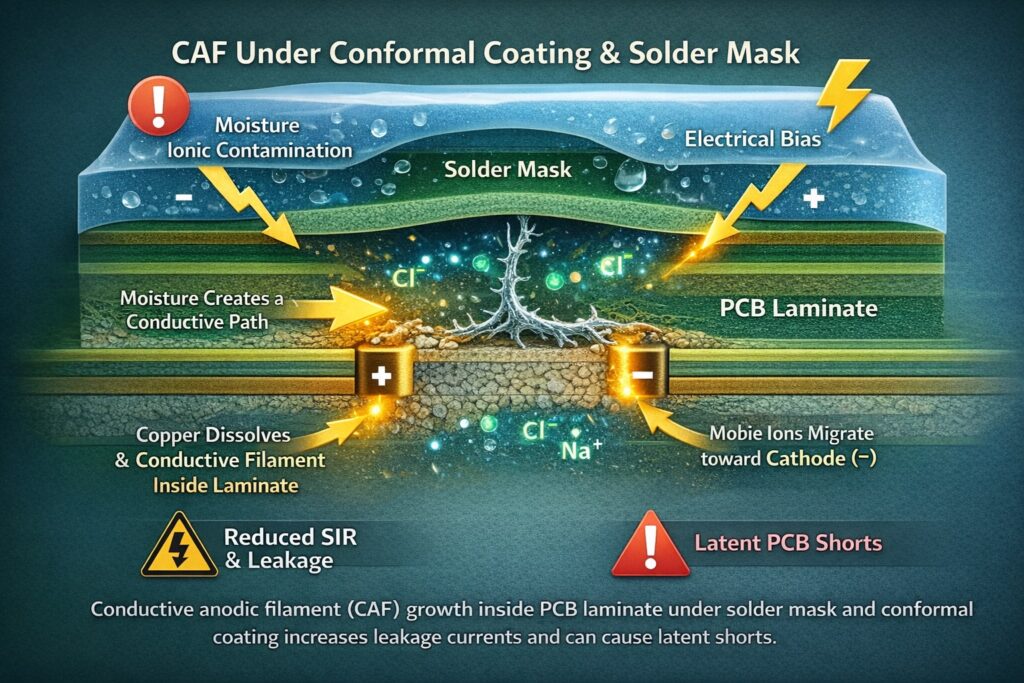
Conductive anodic filament (CAF) is a latent, internal failure mechanism that forms within the PCB laminate (typically glass fibre/resin interfaces), often under solder mask and under conformal coating. CAF is driven by moisture + ionic contamination + electrical bias and presents as progressive insulation resistance loss, intermittent leakage, or sudden shorts. Because the mechanism is inside the board, conformal coating cannot stop it once initiated.
CAF is frequently misdiagnosed as an external coating defect or ECM. Correct diagnosis matters because the controls and repair decisions are fundamentally different.
For the complete index of defect types, use the Conformal Coating Defects Hub. For upstream controls (PCB design /fabrication, cleanliness, dry-out and coating discipline), see the Processes Hub and the Design Hub.
Article Quicklinks
| Topic | More |
|---|---|
| Definitions: CAF, laminate pathways, IR loss | 🔗 |
| How it happens: CAF mechanism inside the PCB | 🔗 |
| Root Causes: laminate, design and environment | 🔗 |
| Prevention: PCB spec, design rules, moisture control | 🔗 |
What is CAF (Conductive Anodic Filament)?
- CAF — a conductive filament that grows inside the PCB laminate, typically along glass fibre/resin interfaces, between biased copper features.
- Under solder mask / under coating — CAF initiates below the surface; coatings and masks may hide symptoms but do not prevent growth.
- IR degradation — CAF causes progressive insulation resistance loss that may appear as intermittent leakage before a hard short.
How CAF Forms Under Mask & Coating
- Step 1 — moisture ingress: absorbed moisture in laminate (or along fibres) creates a conductive medium.
- Step 2 — ionic species present: fabrication residues, resin chemistry and glass sizing provide mobile ions.
- Step 3 — electrical bias: copper dissolves at the anode and migrates along fibre paths toward the cathode.
- Step 4 — filament growth: a conductive path forms within the laminate, reducing IR and eventually shorting nets.
Root Causes of CAF
PCB design & fabrication
- Tight spacing between vias, pads or planes.
- Glass weave exposure and fibre orientation aligned with bias.
- Inadequate resin content or poor laminate quality.
- Drill smear / desmear issues.
Environmental & process drivers
- Moisture cycling and high humidity.
- Electrical bias sustained over time.
- Thermal cycling.
Preventing CAF (What Actually Works)
- CAF-resistant laminate specification
- Moisture control and dry-out
- Design spacing and fibre orientation management
Training on Conformal Coating Defects
SCH delivers practical, standards-driven training covering conductive anodic filament (CAF), PCB design and laminate risk, moisture control, inspection and diagnosis, and the wider defects framework used to prevent latent, repeat failures.
Industry Standards We Work To
SCH Services aligns coating services, training, equipment supply and materials to relevant IPC standards, including:
- IPC-A-610 – Acceptability of Electronic Assemblies
- IPC-CC-830 – Qualification & Performance of Conformal Coatings
- IPC-HDBK-830 – Conformal Coating Handbook (guidance and best practice)
For further details on IPC standards:
electronics.org/ipc-standards ↗
Explore Topic Hubs
Conformal Coating Processes Hub
Conformal Coating Equipment Hub
Conformal Coating Masking Hub
Conformal Coating Design Hub
Conformal Coating Defects Hub
Inspection & Quality Hub
Removal & Rework Hub
Standards Hub
Parylene Basics Hub
Parylene Design Hub
Parylene Application Hub
Parylene Dimers Hub
Why Choose SCH Services?
You gain a complete, integrated platform for Conformal Coating, Parylene & ProShieldESD—plus equipment, materials and training—backed by decades of hands-on process support.
- 🛠️ End-to-End Support – Selection, cleaning, masking, inspection and troubleshooting.
- ✅ Process Discipline – Recipes, control windows and repeatability.
- 🌍 Global Reach – Support across Europe, North America and Asia.
📞 Call: +44 (0)1226 249019 | ✉ Email: sales@schservices.com | 💬 Contact Us ›