Mon - Thur 7.30-15.30   Fri 7.30-14.00

What Application Methods Are Used for Conformal Coating?


Conformal coatings can be applied to printed circuit boards (PCB) in the production process environment in many alternative ways. Listed below are the common methods of applying the conformal coating materials:

  • Brushing
  • Aerosol spray
  • Batch spray
  • Selective spray
  • Dipping
  • Vapour deposition
There are many different methods of applying conformal coatings including brushing, aerosol spray, batch spray, selective spray, dipping and vapour deposition (Parylene).

Common methods of applying conformal coatings include brushing, aerosol spray, batch spray, selective spray, dipping and vapour deposition (Parylene).

It is possible to split the different application methods and their suitability in many different ways including:

  • Compatibility with the conformal coating material
  • Design of the circuit board
  • Suitability to low, medium and high volume
  • Manual versus automatic process
  • Type of method of application
  • Level of control required

Each of the various methods has different advantages and disadvantages and should be carefully considered.

This thought process relates to the holistic approach to conformal coating processing that states that you should consider the conformal coating material, the application process and the circuit board together and not as three separate entities.


Find out how we can help you with your conformal coating application selection now.

Partnering with SCH Services means more than just outsourcing β€” you gain a complete, integrated platform for Conformal Coating, Parylene & ProShieldESD Solutions, alongside equipment, materials and training, all backed by decades of hands-on expertise.

  • ✈️ 25+ Years of Expertise – Specialists in coating technologies trusted worldwide.
  • πŸ› οΈ End-to-End Support – Coating selection, masking, inspection and process validation.
  • πŸ“ˆ Scalable Solutions – From prototypes and NPI through to high-volume production.
  • 🌍 Global Reach – Responsive support across Europe, North America and Asia.
  • βœ… Proven Reliability – Built on quality, consistency and long-term customer partnerships.

πŸ“ž Call: +44 (0)1226 249019
βœ‰ Email: sales@schservices.com
πŸ’¬ Contact Us β€Ί


What is a hydrophobic conformal coating?


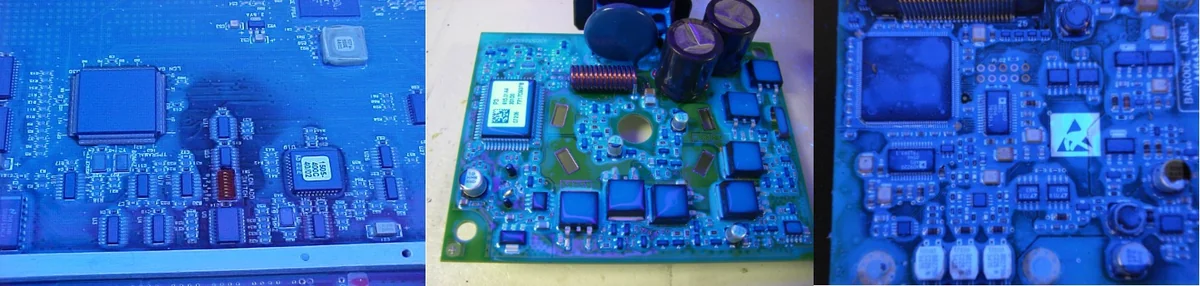
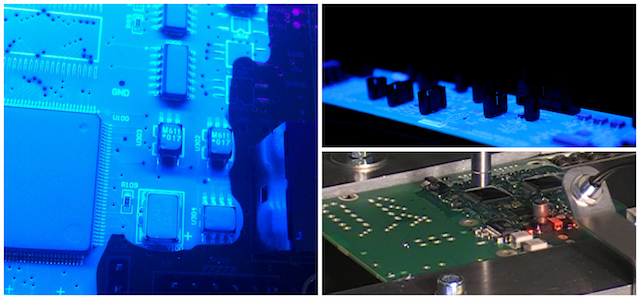
Nano-coating fluoropolymers Collage 640_SCH UK

There are several reasons for using a conformal coating or Parylene to protect a printed circuit board (PCB).

They include:

  • High insulation protection
  • High moisture and humidity protection
  • Chemical and temperature resistance
  • Ruggedisation
  • Improve dielectric properties
  • Barrier protection against particulates

However, one property that most liquid conformal coatings do not possess that is extremely useful to have is being water repellent or hydrophobic.

A coating that is hydrophobic repels water from the surface by changing the surface energy of the coating. This makes it energetically unfavourable for the water to wet the surface. Hence, the water β€œballs up” and rolls off the surface.

This occurs in the fluorinated nano-coatings that are hydrophobic and is an extremely useful property when protecting a circuit board where water may be present. However, typical conformal coatings are not hydrophobic.

Materials like acrylics and polyurethane coatings are excellent against moisture but not so good as water repellent materials. They do not have a low surface energy.

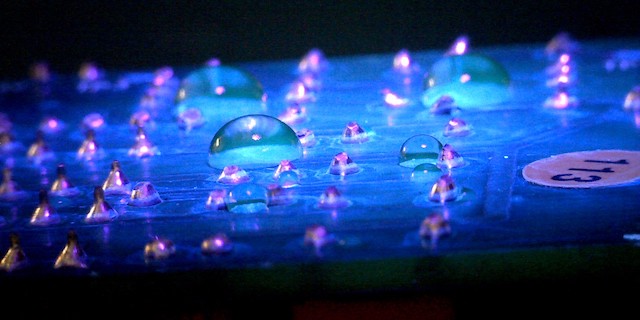
Conformal coatings like acrylics and urethanes do not have water repellent properties (left). A hydrophobic conformal coating repels the water and does not allow it to wet the surface (right).

A hydrophobic acrylic conformal coating – the best of both coatings

Now, there exists a hybrid acrylic coating that has both the properties of an acrylic conformal coating at the same thickness plus the benefits of a hydrophobic nano-coating.

These benefits include:

  • Hydrophobic (water repellent) surface
  • High Insulation protection
  • High moisture and humidity protection
  • Ruggedisation
  • Improved dielectric properties
  • Barrier protection against particulates

This new range of conformal coatings can now offer the best properties of both without any cost penalty.

The water wets the surface (left) on a normal acrylic conformal coating. A hydrophobic acrylic conformal coating, with a low surface energy, makes water de-wet from the surface (right) and still has all the benefits of the acrylic conformal coating.

Find out how we can help you with your acrylic hydrophobic coatings now.

Contact us to discuss your needs and let us explain how our hydrophobic coatings could work for you.

Contact us now.

How Do I Spray My Conformal Coating?


SCH UK Image 3conformal coating batch spraying Collage 640x480

Batch spraying is one of the widest used techniques used in low and medium volume conformal coating processing.

Whether you are using a compressed air spray gun or an aerosol can, the conformal coating is sprayed across the whole of the circuit board. It can produce a high quality coating finish that gives the best protection due to good edge coverage.

However, it is not a selective process. All parts are coated on the circuit board. Therefore, masking may be required to protect components that must not be coated.


What Equipment Do You Need For Batch Conformal Coating spraying?

SCHUK Image 2

If you are not using aerosols then for conformal coating spraying a typical set up is:

  • Spray gun
  • Air Compressor for the Air Supply
  • Spray booth

This is a low cost set up that can handle a fairly high volume of product. However, the quality of the finish is dependent on the quality of the spray equipment itself and the operator.

find out more about our conformal coating spray booth and how it can help you.


How Do You Apply the Conformal Coating by Spraying?

Although the process can be material specific there are a few general guidelines for applying conformal coating by spraying.

These include:

  • Only apply thin, consistent coats. It may be necessary to apply more than one coat.
  • Apply the coating in a narrow raster pattern across the circuit.
  • Rotate the board 90 degrees and repeat. Continue until the whole board is coated to avoid 3D effects.
  • Allow the coating to dry enough to avoid problems like bubbles before applying a second coat.

Following a few simple guidelines can save a lot of problems.

Let us help you with our conformal coating training courses for spraying conformal coating.


What variables control the quality of the conformal coating in batch spraying?

SCHUK Image 1

Variables that influence the quality of the coating process in spraying are:

  • The operator skill
  • Quality of the spray equipment
  • Viscosity of the conformal coating
  • Blending the conformal coating to the right viscosity is critical.
  • The level of masking required

Find out how we can help you with your conformalΒ coatings now.

Contact us to discuss your needs and let us explain how hydrophobic coatings could work for you.

Contact us now.


The ABCs of ultra-thin fluoropolymer coatings for electronic circuit boards


Nano coatings are no mask conformal coatings with great water repellent properties

What is a fluoropolymer coating?

A fluoropolymer coating is typically comprised of fluorocarbons and characterised by carbon-fluorine bonds.

They have many interesting properties and especially for printed circuit boards. However the three key properties for electronics are that the coatings are:

  • Hydrophobic
  • Chemically resistant
  • No masking required

These properties can be key to protecting the electronics and providing a highly cost effective production process.

Hydrophobic coating

  • Fluorocarbons are not susceptible to Van der Waals force.
  • This gives the coatings their signature characteristics. That is they are non-stick, hydrophobic and friction reducing.
  • Therefore, water does not like to wet the surface of the circuit board and this gives the circuit excellent protection.

Chemically Resistant

  • These fluorinated coatings are chemically inert.
  • Owing to the fluorine bonds, fluoropolymer coatings demonstrate a high level of durability as well as resistance to acids, bases and most solvents.
  • This gives the circuit board a high degree of protection from chemical attack.

No masking required

Finally, what is really interesting is that these properties are exhibited at ultra-thin film thicknesses. Typically a dry film can be 1-2um or even less.

This means that masking generally is not required for circuit boards before application. Β Therefore, you can dip the whole product into the liquid and there is no issue with electrical contact. This can lead to significant cost savings in production.

Find out more about our range of fluoropolymer nano coatings here.


What other properties do the fluoropolymer coatings have that may be relevant in electronics?

SCHUK 2

As already mentioned these hydrophobic coatings have very specialised properties.

They can include:

  • Being highly hydrophobic (water repellent)
  • Having a high moisture barrier
  • Requiring no masking before application
  • Being highly oleophobic (oil repellent)
  • Having a high chemical resistance
  • Having a high lubricity
  • Having high dielectric properties
  • Providing high corrosion resistance
  • Providing good abrasion / wear resistance

Note, not all fluoropolymer coatings have all of the above properties. But, some coatings can in fact have almost all of the properties.

The fluoropolymer coatings are extremely flexible coatings and becoming more prolifically used throughout engineering.


What sectors of industry are fluoropolymer coatings being used in protecting electronics?

SCHUK3

Fluorinated coatings are used to protect electronics in almost all industrial sectors.

They include:

  • Aviation
  • Aerospace
  • Defence
  • Automotive
  • Industrial
  • Oil & Gas
  • LEDs
  • Medical
  • Optics
  • Telecommunications
  • White goods / Commercial

This list is limited and there are a lot more areas that they are used.


What are the major differences between a fluoropolymer coating and a conformal coating for protecting an electronic printed circuit board or assembly?

There are several key differences between a conformal coating and a fluoropolymer coating.

They include:

  • Hydrophobic Properties – A fluoropolymer coating is generally hydrophobic in nature. It repels water when the water is on the surface of the coating.
  • Extremely thin coating – The fluoropolymer coating is normally applied a lot thinner than a typical liquid conformal coating. This is due to its superior performance when repels liquids
  • No masking – Due to the extremely thin fluoropolymer coating applied (<1-2um), the components that normally require protecting (connectors, switches etc) from the insulating liquid conformal coating may not need to be masked for the fluoropolymer. The circuit board can be completely submerged in the liquid with no masking applied without fear of damaging the connections.
  • Simple process – No masking means an extremely fast application process
  • Fast drying – due to the thin nature of the fluoropolymer coating and the solvents normally used the coating dries extremely quickly.

Find out how we can help you with your ultra-thin hydrophobic coatings now.

Contact us to discuss your needs and let us explain how hydrophobic coatings could work for you.

Contact us now.

How do I correctly dip coat my circuit board in conformal coating?


The dip process for conformal coating is a method used to coat printed circuit boards for a very long time. The process in its simplest form is as follows:

  1. The printed circuit board (PCB) is lowered into a tank of coating.
  2. This can be complete submersion or partial dip.
  3. The board can be dipped vertically, horizontally or at another angle.
  4. The board can be dipped manually or automatically.
  5. The board is removed from the coating and the excess coating drains away.

This process is highly effective in applying a conformal coating to a printed circuit board (PCB).
Dip conformal coating process showing a PCB being immersed using dip coating equipment for consistent, high-volume application


A simple approach involves dipping a circuit board by hand into a container of conformal coating, which can deliver acceptable results for low-volume work. However, dedicated dip coating equipment is typically usedβ€”particularly for medium- and high-volume productionβ€”where consistency, control, and repeatability are critical.

What equipment may you need for dipping circuit boards?

The reason for using dipping machines in conformal coating is because the process has variables that are critical to film integrity and they are controlled by the system. The variables that are critical for film quality and thickness are:

  • The speed of immersion
  • Dwell time in the coating
  • The withdrawal speed of the board

These factors, plus the viscosity of the conformal coating, are important to create a high quality finish and reduce costs.

How cost effective is the dip process for conformal coating?

The conformal coating dip process itself can be extremely low cost. The cost of a dip system can be low compared to many other processes and when balanced against the speed of application.

However, if the circuit board demands a lot of components be masked before processing then the overall coating process can be expensive. Masking for dipping can be very demanding and very difficult to complete successfully.

Find out more about effective masking strategies for dip coating at our Conformal Coating Masking Hub.

Need to know more about using a conformal coating in your application process?

Contact us now and we can discuss how we can help you. Give us a call at (+44) 1226 249019 or email your inquiries at sales@schservices.com


What are the alternative materials to liquid conformal coatings?


There are several alternative coatings available to the traditional conformal coating materials.

These alternative coatings include:

  • Parylene and other Chemical Vapour Deposition (CVD) films
  • Fluorinated ultra-thin and thin film coatings
  • Molecular Vapour Deposition (MVD) coatings
  • Atomic Layer Deposition (ALD) coatings

They can provide extremely high protection to circuit boards if used correctly for the right product.

There are several new and old alternative coatings available to the traditional conformal coating materials. They include Parylene, fluorinated Nano-coatings, Molecular Vapour Deposition (MVD) and Atomic Layer Deposition (ALD) thin films.

Parylene (XY) Coatings

Parylene is the trade name for a variety of chemical vapor deposited poly(p-xylylene) polymers used as moisture and dielectric barriers.

Parylene is a conformal coating that is deposited as a gas in a vacuum chamber. It is a dry process compared to the standard β€œwet” liquid conformal coatings.

Find out more about our Parylene Coating Solutions or compare Parylene vs liquid conformal coatings in our knowledge hub.

Fluoropolymer (FC) Nano Coatings

Surface Modifiers are ultra thin nano coatings that are applied at less than a few microns in thickness. Liquid conformal coatings are applied in the range of 25-75um so they are considerably thicker in nature.

There are several variations in ultra thin conformal coatings out in the market now but two of the most popular types are liquid materials and partial vacuum deposition.

Read more about our full range of Fluoropolymer Nano Coatings.

Atomic Layer Deposition (ALD)

ALD belongs to the family of chemical vapor deposition methods (CVD).

  • It is a deposition process at a Nano-scale level within a vacuum chamber.
  • The deposition process forms ultra-thin films (atomic layers) with extremely reliable film thickness control.
  • This provides for highly conformal and dense films at extremely thin layers (1-100nm).

Molecular vapour deposition (MVD)

MVD belongs to both the families of chemical vapor deposition (CVD) and atomic layer deposition (ALD) methods.

  • Unlike traditional CVD and ALD flow systems the MVD reaction takes place in a chamber under static pressure resulting in extremely low chemical use.
  • The MVD process produces highly conformal thin film coatings, typically less than 100nm in thickness.
  • The coating provides excellent barrier properties and surface energy control.

Need to know more about alternative materials to the traditional liquid conformal coatings?

Contact us now and we can discuss how we can help you. Or, give us a call at (+44) 1226 249019 or email your inquiries at sales@schservices.com

Is There a Free Guide on Conformal Coating Defects?


Collage of conformal coating capillary flow and wicking defects around PCB components.

SCH services Ltd provide an information section on conformal coating defects in their Defects Knowledge Hub.

This hub explains the most common defects and failure mechanisms, their root causes, and practical actions to prevent or correct them in production.

Conformal coating defects can undermine PCB protection, reduce insulation resistance, and cause costly rework or field failures. This hub explains the most common defects like de-wetting, de-lamination, corrosion and cob-webbing and details their causes and how to prevent them.

All this is linked to detailed technical articles and inspection guidance.


Need to know more about coating defects?

Contact us now and we can discuss how we can help you. Or, give us a call at (+44) 1226 249019 or email your inquiries at sales@schservices.com


Are there design rules for applying conformal coatings?


Conformal coating is not simply a consumable material. Unfortunately, for too many designers, conformal coating is simply a part number, to be applied to circuit boards. However, this can be a major problem especially in the conformal coating production stage of the process.

There are guidelines in the IPC standards that may help with Design for Manufacture (DFM) principles. These are worth considering. Unfortunately, there are no official design guidelines that will help directly with the application process and conformal coating.

Conformal coating treated as a part number rather than a design consideration can cause production issues

When conformal coating is treated as a simple part number rather than a design consideration, it can create significant problems during the production stage.

Conformal Coating Design Hub

SCH Services Ltd has developed design rules for conformal coating in their Design Hub to help users get the fundamentals right.

The hub focuses on designing PCBs and assemblies for coating, including keep-out zones, component spacing, creepage and clearance, and applying DfM/DfCC principles before manufacture. The philosophy is that for companies embracing lean philosophies and applying conformal coatings, a failure to appreciate the subtleties of the application process can result in an un-coatable (at least as specified) assembly process.

The problem is if the rules are not followed, the resultant circuit board design can challenge even the most sophisticated conformal coating system and its operator to achieve the finish desired.

For further information visit conformal coating design rules to learn more.


Need Process Support?

Optimising electronics coating methods requires the right combination of materials, equipment, and operator training. Partner with SCH Services for:

Infographic explaining whether MIL-SPEC qualification is required for conformal coating and how legacy MIL-I-46058C references relate to modern standards.

Do you need MiL spec qualification for your conformal coating?


A common question from aerospace and defence customers is: β€œDo we need MIL-SPEC qualification for our conformal coating?”

The short answer is: sometimes β€” but only when it is contractually required.

Confusion usually arises because legacy military standards are still referenced on drawings, purchase orders, or coating datasheets, even though the underlying standards landscape has changed.

For a full explanation of how military (MIL) requirements relate to modern conformal coating standards, see: MIL-I-46058C (Cancelled) & MIL Standards for Conformal Coating
.


When is MIL-SPEC actually required?

In practice, manufacturers usually know they require MIL-related compliance when:

  • The product is for a military or defence programme
  • MIL requirements are explicitly called up on the customer drawing
  • The purchase order or contract includes MIL flow-down requirements

If none of these are present, β€œMIL-SPEC” is often being used as shorthand for high reliability rather than a defined manufacturing requirement. This is where misunderstandings commonly occur.


Be cautious with datasheets claiming β€œmeets MIL-I-46058C”

Many conformal coating datasheets state that the material β€œmeets the requirements of MIL-I-46058C”. This wording should be treated with caution.

MIL-I-46058C is a cancelled standard, and simply stating compliance does not mean the coating has been independently approved or qualified. In many cases, the claim refers only to internal or historical test data.

Where defence programmes genuinely require MIL-style material qualification, customers will often expect evidence beyond a datasheet statement.


What is the Qualified Product List (QPL)?

Historically, conformal coatings tested against MIL-I-46058C were listed on the Qualified Product List (QPL).

The MIL-I-46058C Conformal coating standard has been inactive for new designs since the late 1990s, but QPL listings are still referenced in legacy documentation and long-lifecycle programmes.

Coatings appearing on the QPL would have undergone independent third-party testing rather than self-certification. This is an important distinction.

However, the presence (or absence) of a coating on the QPL does not automatically determine its suitability for modern programmes. What matters today is how customer requirements are defined and verified.


What is normally used instead today?

Modern defence and aerospace programmes typically rely on a combination of:

  • IPC-CC-830 for conformal coating material performance and qualification
  • IPC-A-610 for workmanship and acceptance criteria
  • Customer drawings and specifications defining coverage, keep-out zones and inspection evidence

MIL requirements are therefore usually met through industry standards plus contractual flow-downs, rather than through a single active β€œMIL-SPEC” document.


Need to understand how the standards fit together?

The Conformal Coating Standards Hub brings together SCH’s guidance on IPC-A-610, IPC-CC-830, IEC 60664, UL 746, NASA workmanship standards and how they relate to conformal coating and Parylene.

It is designed to help engineering, quality and procurement teams understand:

  • What each standard actually covers
  • How acceptance, material qualification and inspection requirements interact
  • Where legacy MIL references still appear β€” and how to interpret them safely

You can also explore related hubs covering Design, Inspection & Quality and Parylene Coating.


If you need help interpreting customer requirements, legacy MIL references, or selecting compliant coating materials and inspection criteria, contact SCH Services.

πŸ“ž Call: +44 (0)1226 249019 Β | βœ‰ Email: sales@schservices.com

0
  • Your current order total is £0.00 β€” you must have an order with a minimum of £75.00 to place your order.
0
Your Cart
Your cart is empty
  • Your current order total is £0.00 β€” you must have an order with a minimum of £75.00 to place your order.
Calculate Shipping
  • Your current order total is £0.00 β€” you must have an order with a minimum of £75.00 to place your order.

Conformal Coating UK

Technical banner showing PCB and process icons representing conformal coating, masking, inspection and training on the SCH technical knowledge hub.
Conformal Coating UK
Privacy Overview

This website uses cookies so that we can provide you with the best user experience possible. Cookie information is stored in your browser and performs functions such as recognising you when you return to our website and helping our team to understand which sections of the website you find most interesting and useful.