Mon - Thur 7.30-15.30   Fri 7.30-14.00
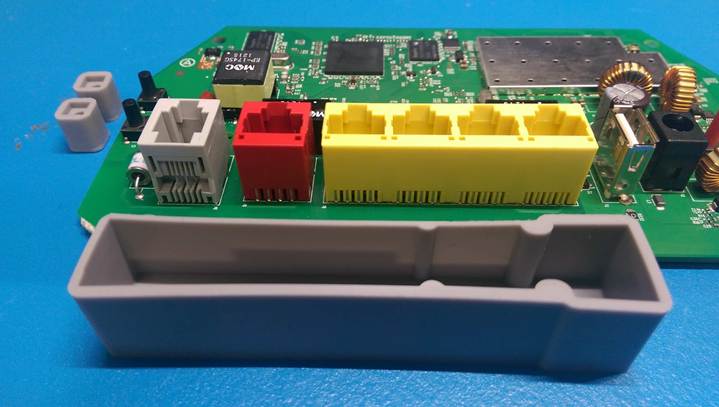
Masking-related defects causing coating ingress and poor boundaries on PCB assemblies

Why Masking Is the Leading Cause of Conformal Coating Defects


When conformal coating defects appear in production, the first response is often to adjust coating parameters such as viscosity, spray settings, cure profiles, or even material selection. In practice, many coating defects are introduced before coating begins.

Across aerospace, automotive, industrial, and electronics manufacturing, a significant proportion of NCRs and customer rejections trace back to masking decisions rather than coating chemistry. These failures typically occur at boundaries such as connectors, test points, interfaces, and defined keep-out zones.

Masking Defines Where Coating Is Allowed β€” and Where It Must Not Go

Masking is not a secondary preparation step. It is a primary process control that physically defines the limits of coating coverage. When masking is poorly selected, incorrectly applied, inadequately sealed, or inconsistently removed, defects will occur even when the coating process itself is stable and well controlled.

  • Coating ingress into keep-out zones
  • Coating lifted or removed during de-masking
  • Residue or contamination transferred from masking materials
  • Incomplete touch-up after mask removal
  • Ragged or inconsistent coating boundaries

Why Conformal Coating Masking Defects Are So Often Missed

Masking defects are frequently overlooked because they do not always present as obvious failures during application. The coating may appear uniform immediately after spraying or dipping, with problems only emerging later during inspection, electrical testing, or customer use.

  • No defined inspection step after de-masking
  • Assumptions that shields act as sealed barriers
  • Lack of clarity on operator touch-up versus escalation
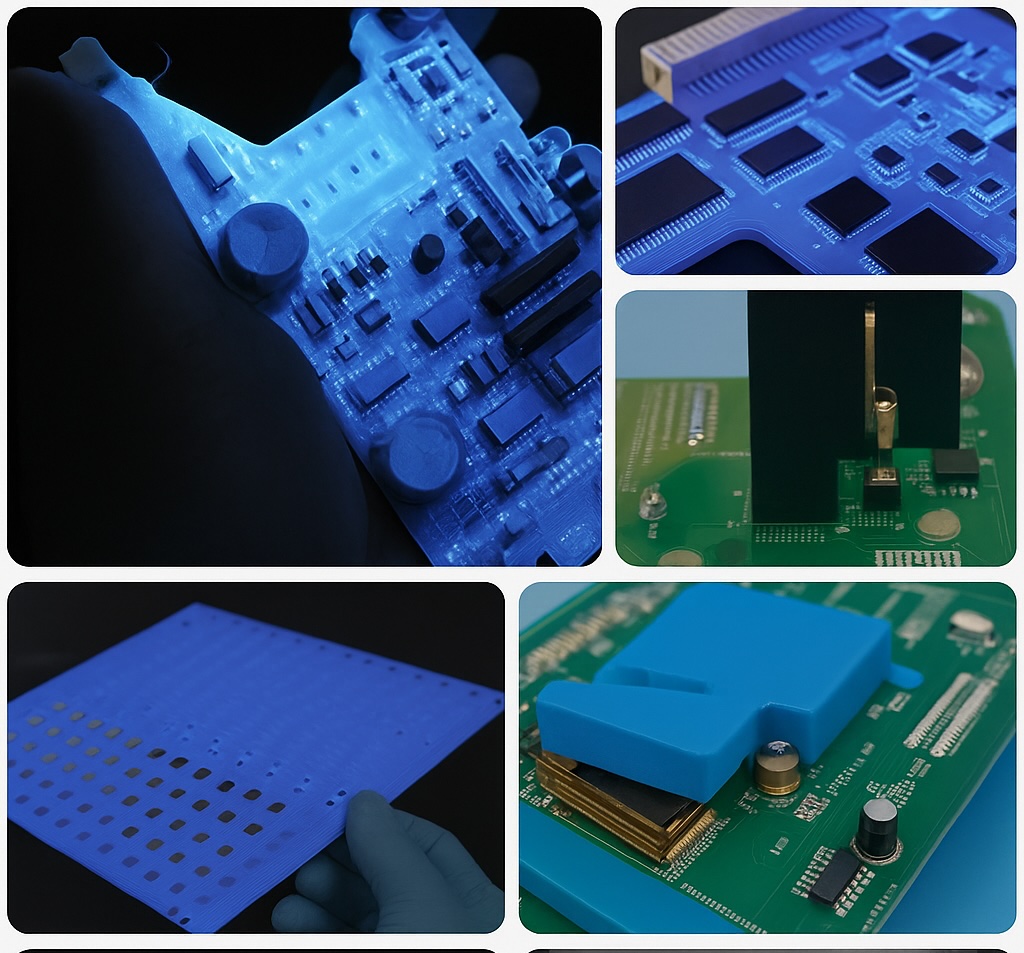
  • Over-reliance on UV inspection alone
  • Ambiguous or poorly defined keep-out zones on drawings

Treat Masking as a Defect-Prevention System

Reducing conformal coating defects requires treating masking as a controlled system, not simply a consumable or materials choice.

  • Matching masking methods to function, such as shields versus sealed barriers
  • Controlling fit, placement, and sealing of tapes, boots, and custom shapes
  • Defining de-masking timing and removal techniques
  • Mandating post de-masking inspection
  • Applying clear rules for operator touch-up versus escalation

New Resource: Masking as a Root Cause of Coating Defects

A new root-cause article has been added to the Conformal Coating Defects Hub. It explains in detail why masking is the leading contributor to coating failures and how to control masking effectively in production.

To understand how masking contributes to coating failures in real production environments, read the full masking root-cause analysis.

If you are reviewing masking methods or addressing recurring coating NCRs, explore our conformal coating masking solutions.

Final Thought

If your coating process is stable but defects persist, the fastest improvement often comes not from changing the coating material or parameters, but from reviewing how and where masking is applied, removed, and verified.

Masking does not simply prepare a board for coating. It determines whether the coating process will succeed.

For support reviewing masking processes, inspection criteria, or escalation rules, contact our technical team.
Why do so many conformal coating problems appear β€œrandom”?


Why Conformal Coating Problems Often Appear Random β€” And Why They Aren’t

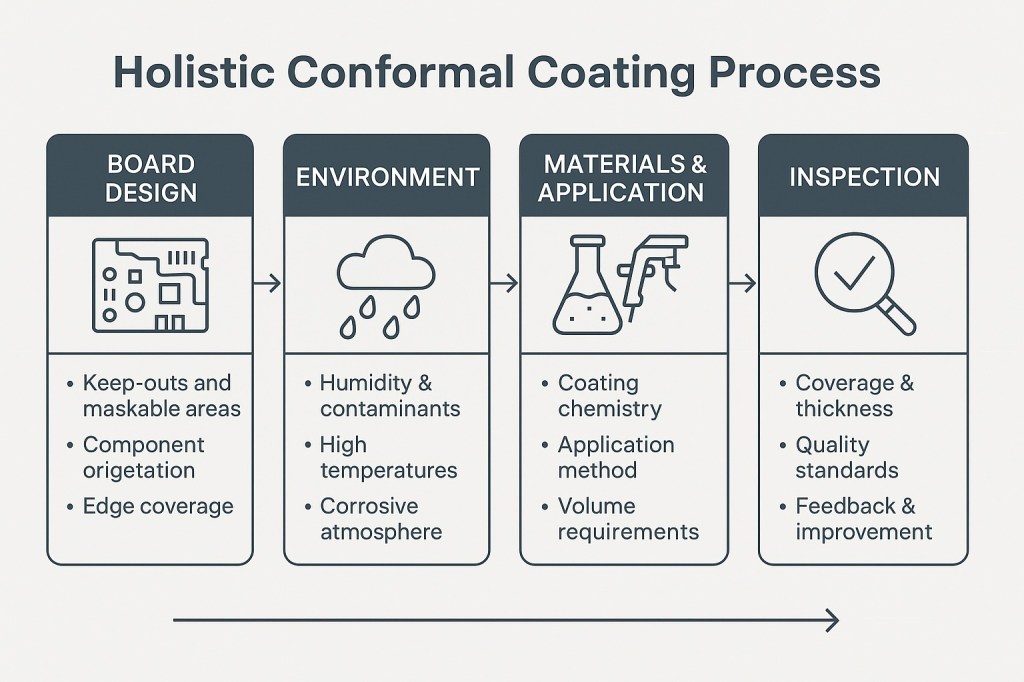
In most cases, they aren’t random at all β€” they are symptoms of a process that was never aligned from the start. Conformal coating only works reliably when PCB design, environmental demands, coating chemistry, application method and inspection strategy all work together as a unified system.

To help manufacturers establish stable, scalable and predictable coating processes, we’ve published a fully updated guide:

πŸ‘‰Β Holistic Conformal Coating Process – End-to-End Framework

Below is a high-level summary. For the full technical model, diagrams and linked resources, explore the article above.

1. It all begins with PCB design

Most coating challenges originate at the design stage β€” long before production starts. Poor keep-outs, difficult orientations, insufficient drain paths or incompatible materials lead to:

  • excessive masking
  • rework and inspection delays
  • pooling, edge thinning and trapped solvent
  • long-term reliability risks

A design that supports coating reduces cost and improves first-pass yield.

Explore the Design for Conformal Coating Hub:

πŸ‘‰Β Design Hub Articles

2. Chemistry must be matched to the real environment

No coating is universally suitable. Chemistry selection should be driven by environmental stress, including:

  • humidity and condensation
  • SOβ‚‚Β / Hβ‚‚S corrosion
  • fuels, oils, chemicals and solvents
  • UV exposure
  • thermal cycling and vibration
  • high-voltage creepage and clearance

Using the wrong chemistry often results in de-wetting, cracking, poor adhesion or long-term corrosion.

Explore:

πŸ‘‰Β Parylene Coating Solutions

πŸ‘‰Β ProShieldESD Conductive Polymer Platform

3. The application method must suit material, volume & geometry

Selective coating, manual spray, dip coating and Parylene each solve different process challenges. Selecting the wrong method leads to inconsistent thickness, material waste and increased labour.

Your method should reflect:

  • production volume
  • assembly density
  • design geometry
  • material selection
  • drainage capability
  • masking burden

See the Coating Process Hub Overview:

πŸ‘‰Β Coating Processes Hub

4. Material & process control prevent drift

Even well-designed processes degrade over time if material conditions are not tightly managed.

Small variations in:

  • viscosity
  • solvent balance
  • 2K mix ratio
  • temperature & humidity
  • flash-off or cure profile

…can create large deviations in coverage, edge definition, adhesion and repeatability.

Good material management is one of the strongest predictors of coating stability over time.

5. Inspection closes the loop

Inspection validates the process and ensures defects are caught before assemblies reach customers.

A robust inspection strategy should include:

  • UV contrast and coverage checks
  • thickness measurement (preferably with coupons)
  • adhesion and environmental tests
  • periodic functional/hi-pot checks

Explore the Inspection & Quality Hub:

πŸ‘‰Β Inspection & Quality Articles

SCH-manufactured UV Inspection Booths:

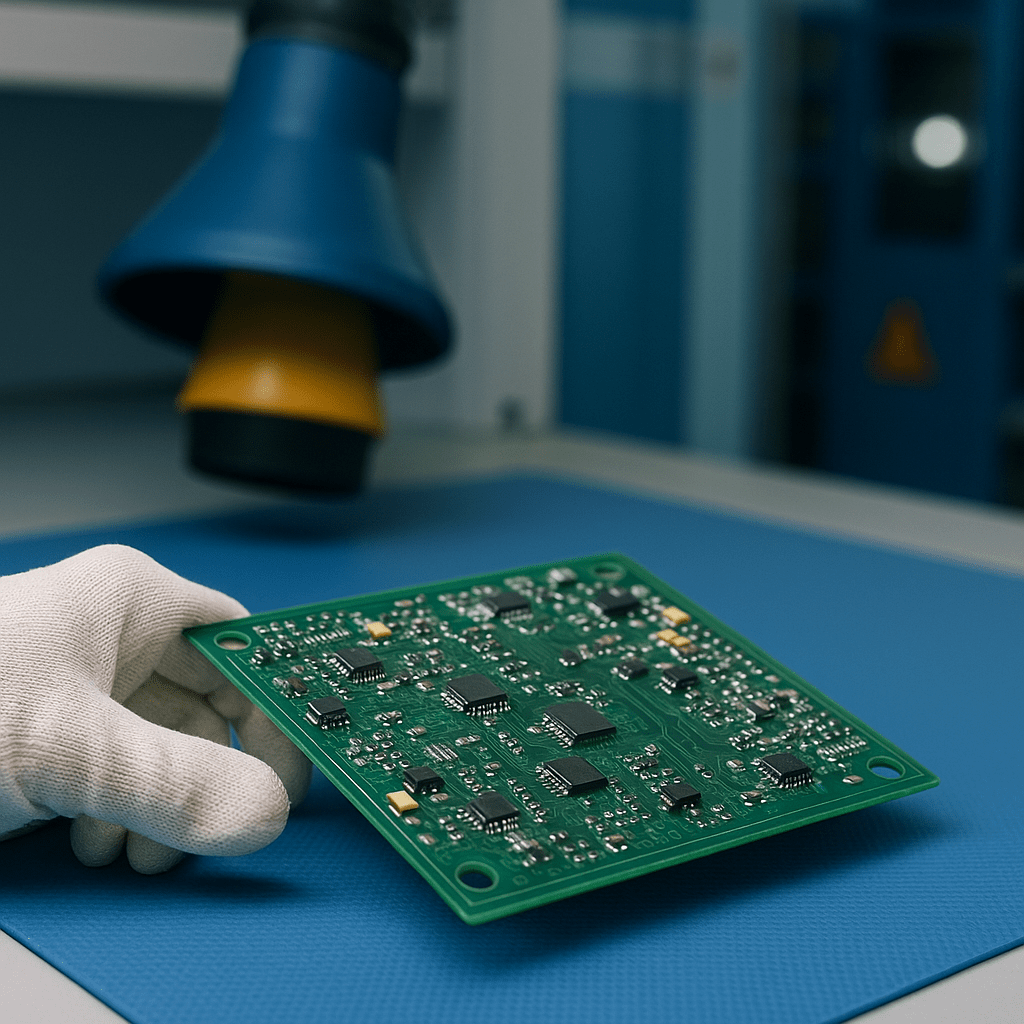
πŸ‘‰Β UV Inspection Booths

6. Continuous improvement keeps the process stable

Production changes, new PCB variants and supplier shifts all introduce risk. Without structured review, even a previously stable line can begin to drift.

SCH’s consultancy team provides:

  • NPI validation & materials benchmarking
  • full process audits
  • defect pattern analysis
  • SPC review & control planning
  • design alignment and masking strategy optimisation

Explore:

πŸ‘‰Β Conformal Coating Consultancy

7. When Parylene is the smarter choice

For certain assemblies, liquid coatings will never deliver the required performance. Parylene excels when:

  • geometries are complex
  • components are closely packed
  • surfaces are hidden, recessed or sharp-edged
  • moisture protection must be absolute
  • very high electrical resistance or stability is required
  • field reliability is mission-critical

Explore:

πŸ‘‰Β Parylene Coating Services

πŸ‘‰Β Parylene Deposition Systems

8. Why the holistic model matters

Failures rarely originate in the coating booth. They arise from misalignment of design, chemistry, application method or environment.

Symptoms include:

  • dewetting
  • fisheyes and pinholes
  • inconsistent thickness
  • chronic masking leakage
  • pooling and edge thinning
  • delamination and poor adhesion

These issues often appear random β€” yet almost always stem from upstream decisions.

Explore the full Coating Defects Hub:

πŸ‘‰Β Common Coating Defects

9. SCH’s Total Solutions Approach

Whether you coat in-house or outsource, SCH provides full lifecycle support across both liquid coatings and Parylene.

⭐ In-house coating support

⭐ Outsourced coating services

Explore:

πŸ‘‰Β Total Conformal Coating Solutions

πŸ”Β Read the full technical framework

This blog provides a high-level summary only. For the complete methodology, diagrams, commercial considerations and cross-linked technical resources, view the full article:

πŸ‘‰Β Holistic Conformal Coating Process – Full Guide

Conformal coating masking methods to prevent coating defects, leakage and rework

Masking Made Easy – 3 Ways to Reduce Defects in Conformal Coating


Masking is one of the simplest steps in conformal coating β€” and one of the most common causes of defects, rework and customer complaints when it goes wrong. Coating on connector pins. Adhesive residue left behind. Silicone boots leaking. Latex that tears or pulls the coating away. These issues cost time and money β€” but most are preventable.

The solution isn’t only better operator training β€” it starts with using the right masking materials and adhesives, the same paper-based tapes, dots and pre-cut shapes we use in our own coating services every day. To understand all available masking materials, see Conformal Coating Masking: Methods & Materials to review different tapes, dots, custom boots, latex and pre-cut shapes.


Why Masking Goes Wrong

Masking protects connectors, test pads, gold fingers, housings and other areas that must remain coating-free. Most masking failures are caused by:

  • Coating wicking under tape, dots, shapes or silicone boots
  • Coating de-wetting away from the tapes and dots due to the adhesive used.
  • Adhesive residue left behind after removal
  • Using general-purpose tape instead of conformal coating tested materials
  • Silicone boots that don’t seal or are worn out
  • Liquid latex applied too thick or removed too late
  • No inspection during demasking

To better understand leak paths and barrier methods, see Conformal Coating Masking Strategies – Barrier vs Shielding.

1. Choose the Right Masking Method β€” and the Right Adhesive

Masking Tape

  • Best for: General areas, edges and flat surfaces
  • Benefits: Low cost, flexible, easy to apply
  • Important: Must be paper-based, low-tack, clean-release. Avoid Kapton or painter’s tape β€” they leave residue or pull coating off.

Masking Dots & Discs

  • Best for: Test pads, vias, screw holes
  • Benefits: Fast, consistent sizing, no cutting needed
  • Important: Use paper-based coating-safe masking discs. Vinyl stickers, labels or strong adhesives will leave residue or lift coating.

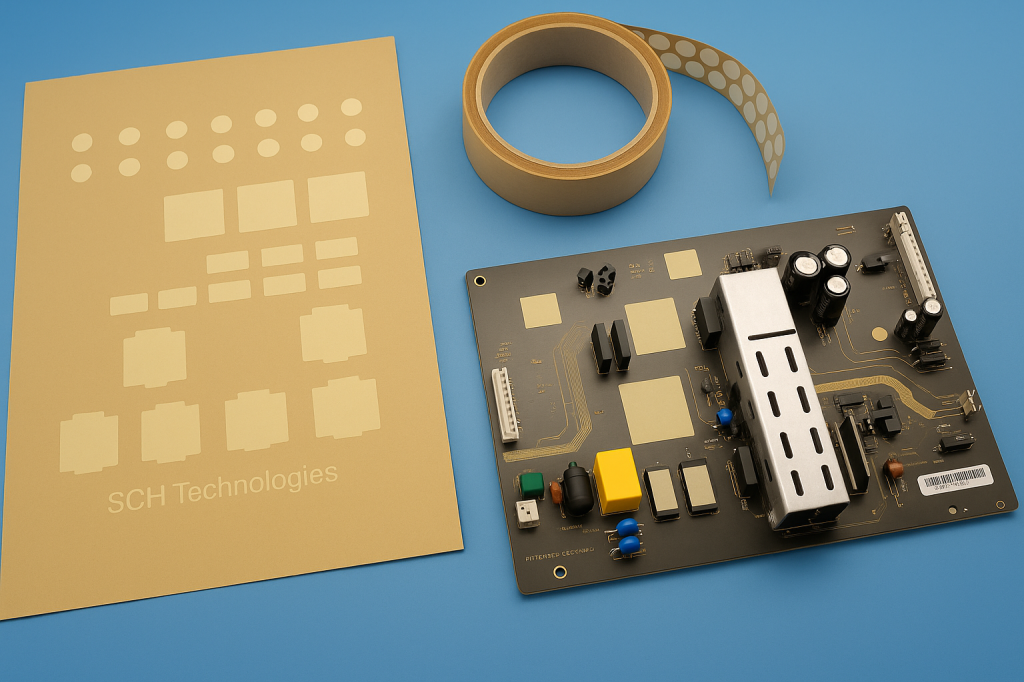
Pre-Cut Masking Shapes (Custom Paper Shapes on Sheets/Rolls)

  • Best for: Complex flat areas, precision masking, gold fingers, connector faces, repeat PCB builds
  • Benefits: No hand-cutting, accurate placement, speeds up production
  • Important: Made from specialist paper masking material with low-tack adhesive β€” same type we use daily in conformal coating services.

Silicone Masking Boots & Caps

Liquid Latex / Hybrid Barrier Systems

  • Best for: Board edges, non-flat surfaces, irregular shapes
  • Benefits: Seamless coating barrier where tape cannot reach
  • Important: Apply in thin coats, peel at the correct time. See Liquid Latex & Hybrid Barrier Systems – sealing tapes & keep-out edges.

πŸ›’ Want materials? Visit Masking Boots, Tapes, Dots & Pre-Cut Shapes from SCH.

2. Apply Masking Correctly β€” Clean, Seal and Fit

Even the right masking materials fail if they’re not applied properly.

Best Practice:

  • Clean the board before masking β€” oils and flux stop adhesives sealing.
  • Press tape/dots/shapes firmly, especially around edges.
  • Use Pre-Cut Masking Shapes for speed and consistency in repeat jobs.
  • Fit boots fully β€” no lifted edges or gaps. For guidance, see How to Mask a PCB with Boots – A How to Guide.
  • Latex must be applied in thin layers and peeled before it fully hardens.

For understanding the benefits of reusable boots in production environments, see Reusable Masking Boots – cost, speed, repeatability.

3. Inspect During Demasking β€” Not After Testing

Most masking failures are found too late β€” after coating cures or during electrical test. The best time to detect problems is while removing masking.

During demasking, check for:

  • Coating on pins, connectors or gold fingers
  • Adhesive residue or paper fibres
  • Coating lifting with the tape or shapes
  • Silicone boots pulling coating at the edges
  • Latex tearing or leaving fragments

Early detection = repair before full cure.

More masking advice can be found in Conformal Coating Masking: Methods & Materials –and Designing Effective PCB Masking Strategies.


πŸ’‘ Bonus Tips β€” Speed Up Masking, Reduce Rework

  • Use Pre-Cut Masking Shapes for intricate masking, complex areas, gold fingers and flat surfaces in repeat builds.
  • Replace silicone boots when they swell, crack or don’t seal.
  • Use latex or hybrid barrier approaches on difficult edges β€” see Liquid Latex & Hybrid Barrier Systems – sealing tapes & keep-out edges.
  • Add masking diagrams and photos to work instructions.
  • Train operators specifically in masking and demasking β€” not just coating.

Conclusion

Most masking problems aren’t caused by operator error β€” they’re caused by using the wrong tape, dots, shapes or boots.

Using the correct conformal coating masking tapes, dots, custom pre-cut shapes, silicone boots or peelable latex, applied and removed at the right time, will drastically cut defects, rework and costs.

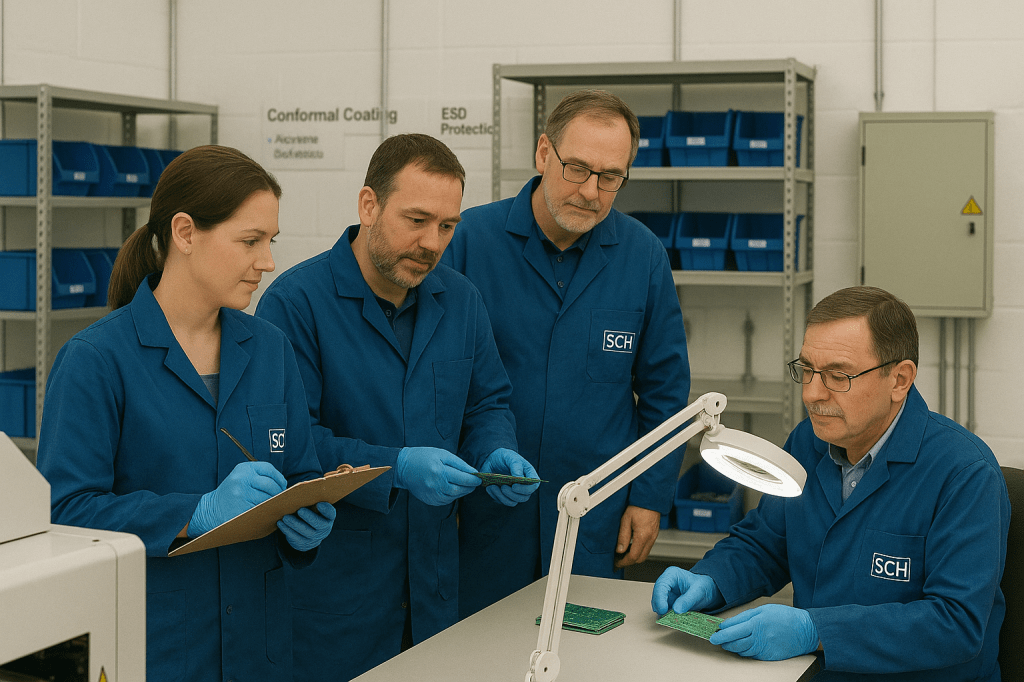
SCH Services team working in conformal coating, Parylene and ESD protection processes

Behind the Scenes at SCH – Where Precision Meets People


At SCH Services Ltd, we’re often known for what we deliver β€” world-class conformal coating, Parylene solutions, and ESD protection trusted by electronics manufacturers across the UK and beyond. But what truly defines SCH isn’t just the technology. It’s the people and processes behind it.

Step behind the scenes, and you’ll find that precision here isn’t just about machinery or materials β€” it’s about mindset. Every member of the SCH team understands that protecting electronics means protecting performance, reliability, and reputation. From the first board to the final inspection, every detail matters.

Precision in Every Process

Our commitment to precision runs through every layer of our operations. Whether it’s the controlled environment of our coating rooms, the exact science of Parylene deposition, or the meticulous ESD testing that underpins ProShieldESD, each step is guided by robust quality systems, ISO standards, and decades of expertise.

Our technicians and quality supervisors work closely together to ensure coatings meet the tightest specifications. Efficiency logs, training matrices, and continuous improvement processes help us stay on track β€” and ahead of industry expectations.

People at the Heart of Performance

What makes SCH different is that behind every coated board, every inspection, and every innovation, there’s a person who cares.

From our skilled masking and demasking technicians to our quality team and operations leaders, everyone contributes to the same goal β€” protecting what matters.

Our culture is one of accountability, teamwork, and continual growth. When challenges arise, we don’t point fingers β€” we find solutions.

Innovation with Integrity

As we prepare for Productronica 2025, we’re showcasing more than just technology. We’re sharing a story β€” one of people who take pride in their craft, of a company that combines innovation with integrity, and of a shared belief that excellence isn’t an act, but a habit.

At SCH, precision meets people every day. It’s what keeps us grounded, what drives us forward, and what makes the difference for every customer we serve.

Learn more about SCH’s conformal coating and Parylene solutions

Subcontract conformal coating services for electronics manufacturing

The Hidden Costs of DIY Coating vs using SCH Services Coating Solutions


When β€œDoing It Yourself” Costs More Than You Think

In electronics manufacturing, it’s easy to assume that keeping conformal coating in-house will save time and money. But in reality, β€œDIY coating” often leads to hidden costsβ€”extra labour, quality issues, and expensive downtime.

Setting up and maintaining a coating process is far more complex than most production teams anticipate. From equipment calibration to masking accuracy and inspection control, there’s a steep learning curve that can impact yield and product reliability.

At SCH Services Ltd, we specialise in subcontract conformal coating, helping manufacturers achieve consistent, high-quality protection without the overhead of running their own coating line.

1. Equipment Costs That Don’t Pay You Back

A full coating setup involves more than just a spray booth or dip system. You’ll need extraction units, curing ovens, inspection lighting, masking materials, and precision jigsβ€”plus ongoing maintenance. These capital investments rarely achieve full utilisation. Production peaks and dips leave expensive machinery sitting idle, while maintenance and calibration costs continue to rise.

By outsourcing to SCH Services, you eliminate capital expenditure. Our purpose-built coating facilities operate at optimal efficiency every day, meaning you only pay for the coating you needβ€”nothing more.

To understand what is really involved in setting up and maintaining an in-house line, see our overview of conformal coating systems and the equipment typically required to achieve repeatable results.

2. Labour and Training: The Hidden Overhead

DIY coating requires skilled technicians. Training staff to apply, inspect, and handle materials safely takes time and experience. Turnover or absences can leave you short-staffed, stalling production and increasing the risk of errors.

At SCH, our trained coating technicians and quality inspectors are dedicated specialists. Every board is processed under controlled conditions and backed by documented inspection data. That ensures consistent qualityβ€”without the cost of training or supervision on your side.

3. Rework, Rejects, and Quality Risks

DIY coating often appears cheaperβ€”until rework begins. Missed areas, conformal coating defects, or masking failures can trigger costly reprocessing, material waste, and delivery delays.

SCH’s inspection process ensures uniform coverage and reliable protection on every job. Using magnification, controlled environments, and robust masking methods, we maintain repeatable coating quality that meets industry standards for aerospace, defence, medical, and automotive sectors.

4. Compliance and Environmental Control

Operating a coating line means dealing with solvents, VOC emissions, and waste disposal. Each of these brings legal, environmental, and safety obligations that require ongoing monitoring and documentation.

SCH Services operates under ISO 9001 and ISO 14001 certification, with fully compliant extraction and waste management systems already in place. Outsourcing to a certified partner removes this regulatory burden, protecting both your people and your audit trail.

5. Scalability and Turnaround

In-house coating can quickly become a production bottleneckβ€”especially when volumes fluctuate or customer deadlines tighten.

SCH offers flexible capacity for both prototype and high-volume coating, ensuring consistent turnaround times without compromising quality. Whether you need rapid response on urgent jobs or scheduled coating support, we align with your production goals.

6. The True Value: Focus on Core Expertise

Ultimately, your team’s expertise is in designing, manufacturing, or assembling electronicsβ€”not in learning to mask, coat, and cure boards.

By partnering with SCH Services, you gain a trusted in-house extension that handles coating complexity for you.

You’ll benefit from:
β€’ Lower overall costs (no capital, no rework, no waste)
β€’ Predictable lead times
β€’ Consistent quality and traceability
β€’ Certified environmental and process compliance
β€’ The freedom to focus on your core business

Conclusion: When Expertise Pays for Itself

DIY conformal coating can look attractive on paperβ€”but the real costs soon surface in training, downtime, and rework. By outsourcing to SCH Services Ltd, you gain precision, consistency, and efficiency from day one.

Ready to compare the true cost difference?

Talk to our team today about how our subcontract and in-house coating solutions can reduce your costs and improve reliability.

πŸ‘‰Speak to our coating specialists
πŸ‘‰ Details

What Are Subcontract Conformal Coating Services and Why Do They Matter?


Conformal coating is vital for protecting electronics from moisture, dust, chemicals, and temperature extremes. Yet many manufacturers don’t have the facilities or expertise to manage coating in-house. That’s where subcontract conformal coating servicesβ€”sometimes called outsourced conformal coatingβ€”play a critical role. By partnering with a specialist provider like SCH Services, companies gain consistent results without the burden of running their own coating line.


What Are Subcontract Conformal Coating Services?

Subcontract conformal coating means entrusting your printed circuit board (PCB) assemblies to an external, professional coating house. Instead of purchasing capital equipment, training staff, and maintaining coating systems, you send assemblies to a contract conformal coating provider who applies the specified finish and returns them production-ready.

At SCH Services, we manage the full process:

  • Intake & documentation
  • Masking & preparation
  • Application by spray, dip, or brush
  • Curing & drying
  • Inspection & testing
  • Final packaging and return

All processes are carried out under ISO 9001 and ISO 14001 certified conditions, supporting repeatability and traceability.


Why Do They Matter?

  • Expertise and precision – Dedicated coating houses specialise in conformal coating, helping reduce defects and improve consistency.
  • No need for in-house specialists – You avoid the challenge of recruiting, training, and retaining coating technicians and inspectors.
  • Cost efficiency – Outsourcing removes capital spend and converts fixed overhead into a predictable service cost.
  • Speed and flexibility – Scale from prototypes to production batches without changing your internal resource plan.
  • Reduced risk – Strong process control and inspection reduces the likelihood of failures, claims, and rework.
  • Compliance and reliability – Certified processes support customer requirements and audit readiness.

When Should You Consider Outsourcing?

  • Prototypes & NPI: Volumes are too small to justify in-house investment.
  • Low-to-medium volumes: Flexibility matters more than maximum throughput.
  • Overflow capacity: Your line is at full load and you need additional support.
  • Specialist projects: Aerospace, defence, or medical builds requiring tighter control and documentation.

Why Choose SCH Services?

With more than 25 years of experience, SCH Services supports OEMs and EMS providers with reliable subcontract conformal coating services across a wide range of product types and production volumes.

  • Liquid and advanced coating options for PCB protection
  • ISO-certified processes focused on quality and reliability
  • Support from prototype through volume production
  • Access to related services such as Parylene coating services when higher performance is required

If you want to explore coating routes and service options in one place, see our Conformal Coating Solutions page.


Conclusion

Subcontract conformal coating services provide manufacturers with the flexibility, expertise, and assurance needed to deliver reliable electronics. By outsourcing to a trusted partner like SCH, you avoid costly setup, reduce risk, and maintain consistent protection against demanding environments.

Next step: If you’d like to discuss volumes, specifications, or turnaround requirements, contact us via our contact page.

Conformal coating masking solutions including reusable boots, high-temperature masking tapes, dots, and custom shapes for protecting PCBs during coating and Parylene processes

From Bottleneck to Breakthrough: How Custom Masking Shapes Transform Conformal Coating Production


In modern electronics and high-reliability assemblies, one of the most overlooked yet critical steps is maskingβ€”protecting areas that must remain coating-free during the conformal coating process. Done poorly, masking becomes a bottleneck: misalignment, rework, and delays can cripple throughput. But with custom masking shapes for conformal coating, you can turn that bottleneck into a breakthrough.

Explore our range of custom masking shapes for conformal coating designed to speed setup, improve consistency, and boost production yield.


The Masking Challenge

When applying conformal coatingsβ€”or advanced materials like Paryleneβ€”pads, connectors, keep-out zones, and sensitive features must be protected precisely. Traditional manual cutting of tape is slow, inconsistent, and often unreliable.

The result?

  • Masking residue left behind
  • Shrinkage or degradation under solvents
  • De-wetting caused by silicone contamination
  • Tape lifting or coating bleed into protected areas

These issues reduce yield, increase rework, and slow down production.

For a full breakdown of masking options and where each is best used, see Conformal Coating Masking: Methods & Materials.


The Advantage of Custom Masking Shapes

At SCH Services Ltd, we provide custom masking shapes designed specifically for conformal coating processesβ€”including the same materials we use in our own production services. That means the shapes we supply are proven daily for accuracy, consistency, and clean removal.

Benefits of custom shapes include:

  • Residue-free removal with no damage to components
  • Solvent and chemical resistance for demanding environments
  • Silicone-free materials to reduce contamination and coating defects
  • Clean, reliable adhesion that helps prevent lifting and bleed
  • Ready-to-use sheets for fast application and reduced operator time

Because we rely on these shapes daily in our own conformal coating services, we know firsthand how they improve throughput, reduce defects, and remove bottlenecks.

For standard formats or fast turnaround requirements, custom masking dot and shape sheets can also be ordered directly via our online shop. Order custom masking dot and shape sheets online.


From Bottleneck to Breakthrough

Standardising masking with custom masking shapes for conformal coating improves speed and repeatabilityβ€”while reducing operator variation.

CHALLENGE MANUAL MASKING CUSTOM MASKING SHAPES
Cutting & prep time High Minimal – peel & place
Consistency Operator dependent Uniform every time
Risk of rework/defects High Low
Cycle efficiency Slow Streamlined
Yield loss Frequent Reduced

By reducing cutting time and improving repeatability, masking becomes faster, cleaner, and more reliableβ€”supporting higher yield and smoother production flow.


SCH Services Ltd: Proven in Our Own Services

Unlike suppliers who only sell materials, SCH Services Ltd actively uses these masking shapes in our own conformal and Parylene coating services. Customers benefit from the same speed, precision, and clean demasking performance we demand for our own clients.

When reliability matters, masking isn’t a bottleneckβ€”it’s a breakthrough.

If you’re ready to standardise masking in your production, learn more about custom masking shapes for conformal coating and how they can reduce defects and cycle time.

If you already know your masking requirements, you can order custom masking dot and shape sheets directly from our shop, or contact us for fully bespoke designs.

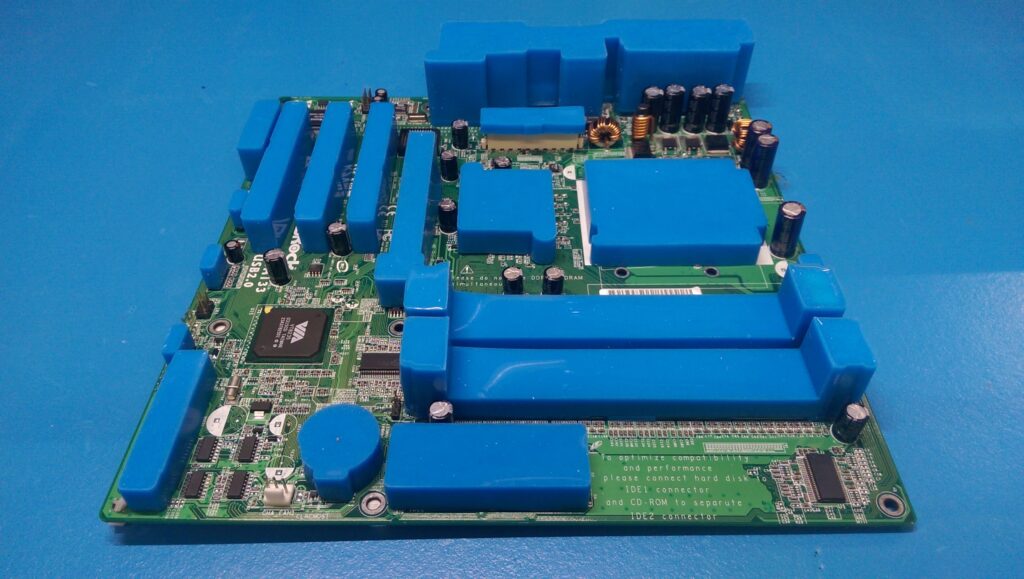
Why less mistakes are made with conformal coating masking boots


Conformal coating masking boots reduceΒ mistakes in handling and coating printed circuit boards (PCBs).

The simple reason is that when using tape there is a higher level of skill involved in applying it to the printed circuit board. When placing a boot over a component it is a lot simpler. Therefore, the conformal coating is less likely to leak.

Conformal coating masking boots used on Printed circuit board as an alternative to masking tapesThree reasons conformal coating masking boots save you money
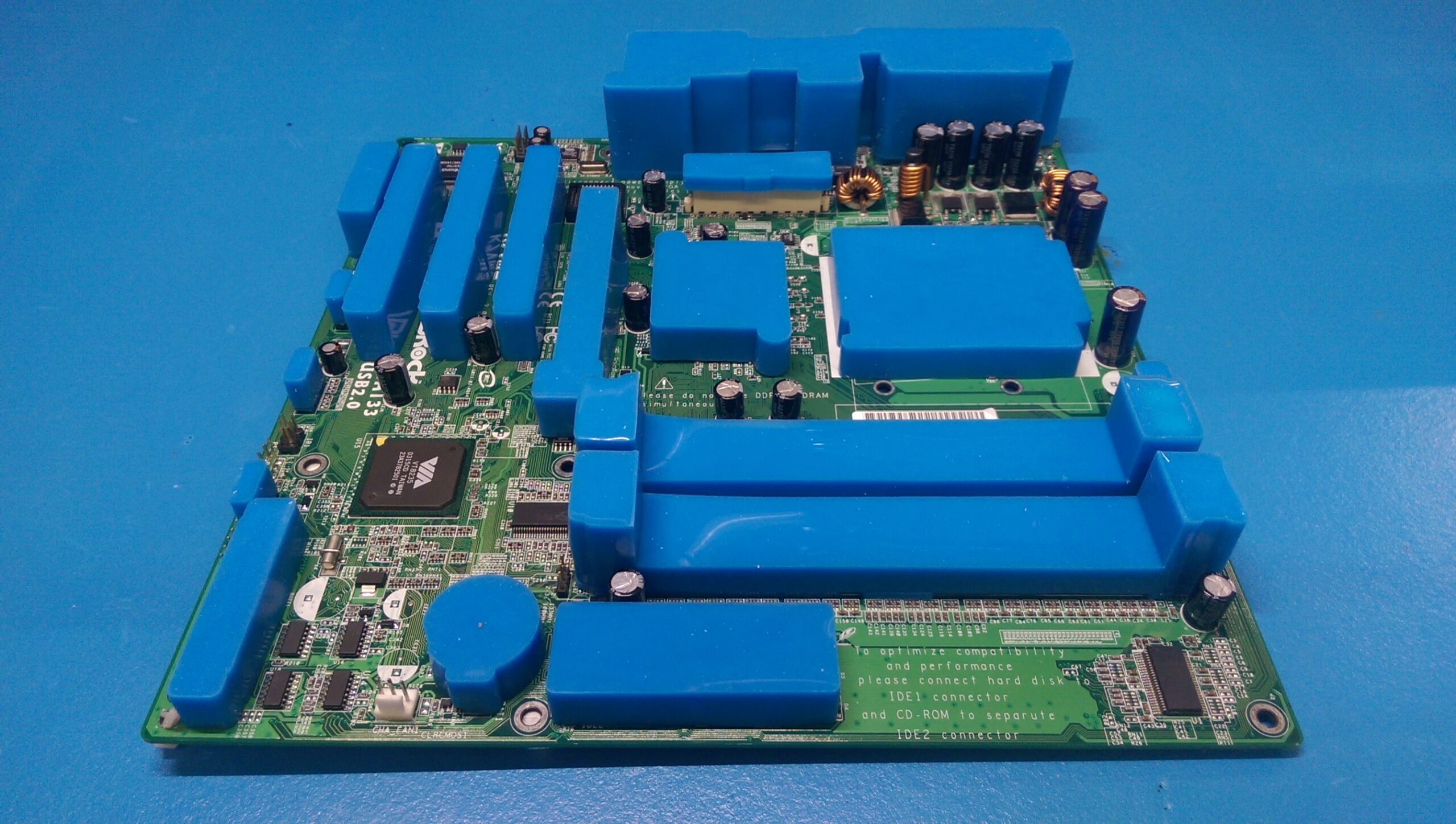

Here are three simple reasons that can save you up to 80% of your costs when using reusable masking boots compared to other conformal coating masking methods:

  1. Masking time is reduced because using boots can be 4-5 times quicker than masking tape.
  2. De-masking time is reduced since it is much quicker to remove boots
  3. Masking boots don’t leak. Therefore, there is less repair due to masking mistakes.

This means you can save a lot of money very quickly when switching to masking boots and reduce the mistakes made during the conformal coating process.

Call us on +44 1226 249019, email us at sales@schservices.com or click contact usΒ to send us your requests.


Conformal coating masking boots used on Printed circuit board as an alternative to masking tapes

Using custom masking boots for the conformal coating masking process saves time, money and improves quality. Find out why….


Masking is a critical step in conformal coating processes, protecting connectors, test points, and keep-out areas from unwanted coating ingress. Traditional masking materials such as tapes, dots, and liquid latex can be effective, but they are often labour-intensive and inconsistent.

In many conformal coating operations, masking and de-masking account for a significant proportion of overall process time and cost. In some cases, these steps can represent more than 75% of the total coating effort, driving up labour costs and limiting throughput.

To understand how masking boots fit into a complete conformal coating process, explore our masking solutions.


Using Recyclable Masking Boots as an Alternative to Tapes, Dots, and Latex

Reusable conformal coating masking boots offer a faster, more reliable alternative to traditional masking methods. By switching to masking boots, manufacturers can significantly reduce process time while improving consistency and repeatability.

Three key reasons to change to masking boots:

  1. Reduced masking time – Masking boots can be four to five times faster to apply than traditional masking tape or dots.
  2. Reduced de-masking time – Removal of masking boots is quicker and cleaner than peeling tape or removing cured latex.
  3. Improved sealing – Masking boots provide a more consistent seal and are less prone to leakage, reducing the need for inspection and repair.

These benefits allow manufacturers to achieve rapid cost savings and improve process efficiency when transitioning away from tape- and latex-based masking.


Find Out More About Conformal Coating Masking Boots

If you are reviewing your masking process or looking to reduce coating-related labour costs, SCH Services Ltd can help assess whether masking boots are suitable for your application.

If you would like to discuss masking boots for your assemblies or compare them against tape-based methods, contact our team.

How Custom Masking Boots Reduce Cost, Time and Risk in Conformal Coating


Custom conformal coating masking boots are an effective alternative to traditional masking materials such as tapes, dots, and liquid latex for protecting components from conformal coating ingress on printed circuit board assemblies.

While conventional masking methods can work, the masking and de-masking process is often labour-intensive and time-consuming, significantly increasing overall production costs. In many applications, masking and removal can account for over 75% of the total conformal coating process time and cost, particularly in medium- and high-volume production.

Three reasons to switch to reusable conformal coating masking boots

Using recyclable masking boots as an alternative to masking tapes, dots, and latex

Here are three good reasons to change to masking boots and save up to 80% of your costs compared to traditional methods like masking tape and dots:

  1. The masking time is reduced significantly. Masking boots can be 4-5 times quicker to use than masking tape.
  2. De-masking time is reduced significantly. Again it is much quicker to remove masking boots than tape.
  3. Masking boots don’t leak as easily as masking tape. So, there is less likely to be repaired.

These reasons mean you can save a lot of money very quickly when switching to masking boots.

Want to find out more about conformal coating masking boots?

Contact us now to discuss your conformal coating masking boot requirements and let us explain how we can help you.


0
  • Your current order total is £0.00 β€” you must have an order with a minimum of £75.00 to place your order.
0
Your Cart
Your cart is empty
  • Your current order total is £0.00 β€” you must have an order with a minimum of £75.00 to place your order.
Calculate Shipping
  • Your current order total is £0.00 β€” you must have an order with a minimum of £75.00 to place your order.

Conformal Coating UK

Conformal Coating UK
Privacy Overview

This website uses cookies so that we can provide you with the best user experience possible. Cookie information is stored in your browser and performs functions such as recognising you when you return to our website and helping our team to understand which sections of the website you find most interesting and useful.