Conformal Coating Removal & Rework Hub
Conformal coating removal methods, micro-abrasion & PCB rework workflow
This Conformal Coating Removal & Rework Hub brings together practical guidance on stripping, repairing and restoring coated electronic assemblies.
The correct removal method depends on coating chemistry, cure state, assembly materials, component sensitivity, the size of the rework area and what must happen to the assembly afterwards.
Use this hub to identify unknown coatings, decide between local and full removal, compare solvent, thermal and micro-abrasive methods, understand Parylene removal and build a controlled clean-repair-recoat workflow.
External resource: IPC-7711/7721 Rework, Modification and Repair
Choose the Removal Path Before Starting Rework
- Coating type unknown → Identify the coating first
- Only a small repair area requires access → Compare local and full removal
- Known solvent-sensitive coating → Review solvent-based removal
- Considering controlled heat → Review thermal removal risks
- Need precise local access → Review micro-abrasive removal
- Removing or restoring Parylene → Review Parylene removal and recoating options
- Removal complete → Follow the clean, repair, verify and recoat workflow
Before you remove anything, cross-check:
- Defects Hub — confirm whether the problem is a coating defect, contamination issue or genuine requirement for removal.
- Inspection & Quality Hub — define accept, rework and strip criteria plus verification requirements.
- Masking Hub — define keep-outs and masking requirements before local recoating.
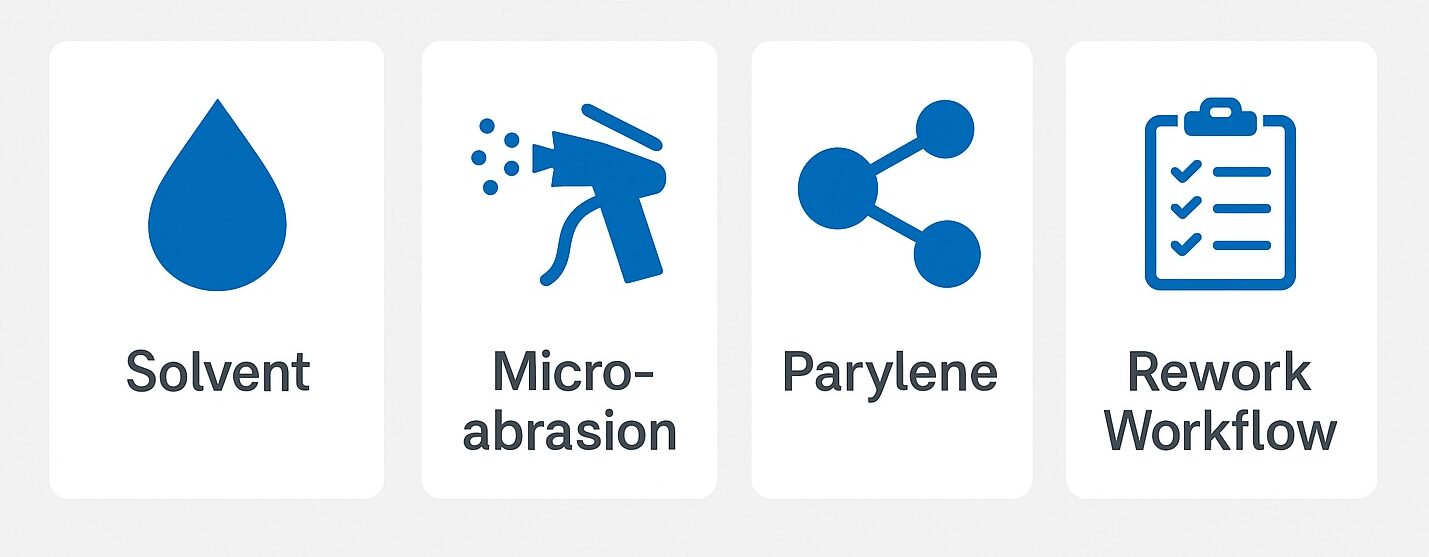
Conformal coating removal requires the correct method for the coating, assembly and rework objective, followed by controlled cleaning, repair, inspection and recoating.
Removal & Rework Hub Index
| Topic | More | Article |
|---|---|---|
| Ultimate Conformal Coating Removal Guide (UK & Europe) | 🔗 | ↗ |
| Identify Unknown Conformal Coatings (IPC-7711 Method) | 🔗 | ↗ |
| Solvent-Based Conformal Coating Removal (UK & Europe) | 🔗 | ↗ |
| Thermal Removal / Controlled Heat Softening | 🔗 | ↗ |
| Conformal Coating Removal Methods (Wet & Micro-abrasion) | 🔗 | ↗ |
| Inside the Micro-Abrasive Blasting Process | 🔗 | ↗ |
| Micro-Abrasive Media Selection Guide (Conformal Coating) | 🔗 | ↗ |
| Parylene Removal: Precision Micro-abrasion | 🔗 | ↗ |
| Conformal Coating Rework Workflow | 🔗 | ↗ |
| Conformal Coating Removal: Local & Full Stripping | 🔗 | ↗ |
Ultimate Conformal Coating Removal Guide (UK & Europe)
A practical UK/EU-focused reference for selecting safe conformal coating removal methods. Covers identification, solvent vs mechanical vs micro-abrasion decision-making, Parylene considerations, risk controls, inspection and recoat planning.
Identify Unknown Conformal Coatings (IPC-7711 Method)
If the coating type is unknown, the biggest risk is choosing the wrong removal method and damaging the assembly. This guide explains behaviour-based identification using visual characteristics, hardness, solvent response and controlled heat response to help plan a safer removal and recoat strategy.
Solvent-Based Conformal Coating Removal (UK & Europe)
Solvent-based removal can be safe and efficient for compatible coating chemistries, especially many acrylic coatings, but it carries compatibility and residue risks if applied by trial-and-error or aggressive immersion.
This guide explains when solvents are appropriate, why local delivery is generally preferable on populated assemblies, how to manage risks to plastics, inks and labels, and when a more controllable removal method should be considered.
Thermal Removal / Controlled Heat Softening
Controlled heat is sometimes used during coating identification or local rework, but populated PCB assemblies can be vulnerable to collateral heating, component damage and unpredictable material responses.
This guide explains where controlled heat may be appropriate, the risks to component bodies, plastics, labels, inks and solder mask, and when to stop and move to a more controllable removal method.
Conformal Coating Removal Methods
Use solvent removal for compatible liquid coatings where the film can be softened and removed without unacceptable risk to the assembly. Consider precision micro-abrasion where controlled local access is required around test points, pads, connectors or other sensitive PCB areas.
Inside the Micro-Abrasive Blasting Process
Go beyond when to use micro-abrasion and understand how the process is controlled. This guide covers media selection including VanAcrylic, air pressure and flow, nozzle geometry, standoff distance, angle and ESD-safe technique for controlled coating removal.
For a practical equipment-led view, see How the Vaniman ProBlast 3 ESD Cuts Conformal Coating Rework Time in Half.
For existing Vaniman ProBlast users experiencing VanAcrylic flow or blockage issues, see Do I Have the Latest VanAcrylic Configuration? to check the current tank, violet tip and internal media-delivery arrangement.
Micro-Abrasive Media Selection Guide
Correct abrasive selection is critical for controlled coating removal without substrate damage. This guide explains how media type, including VanAcrylic plastic abrasive, particle size, hardness and cleanliness should be selected according to coating type, PCB sensitivity, boundary-control requirements and rework risk.
Parylene Removal: Precision Micro-Abrasion
Parylene is highly resistant to conventional solvent removal. Controlled micro-abrasive blasting can provide precise local access for solder repair and modification when media, pressure, nozzle, standoff and angle are correctly controlled.
Does all the existing Parylene need to be removed before the assembly is recoated?
Not always. Where rework is localised and the remaining coating is sound, it may be possible to retain much of the original Parylene and apply a second layer after suitable assessment and surface preparation.
Conformal Coating Rework Workflow
A controlled rework sequence should confirm the defect and repair requirement, remove coating locally or fully, complete the electrical or mechanical repair, clean and verify the area, then recoat and reinspect to restore protection and traceability.
Local vs Full Conformal Coating Removal
Choose localised removal to minimise time, material disturbance and risk when only targeted access is required. Consider full stripping when coating problems are widespread, the existing coating is incompatible with the required repair or recoat process, or the assembly requires a complete restart.
How Removal & Rework Links to the Wider Process
Removal should not be treated as an isolated repair operation. The reworked assembly must return to a controlled coating, inspection and reliability process.
- Conformal Coating Defects Hub — identify the failure and likely root cause before deciding to strip.
- Inspection & Quality Hub — establish acceptance, rework and post-repair verification criteria.
- Masking Hub — control local recoat boundaries and protected interfaces.
- Conformal Coating Processes Hub — return the repaired assembly to a controlled coating workflow.
- Parylene Process & Reliability Hub — wider process guidance where Parylene is being removed and restored.
Need Help with Conformal Coating Removal or PCB Rework?
SCH Services can help determine the safest removal route for coated assemblies, develop controlled rework processes and provide specialist micro-abrasive equipment and technical support for precision conformal coating and Parylene removal.
- Coating identification and removal-method assessment.
- Local versus full stripping strategy.
- Precision micro-abrasive removal of conformal coatings and Parylene.
- Vaniman ProBlast equipment and VanAcrylic media support.
- Rework, cleaning, masking, recoating and post-repair inspection guidance.
- Training and process development for repeatable production rework.
Why Choose SCH Services?
SCH combines practical conformal coating and Parylene experience with specialist removal, inspection, masking and rework knowledge. This allows the complete repair route to be considered rather than treating coating removal as an isolated operation.
- Removal expertise: experience with liquid conformal coatings and Parylene.
- Micro-abrasive knowledge: practical understanding of Vaniman equipment, VanAcrylic media and controlled local removal.
- Complete rework thinking: removal, cleaning, repair, masking, recoating and inspection considered together.
- Process development: support for repeatable production rework rather than one-off trial-and-error removal.
- Training & technical support: practical guidance for operators, engineers and quality teams.