Recoating Defects: Wrinkling & Surface Distortion
Wrinkling is a conformal coating film-formation defect where the cured surface develops ripples, ridges, or surface distortion instead of levelling smoothly. In some industrial coating literature this appearance is referred to as “alligatoring”, describing a cracked or reptile-skin texture; however, in conformal coating practice it is treated as a form of wrinkling caused by intercoat incompatibility or cure-state mismatch.
These defects are most commonly driven by recoat timing errors, solvent attack on a partially cured film, surface skinning with trapped solvent beneath, or uneven polymer crosslinking between layers.
For a complete index of defect types and links to each technical article, use the Conformal Coating Defects Hub.
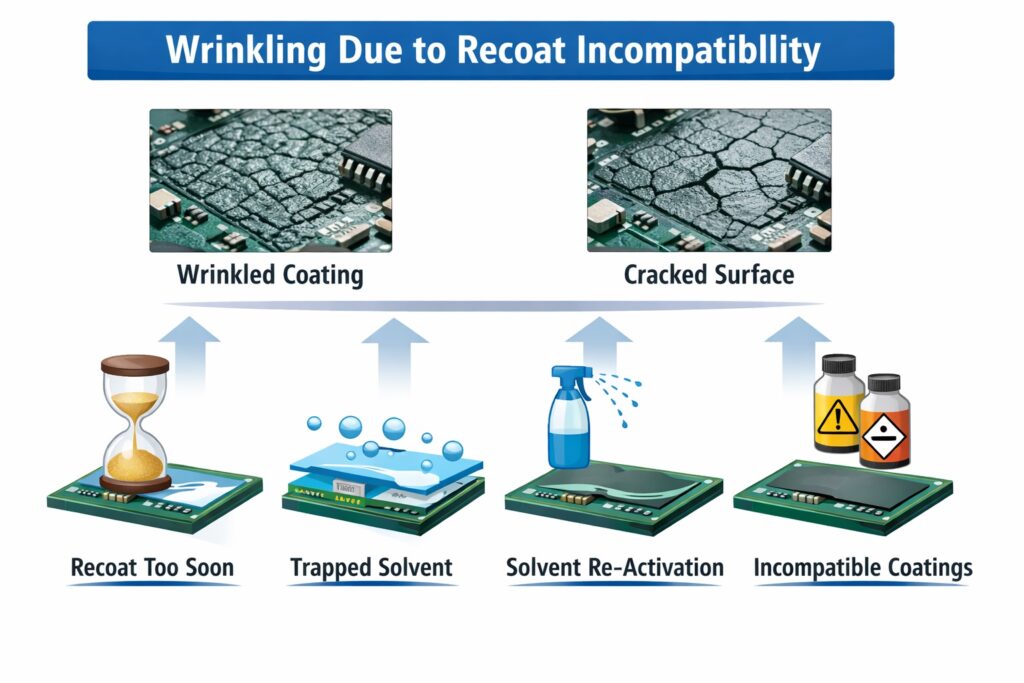
Wrinkling in conformal coating caused by recoat timing errors, solvent attack on partially cured films, and intercoat cure mismatch.
Article Quicklinks
| Topic | More |
|---|---|
| Definitions: wrinkling vs alligatoring | 🔗 |
| How it forms: mechanisms & pattern clues | 🔗 |
| Root causes: material, recoat, cure, process | 🔗 |
| Prevention: control window & recoat rules | 🔗 |
| Troubleshooting: isolate the mechanism fast | 🔗 |
| Repair: touch-up vs strip & recoat | 🔗 |
What are Wrinkling & Alligatoring in Conformal Coating?
- Wrinkling — ripples or raised ridges in the coating surface caused by the top layer “moving” or shrinking differently to the layer beneath.
- Alligatoring — a more severe wrinkling pattern that resembles cracked, segmented “crocodile skin”, often linked to strong differential shrinkage or solvent attack between layers.
These defects are not just cosmetic. They can correlate with poor intercoat adhesion, trapped solvent, local under-cure, and future cracking and moisture pathways.
Sanity check (look-alikes):
- Defects driven primarily by gravity flow, such as runs or curtains, are better covered under Runs, Sags & Curtains.
- Where the surface finish appears dimpled or textured rather than rippled or ridged, refer instead to Orange Peel.
- If the coating remains soft or tacky across large areas, the root cause is more likely incomplete cure—see Tacky / Soft-Cured (Under-Cure).
- Where the failure mode is dominated by brittleness, cracking, or surface crazing, route to Over-Cure / Brittleness.
How Wrinkling & Alligatoring Forms (Mechanisms)
- Recoat attack / incompatibility: the solvent in the second coat softens or partially dissolves the first coat, which then swells and re-shrinks as it dries → surface buckling and ridging.
- Skinning over trapped solvent: the surface “locks” early while solvent remains below; as solvent migrates/vents, the surface distorts → wrinkled texture.
- Mismatched cure state between layers: a partially cured first coat + a fast-curing second coat can create differential shrinkage and internal stress → wrinkling/alligatoring.
- Over-thickness in a local area: thicker regions dry/cure differently to surrounding thin film; localised shrinkage mismatch can initiate ridges and then cracking.
Pattern clue: if the defect appears immediately after recoating, suspect recoat attack or incompatibility first.
If it develops during cure or appears hours later, suspect skinning/trapped solvent or cure-state mismatch.
Related mechanism pages (use when relevant): cracking · pooling / puddling · insufficient coverage / shadowing
Root Causes of Wrinkling & Alligatoring
Recoat & Compatibility
- Recoating outside the validated window — applying a second coat too soon (soft first layer) or too late (poor intercoat bond) can destabilise film formation.
- Chemistry mismatch — different coating chemistries (or thinners) can be incompatible and drive solvent attack or differential shrinkage.
- Partial cure before recoat — the first layer may be “dry to touch” but not sufficiently cured; the second layer can re-wet and distort it.
Process & Film Build
- Over-wet, high-build passes — thick film increases solvent residence time and raises skinning risk.
- Insufficient flash-off — solvent remains trapped when the surface skins early or cure ramps too fast.
- Local pooling at edges/low points — thick regions behave differently and can wrinkle or later crack.
Cure & Environment
- Too aggressive drying / cure ramp — fast skin formation traps solvent beneath.
- Temperature mismatch — cold boards + warm air flow can promote rapid skinning and uneven solvent release.
- Contamination between coats — handling residues or airborne contamination can weaken intercoat bonding and distort levelling.
If you suspect a broader cure-state issue, cross-check the dedicated pages for under-cure (tacky/soft) and over-cure (brittle) within the Defects Hub.
How to Prevent Wrinkling & Alligatoring
Lock your recoat rules (most important)
- Validate and document recoat windows — define minimum flash/dry time and maximum recoat time for your chemistry and film build.
- Use compatible materials — keep chemistry and thinner choice consistent; do not “mix systems” without validation.
- Confirm cure state before recoating — “dry” is not the same as “cured”; align checks to your chemistry and spec.
Control film build and solvent release
- Multiple thin coats with defined flash-off beats one heavy pass.
- Stabilise viscosity within your validated window; avoid unplanned dilution.
- Prevent pooling — manage orientation during flash and avoid loading low points and edges.
Tune your dry/cure profile
- Avoid rapid skinning — use an appropriate ramp/profile for thickness and chemistry.
- Keep substrate conditions consistent — board temperature and airflow influence levelling and solvent escape.
If you’re building acceptance criteria and inspection routines, use the Inspection & Quality Hub.
Troubleshooting & Diagnosis
1) Confirm timing (fastest discriminator)
- Immediately after recoating → suspect solvent attack / incompatibility / recoat window first.
- During cure or hours later → suspect skinning and trapped solvent or cure-state mismatch.
2) Map where it occurs
- Localised to thick areas / edges / low points → check for over-build and pooling.
- Uniform across sprayed zones → check flash-off, airflow, substrate temperature and cure ramp.
3) Check the “recoat triad”
- Was the first coat fully within spec cure state? (not just “touch dry”)
- Were the chemistry and thinner compatible? (no substitutions without validation)
- Was recoat timing inside your validated window?
If the defect coincides with tackiness or contamination pickup, cross-check the Under-Cure (tacky/soft) page.
If you observe brittle cracking or crazing, cross-check the Over-Cure / Brittleness page.
Repair: When to Touch-Up vs Strip & Recoat
- Localised surface wrinkling: if the coating remains well adhered, meets keep-out requirements, and can be verified, controlled local rework may be possible (process-dependent).
- Alligatoring / widespread wrinkling: usually indicates an incompatibility or trapped-solvent mechanism — stripping and recoating is often the only robust option.
- Any sign of poor adhesion between coats: treat as an interface defect; local repair is high risk unless the interface is proven stable.
For removal workflows and best-fit methods, see the Removal & Rework Hub.
Looking for Other Defect Types?
This page covers wrinkling and alligatoring. For the complete index of defect types and links to each technical article:
Training on Conformal Coating Defects
SCH offers conformal coating training that goes beyond theory—recognising and preventing under-cure, over-cure, wrinkling/alligatoring, orange peel, de-wetting, delamination, cracking, corrosion, and coverage/keep-out failures. We cover process analysis, troubleshooting, materials, and application methods.
Industry Standards We Work To
SCH Services aligns coating services, training, equipment supply and materials to relevant IPC standards, including:
- IPC-A-610 – Acceptability of Electronic Assemblies
- IPC-CC-830 – Qualification & Performance of Conformal Coatings
- IPC-HDBK-830 – Conformal Coating Handbook (guidance and best practice)
For further details on IPC standards: electronics.org/ipc-standards ↗
Explore Topic Hubs
Conformal Coating Processes Hub
Conformal Coating Equipment Hub
Conformal Coating Masking Hub
Conformal Coating Design Hub
Conformal Coating Defects Hub
Inspection & Quality Hub
Removal & Rework Hub
Standards Hub
Parylene Basics Hub
Parylene Design Hub
Parylene Application Hub
Parylene Dimers Hub
Why Choose SCH Services?
You gain a complete, integrated platform for Conformal Coating, Parylene & ProShieldESD—plus equipment, materials and training—backed by decades of hands-on process support.
- 🛠️ End-to-End Support – Selection, masking, inspection and troubleshooting.
- ✅ Process Discipline – Recipes, control windows and repeatability.
- 🌍 Global Reach – Support across Europe, North America and Asia.
📞 Call: +44 (0)1226 249019 | ✉ Email: sales@schservices.com | 💬 Contact Us ›