Brittle / Over-Cured Conformal Coating Defects
Brittleness / over-cure is a conformal coating defect where the cured film becomes too stiff and loses flexibility. A brittle film is more likely to crack, craze, or fracture under thermal cycling, vibration, handling, or local stress concentration (edges, fillets, and tight-clearance features).
This page explains how to recognise an over-cured or embrittled coating, what typically drives it, how to confirm the mechanism, and what to change to prevent recurrence.
For the complete index of defect types and links to each technical article, use the Conformal Coating Defects Hub.
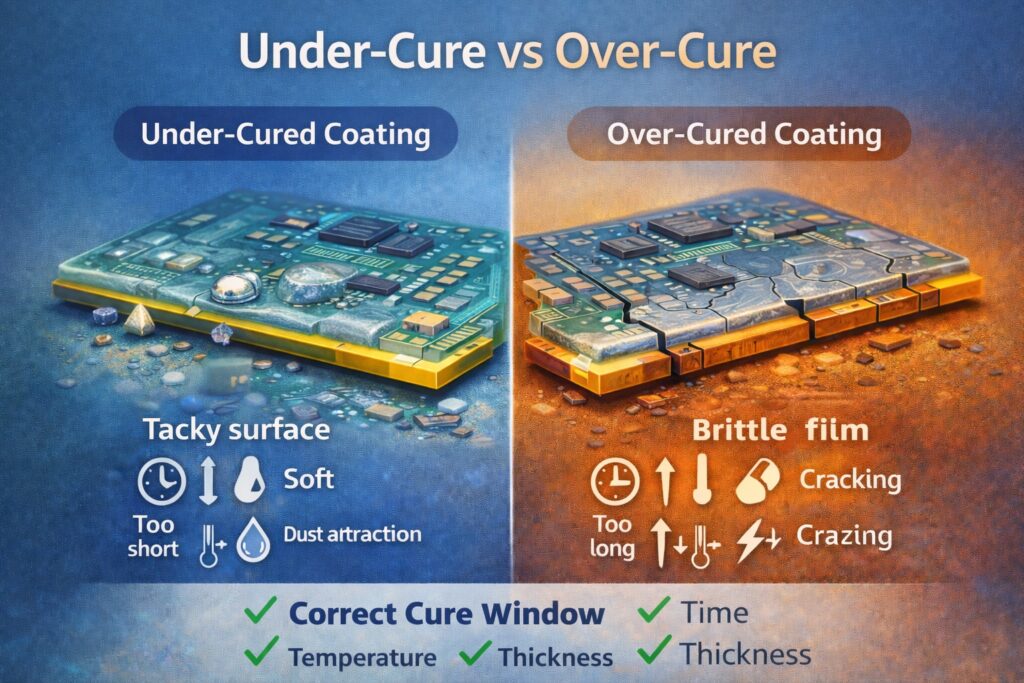
Comparison of under-cured (tacky, soft) and over-cured (brittle, cracked) conformal coating caused by incorrect cure time or temperature
Article Quicklinks
| Topic | More |
|---|---|
| Definition: what “brittle / over-cure” means | 🔗 |
| How it happens: mechanisms and tell-tales | 🔗 |
| Root causes: process, material, environment | 🔗 |
| Prevention: control window and practical changes | 🔗 |
| Troubleshooting: checks to confirm over-cure vs other issues | 🔗 |
| Repair: when to touch-up vs strip and recoat | 🔗 |
What is Brittle / Over-Cured Conformal Coating?
A coating is considered brittle when the cured film has low strain tolerance—it cannot flex with the assembly without forming cracks or craze patterns. “Over-cure” refers to a cure state where excess cure energy (time/temperature/UV dose) or post-cure thermal history increases stiffness and reduces toughness.
- Typical symptoms: cracking, crazing, micro-fractures, edge cracking, fracture lines across fillets, or “spider-web” patterns under magnification.
- Typical risk areas: thick sections, pooled areas, sharp edges, corners, around tall components, and bridged fillets between leads/pads.
Sanity check (look-alikes):
- If the main defect is visible fractures, go to cracking in conformal coating.
- If the problem is that the coating never properly cures and stays tacky, go to tacky / soft-cured (under-cure).
- If adhesion is failing at the interface, route to delamination.
How Brittleness / Over-Cure Happens (Mechanisms)
- Excess crosslink density: more cure energy can increase stiffness and reduce toughness, especially in UV and thermally cured chemistries.
- Thermal ageing / embrittlement: prolonged exposure to elevated temperatures can drive further cure or change polymer structure over time.
- Thickness-driven stress: thick sections develop higher internal stress during cure and see higher thermal strain in service.
- Tg mismatch vs duty environment: if the coating’s glass transition (Tg) is above the operating range, the film can behave more glassy and brittle.
- Stress concentrators: sharp edges, heavy fillets, bridging between leads, and pooled areas concentrate strain and initiate cracks first.
Pattern clue: if cracks initiate at thick build (edges/fillets/pools) rather than randomly across thin areas, brittleness + stress concentration is a strong candidate.
Root Causes of Brittle / Over-Cured Conformal Coating
Process & Cure Profile
- Over-temperature cure — curing hotter than validated can drive excessive stiffness and stress.
- Over-time cure — extended dwell (especially “leave it in longer to be safe”) can create an over-cured film.
- Uncontrolled post-cure heat — reflow proximity, hot storage, or downstream bake cycles that further age the coating.
- Excess thickness — pooling/puddling or heavy passes create thick sections that are more likely to embrittle and crack.
Material Selection & Condition
- Wrong chemistry for the duty — Tg/flexibility not suited for thermal cycling or vibration environment.
- Ageing / shelf life issues — material outside spec can cure unexpectedly hard or inconsistently.
- Mix ratio errors (2K systems) — incorrect mix can yield a film that cures hard and brittle or creates uneven cure state.
Geometry / Stress Concentration
- Sharp edges and corners — higher strain, especially during thermal cycling.
- Fillets / bridges between conductors — thick rigid mass behaves as a stress concentrator (often cracks first).
- Low points and meniscus build — ties directly to pooling/puddling risk.
Related defects: brittleness often shows up as (or triggers) cracking and can accelerate delamination when the interface is stressed.
How to Prevent Brittleness / Over-Cure
Lock the cure window (validated, repeatable)
- Use the validated cure recipe — time, temperature (or UV dose), airflow, and load configuration must match your qualification.
- Control oven mapping / UV dose — confirm actual board temperature and dose at the product surface, not just the setpoint.
- Stop “extra time for safety” — if cure is marginal, fix the cause (film build, solvent balance, dose), not the dwell.
Control thickness and stress concentrators
- Avoid heavy build — use multiple light passes with defined flash-off rather than a single wet load.
- Reduce pooling — control orientation during flash; review low points and drainage.
- Prevent bridging fillets — see bridging & webbing to remove known crack initiators.
Select a coating fit for the environment
- Match flexibility/Tg to duty — thermal cycling and vibration demand more strain tolerance.
- Verify with coupons — cure-state checks, bend/flex screening (where appropriate), and thermal cycling validation aligned to the product spec.
If you’re building acceptance criteria and verification routines, use the Inspection & Quality Hub.
Troubleshooting & Diagnosis (Confirm the Mechanism)
1) Confirm the pattern
- Where do cracks start? edges, fillets, pooled zones, bridges, or random thin film?
- When do they appear? immediately after cure, after handling, or only after thermal cycling?
2) Check cure delivery vs recipe
- Oven mapping / board temperature: confirm the board sees the intended profile (not just air temp).
- UV dose (if applicable): verify dose at the coated surface and shadowed zones.
- Downstream heat events: identify any post-cure bakes or heat exposure that could further embrittle the film.
3) Rule out look-alikes
- Under-cure often shows tackiness/softness and contamination pick-up: see under-cure.
- Adhesion failure presents as lift/peel at the interface: see delamination.
- Thickness defects often drive crack initiation: review pooling / puddling and bridging / webbing.
Repair: When to Touch-Up vs Strip & Recoat
- Local cracking at a known stress concentrator: controlled local removal and recoat may be possible if adhesion is good and the defect is accessible/inspectable.
- Widespread brittleness: treat as a cure-state escape—strip and recoat is usually the only robust option.
- Interface involvement (lift/peel): route to delamination and follow a controlled removal + prep workflow.
For removal workflows and best-fit methods, see the Removal & Rework Hub.
Looking for Other Defect Types?
This page covers brittleness / over-cure. For the complete index of defect types and links to each technical article:
Training on Conformal Coating Defects
SCH offers conformal coating training that goes beyond theory—recognising and preventing brittle films, cracking, delamination, under-cure, pooling, bridging, and contamination-related defects. We cover process analysis, troubleshooting, materials, and application methods.
Industry Standards We Work To
SCH Services aligns coating services, training, equipment supply and materials to relevant IPC standards, including:
- IPC-A-610 – Acceptability of Electronic Assemblies
- IPC-CC-830 – Qualification & Performance of Conformal Coatings
- IPC-HDBK-830 – Conformal Coating Handbook (guidance and best practice)
For further details on IPC standards: electronics.org/ipc-standards ↗
Explore Topic Hubs
Conformal Coating Processes Hub
Conformal Coating Equipment Hub
Conformal Coating Masking Hub
Conformal Coating Design Hub
Conformal Coating Defects Hub
Inspection & Quality Hub
Removal & Rework Hub
Standards Hub
Parylene Basics Hub
Parylene Design Hub
Parylene Application Hub
Parylene Dimers Hub
Why Choose SCH Services?
You gain a complete, integrated platform for Conformal Coating, Parylene & ProShieldESD—plus equipment, materials and training—backed by decades of hands-on process support.
- 🛠️ End-to-End Support – Selection, masking, inspection and troubleshooting.
- ✅ Process Discipline – Recipes, control windows and repeatability.
- 🌍 Global Reach – Support across Europe, North America and Asia.
📞 Call: +44 (0)1226 249019 | ✉ Email: sales@schservices.com | 💬 Contact Us ›