Parylene Coating for Harsh Environments
Thin-Film Parylene Protection for Harsh, Corrosive and Outdoor Conditions
← Back to the Parylene Applications Hub
Parylene coating for harsh environments is used to protect electronics, sensors and assemblies that must survive moisture, salt spray, chemicals, dust, vibration and wide temperature swings. Applied as a vapour-deposited polymer film, Parylene forms an ultra-thin, pinhole-free barrier that conforms perfectly to complex geometries, connectors and sharp edges.
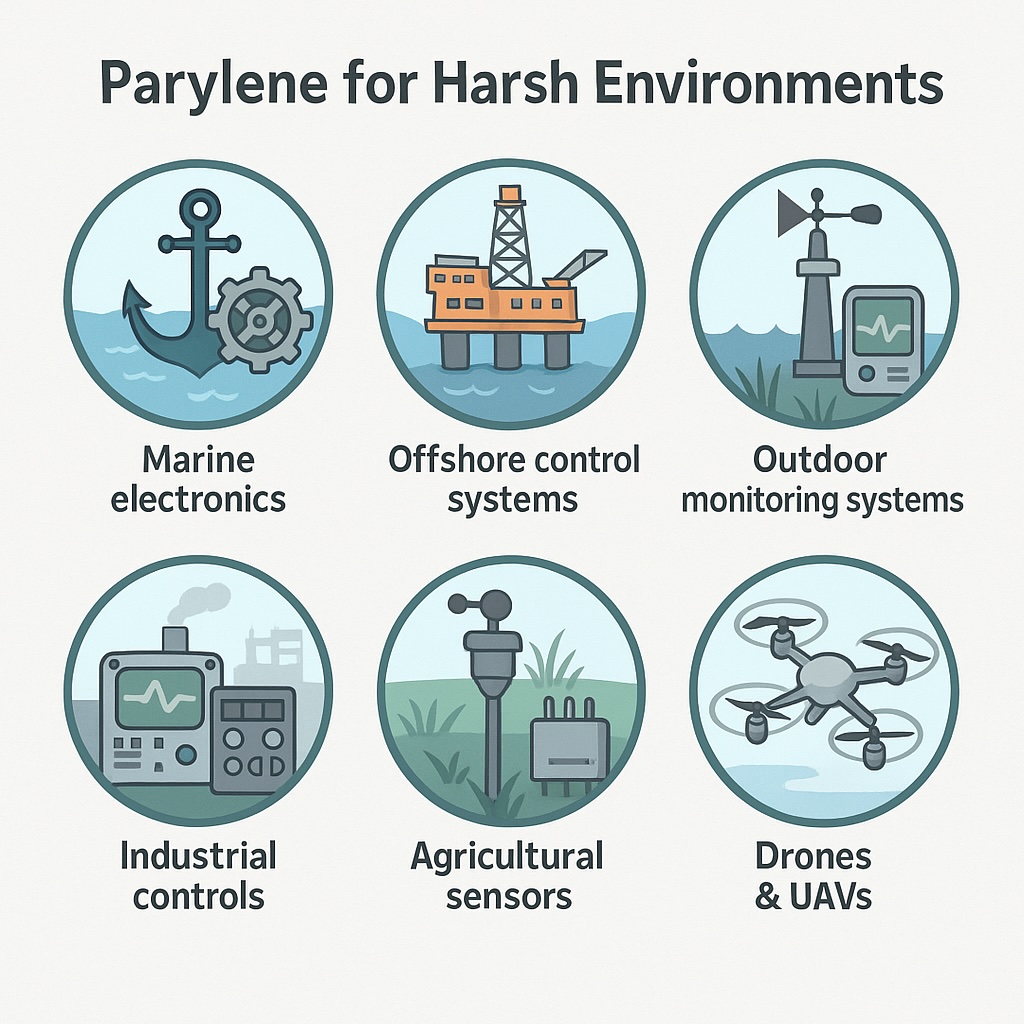
These Parylene coating applications cover marine and offshore systems, outdoor monitoring equipment, industrial controls, automotive underbody electronics, agricultural machinery and ruggedised field devices. Compared with traditional liquid conformal coatings, Parylene’s gas-phase deposition offers superior coverage in tight gaps and cavities, helping to reduce latent failures in demanding field environments.
For a wider overview of Parylene chemistry and properties, see the Parylene Basics Hub in our Knowledge Hub.
Why Parylene Coating Is Used in Harsh Environments
Harsh-environment electronics operate where traditional protective methods are often pushed to their limits: continuous moisture exposure, salt-laden atmospheres, chemical splash, dust, mechanical shock and thermal cycling. A well-specified Parylene coating for harsh environments offers a combination of barrier, dielectric and mechanical properties that make it ideal for ruggedised systems:
- Excellent moisture and salt-mist resistance – Dense, pinhole-free films help protect PCBs, connectors and components in marine, offshore and coastal applications.
- Chemical and solvent resistance – Parylene helps guard against fuels, oils, hydraulic fluids, cleaning agents and industrial contaminants.
- Highly conformal coverage – Vapour deposition ensures uniform coverage over sharp edges, solder joints, internal bores and miniaturised features, even where liquids struggle.
- Stable dielectric performance – High dielectric strength and low dielectric constant support compact insulation for high-voltage or high-density circuits in harsh environments.
- Thin, lightweight protection – Typical thin-film Parylene coatings are in the 5–25 µm range, adding minimal mass and preserving tight dimensional tolerances.
- Mechanical robustness – Parylene films exhibit good toughness and flexibility, helping them withstand vibration and thermal cycling without cracking.
- UV and temperature performance – Appropriate Parylene grades offer stability over wide temperature ranges and, in some cases, improved resistance to UV and outdoor exposure.
For engineers designing ruggedised systems, a correctly engineered Parylene coating for harsh environments can significantly improve field reliability and reduce corrosion-driven warranty returns and service costs.
For broader context on where harsh-environment designs sit among other Parylene use-cases, visit the Parylene Applications Hub.
Typical Harsh-Environment Applications for Parylene Coating
Parylene coating for harsh environments is used across a wide range of sectors where electronics and sensors are exposed to demanding conditions:
Marine, Offshore & Coastal Systems
- Marine instrumentation, navigation and communication systems.
- Offshore platform control electronics and subsea support equipment (non-immersed electronics, topside enclosures).
- Coastal monitoring buoys, tide gauges and environmental logging systems.
Outdoor Monitoring & Smart Infrastructure
- Weather stations, air-quality monitors and environmental sensor networks.
- Smart-city infrastructure such as lighting controllers, parking sensors and signage electronics.
- Security, surveillance and perimeter monitoring devices deployed outdoors.
Industrial, Process & Factory Automation
- Industrial control units and PLCs installed in damp or chemically aggressive areas.
- Motors, drives and feedback systems used in wash-down or high-humidity environments.
- Process instrumentation and measurement equipment exposed to condensate, fumes or splash.
Automotive Underbody, Under-Hood & Off-Highway Equipment
- Underbody sensors, control modules and e-axle electronics exposed to road spray and de-icing salts.
- Under-hood electronics such as engine and transmission control units, actuators and sensors.
- Construction, mining and agricultural machinery electronics operating in mud, dust and vibration.
UAVs, Drones & Field-Deployable Devices
- Drones and UAVs used in agriculture, inspection, surveying and defence applications.
- Portable and battery-powered field devices where moisture, temperature and contamination risks are high.
In many of these use-cases, Parylene is the primary environmental barrier for electronics, interconnects and exposed surfaces, helping to ensure long-term stability and reduced field failure rates in harsh environments.
Design & Engineering Considerations for Harsh-Environment Parylene Coatings
To get the best results from any Parylene coating for harsh environments, assemblies should be designed, cleaned and masked with Parylene in mind. Key engineering considerations include:
Substrate & Material Compatibility
- Metals, ceramics and many polymers can be coated successfully when surfaces are clean and correctly prepared.
- Low-surface-energy plastics (e.g. some fluoropolymers) may require targeted adhesion promotion or alternative design approaches.
- Materials that outgas heavily or contain volatile components may need pre-bake or special conditioning before coating.
Surface Preparation & Adhesion
- Thorough cleaning to remove machining oils, flux residues, mould release agents and fingerprints.
- Use of cleaning chemistries and rinsing protocols compatible with the substrate and assembly.
- Plasma or chemical surface activation and, where appropriate, adhesion promoters tailored to specific materials.
Masking, Keep-Out Areas & Drainage
- Define keep-out regions early (e.g. mating surfaces, connector interfaces, grounding points, heat sinks).
- Use a combination of tapes, custom silicone boots, caps and fixtures to shield areas that must not receive Parylene.
- Ensure design allows vapour access and drainage so that target areas are coated and low points do not trap contaminants.
Thickness Specification & Stress Management
- Specify a realistic thickness range based on required barrier, dielectric strength and mechanical behaviour.
- Typical coatings for harsh environments are in the 5–25 µm range, with increased thickness sometimes used for extended salt-spray or condensation exposure.
- Avoid unnecessary over-thick coatings that can increase mechanical stress at edges and sharp transitions.
For more detailed guidance on developing robust specifications, see our article How to Specify Parylene Coating, which covers grade selection, thickness, masking and testing requirements.
Selecting the Right Parylene Type for Harsh Environments
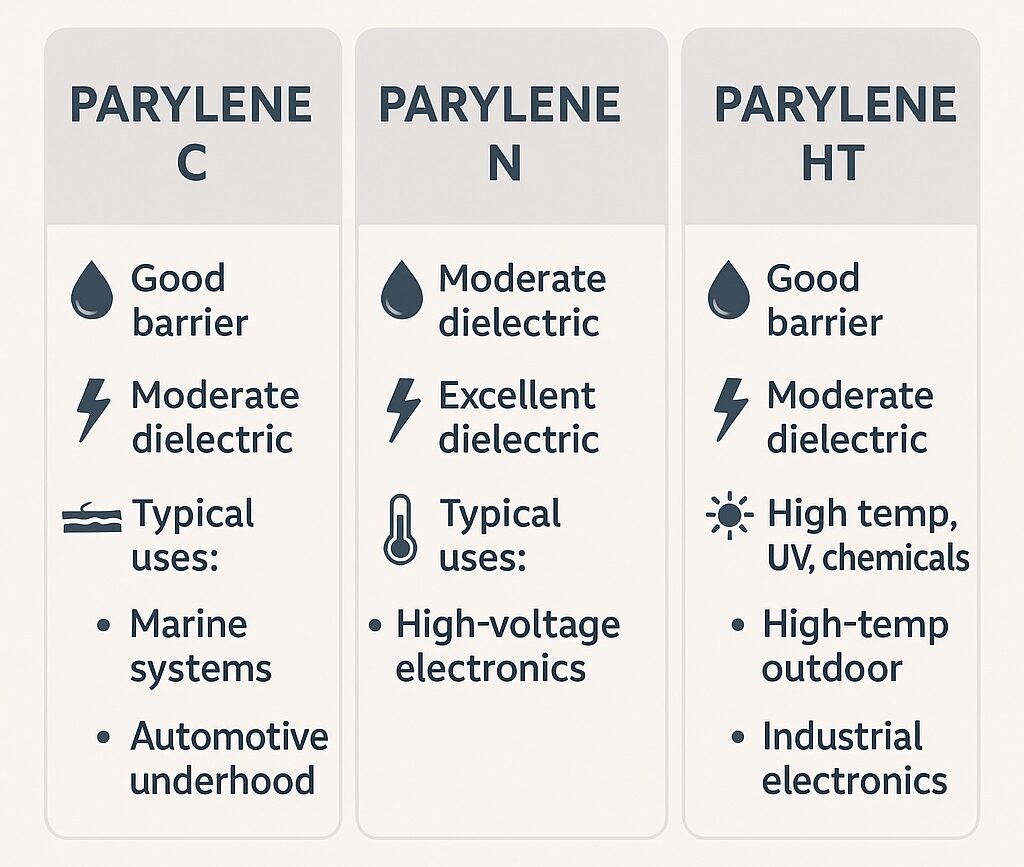
Multiple Parylene types are available, each with different barrier, dielectric and thermal characteristics. When designing a Parylene coating for harsh environments, the most commonly used grades are:
- Parylene C – The workhorse grade for harsh environments, offering an excellent balance of moisture barrier, chemical resistance and dielectric strength. Widely used in marine, industrial and automotive electronics.
- Parylene N – Offers superior dielectric properties and good flexibility. Sometimes chosen for very thin coatings where signal integrity or low dielectric constant is critical.
- Parylene HT (Parylene F / V3-type) – A fluorinated variant with improved high-temperature stability and better resistance to certain chemicals and UV exposure, often used in high-temperature or outdoor applications.
The optimal Parylene type depends on factors such as temperature range, chemical exposure, expected lifetime, cleaning procedures and any relevant environmental standards. In many cases, Parylene C is the default choice, with N or HT considered for specific electrical or thermal requirements.
For more on dimer grades and their relative properties, visit the Parylene Dimers Hub.
Testing, Qualification & Long-Term Stability
Harsh-environment designs rely on robust testing and qualification to prove long-term stability. A well-engineered Parylene system can support compliance with customer, industry and regulatory expectations, but must be validated in context:
- Salt-spray, condensation and humidity testing using standards such as IEC 60068 or customer-specific profiles.
- Thermal cycling, shock and vibration testing to relevant automotive, aerospace or industrial requirements.
- Chemical resistance tests for fuels, oils, coolants, cleaning agents and other process fluids.
- Electrical testing to confirm dielectric performance and insulation resistance after environmental exposure.
Full verification through assembly-specific testing is essential, especially where safety, regulatory compliance or mission-critical performance is involved. Parylene is one component of the overall environmental protection strategy and must be treated as part of the broader reliability plan.
SCH Support: Turnkey Parylene Coating for Harsh-Environment Applications
SCH Services supports customers developing harsh-environment and ruggedised products with a full range of capabilities focused on Parylene coating for harsh environments, from early feasibility to full-scale production:
- Parylene coating services for prototypes, qualification runs and production volumes.
- Parylene coating equipment from lab-scale systems to high-volume production tools for in-house coating lines.
- High-purity Parylene dimers with batch traceability suitable for demanding industrial and automotive applications.
- Design-for-Parylene guidance to help engineers specify thickness, masking and materials correctly for harsh environments.
- Training and knowledge transfer so in-house teams can operate and maintain systems, inspect coatings and support quality audits.
If you are developing or updating a product for marine, offshore, outdoor, industrial or automotive use and need to evaluate Parylene coating for harsh environments as part of your protection strategy, contact SCH to discuss your application and reliability targets.
🔧 Related Parylene Resources
- Parylene Coating Services
- Parylene Deposition Equipment
- Parylene Dimer Supply
- Design for Parylene – Masking & DfC Guidelines
🔗 Explore More Parylene Applications
- Parylene Coating for Medical Devices & Health Technologies
- Parylene Coating for PCB Protection
- Parylene Coating for Aerospace & Defence Electronics
- Parylene Coating for Automotive & EV Electronics
- Parylene Coating for Sensors, MEMS & High-Density Electronics
- Parylene Coating for Harsh Environments
🌐 External Technical Reference
Disclaimer: The information on this page provides general guidance on Parylene coating for harsh environments. Performance and suitability depend on the specific design, materials and application conditions. SCH Services can review assemblies and specifications to confirm the correct coating approach and test strategy.