Parylene Coating for Automotive & EV Electronics
Overview of Parylene in Automotive & EV Electronics
← Back to the Parylene Applications Hub
Parylene coating for automotive and EV electronics is used where conventional liquid conformal coatings struggle to provide reliable protection under harsh, long-term service conditions. Under-bonnet ECUs, battery management systems (BMS), inverters, chargers and sensors are exposed to temperature extremes, vibration, condensation, road spray, salt and automotive fluids.
Applied as a vapour-deposited polymer film, Parylene forms an ultra-thin, pinhole-free barrier that conforms to complex 3D assemblies without disturbing creepage and clearance distances. This makes it particularly attractive for high-density automotive and EV electronics where packaging is tight and field failures are costly.
In many programmes, Parylene is deployed selectively – protecting critical electronics, sensor modules and power assemblies – alongside other conformal coating chemistries in less demanding areas. The goal is to combine robust environmental protection with tight dimensional and electrical performance.
Why Parylene Coating is Used in Automotive & EV Electronics
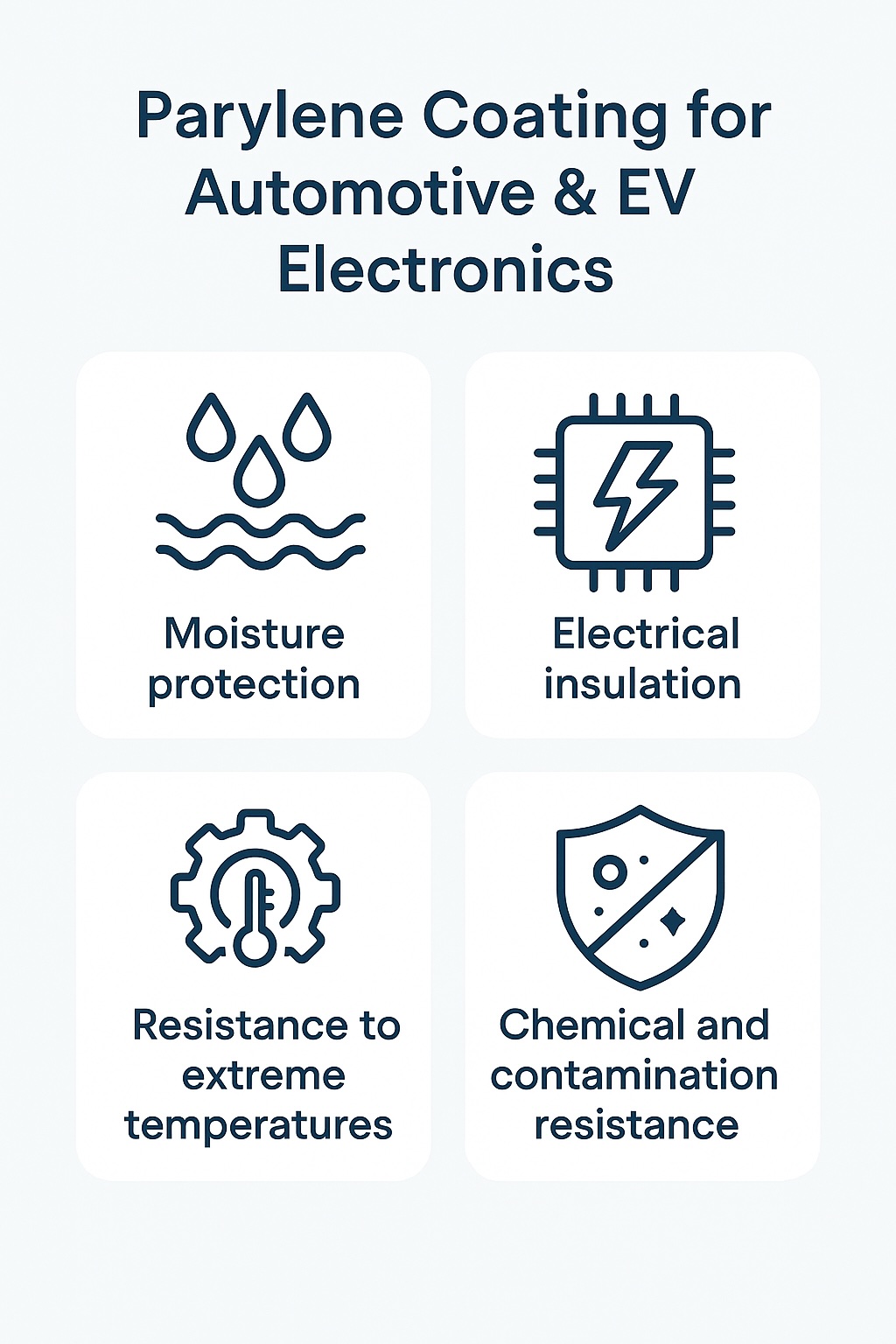
Automotive and EV electronics must survive decades of thermal cycling, humidity, vibration and contamination, often in partially sealed housings. A well-specified Parylene coating offers a combination of properties that is difficult to replicate with liquid coatings alone:
- Excellent moisture and corrosion barrier – Dense, pinhole-free films help protect against condensation, road spray, salt mist and atmospheric pollutants.
- Highly conformal 3D coverage – Vapour deposition coats under components, around terminations and inside gaps where liquid coatings may bridge, pool or leave voids.
- Stable dielectric performance – High dielectric strength at very low thicknesses allows compact insulation without sacrificing creepage and clearance.
- Thin, lightweight protection – Typical automotive Parylene coatings are in the 5–20 µm range, maintaining tight mechanical tolerances and connector fit.
- Chemical and fluid resistance – Correctly chosen Parylene grades offer good resistance to automotive fluids, cleaning agents and atmospheric contamination.
- Low outgassing and low ionic content – Beneficial for sensitive analogue, high-voltage and sensing electronics where leakage and noise must be tightly controlled.
When engineers are selecting a protection strategy for new platforms, Parylene coating for automotive and EV electronics is often considered where the cost of failure, access for repair, or exposure conditions justify a higher-performance barrier.
Typical Automotive & EV Applications for Parylene Coating
Parylene is not applied to every electronic assembly in a vehicle. Instead, it is used where environmental risk and reliability impact are highest. Typical application areas include:
Powertrain & Under-Bonnet Electronics
- Engine and transmission control units (ECUs).
- Powertrain inverters, DC-DC converters and on-board chargers.
- Actuator and valve control modules located in harsh, hot or contaminated areas.
EV Battery & High-Voltage Systems
- Battery management systems (BMS) and cell monitoring boards.
- Current and voltage sensing modules on HV busbars.
- Pack-level interface electronics and safety/monitoring boards.
Sensors, ADAS & Chassis Electronics
- Pressure, position, flow and temperature sensors mounted in exposed locations.
- ADAS radar and camera interface electronics where condensation and road spray are concerns.
- Chassis control modules and ABS/ESP electronics located near wheels or underbody.
Interior & Comfort Systems
- Electronics where long-term reliability is critical but housings are compact or difficult to seal.
- Modules exposed to humidity cycling, cleaning agents or occupant-generated contamination.
In many of these cases, Parylene coating for automotive & EV electronics acts as the primary environmental barrier for PCBs, interconnects and sensor surfaces, complementing good housing design and gasket sealing.
Design & Engineering Considerations for Automotive Parylene Coatings
To obtain consistent, production-ready results, automotive electronics should be designed and prepared with Parylene in mind. Key engineering considerations include:
- PCB layout & spacing – Define creepage and clearance using appropriate pollution degree and overvoltage category, then ensure that Parylene thickness does not compromise connector fit or mechanical interfaces. (See Clearance & Creepage – Coating Influence on Electrical Spacing.)
- Material compatibility & cleanliness – Ensure flux residues, ionic contamination, silicones and mould release agents are controlled. Cleaning and surface preparation are vital for long-term adhesion, particularly on mixed-technology boards.
- Masking and keep-out zones – Define no-coat areas (e.g. connector pins, mating surfaces, grounding points and mechanical interfaces) early in the design. Use masking strategies that can be repeated consistently at volume.
- Thickness specification – Set realistic target ranges, typically 5–20 µm, balancing dielectric and barrier performance against cost and mechanical stress. (See Conformal Coating Thickness Targets.)
- Housing and venting design – Consider how vapour-phase deposition will access the areas that need coating, and avoid geometries that trap un-evacuated monomer or create shadowed regions.
Early collaboration between electronics design, mechanical design and coating specialists typically results in lower rework, fewer test failures and a smoother PPAP/launch process.
Selecting the Right Parylene Type for Automotive & EV Systems
Several Parylene types are available, each with slightly different barrier, dielectric and thermal properties. For automotive and EV electronics, the most commonly used grades include:
- Parylene C – The workhorse grade for automotive applications, offering an excellent balance of moisture barrier, chemical resistance and dielectric strength. Widely used on ECUs, power modules and sensor PCBs.
- Parylene N – Offers very good dielectric characteristics and good flexibility at very low thicknesses. Considered where signal integrity or very low dielectric constant is critical, for example in certain sensing and high-frequency circuits.
- Parylene HT (fluorinated) – Provides improved high-temperature stability and resistance to certain automotive fluids and under-bonnet environments. Often evaluated for power electronics, inverter boards and high-temperature sensor assemblies.
The optimal choice depends on operating temperature, environmental exposure, electrical stress and expected lifetime of the module. The article Parylene Basics: Dimer Grades, Properties & Uses provides a more detailed comparison of available grades.
Reliability, Validation & Automotive Test Requirements
Introducing a Parylene coating for automotive & EV electronics normally requires alignment with the broader reliability and validation framework for the vehicle or platform. Typical areas to consider include:
- Environmental and durability tests – Thermal cycling, thermal shock, humidity-freeze, salt spray and combined environmental tests, often with powered operation during stress.
- Electrical stress and insulation performance – Verification that Parylene maintains creepage, clearance and isolation under expected voltage and contamination conditions.
- Chemical and fluid exposure – Testing against relevant automotive fluids, cleaners and atmospheric contaminants for the specific vehicle environment.
- Mechanical robustness – Vibration, mechanical shock and handling tests to confirm coating integrity on leads, joints and connectors.
Parylene requirements are typically integrated into OEM-specific validation plans and, where relevant, aligned with expectations for automotive-grade (AEC-Q–style) electronics. The Automotive Electronics Council (AEC) provides useful context on qualification philosophies for automotive components.
Integrating Parylene into EV Battery, Powertrain & Sensor Platforms
For EV platforms, decisions about where to deploy Parylene are often made at a system or product-family level rather than per board. Common strategies include:
- Selective protection of high-consequence modules – e.g. BMS boards, HV current sensors and safety-critical control units.
- Enhanced protection for known weak points – locations with a history of corrosion, condensation or contamination issues in earlier generations.
- Complementing other coatings – using Parylene on critical areas while using more conventional conformal coatings on less demanding assemblies.
- Designing for service and replacement – determining which modules are realistically replaceable in the field and where additional coating robustness is justified.
The article Parylene Coating for PCB Protection provides a deeper look at how Parylene behaves on complex, high-density assemblies typical of EV power and control electronics.
🔧 Related Parylene Resources
- Parylene Coating Services
- Parylene Deposition Equipment
- Parylene Dimer Supply
- Design for Parylene – Masking & DfC Guidelines
🔗 Explore More Parylene Applications
- Parylene Coating for Medical Devices & Health Technologies
- Parylene Coating for PCB Protection
- Parylene Coating for Aerospace & Defence Electronics
- Parylene Coating for Automotive & EV Electronics
- Parylene Coating for Sensors, MEMS & High-Density Electronics
- Parylene Coating for Harsh Environments
🌐 External Technical Reference
SCH Support: Parylene Coating for Automotive & EV Electronics
SCH Services supports automotive and EV customers at every stage of their Parylene journey – from feasibility builds and design reviews through to series production:
- Parylene coating services for prototypes, DV/PV builds and production volumes.
- Parylene coating equipment from lab-scale systems to mid-scale and high-volume production tools for in-house capability.
- Parylene dimers with batch traceability appropriate for automotive projects.
- Design-for-Parylene guidance on thickness, masking, material compatibility and validation planning.
- Training and knowledge transfer so in-house teams can come up to speed as fast as possible.
Disclaimer: The information on this page provides general guidance on Parylene coating for PCB protection. Performance, suitability and compliance depend on the specific design, materials and application environment. SCH Services can review assemblies and specifications to confirm the correct coating approach.