Parylene Coating for Aerospace & Defence Electronics
Overview of Aerospace & Defence Parylene Coatings
← Back to the Parylene Applications Hub
Parylene coating for aerospace and defence electronics provides ultra-thin, highly uniform protection for mission-critical systems exposed to harsh and unpredictable environments. Avionics modules, guidance electronics, power systems, ruggedised sensors and communication units must endure moisture, condensation, corrosive atmospheres, vibration, altitude and temperature cycling without failure.
Applied through vapour deposition, Parylene forms a conformal, pinhole-free polymer barrier over every surface, including edges, microstructures and tight gaps that liquid coatings cannot reach. Aerospace-qualified grades such as Parylene C, N and HT offer excellent dielectric insulation, contamination resistance and long-term environmental stability, supporting demanding qualification requirements across aviation, space and defence programmes.
Core benefits include thin-film protection, 3D conformal coverage, moisture and corrosion resistance, dielectric insulation, chemical stability and long-term reliability under extreme environmental loads.
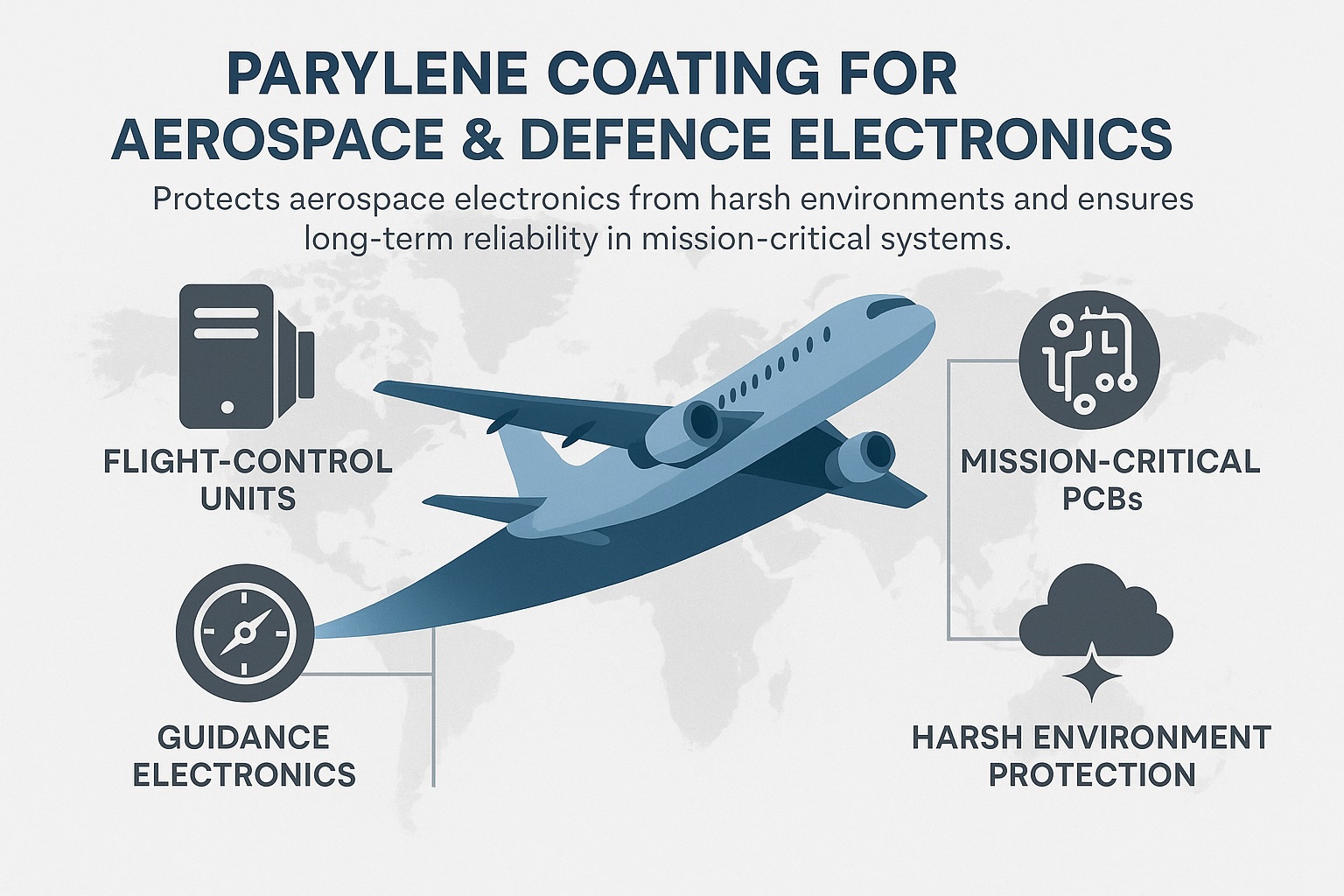
Overview of key aerospace and defence applications protected by Parylene coating, including avionics, sensors, power systems and mission-critical electronics.
Why Parylene Coating for Aerospace & Defence is Used
Aerospace, defence and space electronics must operate reliably where maintenance access is limited—or impossible. A correctly engineered Parylene coating for aerospace and defence electronics provides a unique set of advantages:
- Exceptional barrier protection against moisture, condensation, salt fog, corrosive gases and atmospheric contaminants.
- Pinhole-free 3D coverage achieved through vapour deposition, ideal for complex assemblies, BGAs, connectors and densely populated PCBs.
- High dielectric strength for compact, lightweight avionics and power systems operating at elevated voltages.
- Thin, lightweight films (5–20 µm) that preserve mass targets and dimensional tolerances.
- Resistance to fuels and aerospace chemicals including hydraulic fluids, jet fuel, solvents and cleaning agents.
- Thermal and altitude resilience supporting extreme temperature cycling, vacuum exposure and rapid decompression.
- Long-term stability suitable for mission-critical electronics where service life can extend over decades.
For many engineers, Parylene provides the optimal balance of environmental protection, dielectric insulation and lightweight performance needed for modern airborne and defence platforms.
Typical Aerospace & Defence Applications
Parylene is widely used across avionics, ruggedised defence hardware, spacecraft electronics and autonomous systems.
Avionics & Flight-Critical Systems
- Flight-control computers and navigation modules
- Radar, communication and telemetry assemblies
- Power-distribution units and high-density control boards
- Boards requiring enhanced creepage/clearance and dielectric performance
Defence, Military & Rugged Electronics
- Guidance and targeting systems
- Munition, missile and ordinance electronics
- Vehicle-mounted and portable communication devices
- Environmental and structural-health sensors
Spacecraft, Satellites & High-Altitude Systems
- Low-outgassing electronics for orbit and deep-space missions
- Payload electronics, power regulators and control modules
- Vacuum-exposed assemblies requiring outgassing control
- Systems experiencing extreme thermal cycling
UAV, UAS & Autonomous Platforms
- Lightweight avionics and mission electronics
- Imaging payloads, sensor systems and communication modules
- Battery-management systems exposed to variable climates
- Environmental monitoring systems
Design & Engineering Considerations
To ensure optimal performance, aerospace assemblies should be designed with Parylene in mind. Key design-for-coating principles include:
Substrate Compatibility
- Metals, ceramics, FR-grade laminates and many polymers coat successfully when properly cleaned.
- Low-surface-energy materials may require adhesion promoters or surface activation.
- Volatile materials may require pre-bake or staged processing.
Cleanliness & Surface Preparation
- Remove flux residues, oils, ionic contamination and particulates.
- Use solvent, aqueous or plasma cleaning depending on substrate type.
- Ionic cleanliness testing is often required for high-reliability hardware.
Masking Strategy
- Define no-coat regions early (connectors, heat sinks, interfaces).
- Use tapes, boots, custom fixtures and plugs designed for vapour deposition.
- Consider vapour access to avoid shadowing on dense assemblies.
Thickness Specification
- Typical aerospace coatings: 5–20 µm.
- Balance dielectric strength, mass, mechanical stress and environmental load.
- Over-specifying thickness may add weight and stress; under-specifying may reduce barrier performance.
Selecting the Right Parylene Type
- Parylene C — Excellent moisture barrier and dielectric strength; widely used for avionics and mission-critical boards.
- Parylene N — Best dielectric behaviour and flexibility; useful for very thin coatings and high-frequency electronics.
- Parylene HT / F-Type — Fluorinated grade with superior thermal stability, chemical resistance and compatibility with aggressive aerospace fluids.
The optimal grade depends on altitude, temperature extremes, contamination exposure, electrical requirements and qualification demands. Representative environmental testing is strongly recommended.
Qualification, Testing & Aerospace Standards
Many aerospace and defence systems must meet stringent qualification standards. A Parylene coating for aerospace and defence electronics supports compliance with:
- RTCA/DO-160 — Temperature, altitude, humidity, vibration, sand/dust, icing, contamination.
- MIL-STD-810 — Environmental engineering considerations for defence hardware.
- MIL-STD-202 & MIL-PRF — Component-level reliability and environmental testing.
- NASA outgassing requirements — Low-outgassing materials for vacuum conditions (ASTM E595).
- IPC-A-610 & J-STD cleanliness criteria — Essential for coating adhesion and long-term reliability.
SCH can assist with qualification builds, documentation, thickness recommendations and process validation aligned to programme requirements.
Support for Aerospace & Defence Programmes
SCH provides a full suite of services and technologies to support aerospace and defence customers using Parylene:
- Parylene coating services for prototypes, flight-hardware batches and full-scale production.
- Parylene coating equipment for in-house capability, from lab systems to high-volume tools.
- High-purity Parylene dimers with batch traceability suitable for aerospace and space applications.
- Design-for-Parylene engineering support covering masking, materials, cleaning and specification.
- Training and knowledge transfer to ensure robust in-house coating processes.
Whether you are developing new airborne electronics, updating legacy systems or qualifying next-generation defence hardware, SCH can support your environmental protection strategy.
🔧 Related Parylene Resources
- Parylene Coating Services
- Parylene Deposition Equipment
- Parylene Dimer Supply
- Design for Parylene – Masking & DfC Guidelines
🔗 Explore More Parylene Applications
- Parylene Coating for Medical Devices & Health Technologies
- Parylene Coating for PCB Protection
- Parylene Coating for Aerospace & Defence Electronics
- Parylene Coating for Automotive & EV Electronics
- Parylene Coating for Sensors, MEMS & High-Density Electronics
- Parylene Coating for Harsh Environments
🌐 External Technical Reference
Speak with an Aerospace Parylene Specialist
For guidance on Parylene coating for aerospace and defence electronics—including material selection, masking, thickness and qualification—contact SCH:
Call: +44 (0)1226 249019 | Email: sales@schservices.com | Discuss your aerospace application ›
Disclaimer: The information on this page provides general guidance on Parylene coating for PCB protection. Performance, suitability and compliance depend on the specific design, materials and application environment. SCH Services can review assemblies and specifications to confirm the correct coating approach.