
Protecting Connector Interfaces Without Conformal Coating Them
How to manage environmental protection while keeping electrical contacts clean and functional
Connector interfaces must remain electrically clean, but the surrounding PCB still requires protection.
This creates one of the most common challenges in conformal coating and Parylene processing: how to protect the assembly without allowing coating to interfere with critical electrical contact zones.
In practice, this is not solved by “being more accurate” with coating. It is solved by designing a process that separates protection from function.
1) The core problem: protection vs electrical contact
Conformal coatings are designed to insulate and protect surfaces.
Connector interfaces are designed to do the opposite:
- Maintain direct metal-to-metal contact
- Allow current flow without resistance increase
- Remain free from contamination or films
Any conformal coating entering this interface creates risk of electrical failure, increased resistance or intermittent behaviour.
2) Why “just avoid the connector” does not work
In theory, conformal coating should simply stop at the connector boundary.
In practice, this fails due to:
- Capillary action pulling coating into gaps. See also Capillary Wicking in Conformal Coating.
- Wetting and flow extending beyond dispense location
- Geometry creating hidden paths into contact zones
- Vapour deposition (Parylene) penetrating all exposed surfaces
This means connector protection cannot rely on visual boundary control alone.
Key insight: If coating reaching the connector causes failure, the process must be designed so it physically cannot reach it — not just “aimed away” from it.
3) The three practical strategies that actually work
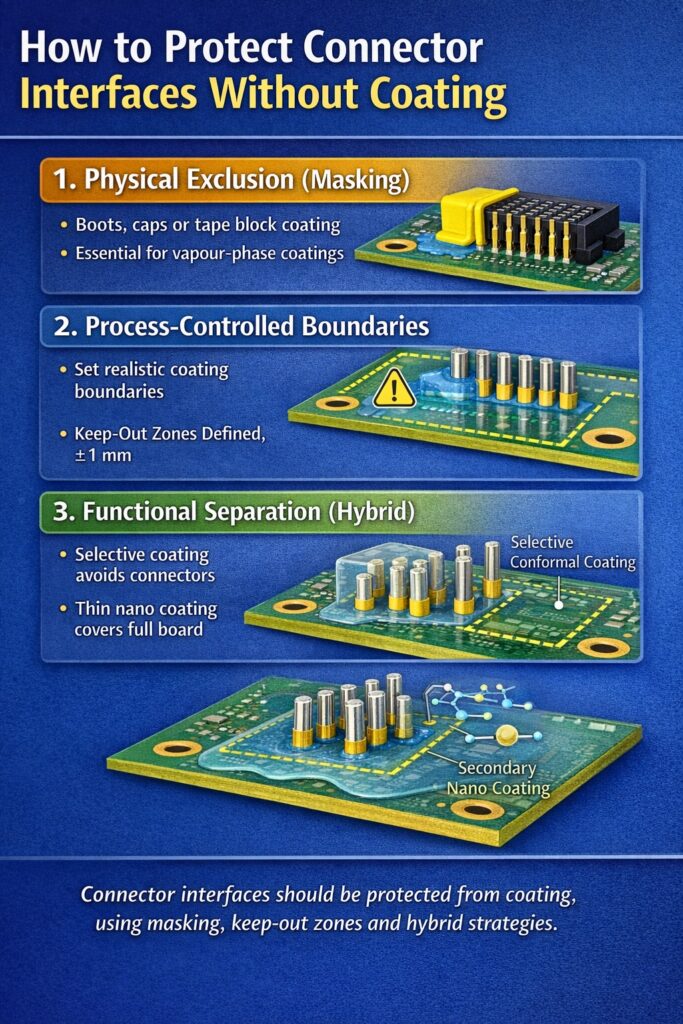
1. Physical exclusion (masking)
- Boots, caps or tapes prevent coating ingress
- Essential for Parylene processes
- Can be effective but introduces labour and variability
2. Process-controlled boundaries
- Define realistic keep-out zones
- Accept ±1 mm or more boundary variation
- Use selective coating within known limits
3. Functional separation (hybrid approach)
- Keep thick coatings away from connectors
- Apply secondary protection (e.g. nano coating) across full board
- Protect without interfering with electrical contact
The third approach is often the most stable in complex assemblies.
4) Why masking alone is not a complete solution
Masking is often necessary, but it introduces its own risks:
- Application variability between operators
- Seal integrity issues on complex geometries
- Removal damage to adjacent coating
- Labour cost and throughput limitations
Masking solves access — but not always process stability. Many recurring boundary and ingress problems are driven by masking design and execution rather than coating behaviour alone. See Masking Causes Most Conformal Coating Defects.
5) Parylene: zero tolerance for exposure
With Parylene, the challenge is more severe:
- Deposition is fully conformal
- All exposed surfaces will be coated
- Connector interfaces must be completely sealed
This makes masking design critical before coating begins. For common sealing and masking problems in vapour deposition processes, see Parylene Masking Failures: Common Problems & How to Prevent Them.
6) What “good” looks like in practice
A stable connector protection strategy typically includes:
- Clearly defined keep-out zones
- Validated masking approach (if required)
- Acceptance of realistic coating boundaries
- Separation of protection functions where needed
- Verification through inspection and testing
This is a controlled process — not a best-effort application.
7) Summary
Connector interfaces should not be protected by conformal coating — they should be protected from coating.
The most effective solutions do not rely on precision alone. They rely on process design:
- Exclude coating where necessary
- Control where coating can realistically go
- Use alternative protection methods where appropriate
This is a process engineering problem, not a coating selection problem.
Related process articles:
Why Choose SCH Services?
SCH Services supports customers in designing coating processes that work in real assemblies — including connector protection, masking strategy and hybrid coating implementation.
- 🛠️ Process-led coating strategy
- 📈 Scalable from trials to production
- 🌍 Global technical support
- ✅ Focus on real-world reliability
📞 +44 (0)1226 249019 | ✉ sales@schservices.com | 💬 Contact Us
Note: This article provides general technical guidance only. Final coating strategy, connector compatibility and validation must be confirmed against product-specific requirements and standards.
