Surface Preparation & Cleanliness for Reliable Coating
How to prevent adhesion failures, corrosion and electrical leakage before coating
Effective surface preparation and cleanliness are critical to conformal coating reliability. Contaminants such as flux residues, oils, process residues and ionic salts can all reduce adhesion, increase corrosion risk or contribute to electrical leakage in service.
Cleanliness is not just about making an assembly look acceptable before coating. It is about controlling the surface condition so the coating can wet correctly, bond consistently and deliver stable long-term protection.
This guide outlines the main preparation methods, when they matter, how cleanliness can be assessed and where the biggest process risks often sit.
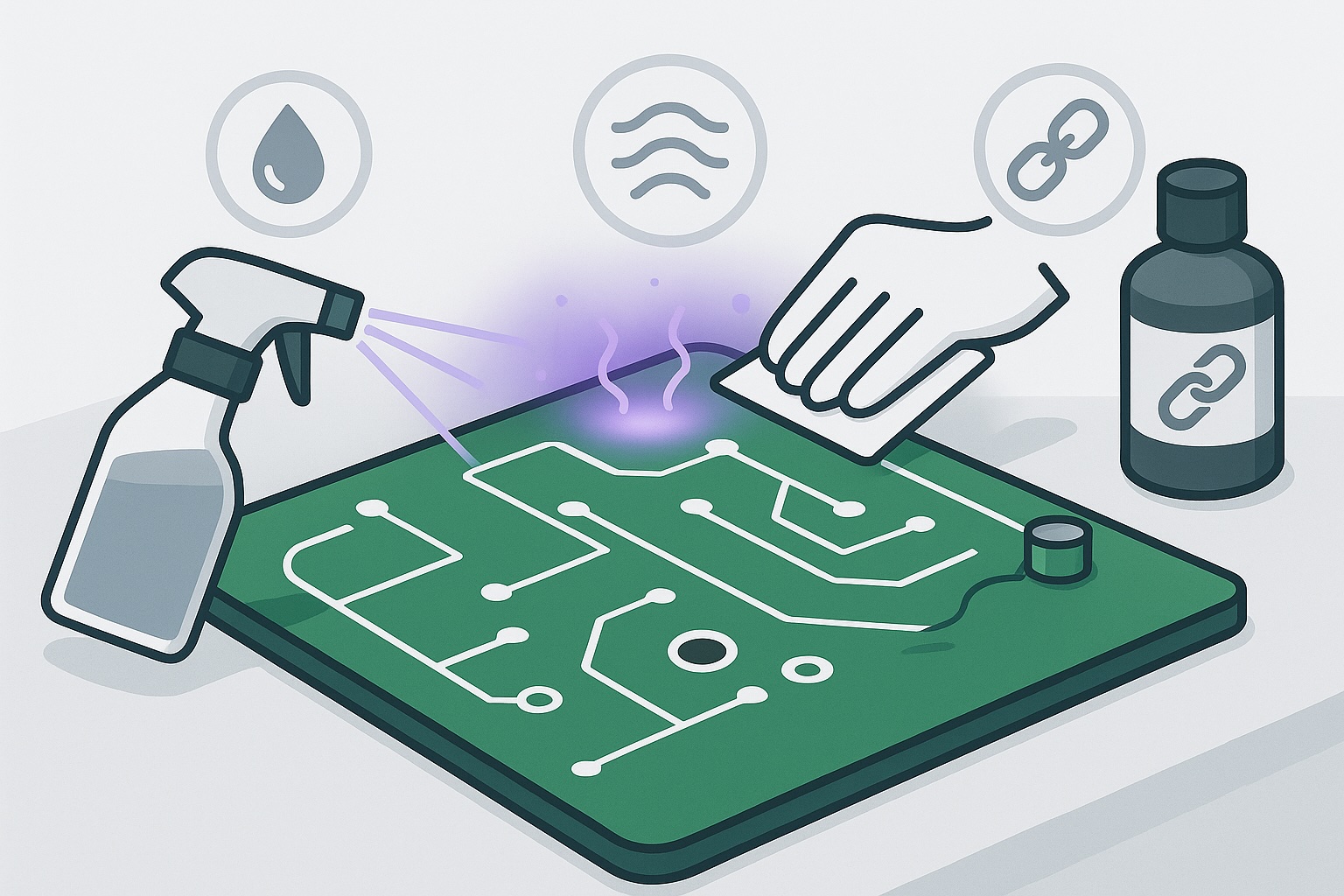
Why surface preparation matters
Surface preparation directly influences whether a coating process remains stable or produces avoidable defects. Even when the coating material and application method are correct, contamination at the substrate level can still undermine the result.
- Adhesion: A clean, dry surface gives the coating the best chance of forming a reliable bond to the substrate.
- Electrical reliability: Ionic contamination can contribute to corrosion, leakage currents and dendritic growth.
- Consistency: Good preparation reduces defects such as dewetting, bubbles and local adhesion loss.
Cleanliness is also only one part of a stable coating process. If you need to understand how booth contamination, compressed air quality, humidity and handling discipline combine to create repeat defects, read Why Conformal Coating Processes Fail.
Surface preparation methods
Different contamination types and substrate conditions require different preparation approaches. The correct method depends on the contamination present, the coating chemistry being applied and the level of reliability required.
- Cleaning: Aqueous, semi-aqueous and solvent-based systems can remove flux residues, oils and general process contamination.
- Plasma treatment: Increases surface energy and can improve adhesion on difficult surfaces, particularly for Parylene and certain plastics.See plasma cleaning for conformal coating for a detailed explanation of how plasma modifies surface energy and improves adhesion.
- Plasma coating (specialist): In some advanced processes, plasma can also be used to deposit ultra-thin functional coatings rather than simply cleaning or activating the surface. These are typically nanometre-scale films used for surface modification rather than primary protection. For a deeper explanation, see what plasma coating is and where it fits.
- Micro-abrasion: Can remove oxides, residues or aged coating in rework situations when used with proper containment and control.
- Adhesion promoters: Silanes such as A-174 or chemistry-specific primers can improve bonding and reduce edge-lift risk on suitable substrates.
Reality check: Cleaning is not automatically beneficial if the chemistry and process are poorly matched. In some cases, partial residue removal creates more risk than leaving a stable no-clean residue untouched.
No-clean flux residues present a particular challenge, especially where partial cleaning can disturb the protective resin matrix without fully removing the active chemistry. For a more detailed explanation of that risk, see our guide to cleaning no-clean flux residues for conformal coating reliability.
Rule of thumb
- Liquid coatings: cleaning is not always required, particularly in controlled no-clean processes. The key requirement is stable, low and well-controlled residues. Problems typically arise where residues are excessive, inconsistent or partially disturbed, leading to dewetting, poor coverage or long-term reliability issues.
- Parylene: residue control alone is often not sufficient. Surface energy control (typically via plasma) and correct adhesion promoter selection are critical to achieve reliable adhesion, particularly on low-energy or contaminated surfaces.
- Rework parts: residues and weak or aged coating edges must be removed before repair, as partial cleaning or overcoating unstable surfaces will introduce reliability risks.
Cleanliness testing
Testing methods should be selected based on the failure mode you are trying to control or investigate. No single test answers every cleanliness question.
- ROSE / ionic contamination testing: measures total ionic residues, often reported as µg NaCl/cm², and is useful for general process control.
- Ion chromatography: identifies specific contaminants such as chlorides, sulphates and weak organic acids, making it more useful for root-cause diagnosis.
- Dyne pen / contact angle testing: helps assess surface energy and wetting behaviour, which is useful when investigating dewetting or difficult substrates.
Important
- Use ROSE for overall ionic contamination control and process monitoring.
- Use ion chromatography (IC) to identify specific contaminants and support root-cause analysis.
- Use surface energy checks (dyne pens or contact angle) to assess wetting behaviour and dewetting risk.
Standards and guidance
Surface preparation requirements vary by product type, end-use environment and customer specification. Standards help provide context, but the final control plan should still be tied to the actual assembly and reliability requirement.
- IPC-5704 – cleanliness requirements for printed boards
- IPC-A-610 – acceptability of electronic assemblies, including cleanliness and coating-related workmanship context
- IEC 60664 – insulation coordination and pollution degree context
- Customer specifications may define tighter ionic, surface energy or adhesion-related requirements
Related process guidance
Surface preparation sits within the wider conformal coating process and should be reviewed alongside failure mechanisms, contamination control and coating behaviour.
Why Choose SCH Services?
SCH Services supports coating users with practical process knowledge, training, consultancy and equipment relevant to cleaning, contamination control and surface preparation. The focus is not just on supplying materials, but on helping users build a more stable and repeatable coating process.
To discuss cleaning, adhesion or contamination control in more detail, contact SCH Services.
This article is provided as general technical guidance only. Final process decisions should be validated against the specific assembly, contamination profile, coating chemistry and applicable qualification or customer standards.