Mon - Thur 7.30-15.30   Fri 7.30-14.00
Masking-related defects causing coating ingress and poor boundaries on PCB assemblies

Why Masking Is the Leading Cause of Conformal Coating Defects


When conformal coating defects appear in production, the first response is often to adjust coating parameters such as viscosity, spray settings, cure profiles, or even material selection. In practice, many coating defects are introduced before coating begins.

Across aerospace, automotive, industrial, and electronics manufacturing, a significant proportion of NCRs and customer rejections trace back to masking decisions rather than coating chemistry. These failures typically occur at boundaries such as connectors, test points, interfaces, and defined keep-out zones.

Masking Defines Where Coating Is Allowed β€” and Where It Must Not Go

Masking is not a secondary preparation step. It is a primary process control that physically defines the limits of coating coverage. When masking is poorly selected, incorrectly applied, inadequately sealed, or inconsistently removed, defects will occur even when the coating process itself is stable and well controlled.

  • Coating ingress into keep-out zones
  • Coating lifted or removed during de-masking
  • Residue or contamination transferred from masking materials
  • Incomplete touch-up after mask removal
  • Ragged or inconsistent coating boundaries

Why Conformal Coating Masking Defects Are So Often Missed

Masking defects are frequently overlooked because they do not always present as obvious failures during application. The coating may appear uniform immediately after spraying or dipping, with problems only emerging later during inspection, electrical testing, or customer use.

  • No defined inspection step after de-masking
  • Assumptions that shields act as sealed barriers
  • Lack of clarity on operator touch-up versus escalation
  • Over-reliance on UV inspection alone
  • Ambiguous or poorly defined keep-out zones on drawings

Treat Masking as a Defect-Prevention System

Reducing conformal coating defects requires treating masking as a controlled system, not simply a consumable or materials choice.

  • Matching masking methods to function, such as shields versus sealed barriers
  • Controlling fit, placement, and sealing of tapes, boots, and custom shapes
  • Defining de-masking timing and removal techniques
  • Mandating post de-masking inspection
  • Applying clear rules for operator touch-up versus escalation

New Resource: Masking as a Root Cause of Coating Defects

A new root-cause article has been added to the Conformal Coating Defects Hub. It explains in detail why masking is the leading contributor to coating failures and how to control masking effectively in production.

To understand how masking contributes to coating failures in real production environments, read the full masking root-cause analysis.

If you are reviewing masking methods or addressing recurring coating NCRs, explore our conformal coating masking solutions.

Final Thought

If your coating process is stable but defects persist, the fastest improvement often comes not from changing the coating material or parameters, but from reviewing how and where masking is applied, removed, and verified.

Masking does not simply prepare a board for coating. It determines whether the coating process will succeed.

For support reviewing masking processes, inspection criteria, or escalation rules, contact our technical team.
Conformal coating masking methods to prevent coating defects, leakage and rework

Masking Made Easy – 3 Ways to Reduce Defects in Conformal Coating


Masking is one of the simplest steps in conformal coating β€” and one of the most common causes of defects, rework and customer complaints when it goes wrong. Coating on connector pins. Adhesive residue left behind. Silicone boots leaking. Latex that tears or pulls the coating away. These issues cost time and money β€” but most are preventable.

The solution isn’t only better operator training β€” it starts with using the right masking materials and adhesives, the same paper-based tapes, dots and pre-cut shapes we use in our own coating services every day. To understand all available masking materials, see Conformal Coating Masking: Methods & Materials to review different tapes, dots, custom boots, latex and pre-cut shapes.


Why Masking Goes Wrong

Masking protects connectors, test pads, gold fingers, housings and other areas that must remain coating-free. Most masking failures are caused by:

  • Coating wicking under tape, dots, shapes or silicone boots
  • Coating de-wetting away from the tapes and dots due to the adhesive used.
  • Adhesive residue left behind after removal
  • Using general-purpose tape instead of conformal coating tested materials
  • Silicone boots that don’t seal or are worn out
  • Liquid latex applied too thick or removed too late
  • No inspection during demasking

To better understand leak paths and barrier methods, see Conformal Coating Masking Strategies – Barrier vs Shielding.

1. Choose the Right Masking Method β€” and the Right Adhesive

Masking Tape

  • Best for: General areas, edges and flat surfaces
  • Benefits: Low cost, flexible, easy to apply
  • Important: Must be paper-based, low-tack, clean-release. Avoid Kapton or painter’s tape β€” they leave residue or pull coating off.

Masking Dots & Discs

  • Best for: Test pads, vias, screw holes
  • Benefits: Fast, consistent sizing, no cutting needed
  • Important: Use paper-based coating-safe masking discs. Vinyl stickers, labels or strong adhesives will leave residue or lift coating.

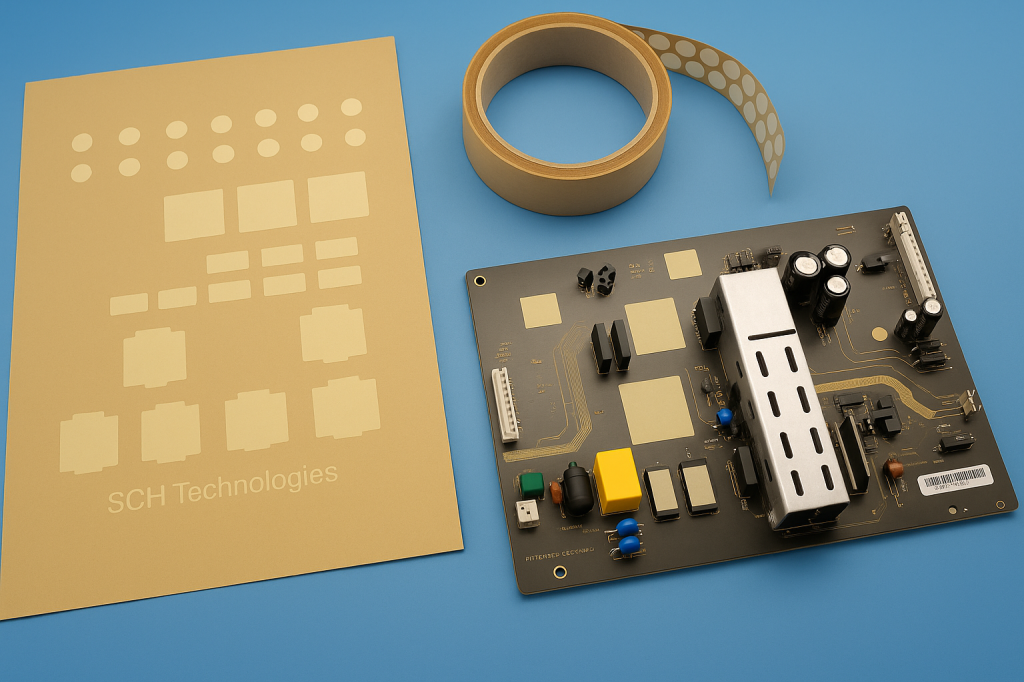
Pre-Cut Masking Shapes (Custom Paper Shapes on Sheets/Rolls)

  • Best for: Complex flat areas, precision masking, gold fingers, connector faces, repeat PCB builds
  • Benefits: No hand-cutting, accurate placement, speeds up production
  • Important: Made from specialist paper masking material with low-tack adhesive β€” same type we use daily in conformal coating services.

Silicone Masking Boots & Caps

Liquid Latex / Hybrid Barrier Systems

  • Best for: Board edges, non-flat surfaces, irregular shapes
  • Benefits: Seamless coating barrier where tape cannot reach
  • Important: Apply in thin coats, peel at the correct time. See Liquid Latex & Hybrid Barrier Systems – sealing tapes & keep-out edges.

πŸ›’ Want materials? Visit Masking Boots, Tapes, Dots & Pre-Cut Shapes from SCH.

2. Apply Masking Correctly β€” Clean, Seal and Fit

Even the right masking materials fail if they’re not applied properly.

Best Practice:

  • Clean the board before masking β€” oils and flux stop adhesives sealing.
  • Press tape/dots/shapes firmly, especially around edges.
  • Use Pre-Cut Masking Shapes for speed and consistency in repeat jobs.
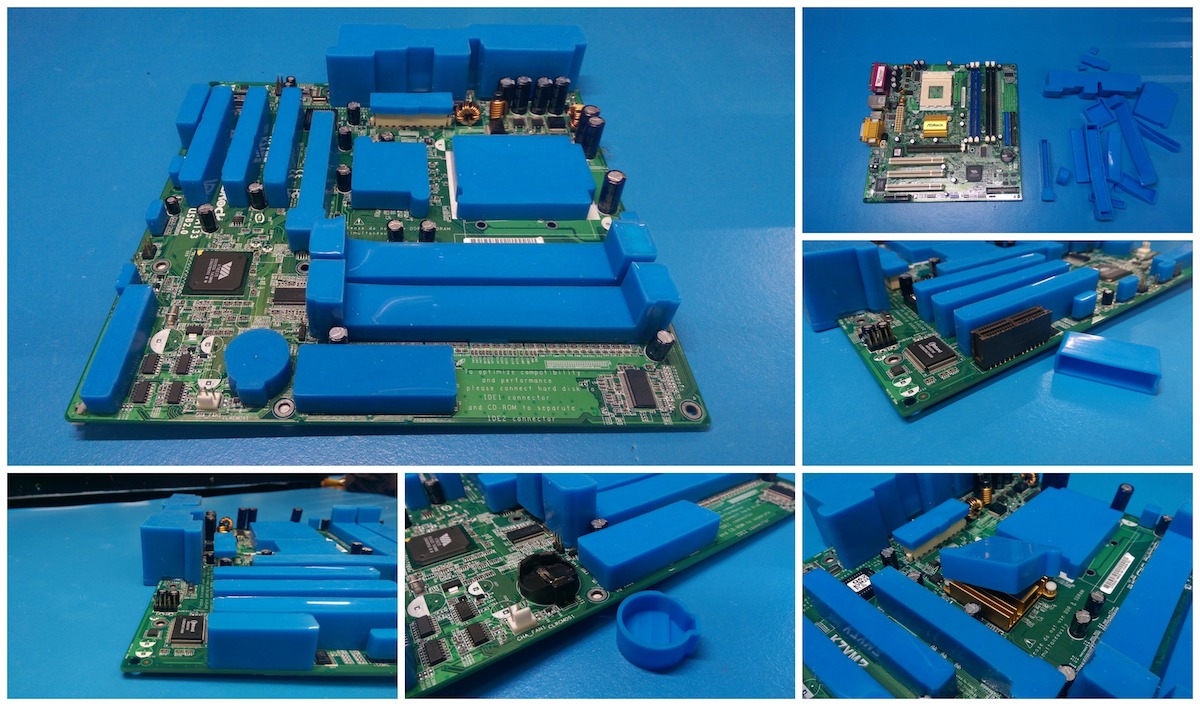
  • Fit boots fully β€” no lifted edges or gaps. For guidance, see How to Mask a PCB with Boots – A How to Guide.
  • Latex must be applied in thin layers and peeled before it fully hardens.

For understanding the benefits of reusable boots in production environments, see Reusable Masking Boots – cost, speed, repeatability.

3. Inspect During Demasking β€” Not After Testing

Most masking failures are found too late β€” after coating cures or during electrical test. The best time to detect problems is while removing masking.

During demasking, check for:

  • Coating on pins, connectors or gold fingers
  • Adhesive residue or paper fibres
  • Coating lifting with the tape or shapes
  • Silicone boots pulling coating at the edges
  • Latex tearing or leaving fragments

Early detection = repair before full cure.

More masking advice can be found in Conformal Coating Masking: Methods & Materials –and Designing Effective PCB Masking Strategies.


πŸ’‘ Bonus Tips β€” Speed Up Masking, Reduce Rework

  • Use Pre-Cut Masking Shapes for intricate masking, complex areas, gold fingers and flat surfaces in repeat builds.
  • Replace silicone boots when they swell, crack or don’t seal.
  • Use latex or hybrid barrier approaches on difficult edges β€” see Liquid Latex & Hybrid Barrier Systems – sealing tapes & keep-out edges.
  • Add masking diagrams and photos to work instructions.
  • Train operators specifically in masking and demasking β€” not just coating.

Conclusion

Most masking problems aren’t caused by operator error β€” they’re caused by using the wrong tape, dots, shapes or boots.

Using the correct conformal coating masking tapes, dots, custom pre-cut shapes, silicone boots or peelable latex, applied and removed at the right time, will drastically cut defects, rework and costs.

Conformal coating masking solutions including reusable boots, high-temperature masking tapes, dots, and custom shapes for protecting PCBs during coating and Parylene processes

From Bottleneck to Breakthrough: How Custom Masking Shapes Transform Conformal Coating Production


In modern electronics and high-reliability assemblies, one of the most overlooked yet critical steps is maskingβ€”protecting areas that must remain coating-free during the conformal coating process. Done poorly, masking becomes a bottleneck: misalignment, rework, and delays can cripple throughput. But with custom masking shapes for conformal coating, you can turn that bottleneck into a breakthrough.

Explore our range of custom masking shapes for conformal coating designed to speed setup, improve consistency, and boost production yield.


The Masking Challenge

When applying conformal coatingsβ€”or advanced materials like Paryleneβ€”pads, connectors, keep-out zones, and sensitive features must be protected precisely. Traditional manual cutting of tape is slow, inconsistent, and often unreliable.

The result?

  • Masking residue left behind
  • Shrinkage or degradation under solvents
  • De-wetting caused by silicone contamination
  • Tape lifting or coating bleed into protected areas

These issues reduce yield, increase rework, and slow down production.

For a full breakdown of masking options and where each is best used, see Conformal Coating Masking: Methods & Materials.


The Advantage of Custom Masking Shapes

At SCH Services Ltd, we provide custom masking shapes designed specifically for conformal coating processesβ€”including the same materials we use in our own production services. That means the shapes we supply are proven daily for accuracy, consistency, and clean removal.

Benefits of custom shapes include:

  • Residue-free removal with no damage to components
  • Solvent and chemical resistance for demanding environments
  • Silicone-free materials to reduce contamination and coating defects
  • Clean, reliable adhesion that helps prevent lifting and bleed
  • Ready-to-use sheets for fast application and reduced operator time

Because we rely on these shapes daily in our own conformal coating services, we know firsthand how they improve throughput, reduce defects, and remove bottlenecks.

For standard formats or fast turnaround requirements, custom masking dot and shape sheets can also be ordered directly via our online shop. Order custom masking dot and shape sheets online.


From Bottleneck to Breakthrough

Standardising masking with custom masking shapes for conformal coating improves speed and repeatabilityβ€”while reducing operator variation.

CHALLENGE MANUAL MASKING CUSTOM MASKING SHAPES
Cutting & prep time High Minimal – peel & place
Consistency Operator dependent Uniform every time
Risk of rework/defects High Low
Cycle efficiency Slow Streamlined
Yield loss Frequent Reduced

By reducing cutting time and improving repeatability, masking becomes faster, cleaner, and more reliableβ€”supporting higher yield and smoother production flow.


SCH Services Ltd: Proven in Our Own Services

Unlike suppliers who only sell materials, SCH Services Ltd actively uses these masking shapes in our own conformal and Parylene coating services. Customers benefit from the same speed, precision, and clean demasking performance we demand for our own clients.

When reliability matters, masking isn’t a bottleneckβ€”it’s a breakthrough.

If you’re ready to standardise masking in your production, learn more about custom masking shapes for conformal coating and how they can reduce defects and cycle time.

If you already know your masking requirements, you can order custom masking dot and shape sheets directly from our shop, or contact us for fully bespoke designs.

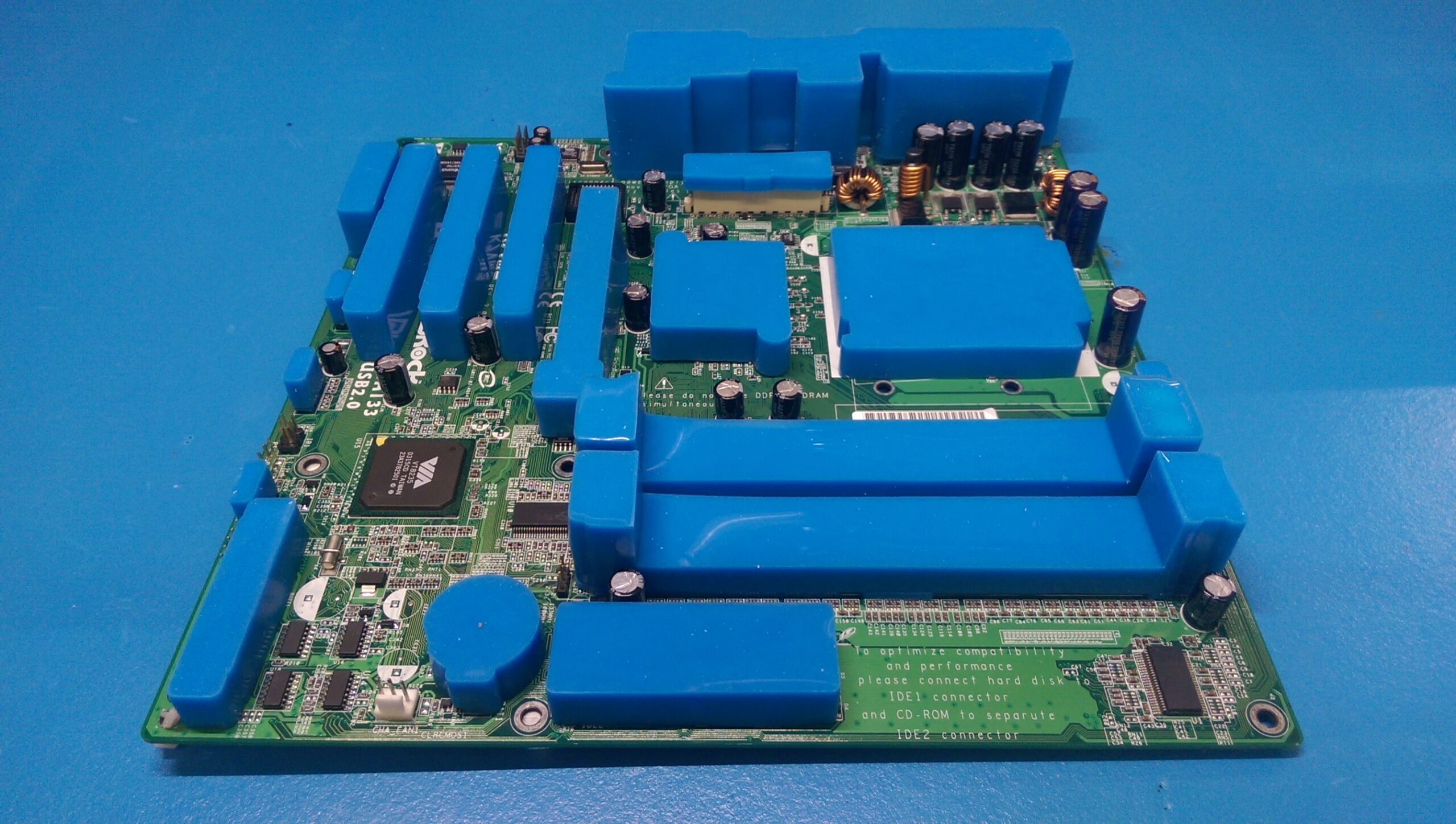
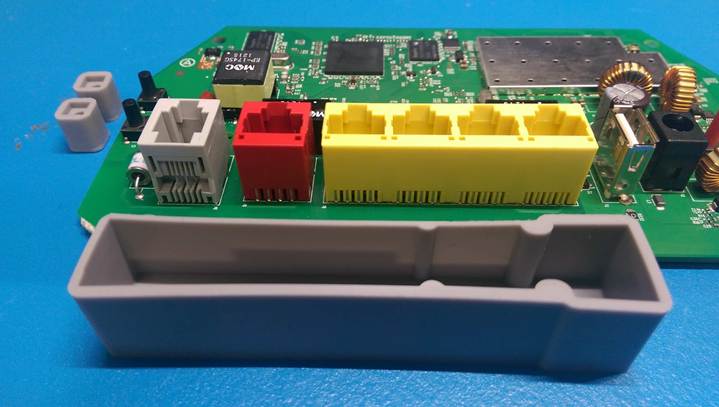
Conformal coating masking boots used on Printed circuit board as an alternative to masking tapes

Using custom masking boots for the conformal coating masking process saves time, money and improves quality. Find out why….


Masking is a critical step in conformal coating processes, protecting connectors, test points, and keep-out areas from unwanted coating ingress. Traditional masking materials such as tapes, dots, and liquid latex can be effective, but they are often labour-intensive and inconsistent.

In many conformal coating operations, masking and de-masking account for a significant proportion of overall process time and cost. In some cases, these steps can represent more than 75% of the total coating effort, driving up labour costs and limiting throughput.

To understand how masking boots fit into a complete conformal coating process, explore our masking solutions.


Using Recyclable Masking Boots as an Alternative to Tapes, Dots, and Latex

Reusable conformal coating masking boots offer a faster, more reliable alternative to traditional masking methods. By switching to masking boots, manufacturers can significantly reduce process time while improving consistency and repeatability.

Three key reasons to change to masking boots:

  1. Reduced masking time – Masking boots can be four to five times faster to apply than traditional masking tape or dots.
  2. Reduced de-masking time – Removal of masking boots is quicker and cleaner than peeling tape or removing cured latex.
  3. Improved sealing – Masking boots provide a more consistent seal and are less prone to leakage, reducing the need for inspection and repair.

These benefits allow manufacturers to achieve rapid cost savings and improve process efficiency when transitioning away from tape- and latex-based masking.


Find Out More About Conformal Coating Masking Boots

If you are reviewing your masking process or looking to reduce coating-related labour costs, SCH Services Ltd can help assess whether masking boots are suitable for your application.

If you would like to discuss masking boots for your assemblies or compare them against tape-based methods, contact our team.

How Custom Masking Boots Reduce Cost, Time and Risk in Conformal Coating


Custom conformal coating masking boots are an effective alternative to traditional masking materials such as tapes, dots, and liquid latex for protecting components from conformal coating ingress on printed circuit board assemblies.

While conventional masking methods can work, the masking and de-masking process is often labour-intensive and time-consuming, significantly increasing overall production costs. In many applications, masking and removal can account for over 75% of the total conformal coating process time and cost, particularly in medium- and high-volume production.

Three reasons to switch to reusable conformal coating masking boots

Using recyclable masking boots as an alternative to masking tapes, dots, and latex

Here are three good reasons to change to masking boots and save up to 80% of your costs compared to traditional methods like masking tape and dots:

  1. The masking time is reduced significantly. Masking boots can be 4-5 times quicker to use than masking tape.
  2. De-masking time is reduced significantly. Again it is much quicker to remove masking boots than tape.
  3. Masking boots don’t leak as easily as masking tape. So, there is less likely to be repaired.

These reasons mean you can save a lot of money very quickly when switching to masking boots.

Want to find out more about conformal coating masking boots?

Contact us now to discuss your conformal coating masking boot requirements and let us explain how we can help you.


0
  • Your current order total is £0.00 β€” you must have an order with a minimum of £75.00 to place your order.
0
Your Cart
Your cart is empty
  • Your current order total is £0.00 β€” you must have an order with a minimum of £75.00 to place your order.
Calculate Shipping
  • Your current order total is £0.00 β€” you must have an order with a minimum of £75.00 to place your order.

Conformal Coating UK

Technical banner showing PCB and process icons representing conformal coating, masking, inspection and training on the SCH technical knowledge hub.
Conformal Coating UK
Privacy Overview

This website uses cookies so that we can provide you with the best user experience possible. Cookie information is stored in your browser and performs functions such as recognising you when you return to our website and helping our team to understand which sections of the website you find most interesting and useful.