Mon - Thur 7.30-15.30   Fri 7.30-14.00

Why do so many conformal coating problems appear β€œrandom”?


Why Conformal Coating Problems Often Appear Random β€” And Why They Aren’t

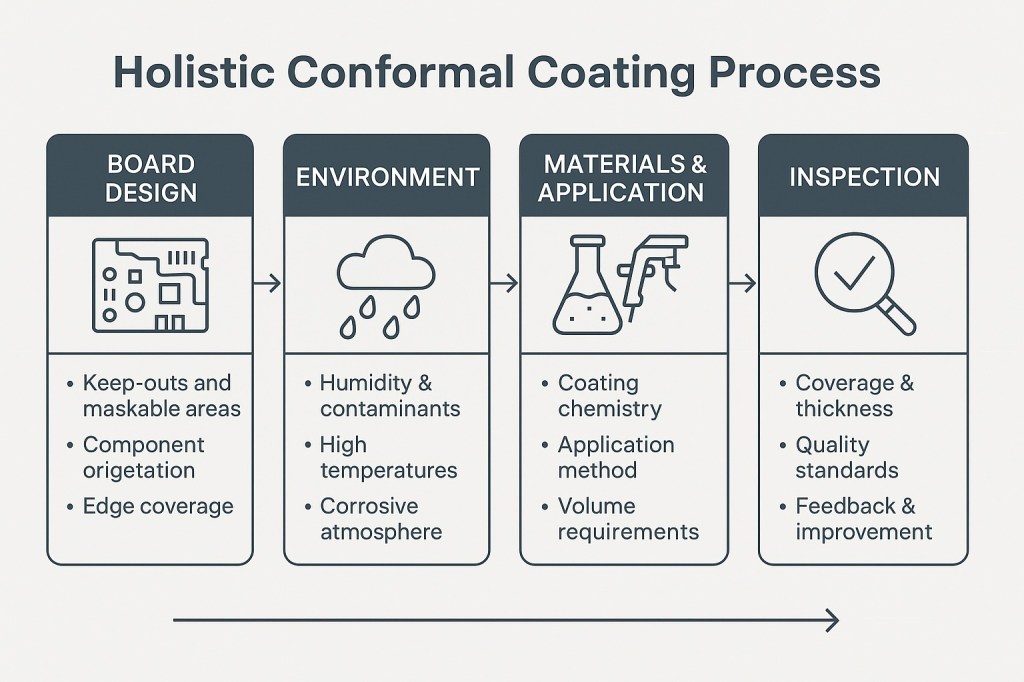
In most cases, they aren’t random at all β€” they are symptoms of a process that was never aligned from the start. Conformal coating only works reliably when PCB design, environmental demands, coating chemistry, application method and inspection strategy all work together as a unified system.

To help manufacturers establish stable, scalable and predictable coating processes, we’ve published a fully updated guide:

πŸ‘‰Β Holistic Conformal Coating Process – End-to-End Framework

Below is a high-level summary. For the full technical model, diagrams and linked resources, explore the article above.

1. It all begins with PCB design

Most coating challenges originate at the design stage β€” long before production starts. Poor keep-outs, difficult orientations, insufficient drain paths or incompatible materials lead to:

  • excessive masking
  • rework and inspection delays
  • pooling, edge thinning and trapped solvent
  • long-term reliability risks

A design that supports coating reduces cost and improves first-pass yield.

Explore the Design for Conformal Coating Hub:

πŸ‘‰Β Design Hub Articles

2. Chemistry must be matched to the real environment

No coating is universally suitable. Chemistry selection should be driven by environmental stress, including:

  • humidity and condensation
  • SOβ‚‚Β / Hβ‚‚S corrosion
  • fuels, oils, chemicals and solvents
  • UV exposure
  • thermal cycling and vibration
  • high-voltage creepage and clearance

Using the wrong chemistry often results in de-wetting, cracking, poor adhesion or long-term corrosion.

Explore:

πŸ‘‰Β Parylene Coating Solutions

πŸ‘‰Β ProShieldESD Conductive Polymer Platform

3. The application method must suit material, volume & geometry

Selective coating, manual spray, dip coating and Parylene each solve different process challenges. Selecting the wrong method leads to inconsistent thickness, material waste and increased labour.

Your method should reflect:

  • production volume
  • assembly density
  • design geometry
  • material selection
  • drainage capability
  • masking burden

See the Coating Process Hub Overview:

πŸ‘‰Β Coating Processes Hub

4. Material & process control prevent drift

Even well-designed processes degrade over time if material conditions are not tightly managed.

Small variations in:

  • viscosity
  • solvent balance
  • 2K mix ratio
  • temperature & humidity
  • flash-off or cure profile

…can create large deviations in coverage, edge definition, adhesion and repeatability.

Good material management is one of the strongest predictors of coating stability over time.

5. Inspection closes the loop

Inspection validates the process and ensures defects are caught before assemblies reach customers.

A robust inspection strategy should include:

  • UV contrast and coverage checks
  • thickness measurement (preferably with coupons)
  • adhesion and environmental tests
  • periodic functional/hi-pot checks

Explore the Inspection & Quality Hub:

πŸ‘‰Β Inspection & Quality Articles

SCH-manufactured UV Inspection Booths:

πŸ‘‰Β UV Inspection Booths

6. Continuous improvement keeps the process stable

Production changes, new PCB variants and supplier shifts all introduce risk. Without structured review, even a previously stable line can begin to drift.

SCH’s consultancy team provides:

  • NPI validation & materials benchmarking
  • full process audits
  • defect pattern analysis
  • SPC review & control planning
  • design alignment and masking strategy optimisation

Explore:

πŸ‘‰Β Conformal Coating Consultancy

7. When Parylene is the smarter choice

For certain assemblies, liquid coatings will never deliver the required performance. Parylene excels when:

  • geometries are complex
  • components are closely packed
  • surfaces are hidden, recessed or sharp-edged
  • moisture protection must be absolute
  • very high electrical resistance or stability is required
  • field reliability is mission-critical

Explore:

πŸ‘‰Β Parylene Coating Services

πŸ‘‰Β Parylene Deposition Systems

8. Why the holistic model matters

Failures rarely originate in the coating booth. They arise from misalignment of design, chemistry, application method or environment.

Symptoms include:

  • dewetting
  • fisheyes and pinholes
  • inconsistent thickness
  • chronic masking leakage
  • pooling and edge thinning
  • delamination and poor adhesion

These issues often appear random β€” yet almost always stem from upstream decisions.

Explore the full Coating Defects Hub:

πŸ‘‰Β Common Coating Defects

9. SCH’s Total Solutions Approach

Whether you coat in-house or outsource, SCH provides full lifecycle support across both liquid coatings and Parylene.

⭐ In-house coating support

⭐ Outsourced coating services

Explore:

πŸ‘‰Β Total Conformal Coating Solutions

πŸ”Β Read the full technical framework

This blog provides a high-level summary only. For the complete methodology, diagrams, commercial considerations and cross-linked technical resources, view the full article:

πŸ‘‰Β Holistic Conformal Coating Process – Full Guide

Inline Dip Coating – The New Era of Conformal Coating Automation


Conformal Coating Automation & Industry 4.0

For many years, conformal coating was seen as a labour-intensive, operator-driven process. Whether spraying PCBs by hand or manually dipping assemblies, consistency depended heavily on individual technique. But the industry has shifted. Manufacturers now expectΒ repeatability, digital traceability and real-time process controlβ€”and automation is becoming central to achieving these goals.

At SCH, we are seeing rapid adoption ofΒ inline dip systems,Β robotic spray coating,Β vision inspection, andΒ SPC-driven quality controlΒ across aerospace, EV, defence, industrial and IoT electronics. Together, these tools define what a modern, Industry-4.0-ready coating line looks like.

In this article, we explore how these technologies are changing the landscape and how manufacturers can begin implementing them.

Why Automation Is Now Essential

Automation delivers immediate, measurable improvements:

  • Consistent film buildΒ through controlled spray passes and dip parameters
  • Lower reworkΒ thanks to early wet-film inspection
  • Traceable processingΒ with logged recipes and parameters
  • Predictable throughputΒ with reduced labour dependency
  • Proactive qualityΒ powered by SPC trend analysis

When combined with smart handling, curing and inspection methods, coating lines become stable, predictable and audit-ready.

Inline Dip Coating – Stability Through Digital Control

Dip coating has always provided excellent coverage, butΒ manual dipping introduces huge variabilityβ€”insertion speed, dip depth, dwell time, withdrawal angle, drain orientation, and more.

AΒ conveyorised inline dip systemΒ solves the problem by controlling:

  • Dwell time in the coating tank
  • Withdrawal and drain profile
  • Immersion speed and depth
  • Drain time and fixed board orientation

These parameters are digitally locked, repeatable, and traceableβ€”allowing dip coating to sit neatly within a fully automated line.

To learn more about coating methods, see:

πŸ‘‰Β Conformal Coating Processes Hub


Robotic Spray Coating – Precision Without Operator Drift

Where dipping isn’t suitable,Β robotic spray controlΒ offers accuracy and repeatability far beyond any manual process.

Modern systems include:

  • Vision alignment
  • Dynamic speed adjustment
  • Path optimisation for complex geometries
  • Masking-clearance detection
  • Locked recipes for process security

This ensures every PCB receives identical coverage regardless of operator, shift, or batch.


Vision Inspection & SPC Data – The Core of Industry 4.0

Industry 4.0 relies on data, and conformal coating is no exception.

Vision Systems

Wet-film vision inspection can verify:

  • Coverage effects including de-wetting
  • Pooling
  • Thick edges
  • Masking position and presence

These checks happenΒ before curing, when rework is fast and low risk.


SPC & Trend Monitoring

Inline or near-line thickness data feeds into SPC dashboards, allowing you to:

  • Detect drift before defects occur
  • Set control limits
  • Analyse coating uniformity
  • Maintain long-term process stability

This level of visibility is quickly becoming an industry expectation.


Traceability & MES Connectivity

Fully automated coating lines increasingly feed intoΒ MES/ERP systems, providing:

  • Logged process parameters
  • Batch, panel or serial traceability
  • Linked operator or cell ID
  • Locked revision-controlled recipes
  • Digital audit trails

This capability is vital for aerospace, defence and EV sectors where documentation is legally mandated.


Where Automation Delivers the Best ROI

We see the largest return in:

  • High-mix PCB assemblyΒ where manual variation is hard to manage
  • Automotive & EV electronicsΒ with tight process control requirements
  • Aerospace & defence, where traceability is critical
  • IoT & miniature devices, where coverage must be perfect
  • Products where dip coating is preferredΒ but historically inconsistent

Automation eliminates the root causes of variation and transforms coating lines into predictable manufacturing assets.


Building a Roadmap Toward Industry 4.0 Coating

Companies don’t need to automate everything at once. Most follow this progression:

  1. Robotic spray or simple automated dip
  2. Digital recipe locking & controlled parameters
  3. Vision inspection before cure
  4. SPC dashboards & data-driven quality
  5. Full MES/ERP connectivity

Each step increases stability, repeatability, and visibility.


How SCH Supports Coating Automation

SCH provides:

Our team helps manufacturers implement stable, repeatable coating workflowsβ€”from dip process control to robotic spray paths and digital traceability.

If you’d like help designing or optimising your coating process:

πŸ‘‰Β Contact the SCH Technical Team

Why Solids Content Matters When Costing Conformal Coating Application


The solids content of a conformal coating represents the proportion of material that remains on the printed circuit board once solvents have evaporated. In simple terms, solids content determines how much usable coating you actually obtain from each litre of material.

The higher the solids content, the more circuit boards can be coated from the same volume β€” directly impacting material efficiency and cost.

High Solids Means Real Coverage

When selecting a conformal coating, it is tempting to focus solely on the price per litre. However, this can be misleading. What truly matters is the final solids content at application viscosity, not the as-supplied specification on the datasheet.

In many cases, a large proportion of the purchased material is solvent that will evaporate during application, contributing nothing to protection.

To understand how solids content fits into overall coating selection and process design, explore our conformal coating materials.

Be Careful When Comparing Coating Materials

Conformal coatings from different manufacturers can vary significantly in both solids content and viscosity. These differences can lead to substantial hidden cost variations, even when products appear similar on paper.

A meaningful comparison must always consider the true solids content of the coating as applied in production, once diluted to the correct working viscosity.

A Typical Industry Example

Consider a common scenario seen across the conformal coating industry:

  • Material X is supplied at 35% solids with a viscosity of approximately 190 cps.
  • To achieve correct spray application, the coating must be reduced to around 24 cps.
  • This reduction requires approximately 50% dilution with solvent.

After dilution:

  • The coating now contains only 17.5% solids.
  • More than 80% of the applied material evaporates during application.

In practical terms, less than one-fifth of the purchased material contributes to actual PCB protection.

Not All Coatings Deliver the Same Value

It is incorrect to assume all conformal coatings perform β€” or cost β€” the same in real-world use.

For example, SCH supplies a UL-approved acrylic conformal coating that is 44% solids at 24 cps, supplied ready to spray without dilution.

When compared directly:

  • Material X: 17.5% solids at spray viscosity
  • High-solids coating: 44% solids at spray viscosity

The higher-solids material provides more than twice the effective coverage per litre. If both coatings are similarly priced per litre, over twice as much of the lower-solids material would be required to achieve equivalent protection.

The Takeaway

Careful evaluation of solids content at application viscosity can deliver substantial material cost savings, reduced solvent handling, and more predictable coating performance.

When costing conformal coating processes, always look beyond headline datasheet values β€” real efficiency is defined by what remains on the board, not what evaporates away.

Want to Calculate Your True Coating Cost?

If you would like a spreadsheet that allows you to calculate coating coverage and cost per PCB using your own process parameters, SCH can provide this directly.

If you would like a coverage and cost calculation spreadsheet or want to discuss your coating process, contact our technical team.

Requirements for setting up a conformal coating facility


Conformal coating application and inspection at SCH Services

The set up of a conformal coating production line regardless of the application method has many similar characteristics.

Any coating facility will need the basic requirements put in place that would be standard for any piece of electronic manufacturing process. These include ESD systems, facilities for the machines, the environmental requirements and the normal Health & Safety (HSE) considerations.

Also, the conformal coating production line, whether it is an operator manually brush coating printed circuit boards (PCBs) or an inline robotic spray coating process is typically made up of several stages. These stages are shown below:

Conformal coating process chart illustrating key stages and controls

Not all the stages are mandatory or may be required. Β However, each should be considered on an individual basis.


Planning to set up a conformal coating facility?

Explore our Conformal Coating Processes Hub and read the detailed guide: How to set up a conformal coating production line. The article covers equipment selection, process flow, quality control and scale-up considerations for reliable, repeatable coating operations.

Prefer to talk it through? Our engineers can review your requirements and help you plan a coating facility that fits your volumes, materials and compliance needs.

Contact SCH to discuss your conformal coating setup β€Ί

Three key points you should know about polyurethane conformal coatings when using them for protecting electronic circuit boards


SCH Services UK conformal coating facility and operations

A polyurethane (urethane for short and designated UR by IPC) conformal coating is part of the organic family of coating materials that also includes the acrylic and epoxy coatings.

Here are three key facts to consider when examining polyurethane conformal coatings:

  1. Most conformal coatings provide good humidity and moisture protection although some are slightly better in performance than others. UR type coatings are just as good on average as acrylic materials.
  2. A polyurethane coating has traditionally been used to protect electronic circuit boards against chemical attack due to their excellent chemical resistance. This protection allows electronic circuit boards to survive in highly aggressive environments and atmospheres such as the aerospace, military and industrial sectors. However, it does make repair a little more difficult as chemical resistance to a coating means more difficult to remove.
  3. Times are changing and whereas acrylic conformal coatings used to dominate 70-80% of the market, there is a shift in emphasis towards alternative materials due to higher specifications for protecting electronics. Many new conformal coatings (UV cure, two part thin film coatings) now comprise of urethane resin bases and are becoming more popular in high volume sectors such as automotive electronics. This is because the urethane resin lends itself to this type of technology more easily than the acrylic based resins.

Want to find out more about polyurethane conformal coating?

Contact us to discuss your needs and let us explain how we can help you.

Contact us now.

What are the different methods available for cleaning electronic circuit boards?


SCH Services conformal coating facility and production environment

The topic of cleaning printed circuit board assemblies (PCBAs) effectively before application of conformal coating can be daunting. This is because the process of cleaning circuit boards can be difficult especially with so many variables to consider.

When considering cleaning the circuit you need to assess many factors including:

  1. The board and component compatibility with the cleaning method
  2. The ability of the cleaning method to remove the contamination effectively from the circuit
  3. Any residues the cleaning process may leave behind that may be harmful to the circuit in the long term.
  4. The reasons for cleaning the circuit (e.g. contamination removal, adhesion promotion etc.)?

After considering these factors you can compare with the processes available.

The main methods of cleaning printed circuit boards

The main methods of cleaning used in everyday electronics processing before conformal coating application can include:

  • Aqueous washing
  • Semi-aqueous washing
  • Solvent & chemical washing
  • Plasma surface cleaning

These processes can be mixed, the method can be varied but the fundamental concepts still apply.

However, whatever method you choose you still have to consider that the key to success in cleaning circuit boards is similar to the success made with conformal coating. You need to match the cleaning process, the cleaning materials and the circuit board together. If you do this then this will give you the best results for cleaning the circuit board assembly.

Want to find out more about cleaning?

Contact us now to discuss your needs and let us explain how we can help you.


Nexus article on, “Outsourcing your conformal coating project – The key points”


Outsourcing your conformal coating project - The key points on subcontracting to an external company

Nexus, the independent conformal coating resource, recently published an article on subcontracting your conformal coating services out to a third party.

I thought it would be useful to signpost people to this article and republish the points they raised since getting it right can be so critical in outsourcing. Nexus identified that there are, “three key points to consider when choosing a subcontractor“.

These three key areas were:

  1. Quality
  2. Turnaround time
  3. Price

They stated that,

“if you get these three key areas correct then you have succeeded. Β Everyone will be happy and there are no more problems with conformal coating.”

(Source: Nexus).

However, within each of these areas, they outlined a lot of questions that should be asked to ensure you get it right. Those points were examined in detail with some real insight into subcontract services.


Want to find out more about subcontract conformal coating services?

Find out how we can help you with your conformal coating process now. Contact us now to discuss your needs and let us explain how we can help you.


Do you need UL qualification for your conformal coating?


UL are the Underwriters Laboratories and are a global safety certification body for consumer electronics. They are a 3rd Party test service. There is no self-certification available. A qualification to UL can be used as a sign of quality control and testing independently of the coatings protective ability.

When do you need UL?

Sometimes it may be required that the conformal coating needs UL approval to be applied to a circuit board. It will depend on the market the electronics goes into. UL approved coatings can be used on electronics in many diverse sectors such as the domestic home, industrial controls, telecommunications and aerospace.

In fact, in nearly all areas conformal coatings tend to be used for protection.

SCH Services UK conformal coating facility and production environment

UL approved coatings can be requested in nearly all areas conformal coatings tend to be used for protection for electronics including domestic home, industrial controls, telecommunications and aerospace.

What standards are used from UL for conformal coatings?

For conformal coating, two parts of the UL standards are important. These are:

  • UL 94: Standard for Safety of Flammability of Plastic Materials for Parts in Devices and Appliances testing.
  • UL 746E: Standard Polymeric Materials: Industrial Laminates, Filament Wound Tubing, Vulcanized Fiber and Materials Used in Printed-Wiring Boards

The two standards together control the quality of the conformal coating.

UL 94

  • It is a plastic material flammability standard.
  • The standard classifies plastics according to how they burn in various orientations and thicknesses.
  • UL 94 measures conformal coating material’s tendency either to extinguish or to spread the flame once the test specimen has been ignited.

For conformal coatings the test coupons are normally tested horizontally. Tests are normally conducted on coupons of the minimum approved thickness with different types of laminate. The conformal coating thickness range also is normally specified.

The ratings are as follows:

  • V-2 burning stops within 30 seconds on a vertical specimen; drips of flaming particles are allowed.
  • V-1: burning stops within 30 seconds on a vertical specimen; drips of particles allowed as long as they are not inflamed.
  • V-0: burning stops within 10 seconds on a vertical specimen; drips of particles allowed as long as they are not inflamed.

Most conformal coatings aim to achieve V-0 status (top result).

UL 746E

UL 746E is the Standard Polymeric Materials: Industrial Laminates, Filament Wound Tubing, Vulcanized Fiber and Materials Used in Printed-Wiring Boards

UL 746E measures the ignition resistance of the conformal coating to electrical ignition sources. The conformal coating material’s resistance to ignition and surface tracking characteristics is described in UL 746E.

Find out how we can help you with your conformal coating process now.

Contact us now to discuss your needs and let us explain how we can optimise your process for you.


How do I selectively apply my conformal coating?


Selective application of conformal coating in this case is applying the conformal coating without using masking to shield components from ingress.

Technically, using masking tapes, latex and boots is a selective process. But, we are looking at coating applications without masking. This leaves a couple of different options.

The first is brushing. This is a simple selective process that can be highly effective.

The second, and the more obvious option, is selective robot. This process uses a small spray valve (there are many conformal coating spray valve types) that is attached to a robot that follows a set pattern applying the conformal coating selectively to the circuit board.


Advantages and disadvantages of selective conformal coating robots

The five advantages and disadvantages of selective application of conformal coating are:

Advantages

  • Masking can be eliminated or minimised
  • High speed coating process
  • High volume process
  • High quality finish when under control
  • Simple process to operate when set up

Disadvantages

  • High engineering skill required for set up and programming
  • High engineering skill required for troubleshooting and supervision
  • High capital cost initially
  • Process controls need to be enforced for good quality production
  • Environment can influence the process controls

Find out how we can help you with your conformal coating process now.

SCH supports OEMs and EMS providers with a fully integrated total-solutions approach to conformal coating and Paryleneβ€”spanning in-house process development through to fully outsourced production. Our focus is on delivering coating strategies that are technically robust, commercially viable and scalable, from early prototype through to full-rate manufacture.

For manufacturers operating their own coating lines, we provide comprehensive engineering support including PCB design reviews, conformal coating line set-up, Parylene deposition equipment, masking optimisation, SPC and control planning, and operator training. We also support NPI programmes, helping teams validate chemistries, define robust masking strategies, optimise equipment parameters and benchmark new materials or processes prior to volume release.

For organisations outsourcing coating, SCH delivers fully managed coating services covering both liquid conformal coatings and Parylene. These services are underpinned by structured technical consultancy, specification development and detailed troubleshooting and failure analysis. Whether addressing a short-term process issue or establishing a long-term coating partnership, we ensure assemblies meet demanding environmental and reliability requirements.

At every level of engagement, SCH provides tailored training and technical consultancy, including process benchmarking, defect prevention, troubleshooting, design-for-coating guidance, and on-site or remote support for engineering and quality teams.

Whether your requirement is technical guidance, equipment supply, production capacity, NPI validation or continuous process improvement, SCH delivers end-to-end support across the complete coating lifecycle.

Find out more about our:

πŸ‘‰ Conformal Coating Solutions
πŸ‘‰ Parylene Solutions

Contact us nowΒ to discuss your needs and let us explain how we can optimize your process for you.

πŸ“ž Call: +44 (0)1226 249019
βœ‰ Email: sales@schservices.com
πŸ’¬ Contact Us β€Ί


How do conformal coating masking boots save money in your production process?


Three ways reusable PCB masking solutions reduce coating costs

Reusable masking solutions protecting PCB components during conformal coating at SCH Services

Switching from disposable tapes to reusable masking solutions can cut conformal coating costs by up to 80%, particularly in medium- to high-volume production.

    1. Faster application. Pre-formed boots are typically 4–5Γ— quicker to apply than manual tape masking,
      reducing operator time per board.
    2. Rapid removal after coating. One-piece removal eliminates the slow peeling, residue cleanup, and inspection
      associated with traditional masking materials.
    3. Lower rework risk. Unlike tape, moulded boots provide consistent sealing around connectors and interfaces,
      reducing coating ingress and costly touch-up or strip-and-recoat cycles.

The result is a more predictable masking process, improved yield, and faster throughputβ€”especially where repeatability matters.

Get expert advice on reusable masking for conformal coating

SCH helps manufacturers select and implement reusable masking boots and component protection solutions that reduce labour, improve consistency, and support scalable production.

You can explore our range of reusable PCB masking boots, or review our technical guidance on conformal coating masking strategies, which explains when to use boots, tapes, dots, liquid mask, or custom plugsβ€”along with best practice,
standards considerations, and common failure modes.

This approach helps ensure your coating operation remains efficient, repeatable, and rework-friendly as volumes increase.
Contact us to discuss your application β†’

0
  • Your current order total is £0.00 β€” you must have an order with a minimum of £75.00 to place your order.
0
Your Cart
Your cart is empty
  • Your current order total is £0.00 β€” you must have an order with a minimum of £75.00 to place your order.
Calculate Shipping
  • Your current order total is £0.00 β€” you must have an order with a minimum of £75.00 to place your order.

Conformal Coating UK

Conformal Coating UK
Privacy Overview

This website uses cookies so that we can provide you with the best user experience possible. Cookie information is stored in your browser and performs functions such as recognising you when you return to our website and helping our team to understand which sections of the website you find most interesting and useful.