Mon - Thur 7.30-15.30   Fri 7.30-14.00
Comparison between liquid conformal coating and Parylene vapour deposition on electronic assemblies

What Is Parylene Coating and Why Is It Different From Other Conformal Coatings?


In electronics and advanced manufacturing, protecting sensitive components from moisture, chemicals, and environmental stress is critical. Conformal coatings play a vital role in ensuring long-term reliability, but not all coatings perform in the same way. Among available technologies, Parylene stands out as a unique and highly effective solution.

What Is Parylene?

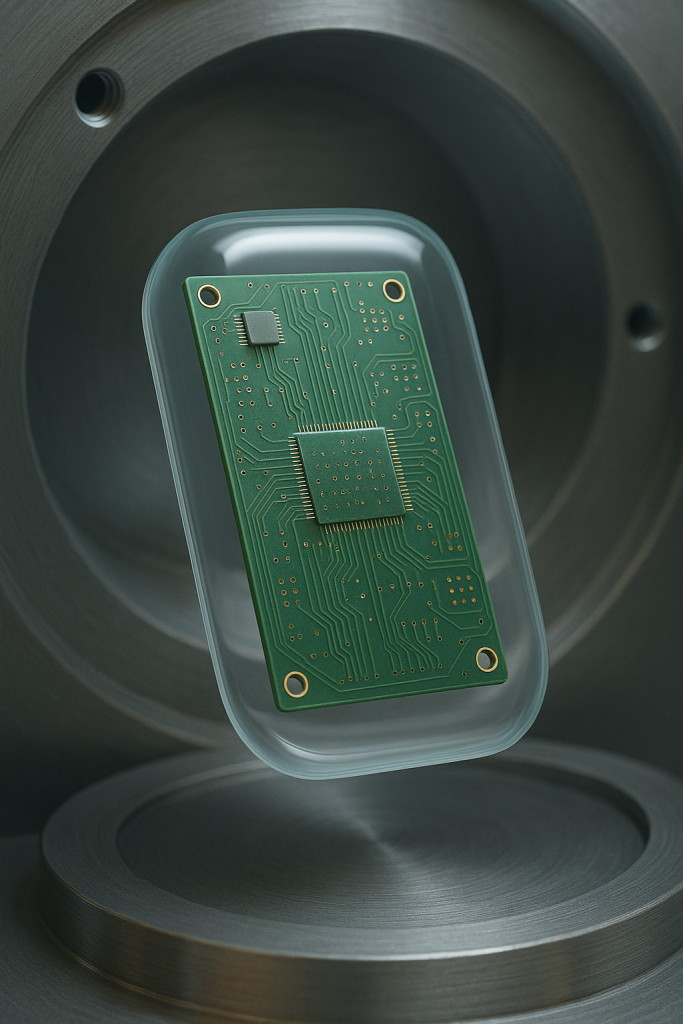
Parylene is a family of thin, transparent polymer coatings applied using a chemical vapour deposition (CVD) process. Unlike liquid conformal coatings that are sprayed, brushed, or dipped, Parylene is deposited as a vapour inside a vacuum chamber. This enables it to coat all exposed surfaces β€” internal and external β€” with a uniform, pinhole-free film.

The most common Parylene variants include:

  • Parylene N – Excellent dielectric properties, often used in high-frequency applications.
  • Parylene C – The most widely used type, offering strong moisture and chemical resistance.
  • Parylene F (AF-4) – Enhanced high-temperature and chemical resistance.

How Parylene Differs From Other Conformal Coatings

  1. Application method – Vapour deposition in a vacuum environment ensures even coverage without pooling, meniscus effects, or edge build-up.
  2. Coverage – Parylene penetrates tight gaps, coats under components, and reaches complex geometries that liquid coatings cannot.
  3. Film properties – Ultra-thin (typically 1–50 Β΅m), transparent, flexible, and biocompatible.
  4. Performance – Superior resistance to moisture, chemicals, and many extreme environments.
  5. Cleanliness – A dry, solvent-free process that leaves no residues, making it ideal for medical, aerospace, and high-reliability electronics.

Where Is Parylene Used?

  • Medical devices – Catheters, stents, pacemakers, sensors, and implantable electronics.
  • Aerospace and defence – Flight electronics, sensors, and mission-critical systems.
  • Automotive – EV electronics, sensors, and ADAS components.
  • Consumer electronics – Wearables, IoT devices, and microelectronics.

Why Choose SCH for Parylene?

At SCH Services Ltd, we combine over 30 years of coating expertise with a complete Parylene offering that supports both outsourced coating and in-house capability.

  • Subcontract coating services – ISO-controlled, production-ready Parylene coating.
  • Turnkey Parylene systems – Complete equipment, dimers, training, and long-term technical support.
  • Reliable materials supply – Official European distribution supporting quality and continuity.

Whether you need immediate coating capacity or a fully validated in-house process, SCH provides the knowledge, equipment, and materials to ensure long-term success.

If you would like to discuss whether Parylene is the right solution for your application, get in touch with SCH. Β To explore SCH’s complete Parylene capability, including services, equipment, dimers, and technical support, visit our Parylene solutions page.

Parylene Training and Support


Expert Training in Parylene Conformal Coating

On-Site or at Our Facility – Tailored to Your Needs

SCH Services Ltd offers specialist Parylene conformal coating training for organisations looking to build, strengthen, or expand their in-house capability. Whether you are introducing Parylene for the first time or developing advanced skills in rework, repair, and process control, our training programmes focus on practical knowledge that delivers quality, compliance, and efficiency.

To understand how Parylene training fits within SCH’s wider coating capability, explore our Parylene solutions.

Hands-on Parylene conformal coating training covering deposition, masking and inspection

Training Options

We offer flexible delivery formats to suit your operation:

Training at Our Facility

Attend training at our fully equipped facility, where your team will learn from experienced engineers in a controlled, real-world production environment using representative equipment and processes.

Training at Your Site

For organisations that prefer in-house delivery, we can provide the full training programme on-site. This approach is ideal for larger teams or where equipment-specific knowledge and live production processes are involved.


Course Content

Each course is tailored to your team’s experience level and production requirements. Core topics include:

  • Introduction to Parylene chemistry and vapour deposition principles
  • Equipment overview and vacuum chamber configuration
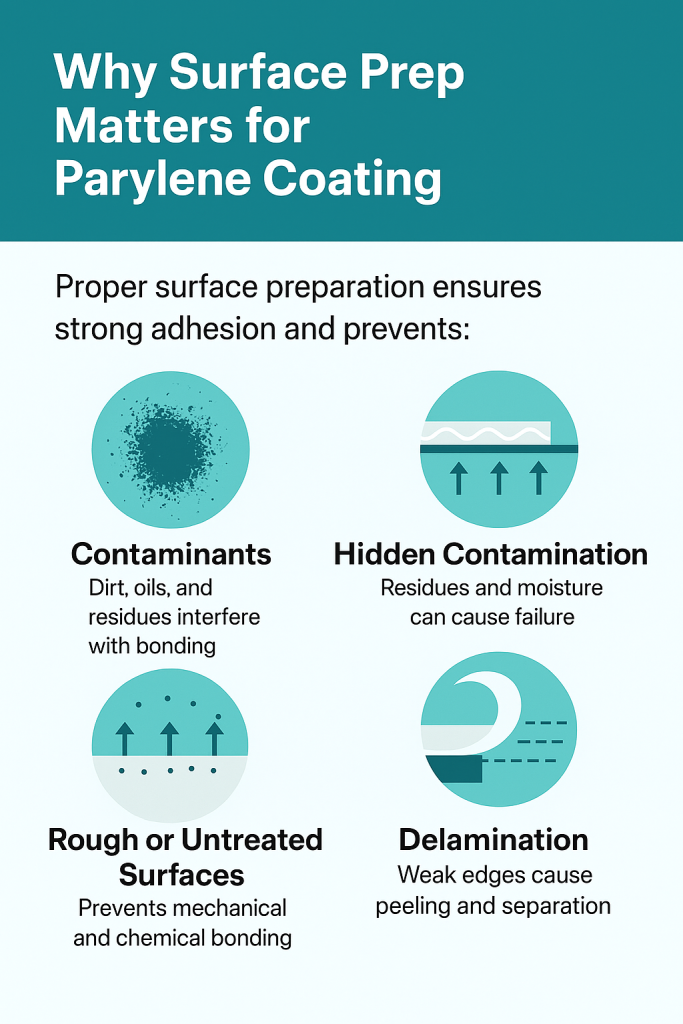
  • Surface preparation and cleanliness requirements
  • Advanced masking techniques, including tapes, boots, and custom solutions
  • Process control and coating uniformity
  • Inspection, quality control, and thickness measurement
  • Rework and repair, including removal, touch-up, and restoration
  • Health, safety, and environmental considerations

Ongoing Technical Support

Training does not end when the course finishes. SCH Services Ltd provides ongoing technical support to ensure long-term success, including:

  • Process troubleshooting and optimisation
  • Remote or on-site consultancy
  • Updates on new masking methods and equipment
  • Guidance for coating complex or sensitive assemblies

Whether you are operating a low-volume development lab or scaling to high-throughput production, SCH supports consistent, high-quality Parylene application.


Ready to Get Started?

If you would like to discuss training options or request a tailored course outline, get in touch with our team.

Email: sales@schservices.com
Phone: 01226 249019

Conformal coating masking boots used on Printed circuit board as an alternative to masking tapes

Using custom masking boots for the conformal coating masking process saves time, money and improves quality. Find out why….


Masking is a critical step in conformal coating processes, protecting connectors, test points, and keep-out areas from unwanted coating ingress. Traditional masking materials such as tapes, dots, and liquid latex can be effective, but they are often labour-intensive and inconsistent.

In many conformal coating operations, masking and de-masking account for a significant proportion of overall process time and cost. In some cases, these steps can represent more than 75% of the total coating effort, driving up labour costs and limiting throughput.

To understand how masking boots fit into a complete conformal coating process, explore our masking solutions.


Using Recyclable Masking Boots as an Alternative to Tapes, Dots, and Latex

Reusable conformal coating masking boots offer a faster, more reliable alternative to traditional masking methods. By switching to masking boots, manufacturers can significantly reduce process time while improving consistency and repeatability.

Three key reasons to change to masking boots:

  1. Reduced masking time – Masking boots can be four to five times faster to apply than traditional masking tape or dots.
  2. Reduced de-masking time – Removal of masking boots is quicker and cleaner than peeling tape or removing cured latex.
  3. Improved sealing – Masking boots provide a more consistent seal and are less prone to leakage, reducing the need for inspection and repair.

These benefits allow manufacturers to achieve rapid cost savings and improve process efficiency when transitioning away from tape- and latex-based masking.


Find Out More About Conformal Coating Masking Boots

If you are reviewing your masking process or looking to reduce coating-related labour costs, SCH Services Ltd can help assess whether masking boots are suitable for your application.

If you would like to discuss masking boots for your assemblies or compare them against tape-based methods, contact our team.

Requirements for setting up a conformal coating facility


Conformal coating application and inspection at SCH Services

The set up of a conformal coating production line regardless of the application method has many similar characteristics.

Any coating facility will need the basic requirements put in place that would be standard for any piece of electronic manufacturing process. These include ESD systems, facilities for the machines, the environmental requirements and the normal Health & Safety (HSE) considerations.

Also, the conformal coating production line, whether it is an operator manually brush coating printed circuit boards (PCBs) or an inline robotic spray coating process is typically made up of several stages. These stages are shown below:

Conformal coating process chart illustrating key stages and controls

Not all the stages are mandatory or may be required. Β However, each should be considered on an individual basis.


Planning to set up a conformal coating facility?

Explore our Conformal Coating Processes Hub and read the detailed guide: How to set up a conformal coating production line. The article covers equipment selection, process flow, quality control and scale-up considerations for reliable, repeatable coating operations.

Prefer to talk it through? Our engineers can review your requirements and help you plan a coating facility that fits your volumes, materials and compliance needs.

Contact SCH to discuss your conformal coating setup β€Ί

Three key points you should know about polyurethane conformal coatings when using them for protecting electronic circuit boards


SCH Services UK conformal coating facility and operations

A polyurethane (urethane for short and designated UR by IPC) conformal coating is part of the organic family of coating materials that also includes the acrylic and epoxy coatings.

Here are three key facts to consider when examining polyurethane conformal coatings:

  1. Most conformal coatings provide good humidity and moisture protection although some are slightly better in performance than others. UR type coatings are just as good on average as acrylic materials.
  2. A polyurethane coating has traditionally been used to protect electronic circuit boards against chemical attack due to their excellent chemical resistance. This protection allows electronic circuit boards to survive in highly aggressive environments and atmospheres such as the aerospace, military and industrial sectors. However, it does make repair a little more difficult as chemical resistance to a coating means more difficult to remove.
  3. Times are changing and whereas acrylic conformal coatings used to dominate 70-80% of the market, there is a shift in emphasis towards alternative materials due to higher specifications for protecting electronics. Many new conformal coatings (UV cure, two part thin film coatings) now comprise of urethane resin bases and are becoming more popular in high volume sectors such as automotive electronics. This is because the urethane resin lends itself to this type of technology more easily than the acrylic based resins.

Want to find out more about polyurethane conformal coating?

Contact us to discuss your needs and let us explain how we can help you.

Contact us now.

What are conformal coating masking boots and why do they save you money?


Conformal coating application and masking process at SCH Services facility

Reusable conformal coating masking boots are a highly cost-effective alternative to traditional masking tape.

Many components on printed circuit boards must remain uncoated during the conformal coating process. The purpose of masking is to prevent migration of coating materials into connectors, contacts, and defined keep-out areas where coating would cause functional or reliability issues.

Custom-made masking boots provide a major labour-saving advantage during both the masking and de-masking stages of conformal coating. Unlike tape-based masking, these boots are fully reusable and are simply fitted over components such as connectors, plugs, and sockets prior to coating.

Reusable conformal coating masking boots can be designed as simple push-fit caps for standard connectors or as more sophisticated custom geometries for complex or high-density assemblies, as shown in the examples below.

They provide reliable, repeatable protection across all major conformal coating application methods, including:

  • Batch and selective robotic spraying (reducing the need for complex programming)
  • Vertical and horizontal dip coating
  • Vapour deposition processes such as Parylene coating

Reusable masking boots used in conformal coating operations at SCH Services

Three reasons to switch from masking tape to reusable masking boots

Switching from tape-based masking to reusable masking boots can reduce total masking costs by up to 80%:

  1. Faster application – masking boots can be applied 4–5Γ— quicker than masking tape.
  2. Faster removal – de-masking boots is significantly quicker and cleaner than removing tape.
  3. Lower defect risk – masking boots are far less prone to leakage, reducing rework compared to tape.

The result is a rapid reduction in labour cost, improved process consistency, and fewer coating-related defects when compared to traditional masking tape methods.

Need expert advice on masking PCBs before conformal coating?

Effective PCB masking is critical to prevent coating ingress into connectors, test points, keep-out zones and mechanical interfaces. Poor masking choices can lead to coating defects, rework, reliability issues and unnecessary cost.

SCH supports customers with practical masking strategies tailored to your assembly, coating chemistry and production volume β€” from reusable masking boots and tapes to liquid masking systems and process optimisation.

If your assemblies also require preparation before coating, you can learn more about our subcontract PCB cleaning and coating services, or speak directly with our engineers to review your masking and coating requirements.

Contact SCH to discuss your PCB masking and conformal coating needs β€Ί

What are the different methods available for cleaning electronic circuit boards?


SCH Services conformal coating facility and production environment

The topic of cleaning printed circuit board assemblies (PCBAs) effectively before application of conformal coating can be daunting. This is because the process of cleaning circuit boards can be difficult especially with so many variables to consider.

When considering cleaning the circuit you need to assess many factors including:

  1. The board and component compatibility with the cleaning method
  2. The ability of the cleaning method to remove the contamination effectively from the circuit
  3. Any residues the cleaning process may leave behind that may be harmful to the circuit in the long term.
  4. The reasons for cleaning the circuit (e.g. contamination removal, adhesion promotion etc.)?

After considering these factors you can compare with the processes available.

The main methods of cleaning printed circuit boards

The main methods of cleaning used in everyday electronics processing before conformal coating application can include:

  • Aqueous washing
  • Semi-aqueous washing
  • Solvent & chemical washing
  • Plasma surface cleaning

These processes can be mixed, the method can be varied but the fundamental concepts still apply.

However, whatever method you choose you still have to consider that the key to success in cleaning circuit boards is similar to the success made with conformal coating. You need to match the cleaning process, the cleaning materials and the circuit board together. If you do this then this will give you the best results for cleaning the circuit board assembly.

Want to find out more about cleaning?

Contact us now to discuss your needs and let us explain how we can help you.


The Science Behind Fluoropolymer Nano Coatings for Protecting Electronic Circuit Boards


Nano-coatings are being used regularly to protect printed circuit board assemblies. This is because the material they are made of fluorinated polymers and these materials have very specialized properties that produce very different results to traditional conformal coatings.

So, what are the unique properties of a Nano-coating?

To understand the properties of a Nano-coating you have to understand what a fluoropolymer coating is made of.

Typically, the coating itself is comprised of fluorocarbons and characterised by carbon-fluorine bonds. Since the coating is made of fluorocarbons then the film surface is not susceptible to Van der Waals forces (interfacial electrostatic bonds). Therefore, the surface energy of the fluoropolymer coating is extremely low and hydrophobic (water repellent). It acts like Teflon on a frying pan.

This non-wetting of water on the circuit board is one of the many key properties making them so popular.

SCH UK1


What other properties do Nano-coatings have that may help protect circuit boards?

For electronic circuit board assemblies there are several key properties that are being used.

These include being:

  • Hydrophobic: Being highly water repellent
  • Ultra-thin: Protection whilst being extremely thin
  • High moisture barrier: Low water vapor transmission rate provides excellent corrosion resistance
  • Chemically resistant: Having a high chemical resistance helps protect the circuits from chemical attack.
  • Good dielectrics: fluoropolymer coatings have high dielectric properties

However, to really understand the benefits you have to look at the key difference compared to a conventional conformal coating. That is that no masking is required when applying the Nano-coating.


So, why is there no need to mask when using a Nano-coating?

First, consider a normal conformal coating is applied at typical thicknesses of 25um or more. Also, the conformal coating is a high insulation material. Therefore, at this thickness the conformal coating would electrically insulate components like connectors and it must not be applied to any part that needs electrical conductivity.

However, this is not a problem for a Nano-coating.

Since the Nano-coating can be applied at ultra-thin thicknesses (1-2um in thickness or less) without any protection performance reduction, then the extremely soft coating is easily removed or scratched away when the connectors are joined and the electrical circuit is easily made.

This key parameter of not requiring masking during Nano-coating application combined with the hydrophobic nature of the coating material makes the Nano-coatings highly effective in protecting electronic circuit boards at a very low cost per unit.


Want to find out more about Nano-coatings?

At SCH Technologies, we supply ultra-thin Nano-coatings based on advanced fluoropolymer chemistries. These coatings provide a cost-effective way to protect printed circuit board assemblies (PCBAs) and other electronics from moisture, corrosion, and environmental damage. Β We also offer a subcontract conformal coating service and can apply these nano-coatings for you.

Find out more and Contact us now to discuss your needs and let us explain how we can help you.

Five key facts about Parylene when protecting printed circuit board assemblies


Infographic showing five key facts about Parylene conformal coating for protecting printed circuit board assemblies, including vapour deposition, uniform coverage, moisture barrier, chemical resistance and electrical performance

Here are five key facts about Parylene that are critical in understanding this process:

  1. The Parylene conformal coating process is a very specialised vapour deposition application method using specialist vacuum chamber systems. This differs significantly to all of the other liquid conformal coatings available on the market that are applied by spraying, brushing and dipping.
  2. Parylene coating is completely conformal and uniform to the surface of the Printed Circuit Board (PCB) or product. It is also pinhole free. Therefore, components with sharp edges, points, flat surfaces, crevices or exposed internal surfaces are coated uniformly without voids.
  3. Parylene coating provides an excellent moisture and gas barrier due its very low permeability. This means that electronics circuit boards coated in Parylene generally are more β€œwaterproof” than the same electronics coated in a liquid conformal coating.
  4. Parylene is unaffected by solvents (it has very high chemical resistance) and is very effective against salt attack.
  5. Parylene has excellent electrical properties. This includes having low dielectric constant and loss with good high-frequency properties, good dielectric strength, and high bulk and surface resistance.

Find more in-depth details about Parylene materials, deposition principles, masking methods, thickness measurement and core application concepts at our Parylene Basics HubΒ now.

Or, if you’re interested in moving towards a Parylene process click through to our Parylene Solutions, Β Parylene equipment and Parylene subcontract services pages.


Want to find out more about Parylene?

Contact us now to discuss your needs and let us explain how we can help you.

Five key facts about using fluoropolymer Nano-coatings for protecting printed circuit boards


June15-3

  1. A Nano-coating is hydrophobic. It repels water from the surface of the circuit board and water will not wet the circuit.
  2. The Nano-coatings are extremely thin (<2um). They are very different to traditional conformal coatings.
  3. Nano-coatings do not require masking. The circuit board can be completely submerged in the liquid with no masking applied without damaging components.
  4. They have excellent chemical resistance due its fluorine bonds. The Nano-coatings are perfect to protect against chemical attack.
  5. Using a Nano-coating is a fast simple process. The coating can be dipped quickly, without masking, and the coating dries extremely fast.

Want to find out more about Nano-coatings?

Contact us to discuss your needs and let us explain how we can help you. Or, read more on Nano-coating technology for protecting circuit boards now.

Find out how we can help you with your conformal coating process now.

Contact usΒ  now.

0
  • Your current order total is £0.00 β€” you must have an order with a minimum of £75.00 to place your order.
0
Your Cart
Your cart is empty
  • Your current order total is £0.00 β€” you must have an order with a minimum of £75.00 to place your order.
Calculate Shipping
  • Your current order total is £0.00 β€” you must have an order with a minimum of £75.00 to place your order.

Conformal Coating UK

Technical banner showing PCB and process icons representing conformal coating, masking, inspection and training on the SCH technical knowledge hub.
Conformal Coating UK
Privacy Overview

This website uses cookies so that we can provide you with the best user experience possible. Cookie information is stored in your browser and performs functions such as recognising you when you return to our website and helping our team to understand which sections of the website you find most interesting and useful.