Industrial fans used in electronics, hazardous areas and process environments are sometimes specified as “anti-static” or “ESD safe.” In practice, achieving stable static control on a rotating component is more complex than simply applying a dissipative ESD coating system.
Why Static Control on Fans Is Different
Unlike flat panels or housings, fans are continuously rotating, exposed to airflow abrasion and dust loading, and mechanically stressed at blade roots. Any anti-static fan coating must maintain electrical performance under dynamic conditions — not just pass an initial surface resistivity test.
This infographic summarises the key engineering risks when specifying anti-static fan coating for rotating equipment.
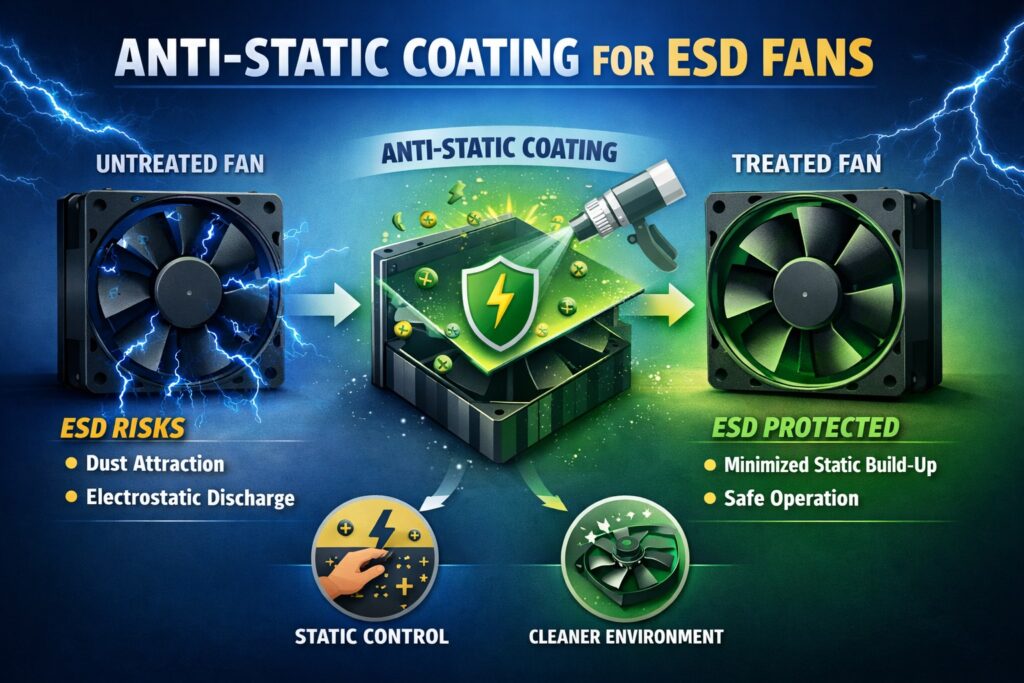
Infographic summarising the engineering challenges of applying anti-static (ESD) coating to rotating plastic fan blades, including adhesion, abrasion resistance and grounding continuity.
What “Anti-Static” Actually Means
In engineering terms, anti-static usually refers to a surface resistivity in the dissipative range (commonly 10⁶–10⁹ Ω/sq, depending on application and standard). On rotating components, three additional factors often determine whether it actually works in service:
- Electrical continuity to ground (a coating alone is not a grounding strategy)
- Stability of resistivity under wear (erosion changes performance)
- Environmental durability (humidity, temperature, airborne contamination)
Without a reliable ground path, even a well-applied dissipative coating may not control charge effectively.
Common Failure Modes on Coated Fans
In practice, issues typically fall into one (or more) of these categories:
- Resistivity drift – electrical performance changes over time.
- Edge wear – coating erodes at blade tips due to airflow abrasion.
- Adhesion loss – coating lifts from low surface energy plastics or contaminated surfaces.
- Inconsistent coverage – uneven film build affecting balance and durability.
For background on surface-energy and contamination-driven mechanisms, see the Conformal Coating Defects Hub and the specific defect pages for de-wetting and poor adhesion on plastics / connector bodies.
Material Selection Considerations
When coating fan blades, the substrate type is critical. Low surface energy polymers (e.g., PP/PE) present adhesion challenges similar to those discussed in our Insight on ESD coating on silicone keyboards (different polymer, similar “low surface energy” reality).
Where coating is feasible, success typically depends on controlled surface preparation and verification, for example:
- Surface activation (plasma or corona) where appropriate
- Controlled film thickness and repeatable application method (see the Processes Hub)
- Verification of balance and vibration post-application
- Surface resistivity measurement and acceptance criteria (see the Inspection & Quality Hub)
- Electrical continuity / grounding validation in the assembled product
Mechanical Balance Matters
Coating thickness must be tightly controlled. Even small asymmetries can alter rotational balance, increase bearing load, and shorten service life. This is often overlooked during prototyping.
Engineering Insight: Define “Working” Early
When a project is “progressing well,” it is worth clarifying what has actually been proven:
- Has surface resistivity been measured after environmental exposure?
- Has performance been tested at operational RPM and duty cycle?
- Has grounding continuity been verified in the final assembly?
- Has wear been assessed after extended runtime?
Static control on moving components must be validated under real operating conditions — not just laboratory conditions.
If you are evaluating anti-static coating on rotating components, we can advise on structured validation routes and realistic performance criteria based on the end-use requirements.
Related Insights: