Conformal Coating Inspection: Standards & Methods
How to Inspect Coated PCBs Consistently Using IPC Rules and Practical Inspection Tools
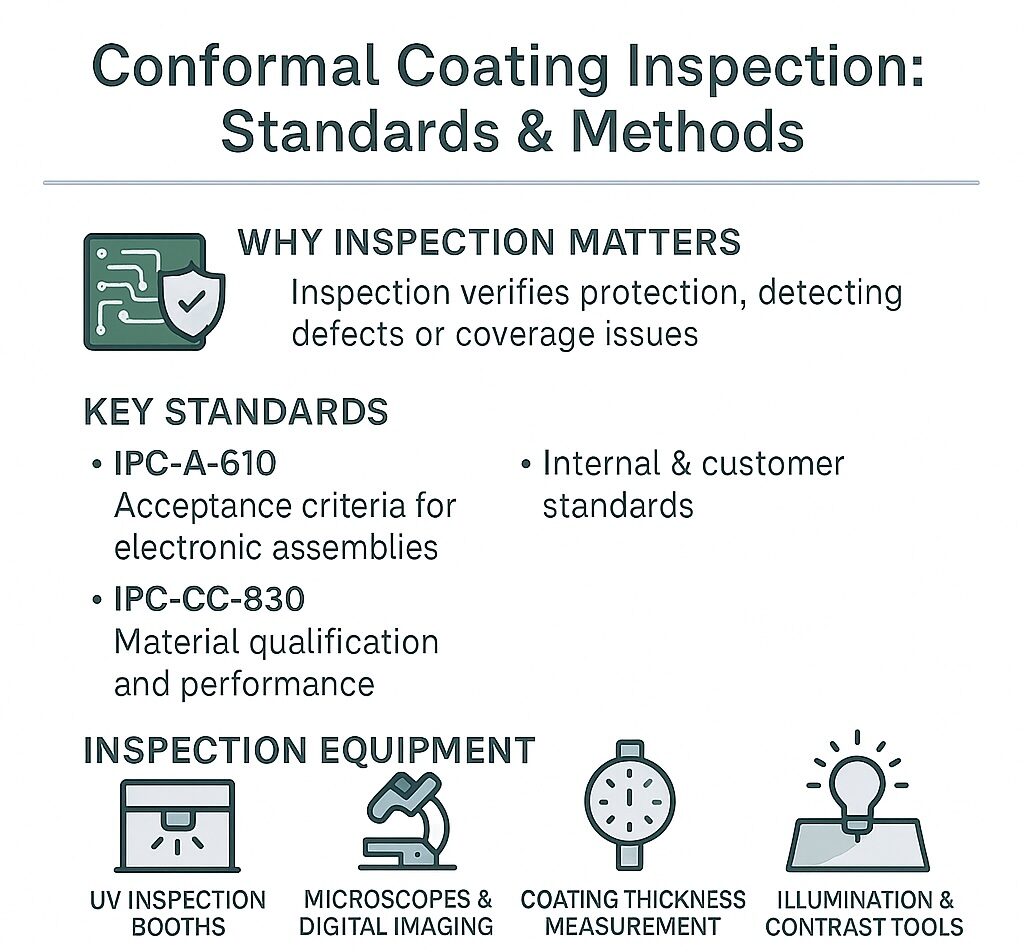
Conformal coating inspection is a controlled process step — not a cosmetic opinion check. It confirms that coating coverage is present where protection is required, that keep-out zones remain clean, and that defects such as voids, bridging, residue or wicking are identified before product release.
This article explains the standards and inspection methods. For the actual “accept/reject/touch-up/strip & recoat” decision framework, use: Conformal Coating Inspection Acceptance Criteria.
For a high-reliability perspective on how cleanliness, inspection discipline and documentation are integrated into a controlled process, see What NASA Gets Right About Conformal Coating.
Quick Links
Why Conformal Coating Inspection Matters
Conformal coating protects against humidity, corrosion, contamination and leakage paths — but only if the film is continuous in the right places and does not violate keep-out zones. Inspection is the step that confirms the process achieved that intent.
- Detects escapes early (coverage misses, shadowing, thin zones in risk areas).
- Prevents functional failures (bridging/webbing, ingress into connectors, contamination-driven de-wetting).
- Stops opinion-led rework by routing decisions into a consistent acceptance framework.
Key Standards That Influence Inspection
IPC-A-610 (Workmanship / Acceptance)
IPC-A-610 defines acceptability of electronic assemblies, including conformal coating coverage expectations, common defect conditions and class-based workmanship thresholds.
- Class 1: General electronic products (function is primary requirement).
- Class 2: Dedicated service products (extended life and sustained performance).
- Class 3: High-performance / harsh environment (mission-critical reliability).
- Read more: IPC-A-610 Standard and Conformal Coating.
IPC-CC-830 (Material Qualification)
IPC-CC-830 is the primary industry standard for conformal coating material qualification and performance testing. It supports confidence in the coating chemistry itself — inspection then confirms the coating was applied correctly in production.
UL 746 / Customer-Specific Specifications
Some programmes reference UL standards and/or customer workmanship documents. In practice, many OEMs adapt IPC acceptance language, then add programme-specific keep-out, marking, documentation and traceability requirements.
NASA Workmanship Guidance (High Reliability)
Space and high-reliability programmes often expect rigorous cleanliness, inspection discipline and documented dispositions. Use NASA workmanship guidance as a reference where applicable.
External resources: IPC-CC-830 · UL · NASA-STD-8739.1 (PDF)
What Inspection Must Confirm (Regardless of Chemistry)
Inspection should answer a simple set of questions that apply across acrylic, polyurethane, silicone, UV-cure coatings and Parylene:
- Coverage: continuous film where protection is required (no bare substrate in critical areas).
- Keep-out compliance: no coating ingress into connectors, pads, mating surfaces, test points or defined zones.
- Defect control: no voids, bubbles, bridging/webbing, cracking, lifting or contamination-driven pullback that creates functional risk.
- Edge behaviour: boundaries are stable (no flaking, peel-back, residue halos linked to poor wetting).
- Thickness intent: thickness is verified by plan (coupons/AQL/SPC) — not guessed from UV brightness.
To convert findings into consistent disposition decisions, use: Inspection Acceptance Criteria.
Core Inspection Methods (How to Look)
1) UV (UVA) Inspection for Coverage & Edge Behaviour
- Best for: confirming coverage presence, edge definition and keep-out violations.
- Limits: UV shows presence, not thickness; some defects require white-light or magnification.
- Link: UV (UVA) Inspection: Coverage & Edge Definition.
2) White-Light Visual Inspection for Surface Defects
- Best for: bubbles, fisheyes, orange peel texture, debris/FOD, lifting, cracks and bloom/whitening.
- Tip: use angled illumination and controlled backgrounds to improve contrast and repeatability.
3) Magnification / Imaging for Small Geometry & Evidence
- Best for: fine-pitch areas, under-component regions, wicking paths, micro-voids and edge lift initiation.
- Value: images support training, NCR records and customer communication.
4) Thickness Verification (Quantitative)
- Best for: verifying film build against targets using coupons, sampling and SPC.
- Link: Thickness Verification Plans (AQL, Coupons, SPC).
Inspection Equipment (What to Use)
UV (UVA) Inspection Booths
- Purpose: UV tracer fluorescence makes conformal coating presence and edge behaviour visible.
- Pros: fast, consistent viewing conditions, ideal for line inspection.
- Limits: does not replace white-light checks or thickness verification.
Equipment link: UV Inspection Booths >
Microscopes & Digital Imaging
- Purpose: magnify defects such as pinholes, wicking, debris, edge lift and bridging.
- Pros: objective evidence and better defect classification.
- Limits: slower; requires trained operators and defined sampling focus areas.
Coating Thickness Measurement
- Purpose: confirm coating thickness is within the specified range using traceable measurement methods.
- Techniques: eddy current, optical methods, coupons / witness samples, destructive cut-back where appropriate.
- Pros: quantitative control, supports SPC and drift detection.
- Limits: method suitability depends on substrate and geometry; some systems are higher-cost.
Equipment link: Coating Thickness Measurement Equipment >
Illumination & Contrast Tools
- Purpose: angled lighting and controlled backgrounds increase visibility of texture and surface defects.
- Pros: low-cost improvement that reduces operator variability.
- Limits: still requires standardised inspection conditions and training.
Records, Traceability & Escalation
Inspection becomes reliable when results are recorded consistently and escalated using the same decision logic:
- Use a defined checklist: coverage, keep-outs, edge stability, defects, thickness plan compliance.
- Photograph representative defects and include reference scale where possible.
- Escalate disputes using the acceptance framework: Acceptance Criteria.
Conformal Coating Inspection & Quality Training
Inspection becomes inconsistent when teams rely on memory and personal judgement. SCH training aligns operators and QA to standards, common defect mechanisms, and repeatable inspection workflows.
📘 Explore our Conformal Coating Training section or download the programme overview below.
Why Choose SCH Services?
Partnering with SCH Services means more than just outsourcing — you gain a complete, integrated platform for Conformal Coating, Parylene & ProShieldESD Solutions, alongside equipment, materials, and training, all backed by decades of hands-on expertise.
- ✈️ 25+ Years of Expertise – Specialists in coating technologies trusted by aerospace, medical, defence, automotive, and electronics industries worldwide.
- 🛠️ End-to-End Support – Guidance on coating selection, Parylene grades, masking strategies, application methods, inspection, and ProShieldESD integration.
- 📈 Scalable Solutions – From small prototype batches to full-scale, high-volume production, SCH delivers flexible capacity that grows with your needs.
- 🌍 Global Reach – Responsive technical support and supply coverage across Europe, North America, and Asia.
- ✅ Proven Reliability – A strong reputation built on quality, consistency, and customer satisfaction across services, equipment, and materials.
📞 Call: +44 (0)1226 249019 | ✉ Email: sales@schservices.com | 💬 Contact Us ›