Parylene Process & Reliability Hub
Advanced process control, troubleshooting & scalable production guidance
Parylene Process & Reliability is the engineering layer of our Parylene Knowledge Hub. It focuses on process stability, defect prevention, validation discipline and yield optimisation—the practical controls that turn Parylene from a “great coating” into a repeatable, scalable, high-reliability production process.
Use this hub if you are specifying Parylene for critical electronics, developing an engineering run, scaling from prototypes to production, or controlling reliability-sensitive applications where the coating process must be validated against real operating conditions. The articles below are organised to help you move from system thinking and process proving, through chamber behaviour and production stability, then into structured diagnosis and supporting control topics.
Planning or Scaling a Parylene Process?
Before committing to equipment or material selection, it’s critical to review cleaning, masking, geometry, deposition stability and throughput assumptions as a complete system.
📞 Book a Process Strategy Discussion with SCH – We can review your application and help you define a stable, scalable Parylene platform.
The diagram below summarises the wider Parylene process control and reliability framework, bringing together chamber stability, validation discipline, masking control, thickness strategy and yield optimisation.
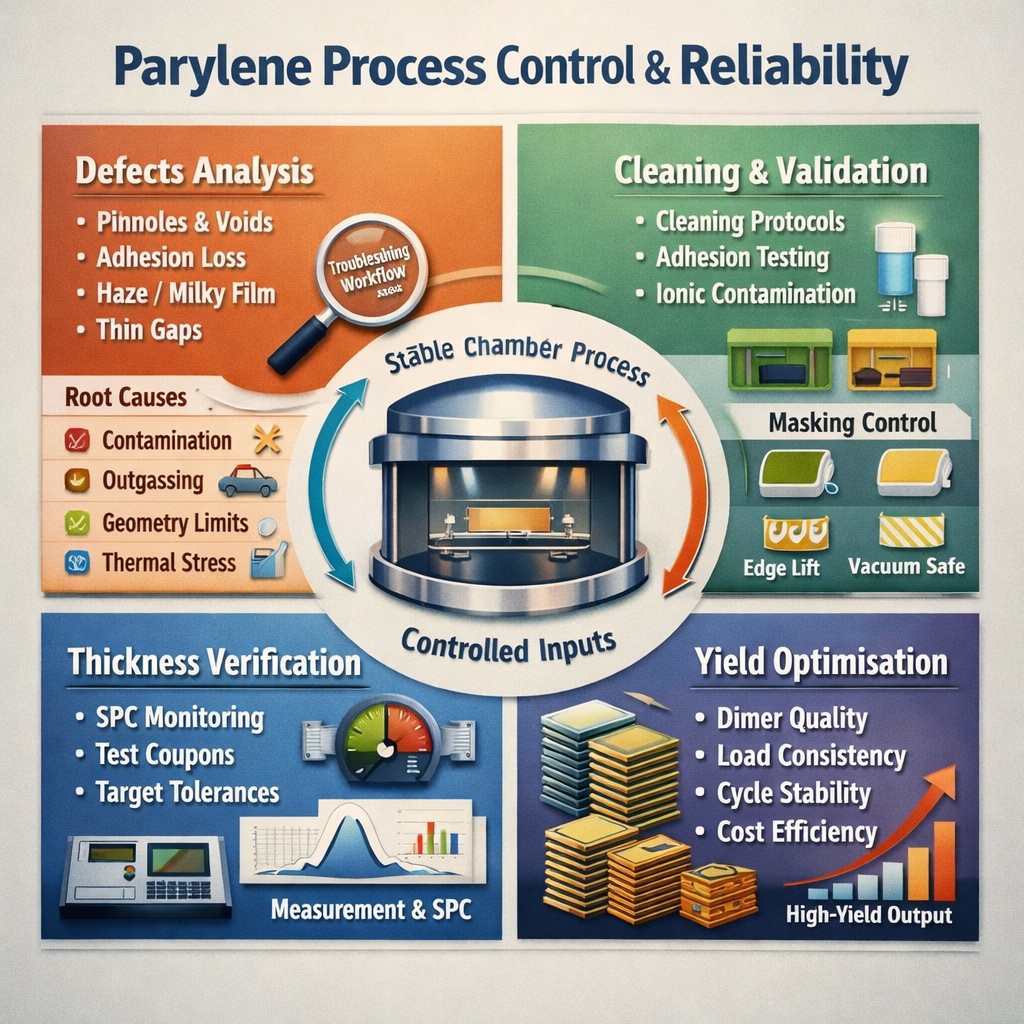
Parylene Process & Reliability Framework illustrating defects analysis, chamber stability, cleaning validation, masking control, thickness verification and yield optimisation.
Use the structure below to navigate from the core process-control spine into the supporting articles that deal with defects, validation, plasma gas chemistry, masking, thickness strategy, high-temperature exposure and qualification support.
Quick Links
Start here (recommended order)
If you are building a new Parylene specification, scaling from prototypes to production, or investigating defects, the sequence below is the fastest path to stable results.
- Parylene as a Manufacturing System: From Deposition to Controlled Production
- Engineering Runs for Parylene Coating: Proving the Process Before Production
- Parylene Chamber Stability & Deposition Control
- Parylene Process Stability & Yield Optimisation
- Parylene Troubleshooting Workflow
- Parylene Cleaning, Surface Preparation & Adhesion Control
- How Plasma Gas Chemistry Changes PCB Surface Preparation Before Parylene
- How to Specify Parylene Coating on a Drawing
- Parylene Thickness Strategy
- High-Temperature Protective Coatings for Electronics
Tip: For fundamentals such as what Parylene is, grade selection and basic specification thinking, start in the Parylene Basics Hub.
Core process control articles
These five articles form the main process-control spine of the hub. Together they explain why Parylene must be managed as a system, how an engineering run proves the proposed process before production, how chamber behaviour influences output, how production stability is maintained, and how failures are diagnosed when results drift.
- Parylene as a Manufacturing System: From Deposition to Controlled Production The keystone article explaining why repeatable Parylene yield depends on controlling the full manufacturing system, not just the recipe.
- Engineering Runs for Parylene Coating: Proving the Process Before Production How representative engineering runs establish masking, surface preparation, thickness verification, inspection and production controls before larger batches are released.
- Parylene Chamber Stability & Deposition ControlHow pressure, temperature, pump-down behaviour and chamber condition influence deposition consistency and repeatability.
- Parylene Process Stability & Yield OptimisationHow controlled inputs, loading discipline, chamber stability and verification reduce variation and protect production yield.
- Parylene Troubleshooting WorkflowA structured diagnostic method using symptom mapping, controlled A/B checks and evidence-based verification to isolate root cause.
Defects & troubleshooting
Parylene defects are usually driven by a small number of repeatable mechanisms: contamination, volatiles and outgassing, geometry and vapour transport limits, or unstable process inputs. The articles below map symptoms to root causes and provide a structured diagnostic approach suitable for high-reliability engineering environments.
- Parylene Defects & Failure MechanismsPinholes, haze, adhesion loss, thin spots in gaps, boundary defects, cracking and flaking—plus chamber physics, masking outgassing and prevention controls aligned to scalable production.
- Parylene Troubleshooting WorkflowA practical decision path: define the symptom → map likely mechanism → run controlled A/B checks → verify with coupons and inspection evidence.
For broader coating defect taxonomy used in audits and training, cross-reference the Conformal Coating Defects Hub.
Cleaning, adhesion & validation
In scalable Parylene production, the difference between “it coated” and “it’s reliable” is often validation discipline. Cleaning validation, controlled handling, substrate readiness, plasma gas selection and vacuum-compatible masking are first-order controls—not afterthoughts.
- Parylene Cleaning, Surface Preparation & Adhesion ControlA repeatable adhesion-control workflow: contamination mapping, validated cleaning and rinse, dry-out and outgassing control, activation, masking discipline and traceability.
- How Plasma Gas Chemistry Changes PCB Surface Preparation Before ParyleneHow oxygen, argon, nitrogen and mixed-gas plasma treatments change surface activation, cleanliness and adhesion behaviour before vapour-deposited coating.
- How to Specify Parylene Coating on a DrawingA practical guide to defining grade, thickness, adhesion and control notes clearly enough for coating, quality and supplier control.
- Parylene Masking (Principles & Methods)Masking approaches, keep-outs and edge definition, with links to practical solutions and reusable methods.
- Parylene Masking Failures: Common Problems & How to Prevent ThemA production-focused guide covering connector contamination, coating creep, demasking damage, repeatability issues and when selective post-coat removal may be more practical than complex masking.
For production masking products, see Masking Solutions.
Thickness selection & verification
Thickness selection and verification is where reliability becomes measurable. Stable thickness trends, coupons, acceptance criteria and SPC-style thinking are what make a Parylene process scalable and audit-friendly.
- Parylene Thickness StrategyHow to choose micron targets without over-building: dielectric intent, geometry penetration limits, environmental severity, stress risk and cost or throughput trade-offs.
- Parylene Thickness & Environmental ProtectionPractical thickness bands and how thickness maps to durability margin and environment severity.
- Parylene Thickness Specification GuideA structured engineering guide to specifying thickness against dielectric performance, coverage limits, geometry and cost control.
- Thickness Verification Plans (AQL, Coupons & SPC)Inspection planning concepts that translate well into Parylene production control.
For measurement and inspection support equipment, see Support Equipment.
Process stability & yield optimisation
High-reliability Parylene operations treat yield as a quality metric and a cost driver. Stable chamber cycles, controlled inputs, repeatable loading and fixturing, and planned maintenance reduce variability and protect throughput.
- Parylene Process Stability & Yield OptimisationHow to reduce run-to-run variability, avoid “mystery defects,” and build repeatability that scales from prototypes to steady production.
- Parylene Chamber Stability & Deposition ControlHow pressure stability, thermal behaviour, pump-down and chamber condition influence deposition consistency.
- Parylene Masking Failures: Common Problems & How to Prevent ThemHow poor masking discipline drives connector contamination, coating creep, demasking damage and hidden yield loss in production.
- Dimer Comparison (N, C, D & AF-4)Selection guidance and practical implications for performance, environment and process behaviour.
If rework is required, see the Removal & Rework Hub and the Vaniman Problast micro-abrasive platform for controlled coating removal.
Application risk & special environments
Some Parylene projects need more than standard coating specification guidance. Heat, thermal cycling, plasma exposure, voltage stress, chemicals and localised hot spots can change how a coating behaves in service, even when the coating looks visually acceptable after exposure.
- High-Temperature Protective Coatings for ElectronicsExplains how to select coatings for elevated temperature, thermal cycling and heat-related reliability risks, including where Parylene, fluorinated Parylene grades, silicone and advanced functional coatings may fit.
- How to Specify Parylene Coating on a DrawingUse this when the coating requirement must be translated into grade, thickness, keep-out, adhesion and validation notes for production control.
- Advanced Functional CoatingsCommercial overview of specialist coating routes where standard conformal coating or Parylene may not fully meet the application requirement.
Why Choose SCH Services?
Partnering with SCH means gaining a complete, integrated platform for Parylene process control and production support, backed by decades of hands-on engineering experience.
- ✈️ 25+ Years – trusted worldwide
- 🛠️ End-to-End Support – coating, masking, application, inspection
- 📈 Scalable Solutions – prototypes to steady production
- 🌍 Global Reach – support in EU, NA, Asia
- ✅ Process Control – traceability, coupons, inspection discipline
📞 Call: +44 (0)1226 249019 | ✉ Email: sales@schservices.com | 💬 Contact Us ›
Fast links: Parylene Coating Services | Parylene Training & Support | Consultancy