Parylene Masking Design Requirements
Defining keep-outs and designing assemblies that mask reliably
← Back to the Parylene Design Hub
Parylene masking design requirements should be considered early, because masking is often the biggest driver of cost, variation and defect risk in vapour-phase coating. Good design reduces masking labour, improves repeatability and protects critical interfaces.
This guide explains how to define keep-out areas, how to design for standard masking methods and how to avoid the common masking traps that cause yield loss.
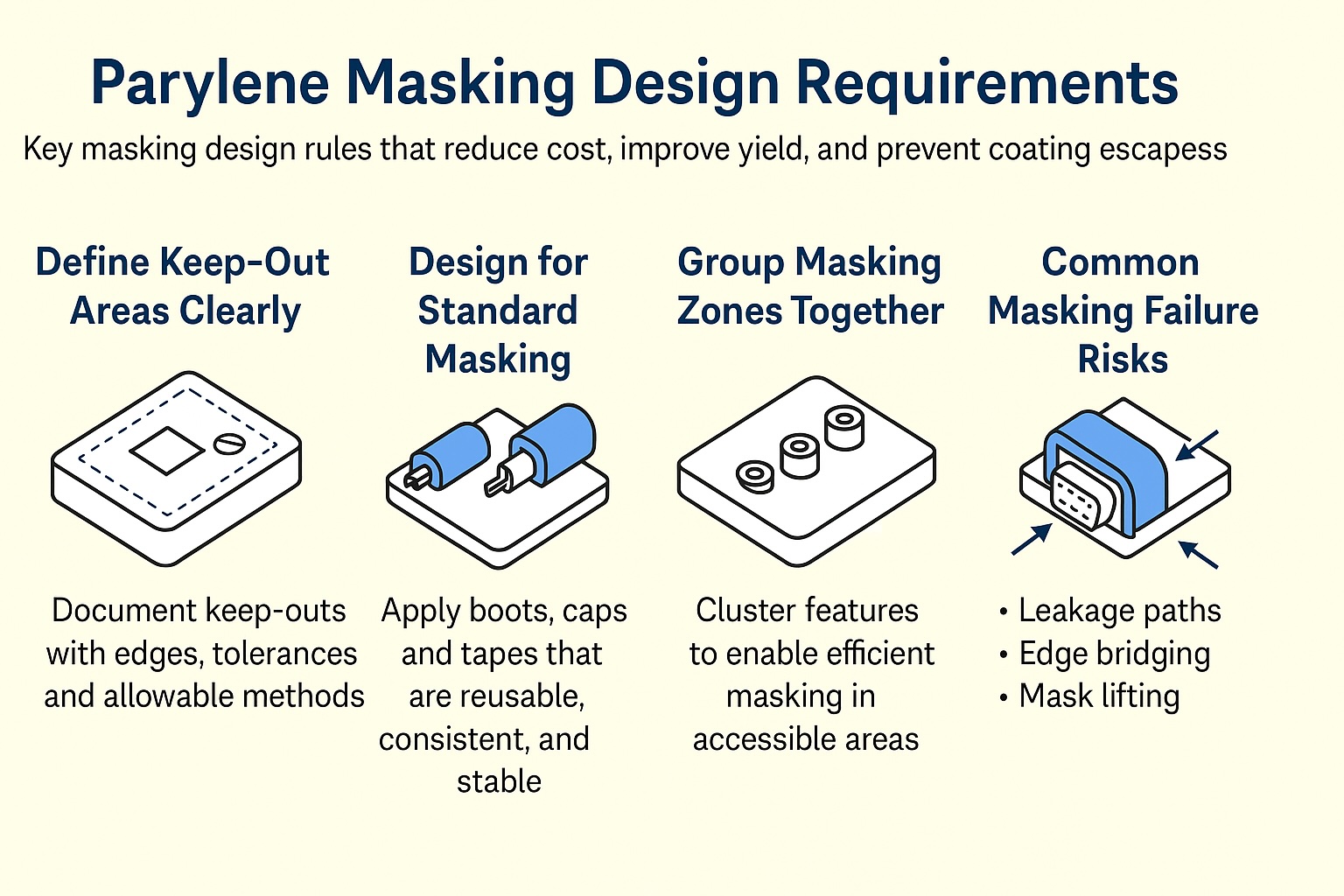
Key masking design rules that reduce cost, improve yield and prevent coating escapes.
Why Masking Matters in Parylene Coating
Parylene is deposited everywhere the vapour can reach. If any areas must remain uncoated, they must be masked correctly. Parylene masking design requirements are critical for:
- Electrical contact points, ground lugs and bonding pads
- Connector mating faces and sealing interfaces
- Weld, braze or bond areas
- Optical windows and sensor apertures
If keep-outs are not planned at design stage, masking becomes slow, inconsistent and expensive.
Define Keep-Out Areas Clearly
Strong Parylene masking design requirements start with clear documentation:
- Mark keep-out zones on drawings and 3D models
- Define tolerance around edges (mask line location)
- Identify whether Parylene edges can be feathered or must be sharp
- Specify if temporary plugs, boots or fixtures are acceptable
Ambiguous keep-out definitions are a common root cause of coating escapes and rework.
Design for Standard Masking (Boots, Caps & Tapes)
To reduce masking cost, designs should support repeatable, standard masking methods:
- Group features that need masking into accessible zones
- Use standard diameters and shapes where possible (boots and caps)
- Avoid tiny isolated keep-outs that require hand masking
- Provide flat, stable surfaces for masking tape adhesion
Good Parylene masking design requirements aim to replace manual masking with standard components and simple fixtures.
Masking Cost Drivers (What Makes Masking Expensive)
Masking time increases sharply when designs include:
- Numerous small keep-out regions spread across the assembly
- Complex 3D surfaces with no stable tape lines
- Features that are hard to access or inspect
- High risk of leakage paths under tapes or boots
Applying Parylene masking design requirements early reduces labour, improves yield and avoids surprises during qualification.
At production volumes, masking is only one part of the wider cost picture. Loading, demasking and inspection can also become significant cost drivers. See our Insight: The Hidden Cost of Parylene Coating: It May Not Be the Deposition.
Common Masking Failure Modes
Common masking defects include:
- Leakage under tapes or boots causing coating in keep-out areas
- Lifting due to poor surface energy or contamination
- Edge bridging where coating creeps into masked zones
- Damage during de-masking that lifts plating or labels
Design choices that support stable tape lines and standard boots dramatically reduce these risks.
Explore Topic Hubs
Why Work with SCH on Parylene Masking Design?
SCH supports customers applying Parylene masking design requirements through:
- Design-led reviews focused on keep-outs, masking strategy and cost drivers
- Turnkey capability covering coating services, equipment, dimers and masking materials
- Cross-sector experience in medical, aerospace, automotive and industrial electronics
- Clear scale-up pathways from prototype masking to stable production masking
Call: +44 (0)1226 249019 · Email: sales@schservices.com
Contact SCH to discuss masking strategy and keep-out requirements ›
Disclaimer: This article provides general guidance on Parylene masking design requirements. Performance, suitability and compliance depend on the specific design, materials and environment. SCH Services can review assemblies and specifications to confirm the most appropriate Parylene coating approach.