How to Specify Parylene Coating
Engineer’s Guide to Requirements, Thickness, Masking & Testing
← Back to the Parylene Basics Hub
Specifying Parylene coating correctly is essential for achieving repeatable performance, predictable reliability and regulatory compliance. This guide outlines the key elements to include in a Parylene specification—covering grade selection, thickness ranges, masking rules, cleaning, testing and qualification.Use this document when preparing drawings, statements of work (SOW), datasheets, purchase orders or supplier quality documents.
For a foundation on Parylene chemistry and properties, see the Parylene Basics guide.
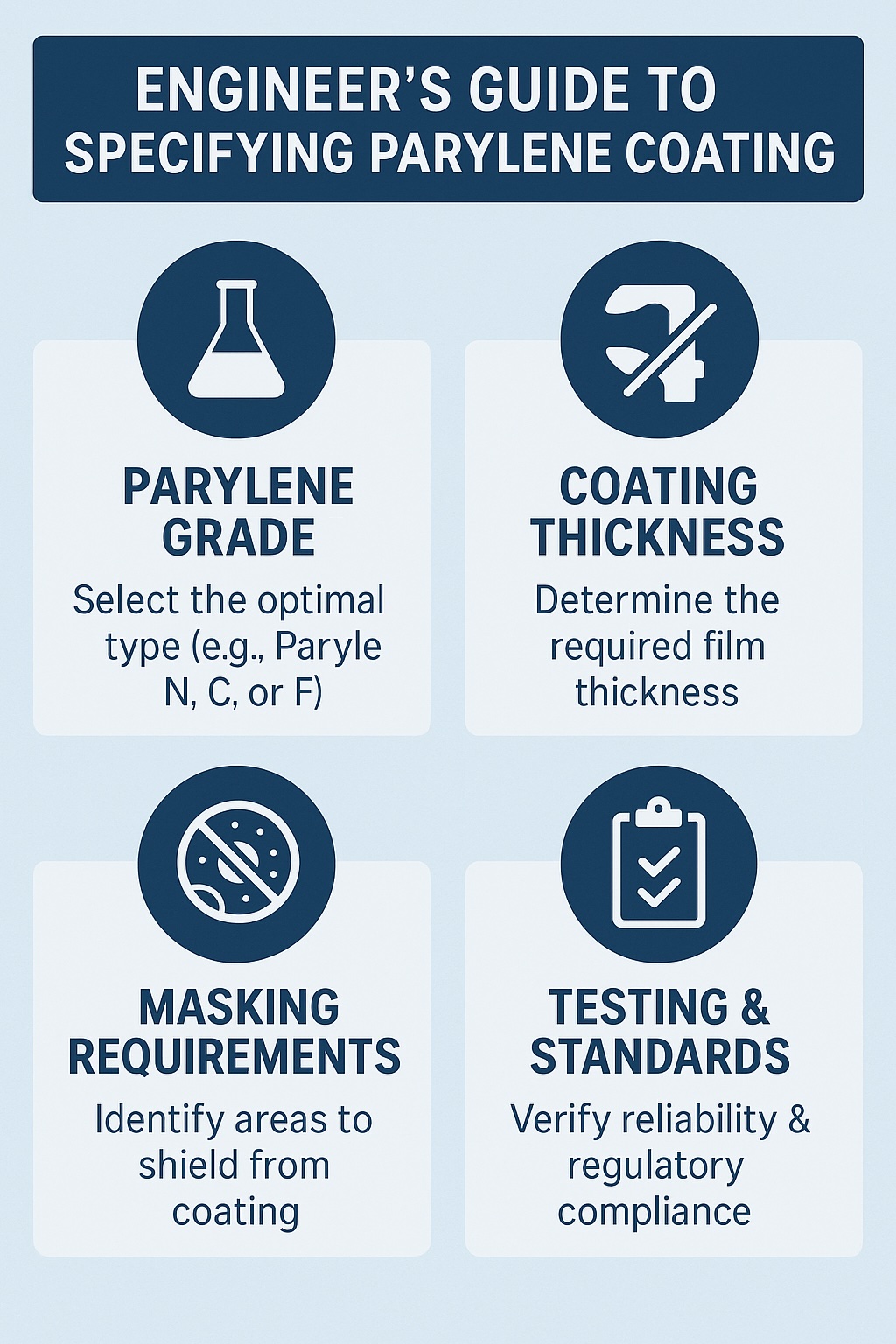
Engineer’s guide to specifying Parylene coating, highlighting the four essential parameters: grade selection, thickness definition, masking requirements, and testing/standards alignment.
1. Define the Application Requirements
A Parylene specification must begin with a clear definition of what the coating must achieve. This ensures alignment between design, manufacturing and supplier capability.
- Operating environment: humidity, condensation, immersion, chemicals, temperature extremes.
- Electrical requirements: dielectric strength, insulation resistance, creepage & clearance constraints.
- Mechanical concerns: vibration, flexing, shock, abrasion, impact.
- Biocompatibility: for medical/implantable applications (ISO 10993, USP Class VI).
- Contamination control: ionic residues, corrosion risks, cleanliness targets.
Documenting these requirements early ensures correct chemistry selection and thickness definition later. For application-led examples, see the Parylene Application Hub.
2. Select the Parylene Grade
Each Parylene type has different mechanical, electrical and barrier properties. Your specification should explicitly define the grade and any purity requirements.
- Parylene C – industry standard: strong moisture barrier, chemical resistance and good dielectric strength.
- Parylene N – best for penetration, microstructures, MEMS and sensors; excellent dielectric constant stability.
- Parylene D – higher thermal performance; increased stability vs C/N.
- Parylene HT (AF-4) – fluorinated; high-temperature capability, UV resistance and excellent chemical inertness.
Include supplier-specific purity requirements (e.g., “Dimer purity ≥ 99.7% with batch traceability”). For more detail on material selection, refer to the Parylene dimer comparison article.
3. Define the Required Coating Thickness
Parylene thickness must be specified as a range, not a single target. Typical functional ranges are:
- Electronics (general): 5–15 µm
- Harsh environment PCBs: 15–25 µm
- Automotive / EV systems: 12–30 µm
- Aerospace / defence: 12–25 µm
- Medical devices: 8–20 µm
Specify measurement method:
- Optical interferometry (recommended for production control)
- Weight gain (less precise; useful for development)
- Profilometry / micro-section (for validation only)
For deeper guidance, see Optical thickness measurement for Parylene.
For a deeper explanation of how protection margin increases with film build, see Parylene Thickness & Environmental Protection: How Much Is Enough?.
4. Masking & Keep-Out Zones
Your specification should provide a clear definition of uncoated areas. Masking is the most labour-intensive part of Parylene coating and must be precise.
- Connector pins, sockets, mating faces
- Ground planes and heat sinks
- Switchgear and mechanical interfaces
- Solder pads for later rework or test access
Include drawings or annotated images showing keep-out boundaries and preferred masking strategy (boots, tapes, caps, custom tooling). For examples and best practice, see Masking for Parylene.
5. Cleaning & Surface Preparation Requirements
Parylene will replicate surface contamination, so cleaning must be defined in the specification. Consider including:
- Cleaning method: aqueous, solvent, plasma, or hybrid processes.
- Ionic contamination limit: e.g., “< 1.56 µg NaCl/cm² per IPC-TM-650”.
- Surface energy requirement: dyne level ≥ 38 dyn/cm for consistent adhesion.
- Drying and bake-out conditions before coating.
For broader context on cleanliness and adhesion, see Surface preparation & cleanliness for reliable coating.
6. Quality Control & Acceptance Criteria
Define inspection rules so the final product meets your reliability needs and is easy to audit.
- UV visual inspection for coverage and edge definition (linked to IPC-A-610 where appropriate).
- Thickness verification using optical systems and defined sampling plans.
- Adhesion tests (cross-hatch or pull tests, typically during development or change control).
- Electrical tests (IR, hipot, leakage) on representative coupons or assemblies.
- Environmental tests if required (humidity, thermal cycling, salt fog, chemical exposure).
Further guidance is available in the Inspection & Quality Hub.
7. Define Qualification Builds & Reliability Testing
In regulated or high-reliability markets, qualification is mandatory. Your specification should outline:
- Pilot batch size and build configuration (test coupons vs production assemblies).
- Sample plan and AQL for visual, thickness and electrical tests.
- Accelerated ageing tests (temperature/humidity, thermal shock, chemical exposure).
- Adhesion and mechanical robustness checks where relevant.
- Document submission requirements (FAI, reports, process FMEAs, traceability packages).
These activities should align with your internal quality system and, where applicable, sector-specific standards (medical, aerospace, automotive).
External References – Standards & Technical Guidance
For deeper engineering detail and design standards that are often used alongside Parylene specifications, see:
- IEEE Xplore – Materials & coatings research – reliability, dielectric performance and environmental testing papers.
- IEC 60664-1 – Insulation coordination – creepage, clearance and how coating can contribute to insulation design.
Frequently Asked Questions – Specifying Parylene Coating
What information should a Parylene coating specification always include?
At minimum, include the Parylene grade, thickness range, masked / uncoated areas, cleaning and surface preparation requirements, and inspection and test criteria. For high-reliability programmes, add qualification steps and documentation expectations.
How do I choose the right Parylene grade?
Start with the operating environment and reliability targets. Parylene C is the default for many electronics, Parylene N is favoured for very thin or sensor applications, Parylene D offers higher thermal performance, and Parylene HT (AF-4) is used for high-temperature or chemically aggressive environments. The dimer comparison guide gives a side-by-side overview.
What thickness should I specify for Parylene?
Most electronic assemblies sit between 5–25 µm depending on environment and sector. Rather than a single value, specify an acceptable range and link it to a defined measurement method such as optical interferometry. See the Parylene thickness measurement article for more detail.
How should masking be documented?
Masking should be defined on drawings or marked-up images showing keep-out areas, plus written notes on preferred masking techniques (e.g., reusable boots, caps, tapes). This reduces ambiguity, improves repeatability and makes cost more predictable. Practical examples are given in the Parylene masking guide.
Do I need qualification builds before full production?
For automotive, aerospace, defence and medical applications the answer is usually yes. A staged approach using coupons and pilot builds allows you to confirm adhesion, thickness, electrical performance and environmental robustness before locking the process into series production.
Need Support Defining Your Parylene Specification?
SCH helps engineers and OEMs develop robust, production-ready Parylene specifications that align with performance, compliance and cost requirements.
- Application and reliability review
- Thickness, masking and cleanliness guidelines
- Pilot builds & qualification planning
- In-house vs subcontract Parylene feasibility
📞 Call: +44 (0)1226 249019
✉ Email: sales@schservices.com
💬 Contact SCH ›
Disclaimer: The information on this page provides general guidance on specifying Parylene coating. Performance, suitability and compliance depend on the specific design, materials and application environment. SCH Services can review assemblies and specifications to confirm the correct coating approach.