MIL-I-46058C (Cancelled) & MIL Standards for Conformal Coating
What it was, why it’s still referenced, and what to use today
MIL-I-46058C is one of the most commonly cited “MIL-SPEC” references for conformal coating in defence and aerospace supply chains. However, it is cancelled — which is exactly why confusion persists.In practice, the key questions are:
- Why is MIL-I-46058C still mentioned on drawings and legacy documentation?
- What replaces it today for coating material qualification and acceptance?
- When do MIL requirements become mandatory (contract flow-down vs “military-grade” claims)?
This page explains the cancellation, the modern equivalents, and how to align your coating and inspection process to defence customer expectations.
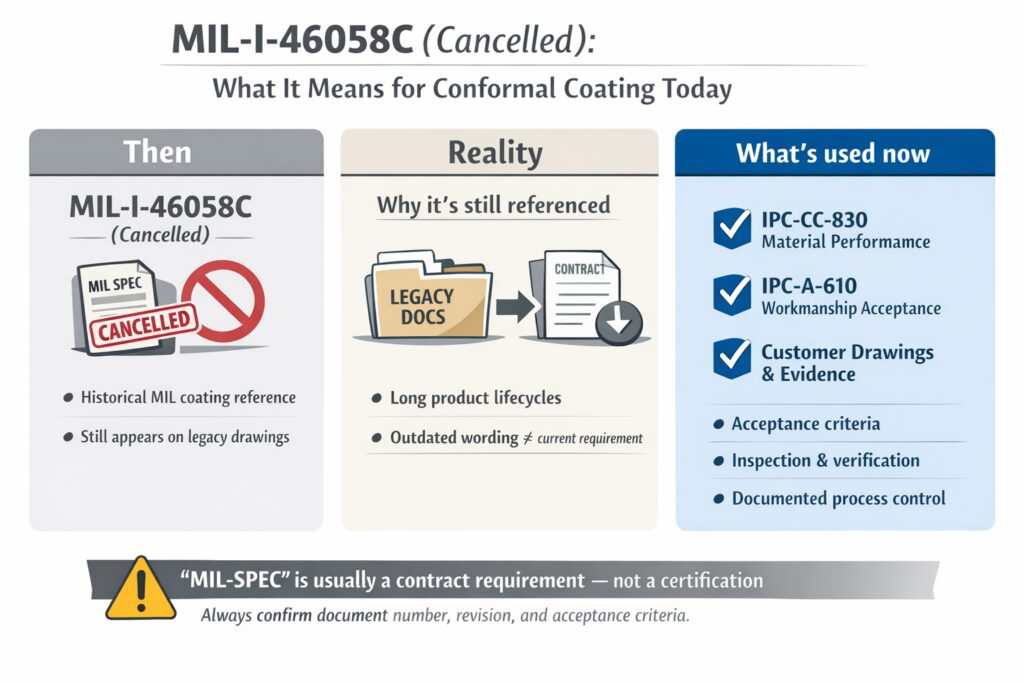
MIL-I-46058C is cancelled but still referenced on legacy drawings. Modern defence conformal coating requirements typically rely on IPC standards and contractual flow-downs.
What is MIL-I-46058C?
MIL-I-46058C was a U.S. military specification historically used to define requirements for conformal coating materials used on electronic assemblies. It became widely referenced because it provided a recognised baseline for coating performance and durability in demanding environments.
In many organisations, “MIL-SPEC conformal coating” became shorthand for “qualified, proven coating material and controlled workmanship.”
MIL-I-46058C is cancelled — what that means (and why it still matters)
MIL-I-46058C is cancelled, meaning it is no longer actively maintained as a current, evolving military specification. This does not mean it disappeared overnight from industry usage.
It still appears in the real world because:
- Legacy drawings and build standards may still reference MIL-I-46058C by habit or because documentation has not been updated.
- Customer flow-down language often lags behind current standards (especially where products have long lifecycles).
- Historical qualification may have been performed against MIL-I-46058C, and organisations continue to use that wording internally.
Practical takeaway: If a defence customer references MIL-I-46058C, you must clarify what they mean today: material qualification, process control, acceptance criteria, or a specific approved materials list.
What is typically used today instead?
Modern programmes commonly rely on a combination of:
- IPC-CC-830 for conformal coating material performance / qualification style requirements (widely treated as the practical successor framework).
- IPC-A-610 for workmanship acceptability on electronic assemblies (including conformal coating acceptance criteria).
- Customer drawings & programme specifications that define keep-out zones, coverage requirements, thickness evidence, and repair rules.
In other words: MIL-style expectations are often met through industry standards + contractual flow-down requirements, supported by controlled evidence.
“MIL-SPEC” is usually a contract requirement, not a general badge
Most manufacturers do not “need MIL-SPEC” in a general sense. MIL requirements become mandatory when they are explicitly:
- Called up on the customer drawing or build specification
- Included in the purchase order / contract as flow-down requirements
- Required by a prime contractor as part of supplier approval
If “MIL-SPEC” is mentioned without a clear document number, revision, or acceptance criteria, treat it as a clarification required — not a manufacturing instruction.
How MIL requirements typically show up in conformal coating programmes
Even when MIL-I-46058C is cancelled, defence programmes often emphasise:
- Controlled cleanliness before coating (to prevent ionic contamination-related corrosion and adhesion failures)
- Defined coating coverage and keep-out zones per drawing / care points (no “interpretation” on prohibited areas)
- Workmanship acceptance criteria for common defects (bubbles, de-wetting, bridging, foreign material, lifting, voiding)
- Verification evidence (UV inspection records, thickness evidence where required, cure control, rework disposition)
This is where IPC acceptance criteria and customer requirements typically combine into a programme-specific standard.
“Qualification” can mean three different things — clarify which one applies
When customers say “MIL-SPEC qualification,” they may mean:
- Material qualification (e.g., coating material meets a recognised performance standard or appears on an approved list)
- Process qualification (e.g., your coating process is validated with documented controls and repeatability)
- Personnel competency (e.g., trained inspectors/operators with documented competency and refresher training)
These are not interchangeable. Agree the definitions early to avoid audit issues and rework later.
Inspection and evidence expectations (what defence customers usually want)
Defence and aerospace supply chains tend to increase the emphasis on objective evidence. For conformal coating, that often includes:
- UV inspection to confirm coverage and detect defects (with clear accept / rework / reject rules)
- Masking integrity (no coating on prohibited zones such as connectors, test points, mating surfaces)
- Repair rules aligned to agreed acceptance criteria (and documented defect disposition)
- Thickness evidence where specified (method, sampling plan, coupons/measurement approach)
- Records retention and traceability consistent with programme requirements
Training & competency (practical approach)
Where defence customers require proven interpretation of workmanship and acceptance criteria, many organisations demonstrate competency via:
- IPC-A-610 training for acceptance interpretation
- Process training for cleaning, masking, coating application, inspection, repair and documentation
- Competency assessment and refresher training records
SCH provides customised conformal coating training and consultancy to help align coating processes to customer and programme expectations.
Why this matters
Understanding the cancellation of MIL-I-46058C — and what is used today — helps you:
- Prevent misinterpretation of “MIL-SPEC” requirements
- Agree clear acceptance criteria early (reducing disputes and rework)
- Build audit-ready evidence for defence supply chains
- Align material and workmanship expectations using recognised modern standards
Useful Links
Standards Hub
- Conformal Coating Standards Hub
- IPC-A-610 & Conformal Coating
- IPC-CC-830 Conformal Coating Material Standard
Supporting Blog
Training Links
- Conformal coating training – Learn everything you need in conformal coating
- Conformal coating consultancy – help with troubleshooting, NPI and benchmarking
Why Choose SCH Services?
Partnering with SCH Services means more than just outsourcing — you gain a complete, integrated platform for
Conformal Coating, Parylene & ProShieldESD Solutions, alongside equipment, materials, and training, all backed by decades of hands-on expertise.
- ✈️ 25+ Years of Expertise – Specialists in coating technologies trusted worldwide.
- 🛠️ End-to-End Support – Guidance on coating selection, Parylene grades, masking, inspection, and ProShieldESD integration.
- 📈 Scalable Solutions – From prototype batches to high-volume production, SCH grows with your needs.
- 🌍 Global Reach – Responsive support across Europe, North America, and Asia.
- ✅ Proven Reliability – Built on quality, consistency, and customer satisfaction.
📞 Call: +44 (0)1226 249019 | ✉ Email: sales@schservices.com | 💬 Contact Us ›