Why Conformal Coating Fails in Complex PCB Assemblies (It’s Not the Material)
Understanding the real cause of coating failure in tight geometry, connectors and particle-sensitive designs
When conformal coating fails on complex PCB assemblies, the immediate reaction is often to question the coating material. In reality, most failures are driven by process, geometry and application constraints, not chemistry.
Assemblies with press-fit connectors, tight spacing (~0.2 mm), mixed surfaces and particle exposure risk present challenges that cannot be solved by material selection alone. Without a defined process strategy, even the best coating will fail.
This article explains why coating failures occur in these environments and how to reframe the problem as a process architecture decision, not a material choice.
Start with the right question: Before troubleshooting defects, first confirm whether the correct protection approach has been selected. For early-stage comparison, see how to select a conformal coating material or compare conformal coating, nano coating and Parylene.
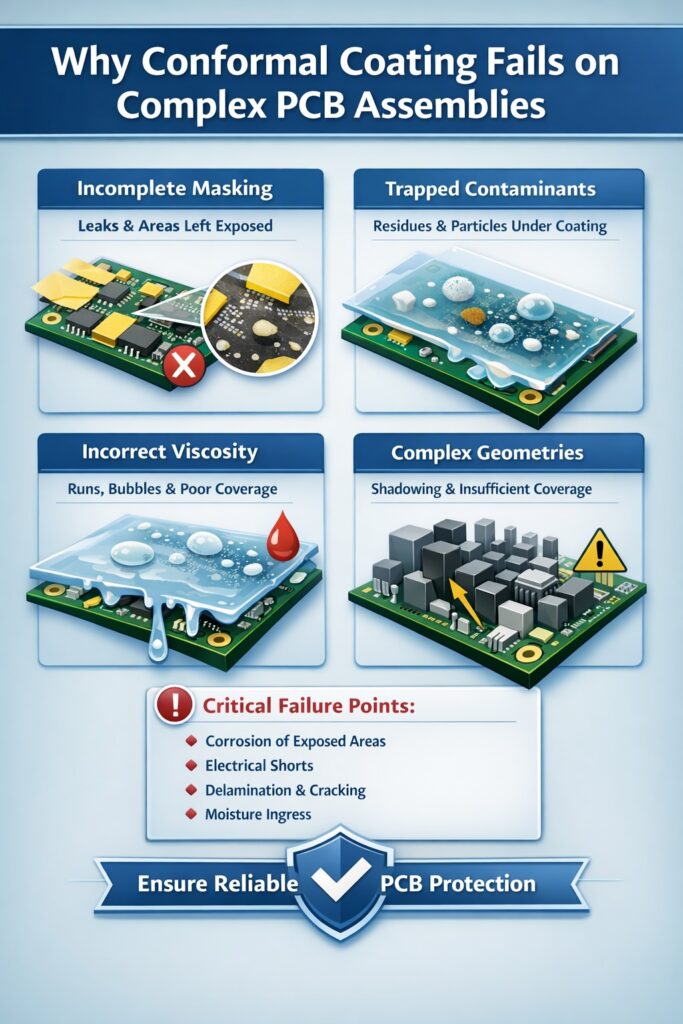
1) The assumption that the coating is the problem
Most investigations into coating failure begin with the question: “Is the coating material failing?”
In complex PCB assemblies, this is usually the wrong starting point.
The coating is typically behaving exactly as expected — flowing, wetting, penetrating and curing based on its chemistry. The failure arises because those behaviours are incompatible with the geometry and constraints of the assembly.
Material selection still matters, but only within the limits defined by the process. If the process is not viable, changing the material rarely solves the problem. This is why material selection must always be aligned with application method, masking and geometry.
2) Geometry defines coating behaviour
On simple boards, coating behaves predictably. On complex assemblies, geometry dominates everything.
- Tight gaps (~0.2 mm) create capillary effects
- Component shadowing affects coverage
- Mixed surface energies change wetting behaviour
- Vertical and horizontal transitions affect film build
These effects are not defects — they are natural outcomes of fluid behaviour.
This is why coating behaviour cannot be fully controlled by machine programming. Even highly accurate selective coating systems cannot override physics. If you are relying on tight edge definition, you must understand the real limits of selective conformal coating accuracy.
3) Boundary control is the real challenge
In most complex assemblies, the critical requirement is not coverage — it is controlled non-coverage.
This includes:
- Connector interfaces
- Test points
- Press-fit zones
- Mechanical interfaces
The challenge is not applying coating. It is preventing coating from reaching sensitive areas while still achieving protection elsewhere.
This is where many processes fail:
- Masking becomes unstable or inconsistent
- Coating spreads beyond intended boundaries
- Capillary action pulls coating into restricted areas
If boundary control cannot be reliably achieved, the entire protection strategy must be reconsidered — often leading to alternatives such as nano coatings or hybrid coating strategies, or a broader reassessment of conformal coating, nano coating and Parylene.
4) Contamination is often the hidden failure driver
Many coating failures are not caused by coating behaviour alone, but by what is already present on the PCB before coating is applied.
- Flux residues
- Handling contamination (oils, particulates)
- Dust and airborne particles
- Moisture or environmental exposure
When coating is applied over contamination, it does not eliminate the risk — it often locks it in place.
This can lead to electrical leakage, corrosion initiation, reduced adhesion and long-term reliability failures.
This is why surface preparation and cleanliness must be treated as a core part of the coating process.
5) Viscosity and process control drive consistency
Even with the correct material and a clean PCB, coating performance depends heavily on process control.
One of the most critical variables is viscosity.
- Film thickness becomes inconsistent
- Edge definition becomes unstable
- Wicking and spread increase
- Repeatability is lost
Viscosity directly affects how the coating flows, levels and builds on the surface. This is why stable processes require defined viscosity windows and monitoring, as outlined in viscosity in process control, alongside verification through thickness measurement.
6) Application method defines what is achievable
Different coating methods have fundamentally different capabilities and limitations.
- Spray coating – flexible but sensitive to operator control and environment
- Selective coating – repeatable but limited by fluid behaviour at boundaries
- Dip coating – highly consistent coverage but difficult to control exclusion zones
- Brush coating – precise but not scalable
Each method defines what is realistically achievable in terms of coverage, boundary control, repeatability and throughput.
If the chosen method cannot meet the requirements of the assembly, no amount of adjustment will fix the outcome. This is why understanding conformal coating processes is essential.
Key insight: Coating failures are rarely a single issue — they result from the interaction between geometry, contamination, viscosity and application method.
7) Press-fit connectors are inherently high-risk
Press-fit connectors combine two incompatible requirements:
- Clean, uncoated electrical interfaces
- High-risk contamination zones
Coating risks include wicking, electrical interference and contaminant entrapment.
These areas must be treated as process-critical exclusion zones. See press-fit connector coating problems and electrical contact failure mechanisms.
8) The three real process options
For complex PCB assemblies, there are only three viable process strategies:
- Full conformal coating with masking
- Full nano coating without masking
- Hybrid coating strategy
Choosing between these is a process architecture decision, not a material selection. Once the process route is realistic, the next step is understanding how to select a conformal coating material that fits the real environment and rework model.
Where masking becomes impractical, the best answer is often a hybrid coating strategy.
Related Process Articles
Conclusion: Coating failure is usually a strategy failure
When conformal coating fails on complex PCB assemblies, the root cause is rarely the coating itself.
- Geometry vs coating behaviour
- Process capability vs boundary control
- Strategy vs real-world constraints
The solution is not a better material, but a realistic coating strategy aligned to the assembly.
This often means stepping back and reassessing the protection approach entirely using structured comparisons such as conformal coating vs nano coating vs Parylene.
Why Choose SCH Services?
Complex assemblies need more than a material recommendation. SCH Services helps define realistic coating strategies around geometry, connectors, masking, inspection and manufacturability — so the solution works in production, not just in theory.
- 🛠️ Process-Led Support – strategy, boundary control and validation
- 📈 Scalable Solutions – from feasibility through to production
- 🌍 Global Reach – UK, Europe, Asia and North America
- ✅ Practical Reliability Focus – aligned to real manufacturing constraints
📞 Call: +44 (0)1226 249019 | ✉ Email: sales@schservices.com | 💬 Contact Us ›