Setting Up a Conformal Coating Production Line
Practical Guidance for Reliable, Compliant Throughput
Building a robust conformal coating production line starts with clear requirements, the right equipment, and disciplined process control. This guide outlines a proven approach—from application and drying to inspection and QA—so you can reduce defects, improve yield, and meet customer and industry workmanship expectations.
If you’re building from scratch, the goal is simple: stable film build + controlled keep-outs + repeatable cure + verified acceptance.
Article Quicklinks
| Topic | Jump |
|---|---|
| 1) Define requirements (spec, thickness, keep-outs, acceptance) | 🔗 |
| 2) Choose equipment (application, cure, inspection, facilities) | 🔗 |
| 3) Control plan (viscosity, recipes, SPC, coupons) | 🔗 |
| 4) Inspection & QA (coverage, thickness, defects, records) | 🔗 |
| Line layout (recommended station order) | 🔗 |
| Common failure points (where lines leak yield) | 🔗 |
| Download (PDF bulletin) | 🔗 |
1) Define Process Requirements
Start with customer drawings, specifications and standards so the line is designed for compliance, not rework.
- Coating chemistry: acrylic, urethane, silicone, epoxy, UV-cure, or Parylene
- Thickness target: min/nom/max + how it will be verified (wet, dry, optical)
- Keep-outs & masking: what must be protected vs what must remain uncoated, and permitted tolerances
- Acceptance criteria: workmanship alignment + coating performance expectations where applicable
- Rework rules: what operators can repair vs what must be escalated
2) Select Application, Drying & Support Equipment
Choose the application method that fits volume + geometry + keep-outs, then add support equipment that stabilises the process window.
- Application: dip systems or selective/manual spray
- Drying/Curing: cabinets/ovens matched to chemistry, solvent loading and takt time
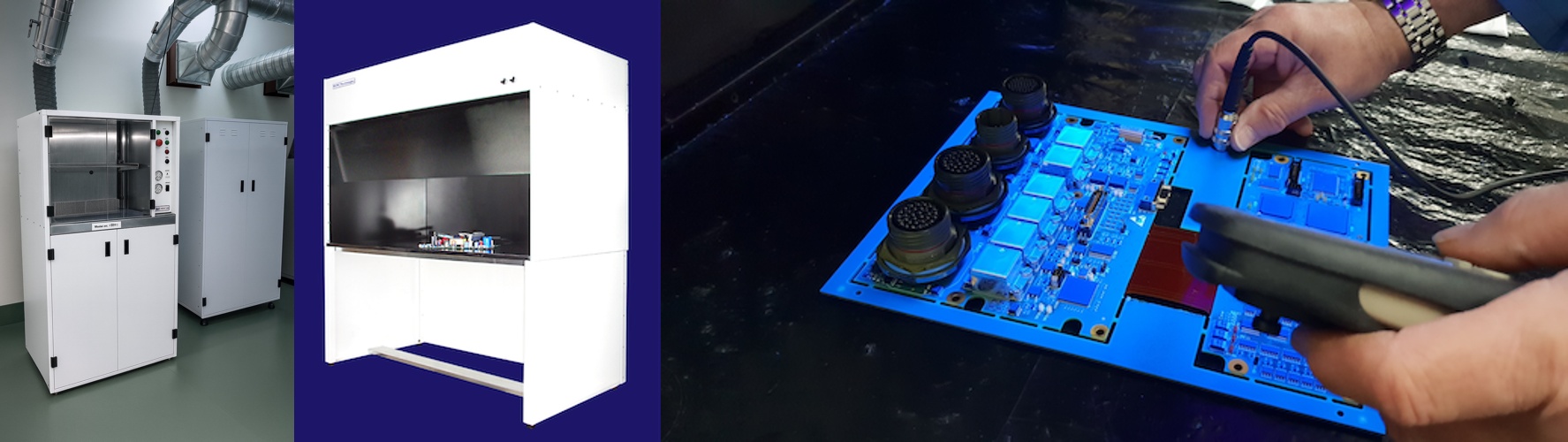
- Inspection: UV/white-light booths for controlled, repeatable coverage checks
- Measurement: wet film gauges, dry film gauges, optical where relevant
- Facilities: extraction, ESD control, temperature/RH management, safe solvent handling
3) Process Control & Repeatability
A coating line becomes reliable when you lock parameters as recipes and verify outputs routinely through a closed-loop approach.
- Viscosity window: defined by coating + method; record temperature and correct drift
- Recipe locking: speeds, passes, pressures/flow, dip dwell/withdrawal, flash-off and cure
- Thickness strategy: wet→dry correlation and a coupon/witness-board plan
- SPC signals: trend thickness, defect rate and rework rate—act before out-of-spec
See also: Viscosity Control and Thickness Measurement Methods.
4) Inspection & Quality Assurance
Inspection must be a built-in station, not an afterthought—this is how you stop defects escaping and keep audits easy.
- Coverage checks: edges, meniscus, shadowing, under-components, keep-outs
- Defect screening: pinholes, bubbles, dewetting, orange peel, delamination, contamination
- Thickness verification: routine checks per plan + escalation rules when trending shifts
- Records: photos where needed, batch/serial traceability, rework documentation
Recommended Line Layout (Station Order)
A practical flow that works for most liquid coating lines:
- Incoming checks (cleanliness, bake-out if needed, handling controls)
- Masking station (controlled method + verification before coating)
- Coating station (spray/dip/selective)
- Flash-off / drain (time/airflow/angle controlled)
- Cure (oven/UV/moisture as required)
- De-mask + touch-up rules (defined tolerances + mandatory inspection)
- Final inspection + thickness checks (record + release)
Common Failure Points That Kill Yield
- Masking leakage + demask damage (often the #1 real root cause)
- Viscosity drift (solvent loss, temperature changes, poor pot management)
- Flash-off mistakes (too short → bubbles; too long → dry spray/orange peel)
- Cure profile mismatch (skinning, trapped solvent, brittle films, adhesion loss)
- No closed-loop thickness plan (out-of-spec discovered late or in the field)
If you’re seeing repeat defects, route through the Defects Hub and link the failure back to the upstream station that creates it.
Benefits of a Well-Designed Line
- Consistent quality and fewer defects
- Higher throughput with predictable cycle times
- Standards compliance and easier audits
- Flexibility to support new products or chemistries
Download the Technical Bulletin
Prefer the PDF format? Download the bulletin for offline reference:
📄 Download: Setting Up a Conformal Coating Production Line (PDF)
Why Choose SCH Services?
A reliable coating line depends on more than just buying equipment. SCH Services helps customers align application method, drying, inspection, control planning and operator practice so production lines achieve stable throughput and fewer coating-related losses.
- 🏭 Line-Build Expertise – Practical guidance on equipment selection, station order and process setup for liquid coating lines.
- 🛠️ End-to-End Support – Help with coating selection, masking strategy, inspection methods and process validation.
- 📈 Scalable Solutions – Support from prototype and NPI through to high-volume production.
- 🔍 Yield & Defect Reduction – Recommendations aimed at controlling drift, improving repeatability and preventing avoidable line losses.
- 🌍 Integrated Technical Capability – Consultancy, equipment support, training and coating services from one specialist partner.
📞 Call: +44 (0)1226 249019 | ✉ Email: sales@schservices.com |💬 Contact Us ›