Mon - Thur 7.30-15.30   Fri 7.30-14.00

Requirements for setting up a conformal coating facility


Conformal coating application and inspection at SCH Services

The set up of a conformal coating production line regardless of the application method has many similar characteristics.

Any coating facility will need the basic requirements put in place that would be standard for any piece of electronic manufacturing process. These include ESD systems, facilities for the machines, the environmental requirements and the normal Health & Safety (HSE) considerations.

Also, the conformal coating production line, whether it is an operator manually brush coating printed circuit boards (PCBs) or an inline robotic spray coating process is typically made up of several stages. These stages are shown below:

Conformal coating process chart illustrating key stages and controls

Not all the stages are mandatory or may be required. Β However, each should be considered on an individual basis.


Planning to set up a conformal coating facility?

Explore our Conformal Coating Processes Hub and read the detailed guide: How to set up a conformal coating production line. The article covers equipment selection, process flow, quality control and scale-up considerations for reliable, repeatable coating operations.

Prefer to talk it through? Our engineers can review your requirements and help you plan a coating facility that fits your volumes, materials and compliance needs.

Contact SCH to discuss your conformal coating setup β€Ί

Three key points you should know about polyurethane conformal coatings when using them for protecting electronic circuit boards


SCH Services UK conformal coating facility and operations

A polyurethane (urethane for short and designated UR by IPC) conformal coating is part of the organic family of coating materials that also includes the acrylic and epoxy coatings.

Here are three key facts to consider when examining polyurethane conformal coatings:

  1. Most conformal coatings provide good humidity and moisture protection although some are slightly better in performance than others. UR type coatings are just as good on average as acrylic materials.
  2. A polyurethane coating has traditionally been used to protect electronic circuit boards against chemical attack due to their excellent chemical resistance. This protection allows electronic circuit boards to survive in highly aggressive environments and atmospheres such as the aerospace, military and industrial sectors. However, it does make repair a little more difficult as chemical resistance to a coating means more difficult to remove.
  3. Times are changing and whereas acrylic conformal coatings used to dominate 70-80% of the market, there is a shift in emphasis towards alternative materials due to higher specifications for protecting electronics. Many new conformal coatings (UV cure, two part thin film coatings) now comprise of urethane resin bases and are becoming more popular in high volume sectors such as automotive electronics. This is because the urethane resin lends itself to this type of technology more easily than the acrylic based resins.

Want to find out more about polyurethane conformal coating?

Contact us to discuss your needs and let us explain how we can help you.

Contact us now.

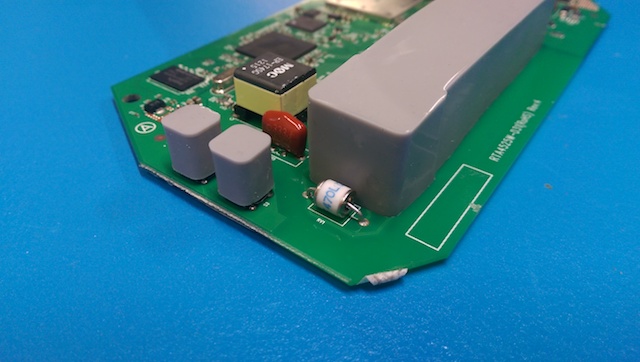
What are conformal coating masking boots and why do they save you money?


Conformal coating application and masking process at SCH Services facility

Reusable conformal coating masking boots are a highly cost-effective alternative to traditional masking tape.

Many components on printed circuit boards must remain uncoated during the conformal coating process. The purpose of masking is to prevent migration of coating materials into connectors, contacts, and defined keep-out areas where coating would cause functional or reliability issues.

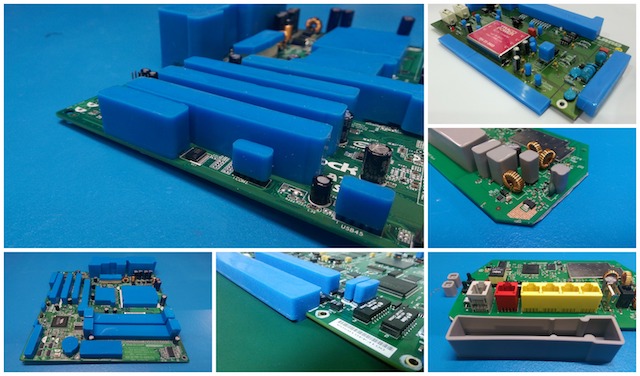
Custom-made masking boots provide a major labour-saving advantage during both the masking and de-masking stages of conformal coating. Unlike tape-based masking, these boots are fully reusable and are simply fitted over components such as connectors, plugs, and sockets prior to coating.

Reusable conformal coating masking boots can be designed as simple push-fit caps for standard connectors or as more sophisticated custom geometries for complex or high-density assemblies, as shown in the examples below.

They provide reliable, repeatable protection across all major conformal coating application methods, including:

  • Batch and selective robotic spraying (reducing the need for complex programming)
  • Vertical and horizontal dip coating
  • Vapour deposition processes such as Parylene coating

Reusable masking boots used in conformal coating operations at SCH Services

Three reasons to switch from masking tape to reusable masking boots

Switching from tape-based masking to reusable masking boots can reduce total masking costs by up to 80%:

  1. Faster application – masking boots can be applied 4–5Γ— quicker than masking tape.
  2. Faster removal – de-masking boots is significantly quicker and cleaner than removing tape.
  3. Lower defect risk – masking boots are far less prone to leakage, reducing rework compared to tape.

The result is a rapid reduction in labour cost, improved process consistency, and fewer coating-related defects when compared to traditional masking tape methods.

Need expert advice on masking PCBs before conformal coating?

Effective PCB masking is critical to prevent coating ingress into connectors, test points, keep-out zones and mechanical interfaces. Poor masking choices can lead to coating defects, rework, reliability issues and unnecessary cost.

SCH supports customers with practical masking strategies tailored to your assembly, coating chemistry and production volume β€” from reusable masking boots and tapes to liquid masking systems and process optimisation.

If your assemblies also require preparation before coating, you can learn more about our subcontract PCB cleaning and coating services, or speak directly with our engineers to review your masking and coating requirements.

Contact SCH to discuss your PCB masking and conformal coating needs β€Ί

What are the different methods available for cleaning electronic circuit boards?


SCH Services conformal coating facility and production environment

The topic of cleaning printed circuit board assemblies (PCBAs) effectively before application of conformal coating can be daunting. This is because the process of cleaning circuit boards can be difficult especially with so many variables to consider.

When considering cleaning the circuit you need to assess many factors including:

  1. The board and component compatibility with the cleaning method
  2. The ability of the cleaning method to remove the contamination effectively from the circuit
  3. Any residues the cleaning process may leave behind that may be harmful to the circuit in the long term.
  4. The reasons for cleaning the circuit (e.g. contamination removal, adhesion promotion etc.)?

After considering these factors you can compare with the processes available.

The main methods of cleaning printed circuit boards

The main methods of cleaning used in everyday electronics processing before conformal coating application can include:

  • Aqueous washing
  • Semi-aqueous washing
  • Solvent & chemical washing
  • Plasma surface cleaning

These processes can be mixed, the method can be varied but the fundamental concepts still apply.

However, whatever method you choose you still have to consider that the key to success in cleaning circuit boards is similar to the success made with conformal coating. You need to match the cleaning process, the cleaning materials and the circuit board together. If you do this then this will give you the best results for cleaning the circuit board assembly.

Want to find out more about cleaning?

Contact us now to discuss your needs and let us explain how we can help you.


The Science Behind Fluoropolymer Nano Coatings for Protecting Electronic Circuit Boards


Nano-coatings are being used regularly to protect printed circuit board assemblies. This is because the material they are made of fluorinated polymers and these materials have very specialized properties that produce very different results to traditional conformal coatings.

So, what are the unique properties of a Nano-coating?

To understand the properties of a Nano-coating you have to understand what a fluoropolymer coating is made of.

Typically, the coating itself is comprised of fluorocarbons and characterised by carbon-fluorine bonds. Since the coating is made of fluorocarbons then the film surface is not susceptible to Van der Waals forces (interfacial electrostatic bonds). Therefore, the surface energy of the fluoropolymer coating is extremely low and hydrophobic (water repellent). It acts like Teflon on a frying pan.

This non-wetting of water on the circuit board is one of the many key properties making them so popular.

SCH UK1


What other properties do Nano-coatings have that may help protect circuit boards?

For electronic circuit board assemblies there are several key properties that are being used.

These include being:

  • Hydrophobic: Being highly water repellent
  • Ultra-thin: Protection whilst being extremely thin
  • High moisture barrier: Low water vapor transmission rate provides excellent corrosion resistance
  • Chemically resistant: Having a high chemical resistance helps protect the circuits from chemical attack.
  • Good dielectrics: fluoropolymer coatings have high dielectric properties

However, to really understand the benefits you have to look at the key difference compared to a conventional conformal coating. That is that no masking is required when applying the Nano-coating.


So, why is there no need to mask when using a Nano-coating?

First, consider a normal conformal coating is applied at typical thicknesses of 25um or more. Also, the conformal coating is a high insulation material. Therefore, at this thickness the conformal coating would electrically insulate components like connectors and it must not be applied to any part that needs electrical conductivity.

However, this is not a problem for a Nano-coating.

Since the Nano-coating can be applied at ultra-thin thicknesses (1-2um in thickness or less) without any protection performance reduction, then the extremely soft coating is easily removed or scratched away when the connectors are joined and the electrical circuit is easily made.

This key parameter of not requiring masking during Nano-coating application combined with the hydrophobic nature of the coating material makes the Nano-coatings highly effective in protecting electronic circuit boards at a very low cost per unit.


Want to find out more about Nano-coatings?

At SCH Technologies, we supply ultra-thin Nano-coatings based on advanced fluoropolymer chemistries. These coatings provide a cost-effective way to protect printed circuit board assemblies (PCBAs) and other electronics from moisture, corrosion, and environmental damage. Β We also offer a subcontract conformal coating service and can apply these nano-coatings for you.

Find out more and Contact us now to discuss your needs and let us explain how we can help you.

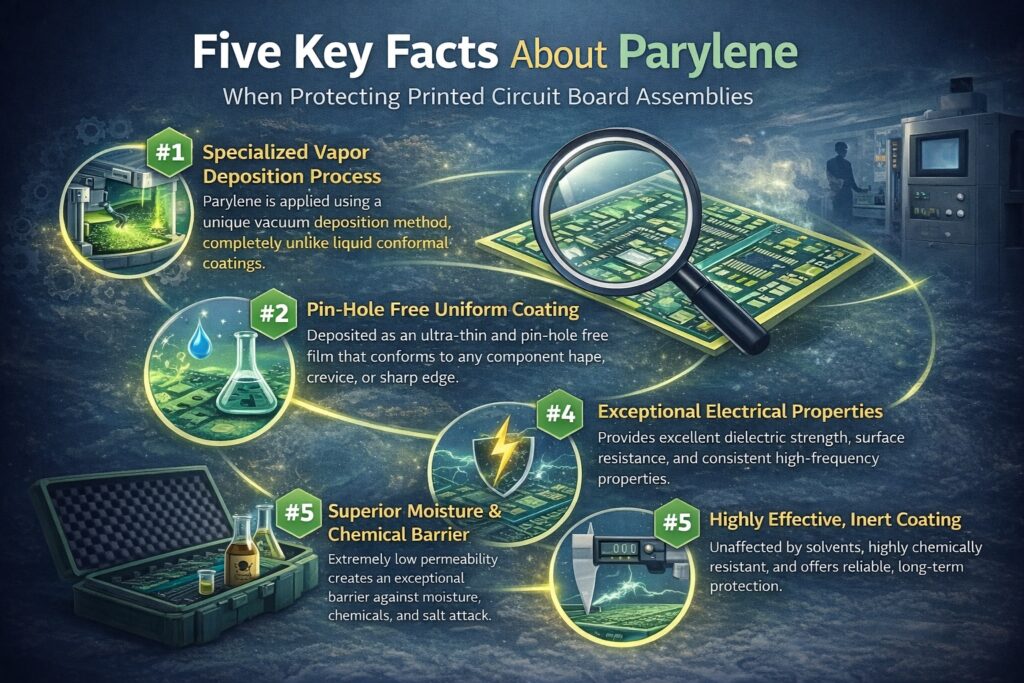
Five key facts about Parylene when protecting printed circuit board assemblies


Large industrial Parylene coating equipment featuring KR1200HS and KR1500HSU systems for high-volume medical, aerospace and electronics manufacturing

Here are five key facts about Parylene that are critical in understanding this process:

  1. The Parylene conformal coating process is a very specialised vapour deposition application method using specialist vacuum chamber systems. This differs significantly to all of the other liquid conformal coatings available on the market that are applied by spraying, brushing and dipping.
  2. Parylene coating is completely conformal and uniform to the surface of the Printed Circuit Board (PCB) or product. It is also pinhole free. Therefore, components with sharp edges, points, flat surfaces, crevices or exposed internal surfaces are coated uniformly without voids.
  3. Parylene coating provides an excellent moisture and gas barrier due its very low permeability. This means that electronics circuit boards coated in Parylene generally are more β€œwaterproof” than the same electronics coated in a liquid conformal coating.
  4. Parylene is unaffected by solvents (it has very high chemical resistance) and is very effective against salt attack.
  5. Parylene has excellent electrical properties. This includes having low dielectric constant and loss with good high-frequency properties, good dielectric strength, and high bulk and surface resistance.

Find more in-depth details about Parylene materials, deposition principles, masking methods, thickness measurement and core application concepts at our Parylene Basics HubΒ now.

Or, if you’re interested in moving towards a Parylene process click through to our Parylene Solutions, Β Parylene equipment and Parylene subcontract services pages.


Want to find out more about Parylene?

Contact us now to discuss your needs and let us explain how we can help you.

What is a fluoropolymer nano coating and how can it protect my circuit board?


What is a fluoropolymer nano coating and how can it protect my circuit board?

A fluoropolymer Nano-coating is an ultra-thin film comprised of fluorocarbons and characterised by carbon-fluorine bonds.

Chemically inert, fluorocarbons are not susceptible to Van der Waals force. This means that films formed using these materials are non-stick (hydrophobic and water repellent) and friction reducing.

Also, due to the fluorine bonds, these Nano-coatings demonstrate a high level of chemical resistance to acids, bases and most solvents. This makes them excellent materials for protecting electronic circuits at certain circumstances.Β 


What properties of the Nano-coatings are used to protect circuit boards?

Fluoropolymer coatings have very specialised properties. However, for electronics the main properties that are useful include:

  • Being highly hydrophobic (water repellent)
  • Having a high moisture barrier
  • Having a high chemical resistance
  • Having high dielectric properties
  • Providing high corrosion resistance
  • Providing good abrasion / wear resistance

These properties are excellent for protecting circuit board assemblies in harsh environments.


Find out how we can help you with your conformal coating process now.

Contact us now to discuss your needs and let us explain how we can optimize your process for you.

Do you need UL qualification for your conformal coating?


UL are the Underwriters Laboratories and are a global safety certification body for consumer electronics. They are a 3rd Party test service. There is no self-certification available. A qualification to UL can be used as a sign of quality control and testing independently of the coatings protective ability.

When do you need UL?

Sometimes it may be required that the conformal coating needs UL approval to be applied to a circuit board. It will depend on the market the electronics goes into. UL approved coatings can be used on electronics in many diverse sectors such as the domestic home, industrial controls, telecommunications and aerospace.

In fact, in nearly all areas conformal coatings tend to be used for protection.

SCH Services UK conformal coating facility and production environment

UL approved coatings can be requested in nearly all areas conformal coatings tend to be used for protection for electronics including domestic home, industrial controls, telecommunications and aerospace.

What standards are used from UL for conformal coatings?

For conformal coating, two parts of the UL standards are important. These are:

  • UL 94: Standard for Safety of Flammability of Plastic Materials for Parts in Devices and Appliances testing.
  • UL 746E: Standard Polymeric Materials: Industrial Laminates, Filament Wound Tubing, Vulcanized Fiber and Materials Used in Printed-Wiring Boards

The two standards together control the quality of the conformal coating.

UL 94

  • It is a plastic material flammability standard.
  • The standard classifies plastics according to how they burn in various orientations and thicknesses.
  • UL 94 measures conformal coating material’s tendency either to extinguish or to spread the flame once the test specimen has been ignited.

For conformal coatings the test coupons are normally tested horizontally. Tests are normally conducted on coupons of the minimum approved thickness with different types of laminate. The conformal coating thickness range also is normally specified.

The ratings are as follows:

  • V-2 burning stops within 30 seconds on a vertical specimen; drips of flaming particles are allowed.
  • V-1: burning stops within 30 seconds on a vertical specimen; drips of particles allowed as long as they are not inflamed.
  • V-0: burning stops within 10 seconds on a vertical specimen; drips of particles allowed as long as they are not inflamed.

Most conformal coatings aim to achieve V-0 status (top result).

UL 746E

UL 746E is the Standard Polymeric Materials: Industrial Laminates, Filament Wound Tubing, Vulcanized Fiber and Materials Used in Printed-Wiring Boards

UL 746E measures the ignition resistance of the conformal coating to electrical ignition sources. The conformal coating material’s resistance to ignition and surface tracking characteristics is described in UL 746E.

Find out how we can help you with your conformal coating process now.

Contact us now to discuss your needs and let us explain how we can optimise your process for you.


How do I selectively apply my conformal coating?


Selective application of conformal coating in this case is applying the conformal coating without using masking to shield components from ingress.

Technically, using masking tapes, latex and boots is a selective process. But, we are looking at coating applications without masking. This leaves a couple of different options.

The first is brushing. This is a simple selective process that can be highly effective.

The second, and the more obvious option, is selective robot. This process uses a small spray valve (there are many conformal coating spray valve types) that is attached to a robot that follows a set pattern applying the conformal coating selectively to the circuit board.


Advantages and disadvantages of selective conformal coating robots

The five advantages and disadvantages of selective application of conformal coating are:

Advantages

  • Masking can be eliminated or minimised
  • High speed coating process
  • High volume process
  • High quality finish when under control
  • Simple process to operate when set up

Disadvantages

  • High engineering skill required for set up and programming
  • High engineering skill required for troubleshooting and supervision
  • High capital cost initially
  • Process controls need to be enforced for good quality production
  • Environment can influence the process controls

Find out how we can help you with your conformal coating process now.

SCH supports OEMs and EMS providers with a fully integrated total-solutions approach to conformal coating and Paryleneβ€”spanning in-house process development through to fully outsourced production. Our focus is on delivering coating strategies that are technically robust, commercially viable and scalable, from early prototype through to full-rate manufacture.

For manufacturers operating their own coating lines, we provide comprehensive engineering support including PCB design reviews, conformal coating line set-up, Parylene deposition equipment, masking optimisation, SPC and control planning, and operator training. We also support NPI programmes, helping teams validate chemistries, define robust masking strategies, optimise equipment parameters and benchmark new materials or processes prior to volume release.

For organisations outsourcing coating, SCH delivers fully managed coating services covering both liquid conformal coatings and Parylene. These services are underpinned by structured technical consultancy, specification development and detailed troubleshooting and failure analysis. Whether addressing a short-term process issue or establishing a long-term coating partnership, we ensure assemblies meet demanding environmental and reliability requirements.

At every level of engagement, SCH provides tailored training and technical consultancy, including process benchmarking, defect prevention, troubleshooting, design-for-coating guidance, and on-site or remote support for engineering and quality teams.

Whether your requirement is technical guidance, equipment supply, production capacity, NPI validation or continuous process improvement, SCH delivers end-to-end support across the complete coating lifecycle.

Find out more about our:

πŸ‘‰ Conformal Coating Solutions
πŸ‘‰ Parylene Solutions

Contact us nowΒ to discuss your needs and let us explain how we can optimize your process for you.

πŸ“ž Call: +44 (0)1226 249019
βœ‰ Email: sales@schservices.com
πŸ’¬ Contact Us β€Ί


What Application Methods Are Used for Conformal Coating?


Conformal coatings can be applied to printed circuit boards (PCB) in the production process environment in many alternative ways. Listed below are the common methods of applying the conformal coating materials:

  • Brushing
  • Aerosol spray
  • Batch spray
  • Selective spray
  • Dipping
  • Vapour deposition
There are many different methods of applying conformal coatings including brushing, aerosol spray, batch spray, selective spray, dipping and vapour deposition (Parylene).

Common methods of applying conformal coatings include brushing, aerosol spray, batch spray, selective spray, dipping and vapour deposition (Parylene).

It is possible to split the different application methods and their suitability in many different ways including:

  • Compatibility with the conformal coating material
  • Design of the circuit board
  • Suitability to low, medium and high volume
  • Manual versus automatic process
  • Type of method of application
  • Level of control required

Each of the various methods has different advantages and disadvantages and should be carefully considered.

This thought process relates to the holistic approach to conformal coating processing that states that you should consider the conformal coating material, the application process and the circuit board together and not as three separate entities.


Find out how we can help you with your conformal coating application selection now.

Partnering with SCH Services means more than just outsourcing β€” you gain a complete, integrated platform for Conformal Coating, Parylene & ProShieldESD Solutions, alongside equipment, materials and training, all backed by decades of hands-on expertise.

  • ✈️ 25+ Years of Expertise – Specialists in coating technologies trusted worldwide.
  • πŸ› οΈ End-to-End Support – Coating selection, masking, inspection and process validation.
  • πŸ“ˆ Scalable Solutions – From prototypes and NPI through to high-volume production.
  • 🌍 Global Reach – Responsive support across Europe, North America and Asia.
  • βœ… Proven Reliability – Built on quality, consistency and long-term customer partnerships.

πŸ“ž Call: +44 (0)1226 249019
βœ‰ Email: sales@schservices.com
πŸ’¬ Contact Us β€Ί


0
  • Your current order total is £0.00 β€” you must have an order with a minimum of £75.00 to place your order.
0
Your Cart
Your cart is empty
  • Your current order total is £0.00 β€” you must have an order with a minimum of £75.00 to place your order.
Calculate Shipping
  • Your current order total is £0.00 β€” you must have an order with a minimum of £75.00 to place your order.

Conformal Coating UK

Conformal Coating UK
Privacy Overview

This website uses cookies so that we can provide you with the best user experience possible. Cookie information is stored in your browser and performs functions such as recognising you when you return to our website and helping our team to understand which sections of the website you find most interesting and useful.